

IB vs Consulting After MBA: Day-in-the-Life & Salaries
Admission & Info Tools
Need Expert Assistance?
Our counselors can help you with fee structures, eligibility guidelines, and upcoming admission cutoffs instantly.
Direct Application Tools
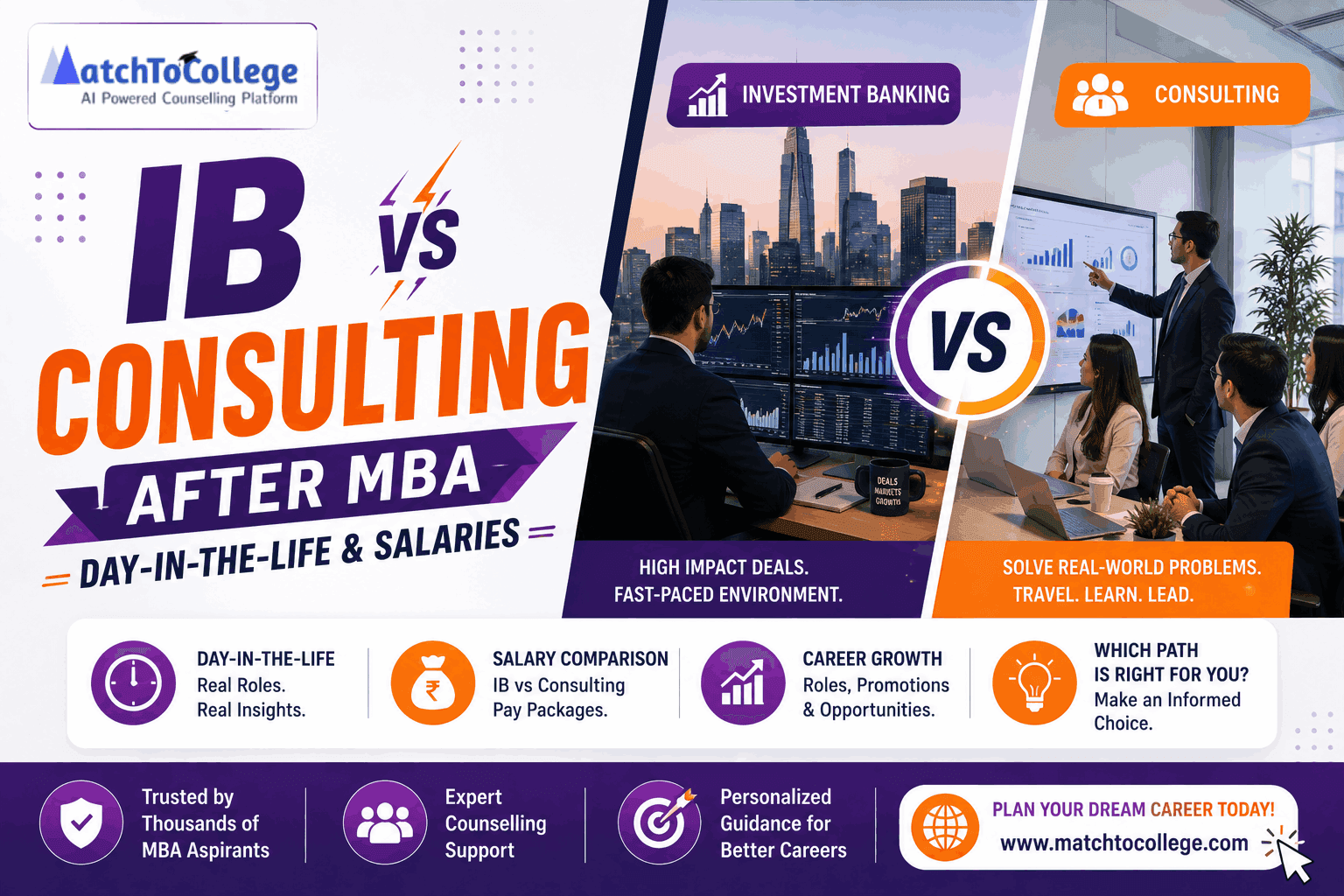
For decades, Investment Banking (IB) and Management Consulting have stood as the twin pillars of post-MBA career aspirations. For graduates from top-tier business schools, these two paths offer the highest starting salaries, the most prestigious networking opportunities, and a fast track to the C-suite or private equity.
However, the choice between them is rarely simple. It requires a deep understanding of not just the financial rewards, but the day-to-day grind, the cultural nuances, and the long-term lifestyle implications. As we look toward the 2026-27 recruitment cycles, the landscape is evolving with AI integration and shifting global market dynamics. At MatchToCollege, we aim to simplify this complex decision-making process by providing data-driven insights and tools to help you navigate your academic and professional journey.
Before diving into the specifics of these high-octane careers, it is essential to recognize that the journey begins long before the MBA interview. Whether you are currently preparing for competitive exams like NEET or JEE, or you are already looking at MBA entrance exams, your foundational performance dictates your trajectory. For instance, many top-tier consultants and bankers have backgrounds in engineering or medicine, having utilized tools like the JEE Main College Predictor or the NEET College Predictor to secure their undergraduate foundations. If you are currently in the pre-MBA phase, using the CAT College Predictor is a vital first step in ensuring you land in a school that is a target for McKinsey, Goldman Sachs, or BCG.
The competition for these roles is fiercer than ever. As firms become more selective, candidates must demonstrate not only analytical prowess but also a clear fit for the specific lifestyle these careers demand. Investment banking is often characterized by deal-flow, financial modeling, and intense, late-night sessions at the desk. Consulting, on the other hand, is defined by problem-solving, client interactions, and a heavy travel schedule. Both require an immense amount of preparation, beginning with selecting the right academic path. Tools like our Career Pathway Matcher can help you determine if your personality and skills align better with the quantitative rigor of banking or the qualitative strategy of consulting.
Furthermore, the financial commitment to an MBA is significant. Prospective students often worry about the Return on Investment (ROI). Utilizing an Education Loan EMI Calculator and the University ROI Calculator can help you visualize how a salary in IB or Consulting will facilitate your loan repayment and long-term wealth creation. In this comprehensive guide, we will break down the day-in-the-life, work hours, and compensation structures for these two elite paths to help you make an informed decision for your 2026-27 career roadmap.
The Day-in-the-Life: Deal-Making vs. Problem Solving
The daily experience of an Investment Banking Associate and a Management Consultant could not be more different, despite both operating in the upper echelons of corporate finance. In Investment Banking, your day is dictated by the markets and the status of ongoing deals (M&A, IPOs, or Debt Capital Markets).
An Associate typically starts their day around 9:00 AM or 10:00 AM, spending the morning reviewing emails from senior MDs (Managing Directors) and checking market updates. The bulk of the afternoon and evening is spent in 'the pit'—working on financial models in Excel, refining 'pitch books' in PowerPoint, and conducting due diligence for potential transactions. Because deal-making is reactive, you might receive a request for a valuation model at 8:00 PM that needs to be ready by the following morning. The work is highly quantitative, focused on the 'how' of finance: how much is this company worth, and how can we structure this merger?
In contrast, the Management Consultant's day is centered around the client’s site. A typical Monday starts with an early flight to the client’s headquarters. From Tuesday to Thursday, the day is a whirlwind of stakeholder interviews, data gathering, and brainstorming sessions. A consultant’s job is to solve a specific business problem—such as why a retail chain's profits are dipping or how a tech giant should enter the Indian market. You spend less time on pure financial modeling and more time on structured thinking, slide deck creation, and presenting findings to executives.
The environment is collaborative and requires high emotional intelligence (EQ) to navigate client politics. While bankers are often tied to their dual-monitor setups in New York, London, or Mumbai, consultants are road warriors, living out of suitcases and hotel rooms. To see if your current academic standing supports such a high-pressure path, you can use our CGPA to Percentage Calculator to ensure your profile meets the stringent cutoffs of these top-tier firms.
Work Hours and Lifestyle: The 100-Hour Week vs. The Travel Grind
When discussing post-MBA careers, the 'work-life balance' is often the most debated topic. In Investment Banking, the hours are notoriously grueling. It is not uncommon for first-year associates to work 80 to 100 hours per week. While the 'protected weekend' policies have improved things slightly, the expectation remains that you are 'on-call' 24/7 during a live deal. The lifestyle is sedentary but mentally exhausting, often involving late-night dinners at the office and sunrise commutes home. This intensity is one reason why the compensation is so high; you are essentially being paid for your total availability. If you are a student planning this path, it’s worth checking your stamina and pathing using the Career Pathway Matcher to see if this lifestyle aligns with your long-term goals.
Consulting hours are generally more predictable but still demanding, typically ranging from 60 to 75 hours per week. However, the 'hidden' cost of consulting is the travel. You might leave home at 5:00 AM on Monday and not return until Thursday night or Friday morning. This can make maintaining a personal routine or local social life difficult. Fridays are usually spent in the 'home office,' catching up with colleagues and internal firm initiatives. While consultants work fewer hours on average than bankers, the intensity of client-facing work and constant travel can lead to a different kind of burnout. For those transitioning from technical backgrounds, such as those who used the GATE College Predictor to enter M.Tech before an MBA, the shift to a client-centric lifestyle can be a significant culture shock. Understanding these demands is crucial before committing to the preparation process for 2026-27 placements.
Compensation and ROI: Salaries for 2026-27 Graduates
Compensation is the primary driver for many MBA students entering these fields. For the 2026-27 cycle, Investment Banking remains the higher-paying path in terms of total cash compensation. A post-MBA Associate at a bulge bracket bank (like JP Morgan or Goldman Sachs) can expect a base salary ranging from $175,000 to $200,000 (INR 1.5 Cr to 2 Cr in global roles), with a performance bonus that can range from 50% to 100% of the base salary.
In India, top-tier IB roles offer starting packages between INR 30 LPA to 50 LPA, with significant bonuses. The upside in banking is virtually uncapped as you move toward Vice President and MD levels, where bonuses become the majority of your pay.
Management Consulting salaries are also elite but slightly more structured. At 'MBB' firms (McKinsey, Bain, BCG), a post-MBA Consultant can expect a base salary of approximately $190,000 to $192,000 in the US, or INR 25 LPA to 40 LPA in India. While the signing bonuses are generous ($30,000+), the year-end performance bonuses are generally lower than in banking, typically ranging from 20% to 40%. However, consulting offers a different kind of ROI: the 'exit opportunities.'
A consultant can often exit into a high-paying 'Head of Strategy' or 'VP of Operations' role at a Fortune 500 company, which offers a better work-life balance while maintaining a high salary. To calculate the true value of your degree and potential salary, we recommend using the University ROI Calculator. Additionally, if you are financing your MBA, the Education Loan EMI Calculator will show you how quickly an IB or Consulting salary can wipe out your student debt.
Strategic Preparation: Tools and Metrics for Success
Success in securing these roles depends on more than just a high GMAT or CAT score; it requires a strategic approach to your entire academic profile. For undergraduate students currently aiming for top engineering or medical colleges, your performance in exams like JEE or NEET sets the stage for your future MBA applications. High-tier B-schools look for 'academic pedigree.' If you are currently in that stage, use our JEE Main Rank Predictor or NEET Rank Predictor to gauge your standing. Once in your degree program, maintaining a high GPA is non-negotiable. Our GPA to Percentage Calculator and SGPA to Percentage Calculator are essential for international applications where conversion is required.
Furthermore, candidates must master the 'Case Interview' for consulting or the 'Technical Finance Interview' for banking. This involves practicing mental math—where our Million to Crore Calculator or Fractions Calculator can actually be handy for quick mental estimations during pressure-filled interviews. Understanding the nuances of the 2026-27 market also means being tech-savvy. Many firms are now looking for 'Digital Consultants' or 'FinTech Bankers.' Exploring our Online Courses listing can help you pick up certifications in Data Science or AI that give you an edge over other MBA candidates. Whether you are using a JoSAA College Predictor today or a CAT College Predictor tomorrow, the goal remains the same: maximizing your potential in the world’s most competitive industries.
Share this Article
FAQFrequently Asked Questions
Q: Which pays more after an MBA, Investment Banking or Consulting?
Generally, Investment Banking pays more in total compensation due to significantly higher year-end bonuses, which can sometimes equal 100% of the base salary. Consulting offers a very high base salary but with lower percentage-based bonuses.
Q: How many hours do Investment Bankers work?
Investment Bankers typically work between 80 to 100 hours per week, especially during active deal phases. This often includes late nights and some weekend work.
Q: Does Management Consulting require a lot of travel?
Yes, traditional management consulting often involves a 'Monday through Thursday' travel schedule to the client's site, though some firms have adopted hybrid models post-pandemic.
Q: What is the best tool to predict my MBA college chances?
The CAT College Predictor on MatchToCollege is an excellent tool for Indian MBA aspirants to estimate their chances based on percentile and profile.
Get More Info About IB vs Consulting After MBA
Recommended Reading

Best Online MBA Specializations for High-Paying Careers 2026
Discover the most lucrative online MBA specializations for 2026-27. Compare ROI, career growth, and use our AI tools to find your perfect management path.

Top Career Opportunities After an Online MBA in 2026-27
Discover high-paying career paths and roles after an online MBA in 2026-27. Explore salary trends, ROI, and tools to navigate your future professional success.

Tax Deductions on Higher Education: 2026-27 India Guide
Maximize your savings with our guide on tax deductions for higher education fees in India for FY 2026-27. Learn about Section 80C, 80E, and upskilling benefits.