

Tax Deductions on Higher Education: 2026-27 India Guide
Admission & Info Tools
Need Expert Assistance?
Our counselors can help you with fee structures, eligibility guidelines, and upcoming admission cutoffs instantly.
Direct Application Tools
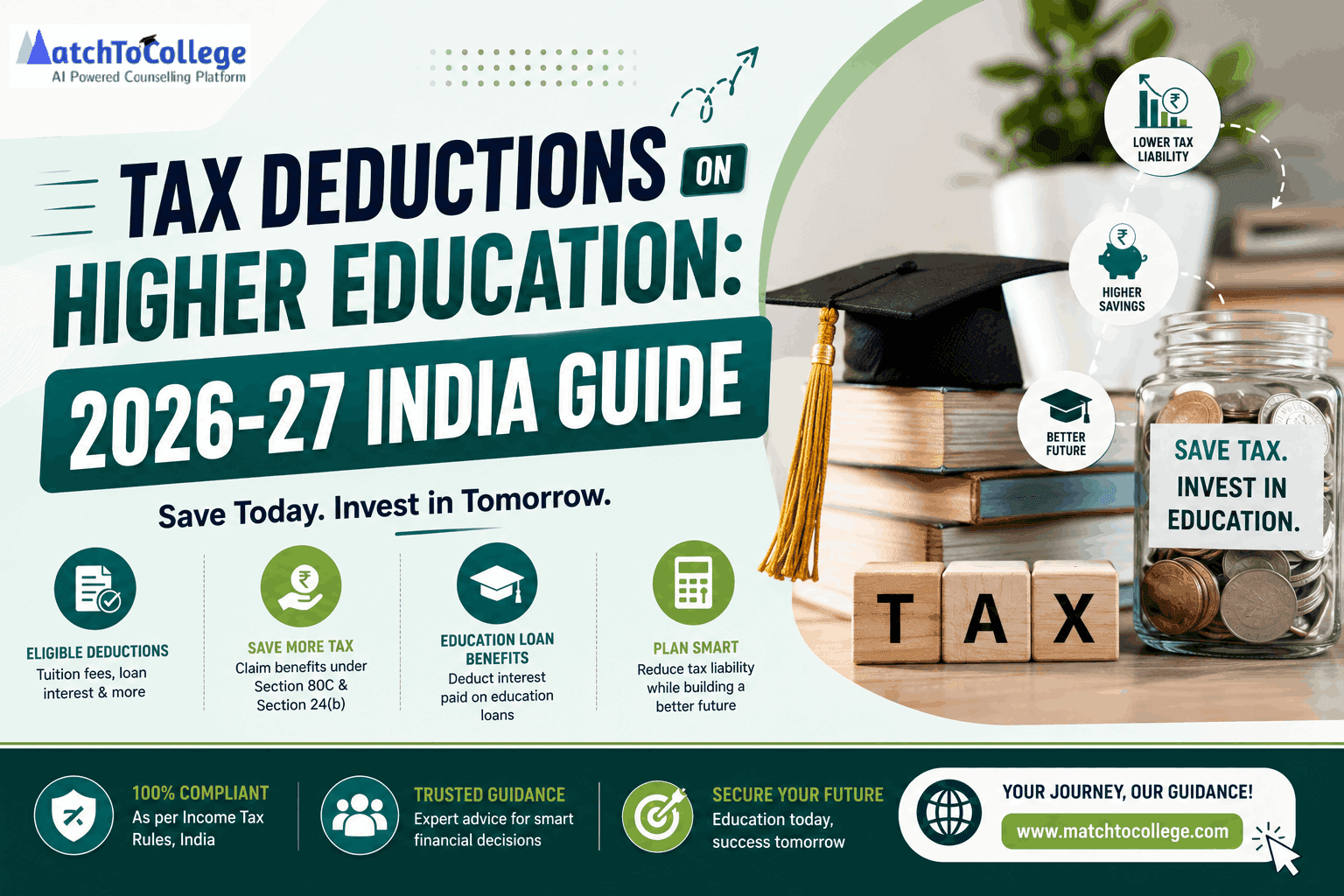
As we approach the financial year 2026-27, the landscape of higher education in India continues to evolve, driven by a surge in professional upskilling and a competitive job market. For working professionals, the pursuit of an Executive MBA, a specialized Master’s, or technical certifications is no longer just a luxury—it is a career necessity. However, the costs associated with premium education can be substantial.
Understanding the nuances of tax deductions on higher education fees is crucial for financial planning. At MatchToCollege, we believe that financial literacy is as important as academic excellence. By leveraging the specific provisions in the Income Tax Act, professionals can significantly offset the cost of their degrees.
Whether you are planning to take an education loan or paying fees out of your savings, the Indian tax code offers several mechanisms to reduce your taxable income. This guide provides a deep dive into Section 80C and Section 80E, the impact of the New Tax Regime vs. Old Tax Regime in 2026, and how tools like our Education Loan EMI Calculator can help you forecast your expenses.
With the right strategy, your journey toward a higher degree can be both intellectually rewarding and fiscally responsible.
In this comprehensive guide, we will explore the eligibility criteria, the limits of deductions, and the documentation required to claim these benefits. We will also integrate how AI-powered tools such as the Online Courses ROI Calculator and various rank predictors can assist you in choosing the right path that offers the best financial and professional return on investment.
Maximizing Benefits Under Section 80C: Tuition Fee Deductions
Section 80C of the Income Tax Act remains the cornerstone of tax planning for most Indian taxpayers. While it is widely known for investments like PPF or LIC, it also allows for the deduction of 'Tuition Fees' paid to any university, college, school, or other educational institution situated within India. For the financial year 2026-27, the overall limit under Section 80C remains capped at ₹1.5 lakh. However, there are specific conditions that working professionals must understand to claim this benefit effectively.
Firstly, the deduction is only available for 'Full-Time' education. This means that part-time courses, distance learning, or private tuitions generally do not qualify under Section 80C. For a working professional pursuing an Executive MBA, it is imperative to check if the program is classified as full-time by the institution. Additionally, the deduction is specifically for the 'Tuition Fee' component of the total fees paid. Development fees, transport fees, and hostel charges are excluded from this benefit. If you are a parent, you can claim this for up to two children. If you are a working professional paying for your own education, you must ensure the course aligns with the 'full-time' requirement to claim it against your own taxable income.
Strategically, if your 80C limit is already exhausted by other investments like EPF or Home Loan principal, the tuition fee deduction might not offer additional relief. In such cases, checking the ROI of your course becomes even more critical. You can use our Online Courses ROI Calculator to see if the tax-adjusted cost of the course aligns with your future salary expectations. Furthermore, if you are looking at domestic options, browse our Domestic Colleges listing to find institutions that provide the necessary certifications for tax claims.
Section 80E: The Power of Unlimited Interest Deductions
While Section 80C has a rigid cap, Section 80E is a goldmine for those taking the loan route. This section allows for a deduction of the 'Interest' component of an education loan taken for higher studies. The most significant advantage of Section 80E is that there is no upper monetary limit on the amount of interest you can claim as a deduction. For professionals eyeing high-cost programs at IIMs, IITs, or even foreign universities, this can lead to massive tax savings over the years.
To qualify, the loan must be taken from a recognized financial institution or an approved charitable organization. The deduction is available for a maximum of 8 years or until the interest is fully paid, whichever is earlier. This makes the timing of your loan repayment crucial. If you are planning to pursue studies in 2026, using an Education Loan EMI Calculator can help you visualize the interest-to-principal ratio. Since only the interest is deductible, you might choose a repayment structure that maximizes interest payments in your highest-earning years to lower your tax bracket.
Section 80E also covers 'Higher Education' which is defined as any course of study pursued after passing the Senior Secondary Examination. This includes vocational training and professional degrees. If you are aiming for competitive entrance exams to get into these high-ROI institutions, our tools like the CAT College Predictor or GATE College Predictor can help you identify colleges where your rank will likely secure admission, thereby helping you plan your loan requirements more accurately.
Tax Implications for Study Abroad and Online Degrees
With the rise of global education, many Indian professionals are looking toward international degrees. Under Section 80E, you can claim interest deductions even for education loans taken for studies abroad. This is a vital relief for those pursuing an MBBS Abroad or a global MS/MBA. However, Section 80C benefits (tuition fees) are strictly limited to institutions located 'within India'.
Therefore, if you are studying in the US or UK, your tuition fees won't help you under 80C, but your loan interest under 80E remains a potent tool for tax reduction.
Similarly, the 2026-27 landscape sees a massive uptick in online degrees. The question arises: Are online degrees tax-deductible? Generally, Section 80C requires 'full-time' attendance. Many hybrid or synchronous online programs now qualify as full-time equivalent by modern standards, but you must obtain a certificate from the university stating the course's status.
Before enrolling, it's wise to use our Online Degree Passing Predictor to ensure you are on a path you can actually complete, as tax benefits are only useful if you remain enrolled and paying fees. For those specifically looking at medical fields abroad, staying updated with NEET Rank Predictors and NEET College Predictors ensures you choose a path that fits both your merit and your budget.
Strategic Financial Planning with MatchToCollege Tools
Planning for higher education is a multi-dimensional task that involves academic, professional, and financial variables. At MatchToCollege, we have developed a suite of AI tools to make this transition seamless. For instance, if you are a professional moving from a technical role to management, our Career Pathway Matcher can help you decide if the tax-deductible expense of an MBA is the right move for your trajectory.
Once you've decided on a path, calculating the exact financial impact is next. Use the Education Loan EMI Calculator to understand your monthly outgoings and the ROI Calculator to see how quickly you'll break even after considering the tax savings. For those transitioning from academic grades to professional requirements, our CGPA to Percentage Calculator and GPA to Percentage Calculator are essential for international applications where specific scoring formats are required. By integrating tax planning with these analytical tools, you ensure that your education is an investment rather than just an expense.
Choosing Between New and Old Tax Regimes in 2026-27
A critical decision for any working professional in 2026-27 is the choice between the Old Tax Regime and the New Tax Regime. The Old Regime allows for all the deductions we have discussed—Section 80C and Section 80E. However, the New Tax Regime, which has become the default for many, offers lower tax rates but traditionally disallows these deductions. Professionals must perform a comparative analysis: Does the tax saved through lower rates in the New Regime outweigh the tax saved through 80C and 80E deductions in the Old Regime?
For someone with a large education loan, the unlimited deduction on interest under Section 80E often makes the Old Tax Regime much more attractive. Conversely, if you have no loan and your 80C is already filled by basic savings, the New Regime might be simpler and more cost-effective. You should use a financial year-specific calculator to run these numbers. Regardless of the regime you choose, your goal should be to minimize the 'Net Cost' of education. By utilizing CAT, JEE, or GATE predictors, you can aim for top-tier institutions that command higher salaries, making the tax-saving aspect a secondary, albeit important, bonus to a high-earning career.
Share this Article
FAQFrequently Asked Questions
Q: Can I claim tax deduction for an Executive MBA in India?
Yes, you can claim deductions for an Executive MBA under Section 80C for tuition fees if it is a full-time course, and under Section 80E for the interest paid on an education loan.
Q: Is there a limit on Section 80E deductions for education loan interest?
No, there is no maximum limit on the amount of interest you can claim as a deduction under Section 80E. It can be claimed for up to 8 consecutive years.
Q: Can I claim tax benefits if I am studying an online degree?
Tax benefits for online degrees under Section 80C depend on the university's classification of the course as 'full-time'. However, interest on education loans for recognized online higher education is generally deductible under Section 80E.
Q: Does Section 80C cover fees for education abroad?
No, Section 80C only covers tuition fees paid to institutions located within India. For studies abroad, only Section 80E (loan interest) is applicable.
Top Colleges Covered in this Blog

The All India Institutes of Medical Sciences (AIIMS) is a group of autonomous government public medical universities of higher education under the jurisdiction of Ministry of Health and Family Welfare, Government of India. These institutes have been declared by an Act of Parliament as Institutes of National Importance. AIIMS New Delhi, the forerunner institute, was established in 1956. Since then, 24 more institutes were announced. As of January 2023, twenty institutes are operating and four more are expected to become operational until 2025. Proposals were made for six more AIIMS under the leadership of Narendra Modi. It is considered as pioneer health institution of Asia.
Total Fees
₹1K - ₹8K
Total Courses
17
Get More Info About Tax Deductions on Higher Education
Recommended Reading
GATE Previous Year Question Papers with Official Answer Keys (2007–2026) – Download PDF by Branch
Download official GATE previous year question papers with answer keys PDF from 2007 to 2026. Access branch-wise question papers for Computer Science (CS), Data Science (DA), Mechanical (ME), Electronics (EC), Electrical (EE), and Civil (CE) by IIT Madras.

Top Mistakes Students Make in CUET Exam (And How to Avoid Them)
Many students lose marks in the CUET exam due to common mistakes like poor time management, ignoring the syllabus, and guessing answers blindly. This guide explains the top mistakes CUET aspirants make and practical strategies to avoid them to improve their exam performance.

How to Achieve AIR Under 500 in JEE Advanced: Proven Strategy Guide
Learn how to crack JEE Advanced with an AIR under 500 using proven strategies, smart study plans, mock test analysis, and subject-wise preparation tips followed by top rankers.