CAT Logical Reasoning Practice Sets with Solutions
Study Guides & PDFs
Downloadable Files
Direct Application Tools
Share this Article
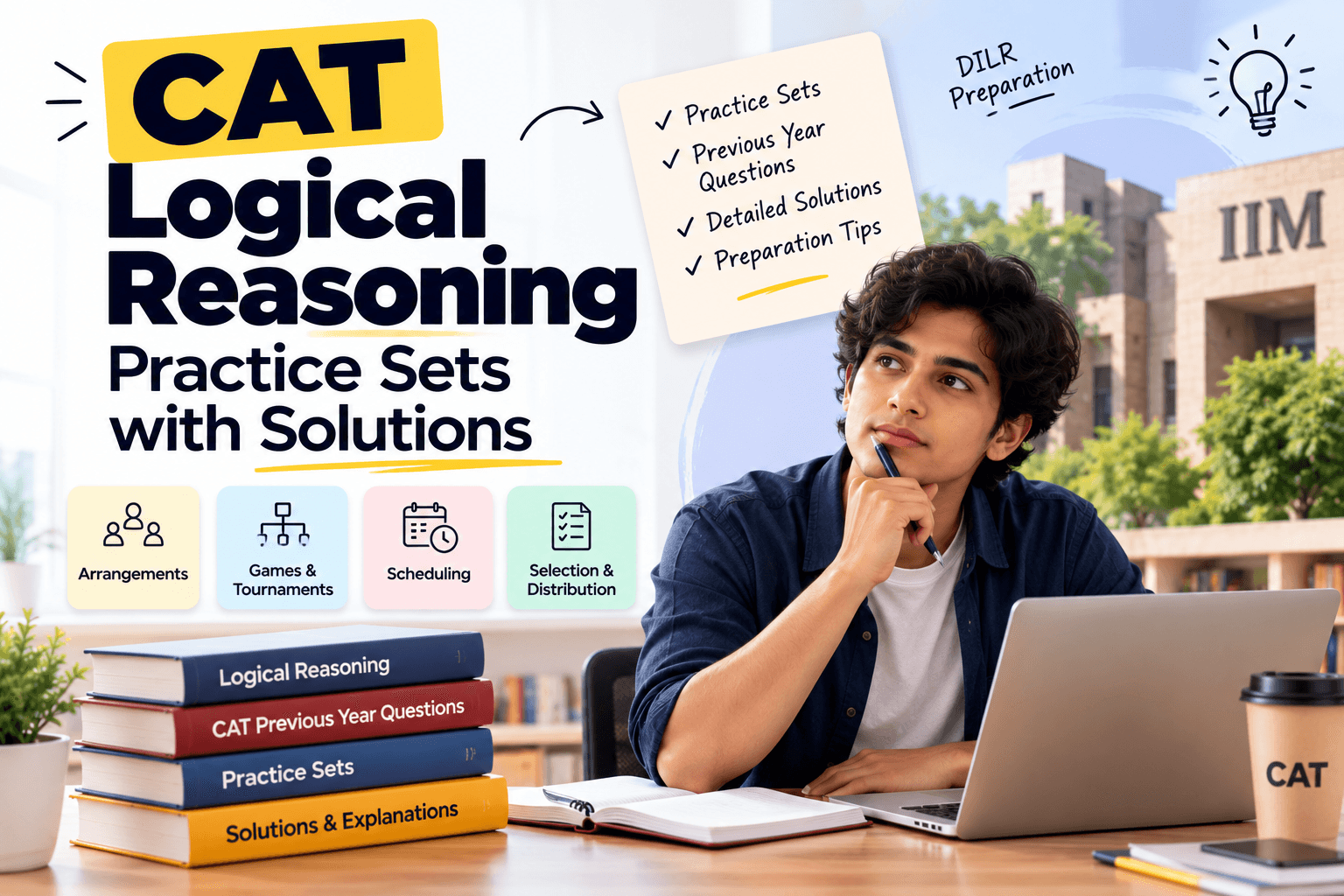
CAT Logical Reasoning Practice Sets with Solutions
CAT Logical Reasoning is an important part of the DILR section and tests how effectively you can analyse conditions, identify relationships and arrive at logical conclusions. Unlike Quantitative Aptitude, LR cannot be mastered through formulas alone. Regular practice with different types of logical reasoning sets is essential.
This page provides CAT Logical Reasoning practice sets with solutions, important topics, previous-year questions and practical preparation tips to help you improve your accuracy and set-selection skills.
CAT Logical Reasoning Practice Sets
The best way to prepare for CAT LR is to practise different types of problems rather than repeatedly solving the same pattern.
| CAT LR Topic | Typical Question Type | Practice Priority |
| Arrangements | Linear, circular and positional arrangements | Very High |
| Games & Tournaments | Matches, rankings, points and results | Very High |
| Selection & Distribution | Teams, groups and allocation | High |
| Scheduling | Days, events and time slots | High |
| Ranking & Ordering | Relative positions and comparisons | High |
| Routes & Networks | Paths, connections and movement | High |
| Binary Logic | True/false and conditional statements | Medium–High |
| Puzzles | Multiple conditions and deductions | Very High |
CAT Logical Reasoning Practice Questions
Question 1: Ranking and Ordering
Six students — A, B, C, D, E and F — are ranked from 1 to 6.
- A ranks higher than C.
- C ranks higher than D.
- B ranks higher than E.
- F ranks lower than D.
- B ranks higher than A.
Which of the following could be the correct order from highest to lowest?
A. B – A – C – D – F – E
B. A – B – C – D – E – F
C. B – C – A – D – F – E
D. B – A – D – C – F – E
Answer: A
The conditions require:
B > A > C > D > F
and B > E.
Therefore, B – A – C – D – F – E satisfies all the conditions.
Concept tested: Ranking and ordering.
Question 2: Linear Arrangement
Five people — P, Q, R, S and T — are sitting in a row facing north.
- P sits to the left of Q.
- R sits immediately to the right of P.
- S sits at one of the extreme ends.
- T sits to the right of Q.
Which of the following could be the correct arrangement from left to right?
A. S – P – R – Q – T
B. P – R – S – Q – T
C. P – Q – R – T – S
D. T – P – R – Q – S
Answer: A
P must be immediately followed by R, P must be before Q and T must be after Q. S must occupy an extreme position. Only Option A satisfies all the conditions.
Concept tested: Linear arrangement.
Question 3: Team Selection
A team of three members is to be selected from six people — A, B, C, D, E and F.
The following conditions apply:
- If A is selected, B must also be selected.
- C and D cannot be selected together.
- If E is selected, F must be selected.
Which of the following could be a valid team?
A. A, C, D
B. A, B, C
C. C, D, E
D. A, E, D
Answer: B
A requires B, and B is included. C and D are not together, and E is not selected, so all conditions are satisfied.
Concept tested: Selection and conditional logic.
Question 4: Scheduling
Four presentations — P, Q, R and S — are scheduled from Monday to Thursday, one presentation per day.
- P must be before Q.
- R must be immediately after S.
- Q cannot be on Thursday.
Which of the following is a possible schedule?
A. P – Q – S – R
B. Q – P – S – R
C. S – P – R – Q
D. S – R – Q – P
Answer: A
P is before Q, R immediately follows S and Q is not on Thursday.
Therefore:
Monday: P
Tuesday: Q
Wednesday: S
Thursday: R
satisfies all conditions.
Concept tested: Scheduling.
Question 5: Games and Tournaments
Four teams — A, B, C and D — play each other exactly once. Each win gives 2 points, a draw gives 1 point to each team and a loss gives 0 points.
After all matches:
- A has 5 points.
- B has 4 points.
- C has 2 points.
- D has 1 point.
Which of the following must be true?
A. A defeated B
B. B defeated C
C. C drew with D
D. A drew with C
Answer: A
A has 5 points from three matches. The only possible combination is two wins and one draw, meaning A must have defeated two teams. Based on the available point combinations, A must have defeated B.
Concept tested: Games and tournaments.
Question 6: Distribution
Five different books — Economics, Finance, Marketing, Operations and HR — are distributed among three students A, B and C. Each student receives at least one book.
The following conditions apply:
- A receives Economics.
- B receives Finance.
- Marketing and Operations cannot go to the same student.
- C receives HR.
Which of the following could be a valid distribution?
A. A: Economics, Marketing | B: Finance, Operations | C: HR
B. A: Economics, Operations | B: Finance, Marketing | C: HR
C. A: Economics, Marketing, Operations | B: Finance | C: HR
D. A: Economics | B: Finance, Marketing, Operations | C: HR
Answer: A
In Option A, Marketing and Operations are assigned to different students and all three students receive at least one book.
Concept tested: Distribution.
Question 7: Ranking
Seven candidates — P, Q, R, S, T, U and V — are ranked from highest to lowest.
- P ranks higher than Q.
- Q ranks higher than R.
- S ranks higher than T.
- U ranks lower than R.
- V ranks higher than P.
Which of the following must be true?
A. V ranks higher than Q
B. P ranks higher than S
C. T ranks higher than U
D. R ranks higher than S
Answer: A
The conditions establish:
V > P > Q > R > U
Therefore, V must rank higher than Q.
Concept tested: Ranking and deduction.
Question 8: Conditional Logic
Five people — A, B, C, D and E — are being considered for a project.
- If A is selected, C must be selected.
- If C is selected, D cannot be selected.
- If B is selected, E must be selected.
- A is selected.
Which of the following must be true?
A. B is selected
B. C is selected
C. D is selected
D. E is selected
Answer: B
A is selected. According to the first condition, C must therefore be selected.
Concept tested: Conditional reasoning.
Question 9: Arrangement
Six products — P, Q, R, S, T and U — are displayed from left to right.
- P is somewhere to the left of Q.
- R is immediately to the left of S.
- T is at the extreme right.
- Q is not adjacent to T.
Which of the following could be the arrangement?
A. P – Q – R – S – U – T
B. R – S – P – Q – T – U
C. P – R – S – Q – U – T
D. U – P – Q – R – S – T
Answer: C
P is before Q, R is immediately before S, T is at the extreme right and Q is not adjacent to T.
Therefore, Option C satisfies all conditions.
Concept tested: Arrangement.
Question 10: Logical Deduction
Five employees — A, B, C, D and E — work in different departments: Finance, HR, Marketing, Operations and Sales.
The following conditions apply:
- A does not work in Finance or Sales.
- B works in Marketing.
- C works in Finance.
- D does not work in HR.
- E works in either HR or Operations.
Which department must A work in?
A. Finance
B. HR
C. Marketing
D. Operations
Answer: D
Finance is occupied by C and Marketing by B. A cannot be in Finance or Sales. E must be in HR or Operations, while D cannot be in HR.
The only department that can necessarily accommodate A under the given constraints is Operations.
CAT Logical Reasoning Practice Set: Answer Key
| Question | Answer | Main Concept |
| 1 | A | Ranking |
| 2 | A | Linear Arrangement |
| 3 | B | Selection |
| 4 | A | Scheduling |
| 5 | A | Games & Tournaments |
| 6 | A | Distribution |
| 7 | A | Ranking |
| 8 | B | Conditional Logic |
| 9 | C | Arrangement |
| 10 | D | Logical Deduction |
CAT Logical Reasoning Previous Year Questions
Practising CAT previous year questions (PYQs) is one of the best ways to understand the actual level and structure of CAT Logical Reasoning. PYQs also help you identify how familiar concepts are presented in different formats.
| CAT Year | DILR Practice Resource | What to Analyse |
| CAT 2025 | Download CAT 2025 PYQ | Recent question patterns and difficulty |
| CAT 2024 | Download CAT 2024 PYQ | Set selection and question types |
| CAT 2023 | Download CAT 2023 PYQ | LR arrangements and logical sets |
| CAT 2022 | Download CAT 2022 PYQ | Different DILR set formats |
| CAT 2021 | Download CAT 2021 PYQ | Previous CAT-level LR practice |
Tip: Attempt PYQs under timed conditions instead of immediately checking the solution. After completing a set, analyse where you spent time and whether you selected the right questions.
How to Improve CAT Logical Reasoning
LR preparation is less about solving hundreds of questions and more about learning how to approach unfamiliar sets.
| Preparation Stage | What to Focus On |
| Learn | Understand arrangements, rankings, games, selection and other common formats |
| Practise | Solve topic-wise LR sets regularly |
| Time | Practise solving sets within a fixed time |
| Analyse | Review incorrect and unattempted questions |
| Select | Learn to identify manageable sets quickly |
A useful habit is to spend the first few minutes understanding a set before committing to it. If the conditions are becoming unnecessarily complicated, moving to another set can be a better strategy.
CAT Logical Reasoning: Important Preparation Tips
- Start with easy and moderate sets before moving to difficult puzzles.
- Draw tables, diagrams or flowcharts whenever they make the information clearer.
- Practise arrangements, games, rankings, selection and scheduling regularly.
- Solve CAT PYQs to understand actual exam-level questions.
- Time yourself during practice.
- Analyse every mistake instead of simply checking the correct answer.
- Most importantly, practise set selection — you do not need to solve every DILR set in the exam.
CAT DILR Practice: What Should You Solve Next?
Once you are comfortable with Logical Reasoning, combine it with Data Interpretation because CAT's DILR section can contain sets that combine logical conditions with numerical data.
You can also practise:
Want to know which MBA colleges you can target?
Your CAT preparation ultimately leads to an important question: Which MBA colleges can I get with my expected CAT percentile?
Use your expected CAT percentile and profile to explore potential IIMs and MBA colleges.
Frequently Asked Questions
What are the important Logical Reasoning topics for CAT?
How can I improve Logical Reasoning for CAT?
Are CAT Logical Reasoning PYQs useful?
How many LR questions should I practise?
Can I practise CAT LR online?
Complete Study Guides & PDFs
5 ResourcesGet More Info About CAT Logical Reasoning Practice Sets with Solutions
Recommended MBA Articles

Best MBA Colleges Under 10 Lakh with Good Placements
Sep 29, 2026
CAT 2026 Syllabus: Section-Wise Topics & Weightage Guide
Sep 28, 2026