

JEE Main 2027: The Ultimate Guide to Mock Tests, Preparation & Admissions
Admission & Info Tools
Need Expert Assistance?
Our counselors can help you with fee structures, eligibility guidelines, and upcoming admission cutoffs instantly.
Direct Application Tools

🎯 MatchToCollege AI Recommendation: Planning your counselling or choice filling? Check your seat allotment probability across premier colleges using the JEE Main College Predictor.
Key Highlights & Program Overview
Understanding the fundamental structure of JEE Main is the first step towards effective preparation. Here’s a quick overview of what you need to know:
| Parameter | Details |
| Exam Name | Joint Entrance Examination (JEE) Main |
| Conducting Body | National Testing Agency (NTA) |
| Official Website | nta.ac.in |
| Exam Frequency | Twice a year (January & April sessions) |
| Exam Mode | Computer-Based Test (CBT) |
| Exam Duration | 3 hours (180 minutes) |
| Subjects | Physics, Chemistry, Mathematics |
| Total Questions | 75 (25 questions per subject) |
| Total Marks | 300 |
| Question Type | Multiple Choice Questions (MCQs) & Numerical Value Questions |
| Languages | English, Hindi, Assamese, Bengali, Gujarati, Kannada, Malayalam, Marathi, Odia, Punjabi, Tamil, Telugu, Urdu |
Eligibility Criteria & Selection Process
To sit for JEE Main, aspirants must meet specific eligibility requirements. It's crucial to ensure you fulfill these before planning your application:
- Educational Qualification: Candidates must have passed Class 12th or equivalent examination with Physics, Chemistry, and Mathematics as compulsory subjects from a recognized board.
- Year of Passing: Candidates appearing for their Class 12th examination in the same year as JEE Main, or those who passed in the preceding two years, are eligible. For JEE Main 2027, this typically means students appearing for Class 12th in 2027, or who passed in 2026 or 2025.
- Age Limit: There is no age limit for appearing in JEE Main.
- Number of Attempts: Candidates can attempt JEE Main for three consecutive years. Each year, they can appear in both sessions (January and April).
The selection process for admission to NITs, IIITs, and GFTIs is based on your JEE Main rank, followed by the JoSAA/CSAB counselling process. For admission to IITs, a strong JEE Main performance is a prerequisite to qualify for JEE Advanced.
Mastering JEE Main: Preparation & Mock Test Strategy
My dear aspirants, effective preparation for JEE Main is a blend of conceptual clarity, consistent practice, and strategic test-taking. Mock tests are an indispensable tool in this journey. Here’s how to approach them:
Understanding the Exam Pattern & Marking Scheme
JEE Main Paper 1 (B.E./B.Tech) consists of Physics, Chemistry, and Mathematics. Each subject has two sections: Section A (20 MCQs) and Section B (10 numerical value questions, out of which 5 are to be attempted). The total marks are 300.
| Parameter | Details |
| MCQ Section (A) | +4 for correct, -1 for incorrect, 0 for unattempted |
| Numerical Value Section (B) | +4 for correct, -1 for incorrect, 0 for unattempted |
| Total Questions | 75 (20+5 from each subject) |
| Total Marks | 300 |
How to Attempt Mock Tests Effectively
To truly benefit from mock tests, simulate the actual exam conditions:
- Quiet Environment: Find a distraction-free space.
- No Breaks: Attempt the full 3-hour paper without interruptions.
- Time Management Strategy:
- Round 1 (45-60 minutes): Tackle all the easy questions across Physics, Chemistry, and Mathematics. Build confidence and secure quick marks.
- Round 2 (70 minutes): Move to moderate-difficulty questions. These require a bit more thought but are solvable with solid conceptual understanding.
- Round 3 (Last 30-45 minutes): Focus on the remaining difficult questions. Prioritize those where you have partial knowledge or a strong intuition.
- Never spend more than 2-3 minutes on a single question initially. If stuck, move on.
Analyzing Your Mock Test Performance
Taking a mock test is only half the battle; the real learning comes from analysis:
- Identify Strong & Weak Areas: Pinpoint subjects and topics where you consistently score well versus those needing improvement.
- Review Incorrect Answers: Understand *why* you made a mistake – was it a conceptual error, calculation mistake, or time pressure?
- Analyze Unattempted Questions: Were these too difficult, or did you run out of time? Could you have solved them with more practice?
- Time Management Audit: Did you allocate time efficiently across sections? Where did you spend too much or too little time?
- Track Progress: Maintain a log of your mock test scores and analysis to see your improvement over time.
Syllabus Coverage & Frequency
- Complete Syllabus First: While high-weightage chapters are important, I strongly advise covering the entire JEE Main syllabus. Relying solely on a few topics can limit your potential score.
- Consistent Practice: Start with at least one mock test per week. In the final month leading up to the exam, increase this frequency to 3-4 mock tests weekly.
Remember, practice makes perfect. Utilize previous year's question papers and NTA mock tests available on nta.ac.in as valuable resources.
Top Engineering Institutes & Navigating Admissions
Securing a high rank in JEE Main opens doors to prestigious institutions like the National Institutes of Technology (NITs), Indian Institutes of Information Technology (IIITs), and other Government Funded Technical Institutes (GFTIs). For those aspiring for the Indian Institutes of Technology (IITs), JEE Main is the qualifying exam for JEE Advanced.
The cutoffs for these institutes vary each year based on factors like the number of applicants, exam difficulty, and available seats. Understanding where you stand and which colleges you might qualify for is a critical step in your admissions journey.
While specific fee structures and placement statistics for individual colleges are dynamic, a strong JEE Main rank generally correlates with better opportunities and a higher return on investment (ROI) from top-tier institutions. To get a personalized estimate of your admission probability and explore potential colleges based on your expected JEE Main score or rank, I highly recommend using our official JEE Main College Predictor. This tool is designed to provide clarity and guide your college selection process effectively.
Career Trajectories & Future Prospects in Engineering
A B.Tech degree from a reputable institution, secured through JEE Main, is a launchpad for diverse and rewarding career paths. The engineering landscape is constantly evolving, offering opportunities in traditional sectors as well as cutting-edge fields.
- Core Engineering Roles: Mechanical, Civil, Electrical, Chemical engineers find roles in manufacturing, infrastructure, energy, and process industries.
- Information Technology & Software Development: Computer Science and IT graduates are in high demand for roles in software development, data science, AI/ML, cybersecurity, and cloud computing.
- Emerging Technologies: Fields like Robotics, Mechatronics, Biotechnology, and Nanotechnology offer exciting prospects for innovation and research.
- Management & Consulting: Many engineers transition into management roles, leveraging their analytical skills in consulting, finance, and operations.
- Entrepreneurship: A strong engineering foundation often inspires graduates to launch their own startups, contributing to India's vibrant entrepreneurial ecosystem.
Average placement packages vary significantly based on the institute, specialization, and economic climate. However, graduates from top NITs and IIITs consistently command competitive salaries, with packages often ranging from INR 8 LPA to INR 25+ LPA, and even higher for exceptional talent in premier roles. The return on investment for a quality engineering education in India remains robust, promising a fulfilling and impactful career.
🏛️ Looking for Admissions & College Cutoffs? Explore verified fee structures, seat matrices, and real student reviews across top institutions on the MatchToCollege Top Colleges & Universities in India Directory.
Frequently Asked Questions
Q: How can I improve my time management during the JEE Main exam?
To effectively manage your time in JEE Main, I recommend a 'three-round' approach. In Round 1 (45-60 mins), attempt all easy questions across subjects. In Round 2 (70 mins), focus on moderate questions. Finally, in Round 3 (30-45 mins), tackle the remaining difficult ones. Crucially, avoid spending more than 2-3 minutes on any single question initially. Consistent practice with mock tests under timed conditions will refine this strategy.
Q: Which mock tests are most effective for JEE Main preparation?
The most effective mock tests for JEE Main are previous year question papers, as they provide an authentic feel of the exam. Additionally, the National Testing Agency (NTA) provides official mock tests on its website (nta.ac.in). All these resources are designed according to the official JEE Main syllabus and exam pattern, making them invaluable for practice.
Q: Is there negative marking in the JEE Main exam?
Yes, JEE Main has negative marking. For every incorrect answer in both the MCQ (Section A) and Numerical Value (Section B) sections, 1 mark is deducted. Correct answers fetch +4 marks, and unattempted questions receive 0 marks. This makes accuracy as important as speed.
Q: Can I change the language of the JEE Main question paper during the exam?
While JEE Main is offered in 13 languages (including English and Hindi), the language you select during your application form submission is generally the one you will see. You cannot switch the language of the question paper during the actual examination. It's essential to choose your preferred language carefully when filling out the application.
Q: What are the most important topics to focus on for JEE Main Physics, Chemistry, and Mathematics?
While a comprehensive understanding of the entire syllabus is ideal, some high-weightage topics often appear. For Mathematics, focus on 3D Geometry, Vectors, Applications of Derivatives, Definite Integrals, and Limit, Continuity & Differentiability. In Physics, prioritize Heat & Thermodynamics, Electromagnetic Waves, Ray & Wave Optics, Kinematics, Current Electricity, and Magnetism. For Chemistry, Electrochemistry, Chemical Kinetics, Thermodynamics, p-block elements, and Chemical Bonding are frequently tested. However, I strongly advise covering the full syllabus first before focusing on these key areas.
Q: How can MatchToCollege help me predict my college admissions for JEE Main?
MatchToCollege offers a powerful JEE Main College Predictor tool. By inputting your expected JEE Main score or rank, this tool can help you identify potential B.Tech colleges and branches you might qualify for based on previous years' cutoffs. It's an excellent resource to strategize your college preferences and understand your admission probability.
Key Highlights & Program Overview
Understanding the fundamental structure of JEE Main is the first step towards effective preparation. Here’s a quick overview of what you need to know:
| Parameter | Details |
| Exam Name | Joint Entrance Examination (JEE) Main |
| Conducting Body | National Testing Agency (NTA) |
| Official Website | nta.ac.in |
| Exam Frequency | Twice a year (January & April sessions) |
| Exam Mode | Computer-Based Test (CBT) |
| Exam Duration | 3 hours (180 minutes) |
| Subjects | Physics, Chemistry, Mathematics |
| Total Questions | 75 (25 questions per subject) |
| Total Marks | 300 |
| Question Type | Multiple Choice Questions (MCQs) & Numerical Value Questions |
| Languages | English, Hindi, Assamese, Bengali, Gujarati, Kannada, Malayalam, Marathi, Odia, Punjabi, Tamil, Telugu, Urdu |
Eligibility Criteria & Selection Process
To sit for JEE Main, aspirants must meet specific eligibility requirements. It's crucial to ensure you fulfill these before planning your application:
- Educational Qualification: Candidates must have passed Class 12th or equivalent examination with Physics, Chemistry, and Mathematics as compulsory subjects from a recognized board.
- Year of Passing: Candidates appearing for their Class 12th examination in the same year as JEE Main, or those who passed in the preceding two years, are eligible. For JEE Main 2027, this typically means students appearing for Class 12th in 2027, or who passed in 2026 or 2025.
- Age Limit: There is no age limit for appearing in JEE Main.
- Number of Attempts: Candidates can attempt JEE Main for three consecutive years. Each year, they can appear in both sessions (January and April).
The selection process for admission to NITs, IIITs, and GFTIs is based on your JEE Main rank, followed by the JoSAA/CSAB counselling process. For admission to IITs, a strong JEE Main performance is a prerequisite to qualify for JEE Advanced.
Mastering JEE Main: Preparation & Mock Test Strategy
My dear aspirants, effective preparation for JEE Main is a blend of conceptual clarity, consistent practice, and strategic test-taking. Mock tests are an indispensable tool in this journey. Here’s how to approach them:
Understanding the Exam Pattern & Marking Scheme
JEE Main Paper 1 (B.E./B.Tech) consists of Physics, Chemistry, and Mathematics. Each subject has two sections: Section A (20 MCQs) and Section B (10 numerical value questions, out of which 5 are to be attempted). The total marks are 300.
| Parameter | Details |
| MCQ Section (A) | +4 for correct, -1 for incorrect, 0 for unattempted |
| Numerical Value Section (B) | +4 for correct, -1 for incorrect, 0 for unattempted |
| Total Questions | 75 (20+5 from each subject) |
| Total Marks | 300 |
How to Attempt Mock Tests Effectively
To truly benefit from mock tests, simulate the actual exam conditions:
- Quiet Environment: Find a distraction-free space.
- No Breaks: Attempt the full 3-hour paper without interruptions.
- Time Management Strategy:
- Round 1 (45-60 minutes): Tackle all the easy questions across Physics, Chemistry, and Mathematics. Build confidence and secure quick marks.
- Round 2 (70 minutes): Move to moderate-difficulty questions. These require a bit more thought but are solvable with solid conceptual understanding.
- Round 3 (Last 30-45 minutes): Focus on the remaining difficult questions. Prioritize those where you have partial knowledge or a strong intuition.
- Never spend more than 2-3 minutes on a single question initially. If stuck, move on.
Analyzing Your Mock Test Performance
Taking a mock test is only half the battle; the real learning comes from analysis:
- Identify Strong & Weak Areas: Pinpoint subjects and topics where you consistently score well versus those needing improvement.
- Review Incorrect Answers: Understand *why* you made a mistake – was it a conceptual error, calculation mistake, or time pressure?
- Analyze Unattempted Questions: Were these too difficult, or did you run out of time? Could you have solved them with more practice?
- Time Management Audit: Did you allocate time efficiently across sections? Where did you spend too much or too little time?
- Track Progress: Maintain a log of your mock test scores and analysis to see your improvement over time.
Syllabus Coverage & Frequency
- Complete Syllabus First: While high-weightage chapters are important, I strongly advise covering the entire JEE Main syllabus. Relying solely on a few topics can limit your potential score.
- Consistent Practice: Start with at least one mock test per week. In the final month leading up to the exam, increase this frequency to 3-4 mock tests weekly.
Remember, practice makes perfect. Utilize previous year's question papers and NTA mock tests available on nta.ac.in as valuable resources.
Top Engineering Institutes & Navigating Admissions
Securing a high rank in JEE Main opens doors to prestigious institutions like the National Institutes of Technology (NITs), Indian Institutes of Information Technology (IIITs), and other Government Funded Technical Institutes (GFTIs). For those aspiring for the Indian Institutes of Technology (IITs), JEE Main is the qualifying exam for JEE Advanced.
The cutoffs for these institutes vary each year based on factors like the number of applicants, exam difficulty, and available seats. Understanding where you stand and which colleges you might qualify for is a critical step in your admissions journey.
While specific fee structures and placement statistics for individual colleges are dynamic, a strong JEE Main rank generally correlates with better opportunities and a higher return on investment (ROI) from top-tier institutions. To get a personalized estimate of your admission probability and explore potential colleges based on your expected JEE Main score or rank, I highly recommend using our official JEE Main College Predictor. This tool is designed to provide clarity and guide your college selection process effectively.
Career Trajectories & Future Prospects in Engineering
A B.Tech degree from a reputable institution, secured through JEE Main, is a launchpad for diverse and rewarding career paths. The engineering landscape is constantly evolving, offering opportunities in traditional sectors as well as cutting-edge fields.
- Core Engineering Roles: Mechanical, Civil, Electrical, Chemical engineers find roles in manufacturing, infrastructure, energy, and process industries.
- Information Technology & Software Development: Computer Science and IT graduates are in high demand for roles in software development, data science, AI/ML, cybersecurity, and cloud computing.
- Emerging Technologies: Fields like Robotics, Mechatronics, Biotechnology, and Nanotechnology offer exciting prospects for innovation and research.
- Management & Consulting: Many engineers transition into management roles, leveraging their analytical skills in consulting, finance, and operations.
- Entrepreneurship: A strong engineering foundation often inspires graduates to launch their own startups, contributing to India's vibrant entrepreneurial ecosystem.
Average placement packages vary significantly based on the institute, specialization, and economic climate. However, graduates from top NITs and IIITs consistently command competitive salaries, with packages often ranging from INR 8 LPA to INR 25+ LPA, and even higher for exceptional talent in premier roles. The return on investment for a quality engineering education in India remains robust, promising a fulfilling and impactful career.
🏛️ Looking for Admissions & College Cutoffs? Explore verified fee structures, seat matrices, and real student reviews across top institutions on the MatchToCollege Top Colleges & Universities in India Directory.
Share this Article
FAQFrequently Asked Questions
Q: How can I improve my time management during the JEE Main exam?
To effectively manage your time in JEE Main, I recommend a 'three-round' approach. In Round 1 (45-60 mins), attempt all easy questions across subjects. In Round 2 (70 mins), focus on moderate questions. Finally, in Round 3 (30-45 mins), tackle the remaining difficult ones. Crucially, avoid spending more than 2-3 minutes on any single question initially. Consistent practice with mock tests under timed conditions will refine this strategy.
Q: Which mock tests are most effective for JEE Main preparation?
The most effective mock tests for JEE Main are previous year question papers, as they provide an authentic feel of the exam. Additionally, the National Testing Agency (NTA) provides official mock tests on its website (<a href="https://nta.ac.in/" target="_blank">nta.ac.in</a>). All these resources are designed according to the official JEE Main syllabus and exam pattern, making them invaluable for practice.
Q: Is there negative marking in the JEE Main exam?
Yes, JEE Main has negative marking. For every incorrect answer in both the MCQ (Section A) and Numerical Value (Section B) sections, 1 mark is deducted. Correct answers fetch +4 marks, and unattempted questions receive 0 marks. This makes accuracy as important as speed.
Q: Can I change the language of the JEE Main question paper during the exam?
While JEE Main is offered in 13 languages (including English and Hindi), the language you select during your application form submission is generally the one you will see. You cannot switch the language of the question paper during the actual examination. It's essential to choose your preferred language carefully when filling out the application.
Q: What are the most important topics to focus on for JEE Main Physics, Chemistry, and Mathematics?
While a comprehensive understanding of the entire syllabus is ideal, some high-weightage topics often appear. For Mathematics, focus on 3D Geometry, Vectors, Applications of Derivatives, Definite Integrals, and Limit, Continuity & Differentiability. In Physics, prioritize Heat & Thermodynamics, Electromagnetic Waves, Ray & Wave Optics, Kinematics, Current Electricity, and Magnetism. For Chemistry, Electrochemistry, Chemical Kinetics, Thermodynamics, p-block elements, and Chemical Bonding are frequently tested. However, I strongly advise covering the full syllabus first before focusing on these key areas.
Q: How can MatchToCollege help me predict my college admissions for JEE Main?
MatchToCollege offers a powerful <a href="https://matchtocollege.com/tools/jee-college-predictor" target="_blank">JEE Main College Predictor</a> tool. By inputting your expected JEE Main score or rank, this tool can help you identify potential B.Tech colleges and branches you might qualify for based on previous years' cutoffs. It's an excellent resource to strategize your college preferences and understand your admission probability.
Get More Info About JEE Main 2027
Recommended Reading
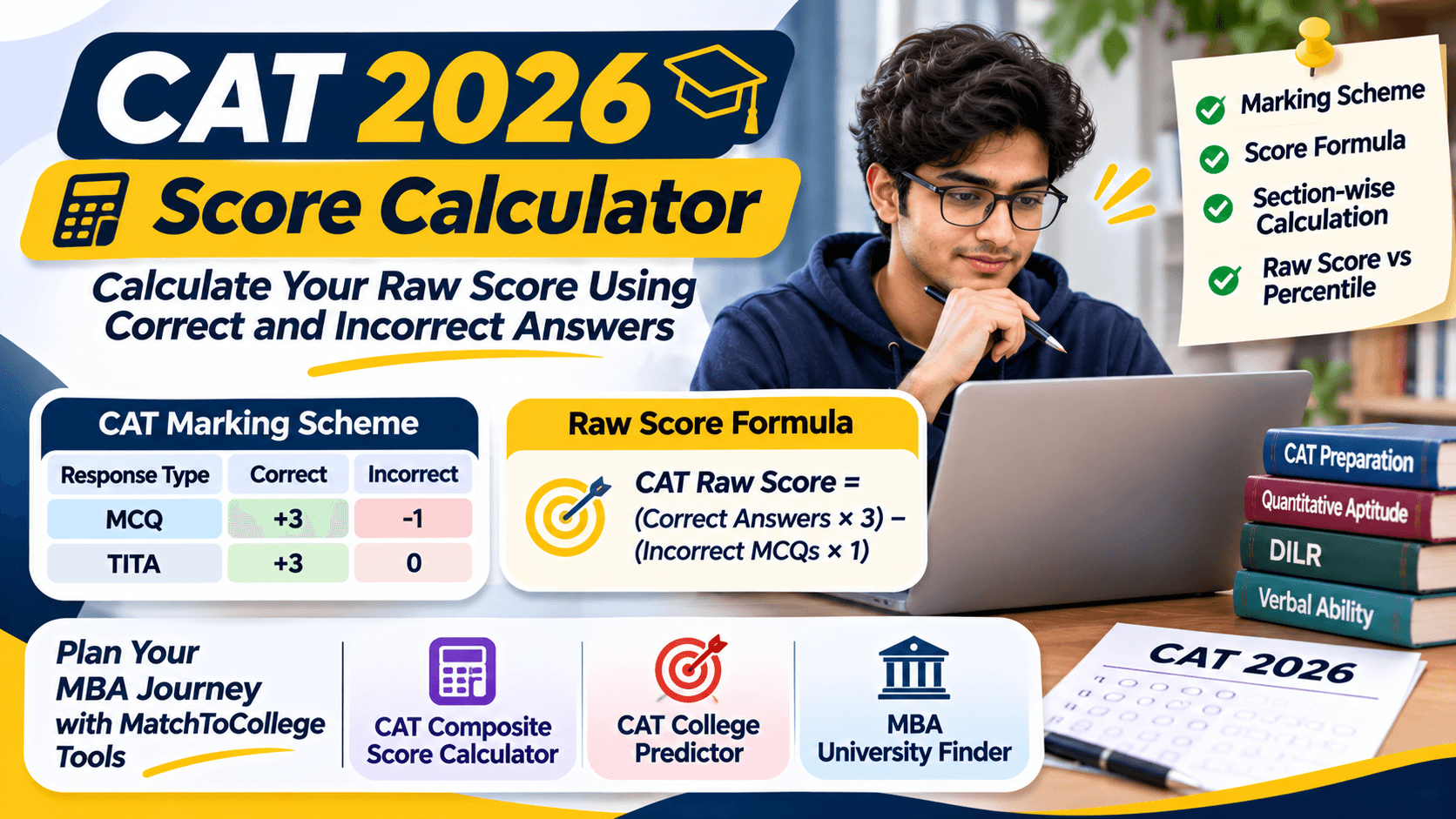
CAT 2026 Score Calculator: Calculate Your Raw Score Using Correct and Incorrect Answers
Learn how to calculate your CAT 2026 raw score using the official marking scheme. Understand correct answers, negative marking, sectional scores and the difference between raw score, scaled score and percentile.
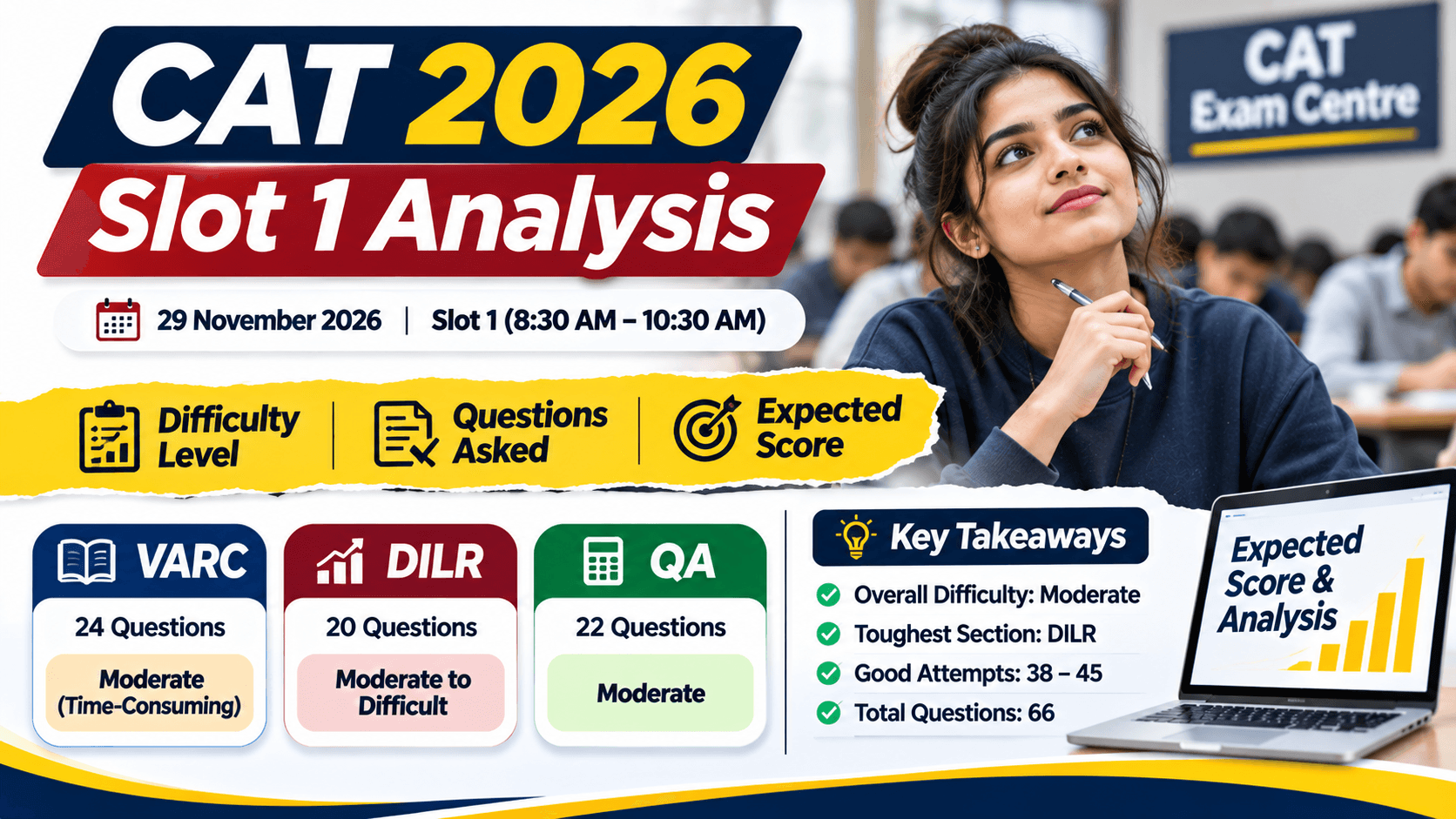
CAT 2026 Slot 1 Analysis: Difficulty Level, Questions Asked and Expected Score
CAT 2026 Slot 1 analysis covering VARC, DILR and QA difficulty, memory-based topics, expected good attempts, score calculation and MBA admission guidance.

CUET Mathematics Syllabus 2027: Master Your Exam Prep with Expert Guidance
Prepare effectively for CUET Mathematics 2027 with our comprehensive guide. Understand the syllabus, exam pattern, and expert strategies to ace your university admissions.