

CAT 2026 Slot 1 Analysis: Difficulty Level, Questions Asked and Expected Score
Admission & Info Tools
Need Expert Assistance?
Our counselors can help you with fee structures, eligibility guidelines, and upcoming admission cutoffs instantly.
Direct Application Tools
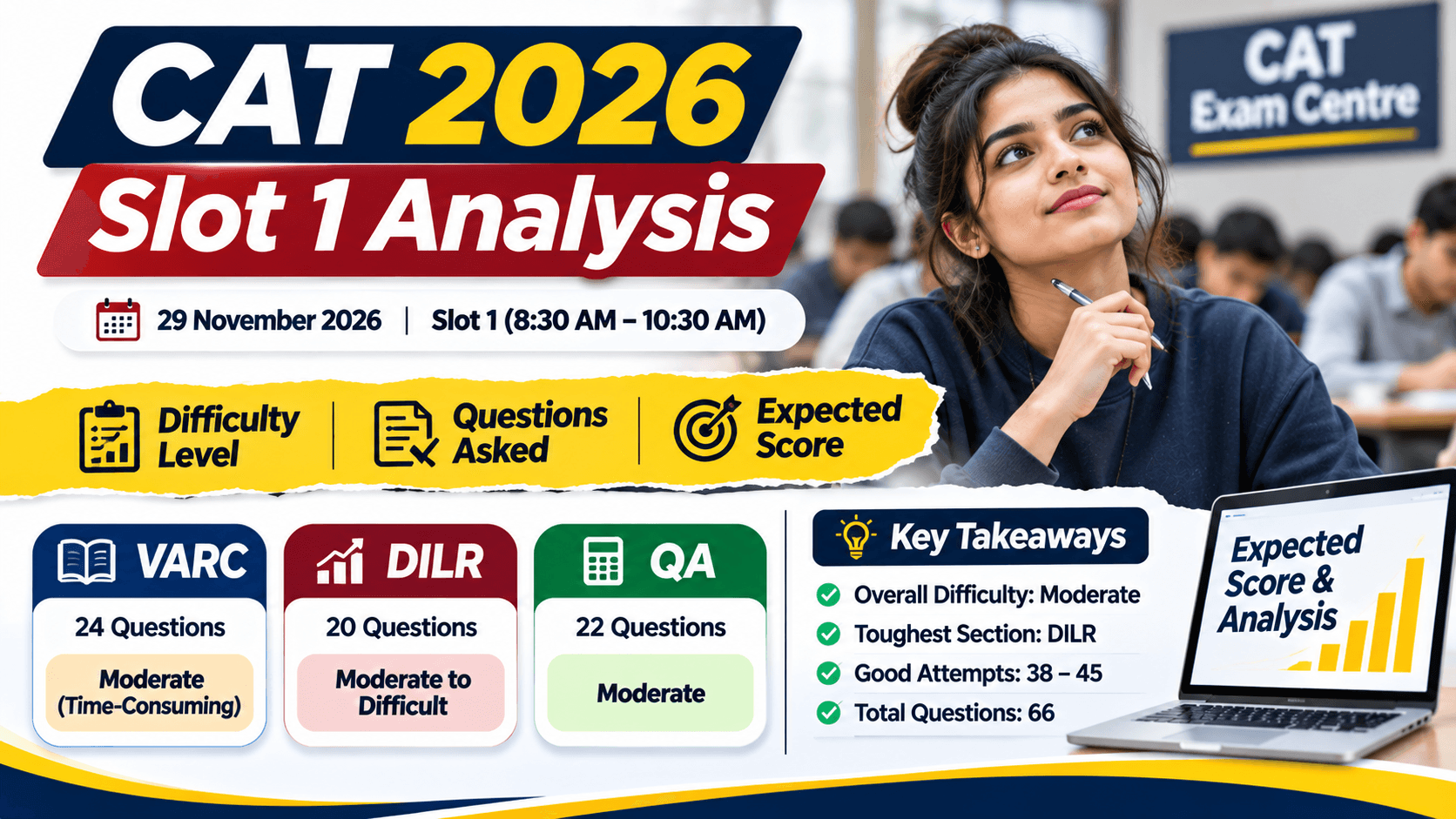

CAT 2026 Slot 1 was conducted on 29 November 2026, from 8:30 AM to 10:30 AM. Based on initial candidate feedback, the paper was moderate overall, with DILR emerging as the most challenging section. VARC was considered time-consuming, while Quantitative Ability offered a relatively balanced mix of questions.
This analysis covers the overall difficulty level, section-wise review, memory-based topics, expected good attempts and score-related insights for candidates who appeared in the morning shift.
Note: This is a preliminary analysis based on candidate feedback and memory-based question reports. The exact questions, official answer key and final score calculations will be confirmed through the official CAT response sheet and answer key.
CAT 2026 Slot 1: Highlights
| Particulars | Details |
| Exam | CAT 2026 |
| Exam date | 29 November 2026 |
| Slot | Slot 1 |
| Timing | 8:30 AM – 10:30 AM |
| Overall difficulty | Moderate |
| Toughest section | DILR |
| VARC difficulty | Moderate, time-consuming |
| DILR difficulty | Moderate to Difficult |
| Quantitative Ability | Moderate |
| Total questions | 66 (as per initial section-wise reports) |
| Total duration | 120 minutes |
| Sectional duration | 40 minutes each |
CAT 2026 Slot 1 Overall Difficulty Level
The initial response from candidates suggests that CAT 2026 Slot 1 was moderate in difficulty. However, the experience varied across sections.
- VARC: Reading Comprehension passages were relatively abstract and required careful reading. Verbal Ability questions were comparatively manageable.
- DILR: This was the most unpredictable section. A scheduling-based set with multiple conditions reportedly consumed considerable time.
- QA: The section was balanced, with a noticeable presence of Arithmetic and Algebra. Some Number System questions required additional attention.
The paper rewarded candidates who selected questions carefully rather than attempting every question. Accuracy and time management were important across all three sections.
CAT 2026 Slot 1 Section-Wise Analysis
1. VARC Analysis: Moderate and Time-Consuming
The VARC section reportedly included five Reading Comprehension passages along with Verbal Ability questions. Some passages were abstract and required candidates to understand the central argument before attempting the questions.
Topics reported in VARC:
- Philosophy and language
- Macroeconomics and economic history
- Natural sciences
- Literature
- Environment-related themes
- Para-jumbles
- Para-summary
- Odd sentence out
| VARC Parameters | Initial Analysis |
| Total questions | 24 |
| Difficulty level | Moderate |
| Reading Comprehension | Moderate to Difficult |
| Verbal Ability | Easy to Moderate |
| Major challenge | Time management and passage interpretation |
2. DILR Analysis: Most Challenging Section
DILR reportedly created the biggest challenge for candidates in Slot 1. The scheduling set was considered particularly demanding because it involved multiple interdependent conditions.
Memory-based topics reported in DILR:
- Scheduling and timetable-based arrangements
- Bar chart with multiple conditions
- Venn diagram-based questions
- Seating arrangement or binary logic
| DILR Parameters | Initial Analysis |
| Total questions | 20 (initial reports) |
| Difficulty level | Moderate to Difficult |
| Most challenging area | Scheduling-based set |
| Other reported topics | Bar chart, Venn diagram, logical arrangements |
| Major challenge | Set selection and time management |
3. Quantitative Ability Analysis: Moderate and Balanced
Quantitative Ability was considered relatively approachable compared with DILR. Arithmetic and Algebra reportedly formed a significant part of the section, while a few questions from Number System and Geometry required careful calculations.
Memory-based topics reported in QA:
- Time, Speed and Distance
- Percentages
- Profit and Loss
- Mixtures and Alligation
- Algebraic equations and inequalities
- Functions
- Number System
- Geometry
- Permutation and Combination
| QA Parameters | Initial Analysis |
| Total questions | 22 |
| Difficulty level | Moderate |
| Major topics | Arithmetic and Algebra |
| Other topics | Number System, Geometry and Modern Maths |
| Major challenge | Calculation accuracy and question selection |
CAT 2026 Slot 1: Expected Good Attempts
Good attempts depend on both the number of questions attempted and the accuracy of those attempts. A higher attempt count does not necessarily translate into a higher score, particularly because incorrect MCQ answers attract negative marking.
Based on preliminary candidate feedback, an overall range of 38–45 attempts has been discussed as a possible benchmark for Slot 1. This is not an official cutoff or guaranteed percentile indicator.
| Section | Questions | Preliminary Difficulty | Attempt Strategy |
| VARC | 24 | Moderate | Prioritise readable RC passages and manageable VA questions |
| DILR | 20 | Moderate–Difficult | Focus on solvable sets rather than attempting every set |
| QA | 22 | Moderate | Prioritise familiar Arithmetic and Algebra questions |
| Total | 66 | Moderate | Accuracy over attempts |
These figures are indicative and may be revised as more candidate feedback and expert analysis become available.
CAT 2026 Slot 1 Expected Score: What Can Candidates Expect?
Your expected score depends on the number of correct and incorrect answers, not simply the number of attempts.
CAT generally follows this marking pattern:
- Correct answer: +3 marks
- Incorrect MCQ answer: -1 mark
- Incorrect TITA answer: No negative marking
- Unattempted question: 0 marks
Raw score calculation:
Raw Score = (Correct Answers × 3) − (Incorrect MCQ Answers × 1)
For example, if a candidate answers 40 questions correctly and has 5 incorrect MCQ answers:
Raw Score = (40 × 3) − 5 = 115 marks
This is only an illustration of the scoring method, not an estimate of the actual Slot 1 score.
Candidates can use the CAT Composite Score Calculator to understand how CAT performance, academic scores and other profile factors may influence shortlisting calculations. The calculator is useful for evaluating admission-related factors beyond the CAT raw score.
CAT 2026 Slot 1 Score vs Percentile: Expected Trends
The relationship between CAT score and percentile changes every year. It depends on factors such as:
- Overall paper difficulty
- Slot-wise difficulty differences
- Number of candidates appearing
- Normalisation of scores
- Distribution of candidate performance
Therefore, a raw score should not be directly converted into a final percentile before the normalisation process.
Candidates should wait for more reliable score estimates based on expert analysis and response-sheet data. Once the official answer key is released, candidates will be able to calculate their raw scores more accurately.
You can also use the CAT College Predictor to explore MBA college possibilities based on your expected CAT performance.
How Will CAT 2026 Normalisation Affect Slot 1 Scores?
CAT 2026 is conducted across multiple slots. Since candidates in different slots may encounter papers of varying difficulty, the normalisation process is used to make scores comparable.
The process involves converting raw scores into scaled scores, accounting for differences in performance across examination sessions.
This means:
- Slot 1 raw scores may not be directly comparable with Slot 2 or Slot 3 raw scores.
- A candidate's scaled score may differ from their raw score.
- Final percentiles depend on relative performance across all candidates.
- The actual impact of normalisation can only be understood after the examination data is processed.
Candidates should avoid relying on unofficial percentile conversions immediately after the exam.
What Should CAT 2026 Slot 1 Candidates Do Next?
After the examination, candidates should focus on the next steps rather than repeatedly estimating their performance using incomplete information.
- Review your attempts: Note down the questions you remember attempting and identify any doubtful answers.
- Wait for the response sheet: Use the official response sheet to verify your marked answers.
- Calculate your raw score: Apply the official marking scheme after checking the answer key.
- Estimate your percentile: Refer to updated expert score-versus-percentile estimates, keeping normalisation in mind.
- Start shortlisting colleges: Explore programmes based on your expected score, academic profile, category and career preferences.
The MBA University Finder can help candidates explore MBA universities and programmes based on their preferences.
CAT 2026 Slot 1 Analysis: Key Takeaways
| Parameter | Verdict |
| Overall paper | Moderate |
| Easiest section (based on initial feedback) | QA |
| Most challenging section | DILR |
| Time-consuming section | VARC |
| Reported good attempts | 38–45 (indicative) |
| Important QA areas | Arithmetic and Algebra |
| Important DILR areas | Scheduling and logical arrangements |
| Important VARC areas | Reading Comprehension and Verbal Ability |
The overall Slot 1 paper appears to have tested conceptual understanding, reading ability, logical reasoning and question selection. Candidates should remember that final performance will depend on accuracy and the normalisation process.
Share this Article
FAQFrequently Asked Questions
Q: What was the difficulty level of CAT 2026 Slot 1?
Based on initial candidate feedback, CAT 2026 Slot 1 was moderate overall. DILR was considered the most challenging section, while VARC was time-consuming and QA was relatively balanced.
Q: Which was the toughest section in CAT 2026 Slot 1?
DILR was reportedly the toughest section. A scheduling-based set with multiple conditions was particularly challenging for some candidates.
Q: How many questions were asked in CAT 2026 Slot 1?
Initial section-wise reports indicate 66 questions: 24 in VARC, 20 in DILR and 22 in QA. The official question paper and response sheet should be treated as the final reference.
Q: What were the good attempts in CAT 2026 Slot 1?
Preliminary estimates suggest around 38–45 overall attempts may be considered a useful benchmark. Actual performance depends on accuracy, question selection and the difficulty of the paper.
Q: What topics were asked in CAT 2026 Slot 1 Quant?
Memory-based reports mention Arithmetic, Algebra, Number System, Geometry and Modern Mathematics. Arithmetic and Algebra reportedly had a significant presence.
Q: When will the CAT 2026 answer key be released?
The answer key and candidate response sheets are expected after the examination. Candidates should check the official CAT website, iimcat.ac.in, for the confirmed release announcement.
Get More Info About CAT 2026 Slot 1 Analysis
Recommended Reading

CAT 2026 Score Calculator: Calculate Your Raw Score Using Correct and Incorrect Answers
Learn how to calculate your CAT 2026 raw score using the official marking scheme. Understand correct answers, negative marking, sectional scores and the difference between raw score, scaled score and percentile.

CUET Mathematics Syllabus 2027: Master Your Exam Prep with Expert Guidance
Prepare effectively for CUET Mathematics 2027 with our comprehensive guide. Understand the syllabus, exam pattern, and expert strategies to ace your university admissions.

JEE Main 2027: The Ultimate Guide to Mock Tests, Preparation & Admissions
My dear aspirants, preparing for JEE Main is a marathon, not a sprint. This comprehensive guide from MatchToCollege will equip you with the strategies to ace your mock tests and secure admission to India's top engineering institutes.