

CAT Exam Day Success: Your Ultimate Guide for a Smooth Experience
Admission & Info Tools
Need Expert Assistance?
Our counselors can help you with fee structures, eligibility guidelines, and upcoming admission cutoffs instantly.
Direct Application Tools

🎯 MatchToCollege AI Recommendation: Planning your counselling or choice filling? Check your seat allotment probability across premier colleges using the CAT College Predictor.
Your CAT Exam Day Blueprint: Key Highlights & Pre-Checks
A well-planned exam day begins long before you reach the test centre. Understanding the core structure of CAT and meticulously preparing your essentials are paramount. Here’s a quick overview of what to expect and what to confirm before you even step out of your home.
CAT 2026 at a Glance
| Parameter | Details |
| Conducting Body | IIM Indore |
| Exam Date | November 29, 2026 |
| Exam Slots | 3 (8:00 AM - 10:00 AM, 12:00 PM - 2:00 PM, 4:00 PM - 6:00 PM) |
| Total Duration | 2 Hours (120 minutes) |
| Sectional Duration | 40 minutes per section |
| Total Questions | 66 (approx.) |
| Marking Scheme | +3 for correct, -1 for incorrect (MCQs) |
| Test Cities | Approx. 170 cities across India |
Crucial Pre-Departure Checklist
Before you leave, double-check these vital points:
- Admit Card: Ensure you have printed every page of your CAT 2026 admit card on A4 paper using a laser printer. Verify that your photograph and signature are clearly visible. Carry at least two copies.
- Photo ID: Bring one original, valid government-issued photo identification. Accepted IDs include PAN card, Driving Licence, Voter ID, Passport, Aadhaar with photograph, e-Aadhaar, or a Ration Card. Digital copies on your phone are strictly not permitted.
- Centre Address & Travel Plan: Locate your designated test centre at least a day in advance. Plan your travel to account for traffic and potential delays, aiming to arrive well before the reporting time mentioned on your admit card.
- Reporting & Gate Closing Time: Note the exact reporting time and gate closing time on your admit card. Entry will be denied to candidates arriving after the gates close.
- Instructions Review: Carefully read all exam day guidelines printed on your CAT admit card. These rules can be updated each year, so familiarity is key.
Essential Documents & Strict Protocols: Navigating Entry
Your entry into the CAT examination hall is contingent upon strict adherence to identification and security protocols. Any deviation can lead to unnecessary stress or even denial of entry. Here’s what you need to know:
Admit Card & Photo ID Verification
- Physical Copies Only: As reiterated, only physical printouts of your admit card and original photo ID are accepted. Keep them readily accessible.
- Photograph Requirement: Carry a few extra passport-sized photographs (the same as uploaded in your application) as they might be required for attendance sheets or other formalities.
- PwD Candidates: If you are a Person with Disability (PwD), ensure you carry all relevant certificates and documents as specified in the CAT information bulletin.
Security & Identification Procedures
- Cooperation is Key: Be prepared for thorough ID checks, frisking, and biometric verification. Cooperate fully with the test centre staff and invigilators. Their instructions are final.
- No Prohibited Items: Do not attempt to carry any prohibited items into the centre. Security checks are stringent, and any such attempt will lead to disqualification.
- Attendance Sheet: You will need a blue/black ballpoint pen to sign the attendance sheet. No other stationery is allowed.
Inside the Test Lab: Sectional Strategy & Time Management
Once you are seated in the examination hall, your focus shifts entirely to the test. Understanding the structure and managing your time effectively within each section is crucial for maximizing your score. The CAT exam is divided into three sections, each with a strict time limit.
CAT Exam Structure & Sectional Overview
- Verbal Ability & Reading Comprehension (VARC): First section, 40 minutes.
- Data Interpretation & Logical Reasoning (DILR): Second section, 40 minutes.
- Quantitative Aptitude (QA): Third and final section, 40 minutes.
Remember, you cannot switch between sections once the time for a particular section is over. Focus intensely on the section at hand.
Mastering the Quantitative Aptitude (QA) Section
The QA section, typically the last one, comprises 22 questions for a total of 66 marks. This section often proves to be a differentiator. Here's a breakdown of its key components:
| Parameter | Details |
| Total Questions | 22 |
| Total Marks | 66 |
| Dominant Topics | Arithmetic and Algebra (7-9 questions each) |
| Other Key Areas | Mensuration, Modern Math, Number System, Geometry |
Important Sub-Topics in Quantitative Aptitude:
- Arithmetic: Ratio & Proportion, Simple & Compound Interest, Profit & Loss, Mixtures & Allegations, Averages, Percentages, Time & Work, Time Speed & Distance.
- Algebra: Basic Algebraic Formulae, Quadratic Equations, Linear Equations, Inequalities, Logarithm, Functions, Maxima & Minima.
- Number System: Divisibility Rules, Factors, HCF & LCM, Remainders, Base Systems, Properties of Numbers.
- Geometry: Lines & Angles, Triangles, Polygons, Circles, Mensuration (3D Geometry), Coordinate Geometry.
- Modern Math: Sequence & Series, Permutation & Combination, Probability, Set Theory.
Virtual Calculator: A virtual on-screen calculator is provided. Practice using it during your mock tests to save time on exam day. Physical calculators are strictly prohibited.
Common Pitfalls to Avoid for a Smooth Experience
Even the most prepared candidates can stumble due to simple, avoidable errors on exam day. Being aware of these common pitfalls can help you steer clear of them and ensure a seamless examination process.
Mistakes to Strictly Avoid:
- Late Arrival: The most critical mistake. Gates close 15 minutes before the exam starts, and no candidate is allowed entry thereafter. Plan to arrive at least an hour before the reporting time.
- Carrying Prohibited Items: Do not bring bags, purses, mobile phones, electronic gadgets (smartwatches, beepers, cameras), calculators (physical), or any study material. There are no provisions for depositing valuables.
- Wearing Prohibited Attire: Avoid closed shoes, heavy jewellery (especially metallic), jackets, clothes with large pockets, or caps/hoodies. Simple, light clothing is advisable. Socks are generally allowed.
- Ignoring Invigilator Instructions: Always listen carefully to the invigilators. They are there to ensure a fair process. Not following their instructions can lead to serious consequences.
- Touching the Keyboard: Use only the computer mouse for navigation and answering. Touching the keyboard can lock your screen, wasting precious time.
- Engaging in Malpractice: Any form of cheating or disruptive behaviour will result in immediate disqualification. Maintain decorum throughout the exam.
- Leaving Early: Do not leave your seat until the exam duration is officially over and the invigilator announces that candidates may exit.
By being mindful of these points, you can eliminate external stressors and dedicate your full mental energy to the exam itself. Once you've successfully navigated the CAT exam, the next crucial step is evaluating your performance and understanding your potential B-school call chances. Our CAT College Predictor is an invaluable tool to help you assess your admission probability into IIMs, FMS Delhi, SPJIMR, and other top B-schools based on your CAT percentile. Use it to strategize your next steps effectively!
Your Final Checklist for CAT Exam Day Success
As you approach CAT exam day, a calm mind and a clear plan are your best assets. Here’s a final checklist and some important tips to ensure you have a successful and stress-free experience:
The 'Dos' for CAT Exam Day:
- Arrive Early: Reach the centre well before the reporting time.
- Carry Essentials: Two copies of admit card, original photo ID, a few passport-sized photos, and a blue/black ballpoint pen.
- Dress Appropriately: Wear simple, comfortable, and light clothing.
- Stay Hydrated & Fed: If you have diabetes, carry fruits as per medical prescription. Otherwise, eat a light, nutritious meal before leaving.
- Cooperate: Follow all instructions from the test centre staff and invigilators.
- Focus: Concentrate solely on your exam. Use the on-screen virtual calculator.
The 'Don'ts' for CAT Exam Day:
- Don't Be Late: Gates close strictly at the specified time.
- Don't Carry Prohibited Items: No bags, phones, electronics, jewellery, or study material.
- Don't Panic: If you encounter a difficult question, move on and return later if time permits.
- Don't Touch Keyboard: Use only the mouse.
- Don't Engage in Malpractice: Maintain integrity throughout the exam.
- Don't Leave Early: Stay until the invigilator dismisses you.
Remember, the CAT exam is a marathon, not a sprint. Your preparation culminates on this single day. By meticulously following these guidelines and maintaining a positive mindset, you'll be well-equipped to perform your best. Trust in your preparation, stay calm, and approach the exam with confidence. MatchToCollege wishes you the very best!
🏛️ Looking for Admissions & College Cutoffs? Explore verified fee structures, seat matrices, and real student reviews across top institutions on the MatchToCollege Top Colleges & Universities in India Directory.
Frequently Asked Questions
Q: What essential items must I carry to the CAT exam centre?
You must carry two printouts of your CAT admit card (on A4 paper, laser printed, with clear photo and signature), one original government-issued photo ID (PAN, Driving Licence, Voter ID, Passport, Aadhaar, e-Aadhaar, Ration Card), a few passport-sized photographs (same as application), and a blue/black ballpoint pen. Digital copies of documents are not allowed.
Q: What are the strict 'dos and don'ts' for CAT exam day?
Dos: Arrive early, carry all required documents, dress in simple attire, cooperate with staff, and use only the mouse for the exam. Don'ts: Be late, carry prohibited items (phones, bags, electronics, jewellery, study material), touch the keyboard, engage in any malpractice, or leave your seat before dismissal.
Q: Is a physical calculator allowed in the CAT examination hall?
No, physical calculators are strictly prohibited inside the CAT exam hall. An on-screen virtual calculator is provided within the computer interface for all calculation purposes during the exam. It's advisable to practice using this virtual calculator during your mock tests.
Q: Who will be conducting the CAT 2026 exam?
CAT 2026 will be conducted by IIM Indore. The responsibility for conducting the CAT exam rotates among the older IIMs, including Ahmedabad, Bangalore, Calcutta, Lucknow, Kozhikode, and Indore.
Q: Will the CAT 2026 exam be held in multiple shifts?
Yes, CAT 2026 will be conducted in three distinct shifts on November 29, 2026. The typical timings are 8:00 AM - 10:00 AM, 12:00 PM - 2:00 PM, and 4:00 PM - 6:00 PM. Your specific slot will be mentioned on your admit card.
Q: What is the sectional weightage and key topics for Quantitative Aptitude in CAT?
The Quantitative Aptitude (QA) section is the third and final section of CAT, comprising 22 questions for 66 marks. It is primarily dominated by Arithmetic and Algebra (each having 7-9 questions). Other important topics include Mensuration, Modern Math (P&C, Probability, Set Theory), Number System, and Geometry.
Your CAT Exam Day Blueprint: Key Highlights & Pre-Checks
A well-planned exam day begins long before you reach the test centre. Understanding the core structure of CAT and meticulously preparing your essentials are paramount. Here’s a quick overview of what to expect and what to confirm before you even step out of your home.
CAT 2026 at a Glance
| Parameter | Details |
| Conducting Body | IIM Indore |
| Exam Date | November 29, 2026 |
| Exam Slots | 3 (8:00 AM - 10:00 AM, 12:00 PM - 2:00 PM, 4:00 PM - 6:00 PM) |
| Total Duration | 2 Hours (120 minutes) |
| Sectional Duration | 40 minutes per section |
| Total Questions | 66 (approx.) |
| Marking Scheme | +3 for correct, -1 for incorrect (MCQs) |
| Test Cities | Approx. 170 cities across India |
Crucial Pre-Departure Checklist
Before you leave, double-check these vital points:
- Admit Card: Ensure you have printed every page of your CAT 2026 admit card on A4 paper using a laser printer. Verify that your photograph and signature are clearly visible. Carry at least two copies.
- Photo ID: Bring one original, valid government-issued photo identification. Accepted IDs include PAN card, Driving Licence, Voter ID, Passport, Aadhaar with photograph, e-Aadhaar, or a Ration Card. Digital copies on your phone are strictly not permitted.
- Centre Address & Travel Plan: Locate your designated test centre at least a day in advance. Plan your travel to account for traffic and potential delays, aiming to arrive well before the reporting time mentioned on your admit card.
- Reporting & Gate Closing Time: Note the exact reporting time and gate closing time on your admit card. Entry will be denied to candidates arriving after the gates close.
- Instructions Review: Carefully read all exam day guidelines printed on your CAT admit card. These rules can be updated each year, so familiarity is key.
Essential Documents & Strict Protocols: Navigating Entry
Your entry into the CAT examination hall is contingent upon strict adherence to identification and security protocols. Any deviation can lead to unnecessary stress or even denial of entry. Here’s what you need to know:
Admit Card & Photo ID Verification
- Physical Copies Only: As reiterated, only physical printouts of your admit card and original photo ID are accepted. Keep them readily accessible.
- Photograph Requirement: Carry a few extra passport-sized photographs (the same as uploaded in your application) as they might be required for attendance sheets or other formalities.
- PwD Candidates: If you are a Person with Disability (PwD), ensure you carry all relevant certificates and documents as specified in the CAT information bulletin.
Security & Identification Procedures
- Cooperation is Key: Be prepared for thorough ID checks, frisking, and biometric verification. Cooperate fully with the test centre staff and invigilators. Their instructions are final.
- No Prohibited Items: Do not attempt to carry any prohibited items into the centre. Security checks are stringent, and any such attempt will lead to disqualification.
- Attendance Sheet: You will need a blue/black ballpoint pen to sign the attendance sheet. No other stationery is allowed.
Inside the Test Lab: Sectional Strategy & Time Management
Once you are seated in the examination hall, your focus shifts entirely to the test. Understanding the structure and managing your time effectively within each section is crucial for maximizing your score. The CAT exam is divided into three sections, each with a strict time limit.
CAT Exam Structure & Sectional Overview
- Verbal Ability & Reading Comprehension (VARC): First section, 40 minutes.
- Data Interpretation & Logical Reasoning (DILR): Second section, 40 minutes.
- Quantitative Aptitude (QA): Third and final section, 40 minutes.
Remember, you cannot switch between sections once the time for a particular section is over. Focus intensely on the section at hand.
Mastering the Quantitative Aptitude (QA) Section
The QA section, typically the last one, comprises 22 questions for a total of 66 marks. This section often proves to be a differentiator. Here's a breakdown of its key components:
| Parameter | Details |
| Total Questions | 22 |
| Total Marks | 66 |
| Dominant Topics | Arithmetic and Algebra (7-9 questions each) |
| Other Key Areas | Mensuration, Modern Math, Number System, Geometry |
Important Sub-Topics in Quantitative Aptitude:
- Arithmetic: Ratio & Proportion, Simple & Compound Interest, Profit & Loss, Mixtures & Allegations, Averages, Percentages, Time & Work, Time Speed & Distance.
- Algebra: Basic Algebraic Formulae, Quadratic Equations, Linear Equations, Inequalities, Logarithm, Functions, Maxima & Minima.
- Number System: Divisibility Rules, Factors, HCF & LCM, Remainders, Base Systems, Properties of Numbers.
- Geometry: Lines & Angles, Triangles, Polygons, Circles, Mensuration (3D Geometry), Coordinate Geometry.
- Modern Math: Sequence & Series, Permutation & Combination, Probability, Set Theory.
Virtual Calculator: A virtual on-screen calculator is provided. Practice using it during your mock tests to save time on exam day. Physical calculators are strictly prohibited.
Common Pitfalls to Avoid for a Smooth Experience
Even the most prepared candidates can stumble due to simple, avoidable errors on exam day. Being aware of these common pitfalls can help you steer clear of them and ensure a seamless examination process.
Mistakes to Strictly Avoid:
- Late Arrival: The most critical mistake. Gates close 15 minutes before the exam starts, and no candidate is allowed entry thereafter. Plan to arrive at least an hour before the reporting time.
- Carrying Prohibited Items: Do not bring bags, purses, mobile phones, electronic gadgets (smartwatches, beepers, cameras), calculators (physical), or any study material. There are no provisions for depositing valuables.
- Wearing Prohibited Attire: Avoid closed shoes, heavy jewellery (especially metallic), jackets, clothes with large pockets, or caps/hoodies. Simple, light clothing is advisable. Socks are generally allowed.
- Ignoring Invigilator Instructions: Always listen carefully to the invigilators. They are there to ensure a fair process. Not following their instructions can lead to serious consequences.
- Touching the Keyboard: Use only the computer mouse for navigation and answering. Touching the keyboard can lock your screen, wasting precious time.
- Engaging in Malpractice: Any form of cheating or disruptive behaviour will result in immediate disqualification. Maintain decorum throughout the exam.
- Leaving Early: Do not leave your seat until the exam duration is officially over and the invigilator announces that candidates may exit.
By being mindful of these points, you can eliminate external stressors and dedicate your full mental energy to the exam itself. Once you've successfully navigated the CAT exam, the next crucial step is evaluating your performance and understanding your potential B-school call chances. Our CAT College Predictor is an invaluable tool to help you assess your admission probability into IIMs, FMS Delhi, SPJIMR, and other top B-schools based on your CAT percentile. Use it to strategize your next steps effectively!
Your Final Checklist for CAT Exam Day Success
As you approach CAT exam day, a calm mind and a clear plan are your best assets. Here’s a final checklist and some important tips to ensure you have a successful and stress-free experience:
The 'Dos' for CAT Exam Day:
- Arrive Early: Reach the centre well before the reporting time.
- Carry Essentials: Two copies of admit card, original photo ID, a few passport-sized photos, and a blue/black ballpoint pen.
- Dress Appropriately: Wear simple, comfortable, and light clothing.
- Stay Hydrated & Fed: If you have diabetes, carry fruits as per medical prescription. Otherwise, eat a light, nutritious meal before leaving.
- Cooperate: Follow all instructions from the test centre staff and invigilators.
- Focus: Concentrate solely on your exam. Use the on-screen virtual calculator.
The 'Don'ts' for CAT Exam Day:
- Don't Be Late: Gates close strictly at the specified time.
- Don't Carry Prohibited Items: No bags, phones, electronics, jewellery, or study material.
- Don't Panic: If you encounter a difficult question, move on and return later if time permits.
- Don't Touch Keyboard: Use only the mouse.
- Don't Engage in Malpractice: Maintain integrity throughout the exam.
- Don't Leave Early: Stay until the invigilator dismisses you.
Remember, the CAT exam is a marathon, not a sprint. Your preparation culminates on this single day. By meticulously following these guidelines and maintaining a positive mindset, you'll be well-equipped to perform your best. Trust in your preparation, stay calm, and approach the exam with confidence. MatchToCollege wishes you the very best!
🏛️ Looking for Admissions & College Cutoffs? Explore verified fee structures, seat matrices, and real student reviews across top institutions on the MatchToCollege Top Colleges & Universities in India Directory.
Share this Article
FAQFrequently Asked Questions
Q: What essential items must I carry to the CAT exam centre?
You must carry two printouts of your CAT admit card (on A4 paper, laser printed, with clear photo and signature), one original government-issued photo ID (PAN, Driving Licence, Voter ID, Passport, Aadhaar, e-Aadhaar, Ration Card), a few passport-sized photographs (same as application), and a blue/black ballpoint pen. Digital copies of documents are not allowed.
Q: What are the strict 'dos and don'ts' for CAT exam day?
<strong>Dos:</strong> Arrive early, carry all required documents, dress in simple attire, cooperate with staff, and use only the mouse for the exam. <strong>Don'ts:</strong> Be late, carry prohibited items (phones, bags, electronics, jewellery, study material), touch the keyboard, engage in any malpractice, or leave your seat before dismissal.
Q: Is a physical calculator allowed in the CAT examination hall?
No, physical calculators are strictly prohibited inside the CAT exam hall. An on-screen virtual calculator is provided within the computer interface for all calculation purposes during the exam. It's advisable to practice using this virtual calculator during your mock tests.
Q: Who will be conducting the CAT 2026 exam?
CAT 2026 will be conducted by IIM Indore. The responsibility for conducting the CAT exam rotates among the older IIMs, including Ahmedabad, Bangalore, Calcutta, Lucknow, Kozhikode, and Indore.
Q: Will the CAT 2026 exam be held in multiple shifts?
Yes, CAT 2026 will be conducted in three distinct shifts on November 29, 2026. The typical timings are 8:00 AM - 10:00 AM, 12:00 PM - 2:00 PM, and 4:00 PM - 6:00 PM. Your specific slot will be mentioned on your admit card.
Q: What is the sectional weightage and key topics for Quantitative Aptitude in CAT?
The Quantitative Aptitude (QA) section is the third and final section of CAT, comprising 22 questions for 66 marks. It is primarily dominated by Arithmetic and Algebra (each having 7-9 questions). Other important topics include Mensuration, Modern Math (P&C, Probability, Set Theory), Number System, and Geometry.
Top Colleges Covered in this Blog
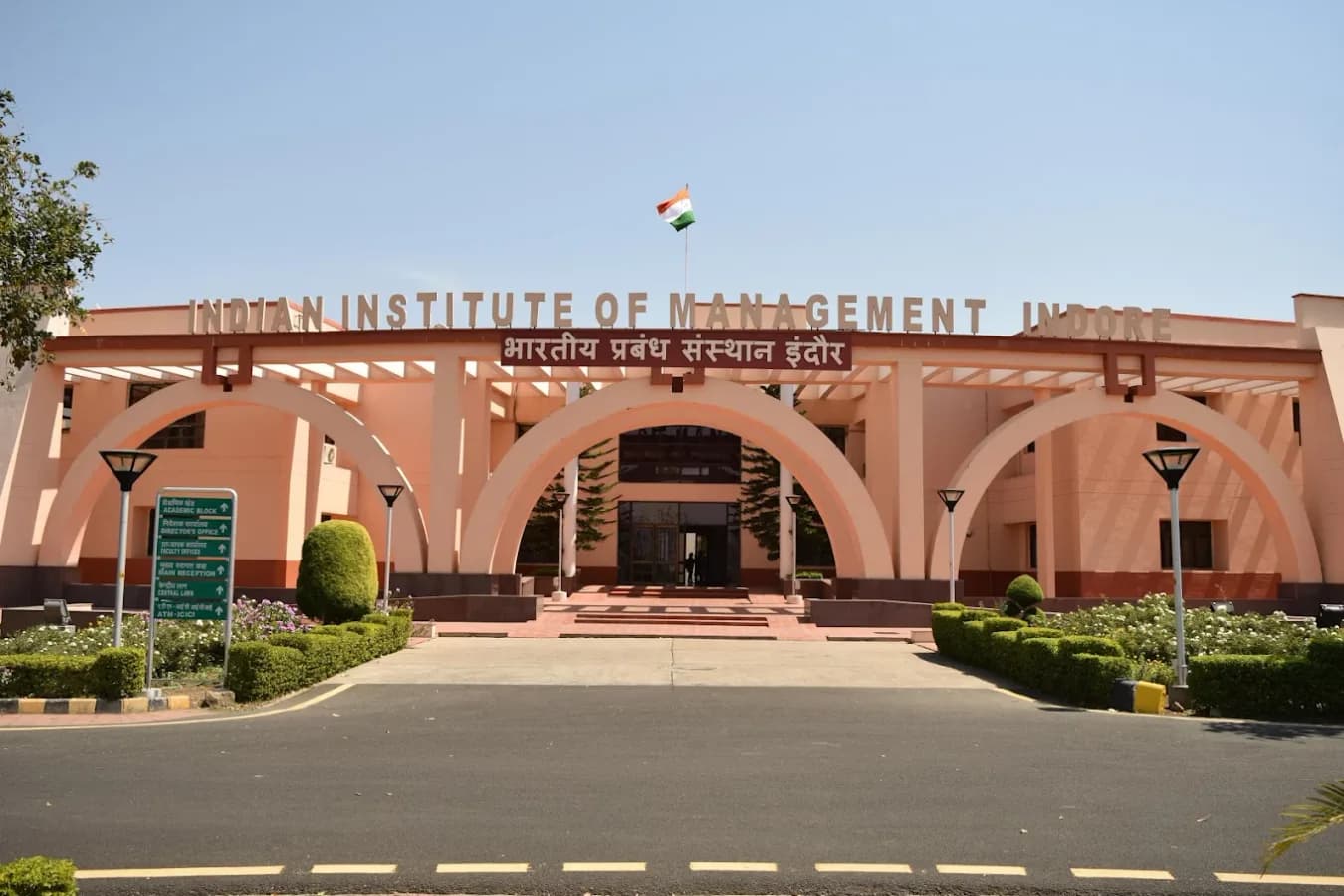

An Institution of Excellence With the objectives of imparting high-quality management education and training, the Department of Higher Education, Ministry of Education, Government of India, established the Indian Institute of Management Indore as an institution of excellence. These institutions are recognized as premier management institutions, comparable to the best in the world for teaching, research, and interaction with industries. Established in 1996, the Indian Institute of Management Indore (IIM Indore) has been a leader in the field of management education, interfacing with the industry, government, and PSUs. It is promoted and nurtured by the Ministry of Education, Government of India, and is an institute of national importance under the Indian Institutes of Management Act 2017. Situated atop a scenic hillock, the 193-acre campus of IIM Indore provides an ideal backdrop for contemplative learning. IIM Indore has the latest in teaching aids, rich learning resources, a strong IT backbone, state-of-the-art sports complex and hostels, and contemporary infrastructure.
Total Fees
₹54K - ₹44.8L
Total Courses
17


With an educational trajectory spanning 11 years since its inception in 2015, FACULTY OF MANAGEMENT STUDIES serves as a prominent seat of learning in Rajkot, Gujarat. Affiliated with Marwadi University and adhering to statutory benchmarks established by All India Council for Technical Education (AICTE) / UGC, the institution delivers specialized academic curricula centered on business strategy, financial analytics, corporate governance, and entrepreneurial leadership. Students benefit from contemporary infrastructure featuring management simulation suites, modern boardroom presentation centers, and incubation hubs, designed to support hands-on learning and comprehensive intellectual growth. By combining academic discipline with practical exposure, it equips emerging scholars to meet evolving demands in industry, academia, and public service.
Total Fees
₹75K - ₹2.3L
Total Courses
3
Get More Info About CAT Exam Day Success
Recommended Reading

CAT 2026 Score Calculator: Calculate Your Raw Score Using Correct and Incorrect Answers
Learn how to calculate your CAT 2026 raw score using the official marking scheme. Understand correct answers, negative marking, sectional scores and the difference between raw score, scaled score and percentile.
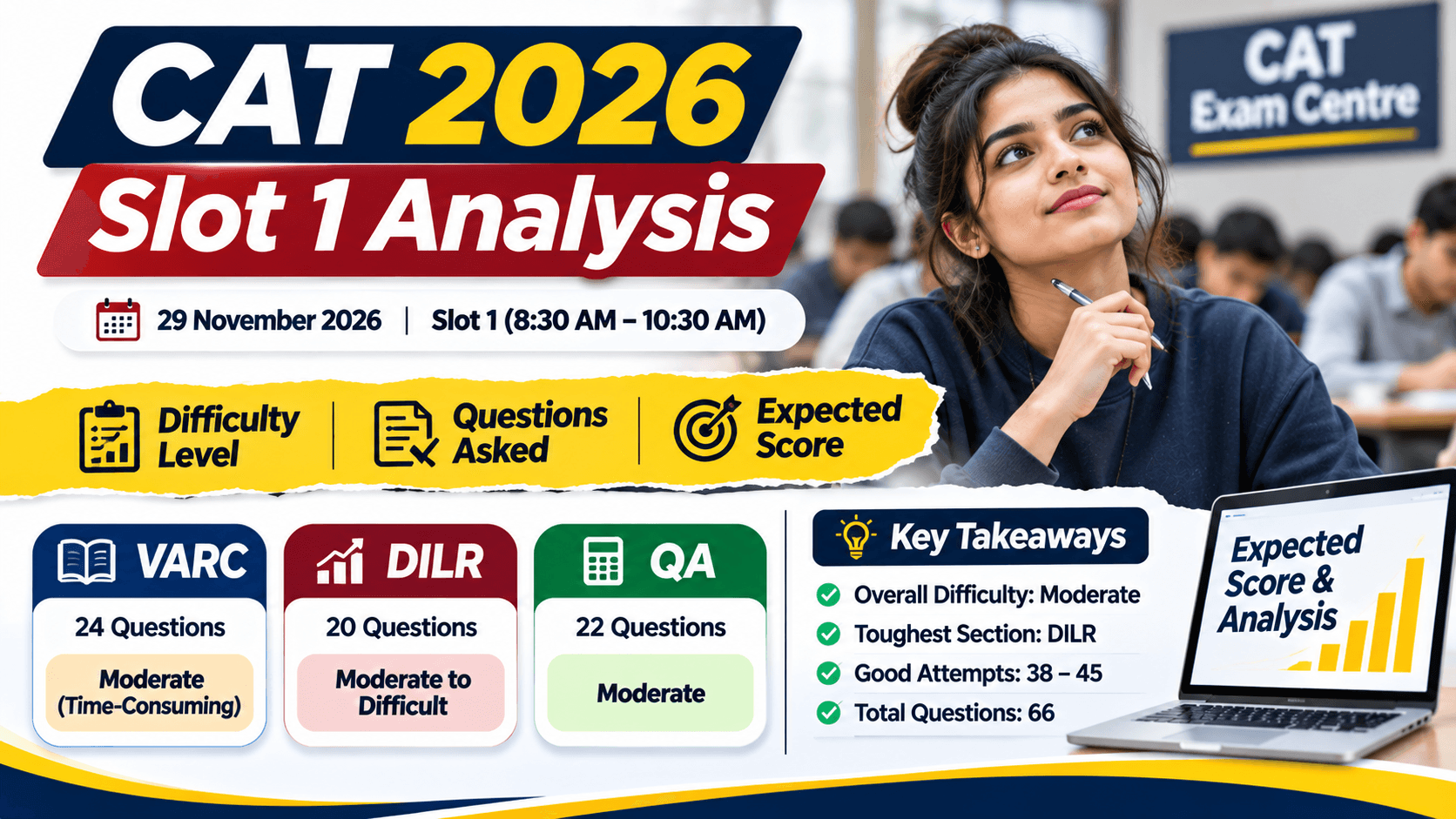
CAT 2026 Slot 1 Analysis: Difficulty Level, Questions Asked and Expected Score
CAT 2026 Slot 1 analysis covering VARC, DILR and QA difficulty, memory-based topics, expected good attempts, score calculation and MBA admission guidance.

CUET Mathematics Syllabus 2027: Master Your Exam Prep with Expert Guidance
Prepare effectively for CUET Mathematics 2027 with our comprehensive guide. Understand the syllabus, exam pattern, and expert strategies to ace your university admissions.