CAT 2026 Score Calculator: Calculate Your Raw Score Using Correct and Incorrect Answers
Admission & Info Tools
Need Expert Assistance?
Our counselors can help you with fee structures, eligibility guidelines, and upcoming admission cutoffs instantly.
Direct Application Tools
Share this Article

After appearing for CAT 2026, one of the first things candidates want to know is their expected score. By checking their responses against the answer key, students can calculate their estimated CAT raw score and understand how many marks they have gained or lost.
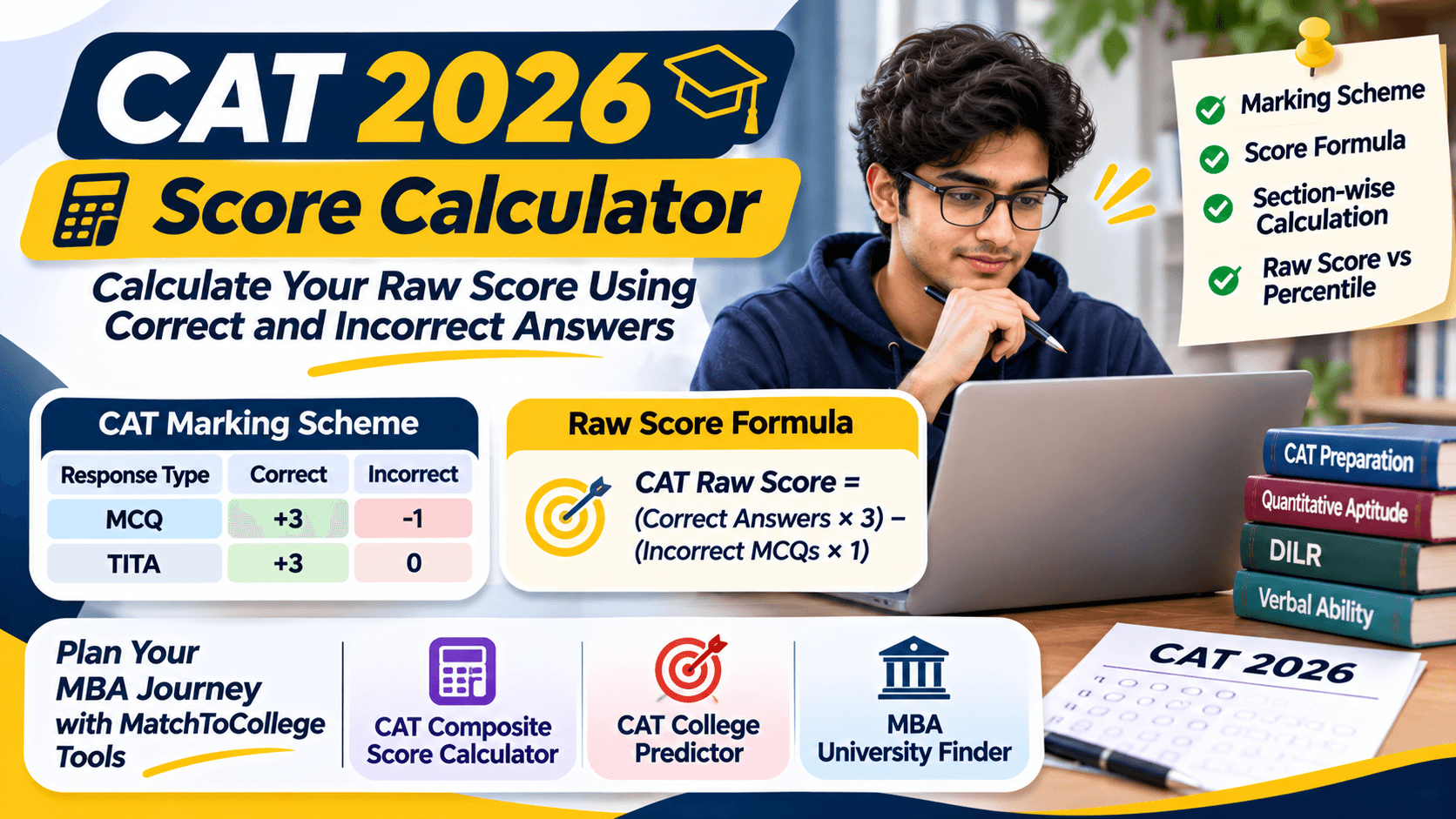
The CAT 2026 Score Calculator approach is based on a simple marking system: +3 marks for every correct answer, -1 mark for every incorrect MCQ and no negative marking for incorrect TITA questions.
In this guide, learn how to calculate your CAT 2026 raw score, understand the marking scheme, calculate section-wise marks and distinguish between raw score, scaled score and percentile.
CAT 2026 Marking Scheme: How Are Marks Awarded?
Before calculating your score, understand how CAT evaluates different question types.
| Response Type | Correct Answer | Incorrect Answer | Unattempted |
| MCQ | +3 | -1 | 0 |
| TITA | +3 | 0 | 0 |
Important points:
- Every correct MCQ or TITA answer earns 3 marks.
- Every incorrect MCQ answer attracts a penalty of 1 mark.
- Incorrect TITA answers do not attract negative marking.
- Unattempted questions receive zero marks.
This means candidates must count correct answers and incorrect MCQs separately. Simply multiplying the number of attempts by three will not give an accurate raw score.
CAT 2026 Raw Score Calculation Formula
The formula for calculating your CAT raw score is:
CAT Raw Score = (Correct Answers × 3) − (Incorrect MCQs × 1)
Where:
- Correct Answers = Total correct MCQ and TITA responses.
- Incorrect MCQs = Total incorrect multiple-choice responses.
- Incorrect TITA responses are not deducted from the score.
Example 1: Calculate CAT Score Using Correct and Incorrect Answers
Suppose a candidate has the following response details:
| Response | Number of Questions |
| Correct answers | 40 |
| Incorrect MCQ answers | 10 |
| Incorrect TITA answers | 3 |
| Unattempted questions | 15 |
Calculation:
Marks from correct answers = 40 × 3 = 120
Negative marks from incorrect MCQs = 10 × 1 = 10
Incorrect TITA penalty = 0
Final Raw Score = 120 − 10 = 110 marks
The candidate's estimated CAT raw score is 110 marks.
Example 2: CAT Score With Fewer Correct Answers
Suppose another candidate has:
- 30 correct answers
- 12 incorrect MCQs
- 5 incorrect TITA answers
Calculation:
(30 × 3) − (12 × 1) = 90 − 12
Final Raw Score = 78 marks
Even though the candidate attempted more than 40 questions, the final score depends on the number of correct and incorrect responses.
CAT 2026 Section-Wise Score Calculation
Candidates should calculate their scores separately for VARC, DILR and QA before adding them to obtain the overall raw score.
| Section | What to Count |
| VARC | Correct answers and incorrect MCQs |
| DILR | Correct answers and incorrect MCQs |
| QA | Correct answers and incorrect MCQs |
Use the same formula for each section:
Sectional Raw Score = (Correct Answers × 3) − Incorrect MCQs
Illustrative Section-Wise Score Calculation
| Section MCQs | Correct Answers | Incorrect | Raw Score |
| VARC | 14 | 4 | 38 |
| DILR | 10 | 3 | 27 |
| QA | 12 | 5 | 31 |
| Total | 36 | 12 | 96 |
The candidate's estimated overall raw score is 96 marks.
Section-wise calculation is important because IIMs and other management institutes may consider sectional performance along with the overall CAT score.
How to Calculate Your CAT 2026 Score Using the Answer Key
Once the provisional response sheet and answer key are available, follow these steps:
Step 1: Download your response sheet
Visit the official CAT website at https://iimcat.ac.in and access your candidate response sheet when released.
Step 2: Open the provisional answer key
Use the answer key to identify the correct responses for each question.
Step 3: Match your responses
Compare the answers marked in your response sheet with the provisional answer key.
Step 4: Count correct and incorrect answers
Maintain separate counts for:
- Correct MCQ answers
- Incorrect MCQ answers
- Correct TITA answers
- Incorrect TITA answers
- Unattempted questions
Step 5: Calculate sectional raw scores
Apply the formula separately to VARC, DILR and QA.
Step 6: Calculate your overall raw score
Add the three sectional scores to get your estimated CAT raw score.
Candidates should recheck their calculations after the final answer key, especially if any provisional answers are revised following objections.
CAT Raw Score vs Scaled Score vs Percentile
Many candidates confuse raw scores, scaled scores and percentiles. These are three different measures of CAT performance.
| Parameter | Meaning |
| Raw Score | Marks calculated directly using correct and incorrect responses |
| Scaled Score | Score adjusted through the CAT normalisation process |
| Percentile | Relative position of a candidate compared with other test-takers |
1. What Is CAT Raw Score?
Raw score is the direct score calculated using the official marking scheme. It does not account for differences in difficulty between examination slots.
2. What Is CAT Scaled Score?
CAT is conducted in multiple examination slots. The normalisation process adjusts scores to account for differences in the difficulty and score distribution across sessions.
The final scaled score may therefore differ from the raw score.
3. What Is CAT Percentile?
Percentile indicates how a candidate performed relative to other test-takers.
For example, a 95 percentile broadly means that the candidate performed at or above the level of approximately 95% of the test-takers, subject to the official percentile calculation and tie-handling rules.
Remember: Your raw score is not your final percentile. The official result uses scaled scores and the overall performance of candidates.
What Should You Do After Calculating Your CAT 2026 Raw Score?
Calculating your raw score is the first step. The next step is understanding what your performance could mean for MBA admissions.
1. Evaluate Your IIM Shortlisting Profile
CAT percentile is not the only factor considered by IIMs. Academic marks, work experience, diversity and institute-specific selection criteria can also influence interview shortlisting.
Use the MatchToCollege CAT Composite Score Calculator to evaluate your IIM shortlisting profile using CAT performance, Class 10, Class 12, graduation marks, work experience and applicable diversity parameters.
The tool helps you understand how your academic and professional profile may contribute to an institute's composite score. Remember that the composite score is different from your CAT raw score.
2. Explore Potential MBA Colleges
Once you have a reasonable estimate of your CAT percentile, start identifying colleges that match your performance and profile.
The MatchToCollege CAT College Predictor can help you explore potential MBA college options based on your expected CAT performance.
Use the results as an initial shortlist, not as a guarantee of an interview call or admission.
3. Compare MBA Universities and Programmes
Your admission decision should also consider programme fees, placements, specialisations, accreditation, location and career opportunities.
Explore the MatchToCollege MBA University Finder to discover MBA universities and management programmes.
4. Explore More CAT and MBA Resources
Students can also explore the MatchToCollege Tools Directory for additional college discovery, admission planning and student-focused calculators.
Using these resources together can help you move from score calculation to a more structured MBA admission plan.
Common Mistakes to Avoid While Calculating CAT Scores
Candidates sometimes make mistakes while calculating their expected marks. Avoid these common errors:
- Deducting marks for incorrect TITA answers: There is no negative marking for incorrect TITA responses.
- Ignoring negative marking in MCQs: Every incorrect MCQ costs one mark.
- Counting only attempted questions: Attempt count alone does not determine your score.
- Mixing sectional scores: Calculate each section separately before adding the total.
- Confusing raw score with percentile: Raw marks cannot directly establish your final percentile.
- Using an outdated answer key: Recalculate your score if the final answer key changes any response.
Frequently Asked Questions
How is the CAT 2026 raw score calculated?
What is the formula for calculating CAT 2026 scores?
Is there negative marking for TITA questions in CAT 2026?
How many marks are deducted for a wrong MCQ in CAT 2026?
How can I calculate my IIM composite score after CAT?
Get More Info About CAT 2026 Score Calculator
Free MBA Decision Tools
Plan your management admissions with MatchToCollege's AI predictors and comparison engines.
Recommended MBA Articles
CAT 2026 Slot 1 Analysis: Difficulty Level, Questions Asked and Expected Score
Nov 29, 2026
Best MBA College Predictor Tools in India 2027: Compare Features and Accuracy
Nov 28, 2026