

Research Funding: Key to UG/PG Student Success
Admission & Info Tools
Need Expert Assistance?
Our counselors can help you with fee structures, eligibility guidelines, and upcoming admission cutoffs instantly.
Direct Application Tools
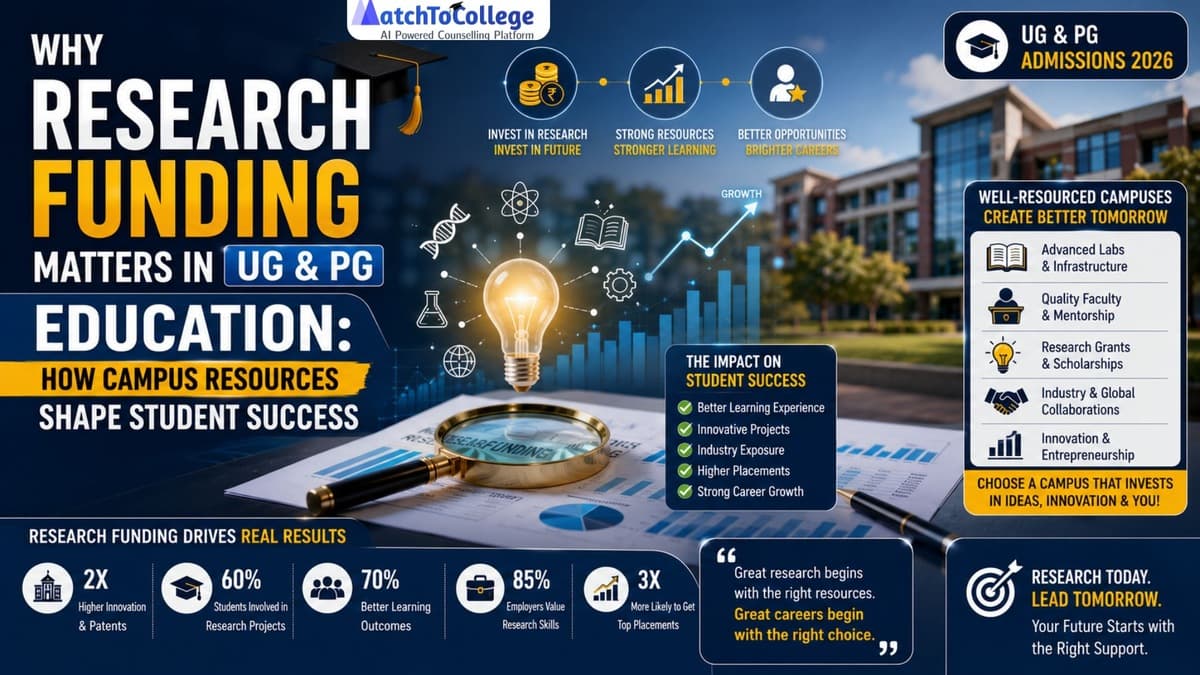
Research funding: shaping future success
Choosing a university isn't just about rankings or campus life. One of the most important factors to consider is research funding and campus resources. Universities with strong research investments provide students with better learning opportunities, advanced facilities, expert mentorship, and real-world experience.
Whether you're pursuing UG, PG, MBA, Engineering, Medical, or Study Abroad programs, access to research can strengthen your academic journey and improve your career prospects.
How Research Funding Benefits Students
| Benefit | How It Helps |
| Hands-on learning | Work on real-world projects and apply classroom knowledge. |
| Advanced facilities | Access modern laboratories, research centers, and the latest technology. |
| Faculty mentorship | Learn from experienced researchers and industry experts. |
| Innovation & skill development | Build critical thinking, problem-solving, and research skills. |
| Career readiness | Gain practical experience valued by employers and higher education institutions. |
| Better opportunities | Improve chances for internships, higher studies, publications, and global careers. |
How MatchToCollege Helps
MatchToCollege's AI-powered platform helps students identify universities with strong research opportunities, academic resources, faculty expertise, funding, and career outcomes. By matching your academic profile and career goals with the right institutions, MatchToCollege helps you choose a university that supports both your education and long-term success.
A university with strong research funding doesn't just invest in innovation—it invests in your future.
Direct Impact: Experiential Learning & Skill Development
Strong research funding directly benefits students by creating real opportunities to learn beyond the classroom. It enables paid research assistantships, project stipends, and travel grants for conferences, allowing students—even at the undergraduate level—to take part in real research work with experienced faculty on important global issues.
Key Skills Developed Through Research Opportunities
| Skill Area | What Students Learn |
| Critical Thinking & Problem-Solving | Improve analysis skills by working on complex research questions and finding solutions |
| Data Analysis & Interpretation | Handle real data using software tools and draw meaningful conclusions |
| Laboratory & Fieldwork Skills | Gain hands-on experience with modern equipment and research methods |
| Communication & Presentation | Develop ability to write reports, present findings, and publish research work |
These experiences go beyond textbooks and help students understand their subjects more deeply. They also prepare students for higher studies and professional careers. In addition, guidance from faculty mentors in funded projects helps students become more confident, independent, and innovative thinkers.
Elevating Campus Resources & Faculty Expertise
Universities with strong research funding can build advanced campus resources such as modern laboratories, high-performance computing facilities, specialized libraries, and access to research tools and databases. These facilities improve the learning experience for students by providing practical exposure beyond traditional classroom teaching.
How Research Resources Benefit Students
| Resource/Factor | Student Benefit |
| Advanced Laboratories & Facilities | Gain practical experience using modern equipment and technologies |
| Computing Tools & Databases | Learn with industry-relevant software and research resources |
| Research-Oriented Faculty | Learn from professors involved in current innovations and discoveries |
| Interdisciplinary Environment | Explore different fields and develop broader perspectives |
Research-focused universities attract highly qualified faculty who bring real-world research insights, new discoveries, and industry trends into the classroom. This creates an environment that encourages curiosity, innovation, and deeper learning.
Whether engineering students work in advanced labs or medical students participate in clinical research, strong research resources play a key role in building practical skills and preparing students for future careers.
The Long-Term Advantage: Career & Academic Advancement
Participating in funded research during UG or PG studies gives students a strong advantage for both higher education and careers. A research portfolio with projects, publications, or presentations shows curiosity, skills, and readiness for advanced academic challenges.
Benefits of Funded Research Experience
| Area | Benefit |
| Higher Studies | Strengthens applications for Master's, Ph.D., and professional programs by showcasing research ability |
| Career Growth | Helps graduates stand out with practical experience along with academic knowledge |
| Job Opportunities | Creates better career prospects in fields like technology, healthcare, science, and consulting |
| Professional Development | Builds networks with faculty, researchers, and industry experts for future opportunities |
Research experience helps students develop a balance of theoretical understanding and practical skills, which can lead to better job roles, faster career growth, and stronger professional connections.
MatchToCollege helps students find institutions that provide quality education along with strong research opportunities and resources to support long-term success.
Share this Article
FAQFrequently Asked Questions
Q: How can I find out about a university's research funding and opportunities?
Prospective students should explore the university's official website, specifically sections on research, faculty profiles, and student opportunities. Look for annual reports, press releases on grant awards, and departmental research pages. Websites like the National Science Foundation (NSF) or National Institutes of Health (NIH) list funded projects, often indicating participating institutions. MatchToCollege can also provide insights into institutions strong in research.
Q: Does research funding only benefit students in STEM fields?
Absolutely not. While STEM fields often have visible lab-based research, funding supports a wide array of disciplines. Humanities, social sciences, arts, and business programs also benefit from grants for fieldwork, archival research, data collection, digital humanities projects, economic modeling, and creative endeavors. A strong research culture, fueled by funding, elevates the intellectual environment for all students, fostering interdisciplinary projects and critical thinking across the board.
Get More Info About Research Funding
Recommended Reading

Best Online MBA Specializations for High-Paying Careers 2026
Discover the most lucrative online MBA specializations for 2026-27. Compare ROI, career growth, and use our AI tools to find your perfect management path.

Top Career Opportunities After an Online MBA in 2026-27
Discover high-paying career paths and roles after an online MBA in 2026-27. Explore salary trends, ROI, and tools to navigate your future professional success.

Tax Deductions on Higher Education: 2026-27 India Guide
Maximize your savings with our guide on tax deductions for higher education fees in India for FY 2026-27. Learn about Section 80C, 80E, and upskilling benefits.