

Top Programming Languages Every UG Student Must Learn
Admission & Info Tools
Need Expert Assistance?
Our counselors can help you with fee structures, eligibility guidelines, and upcoming admission cutoffs instantly.
Direct Application Tools
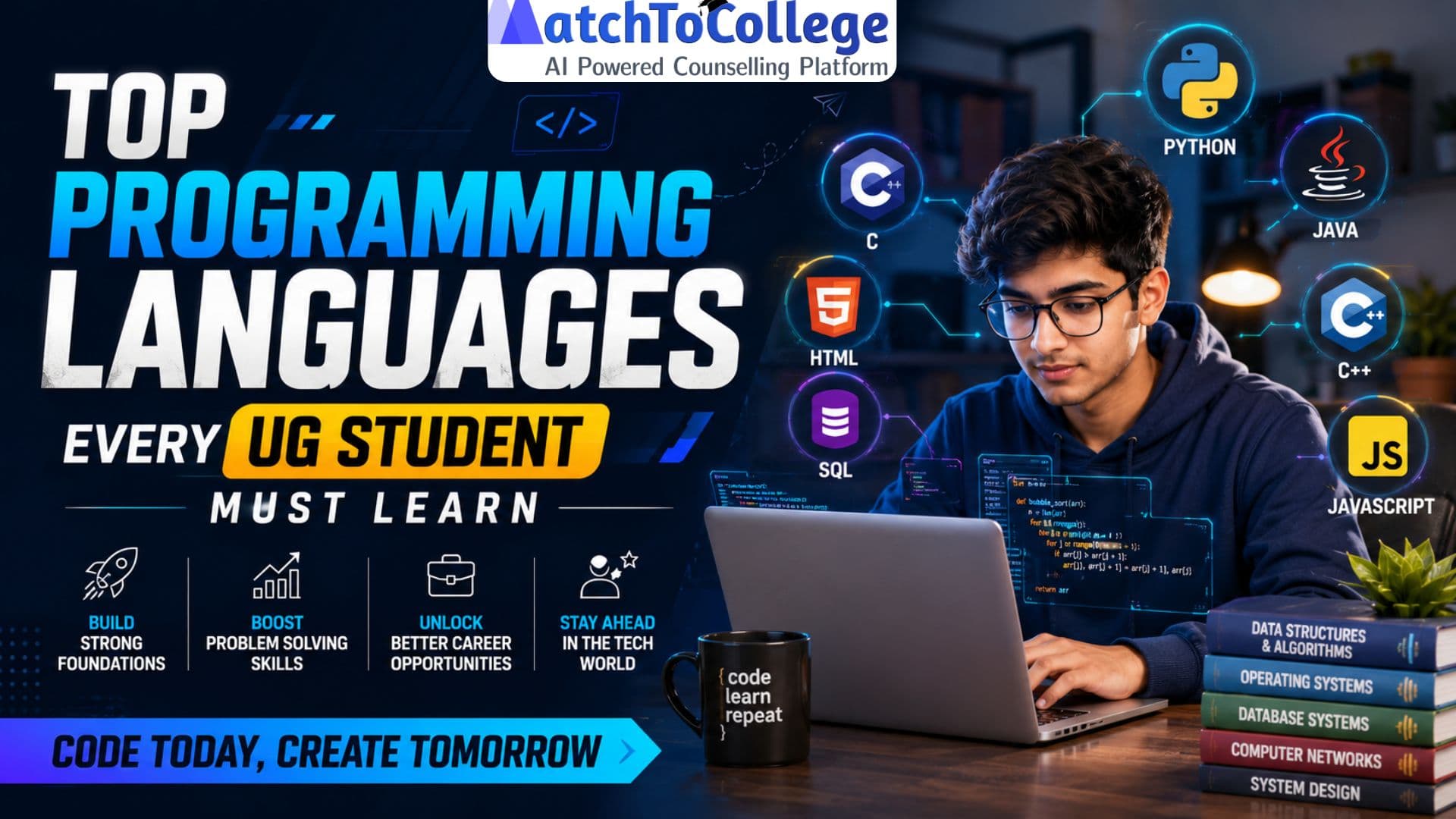
Master Coding Skills for Success
In today's technology-driven world, programming skills are valuable across industries, from software development and data science to finance, engineering, and artificial intelligence. For undergraduate (UG) students, learning the right programming languages can strengthen technical expertise, improve employability, and open doors to a wide range of career opportunities.
With numerous programming languages available, it's important to focus on those that are versatile, widely used, and relevant to future industry demands. Building proficiency in these languages can help you develop a strong foundation for both higher education and professional success.
Top Programming Languages for UG Students
| Programming Language | Primary Use Cases | Why Learn It? |
| Python | Data Science, AI, Machine Learning, Automation, Web Development | Easy to learn, versatile, and highly in demand |
| Java | Enterprise Applications, Android Development, Backend Systems | Widely used in large organizations and software systems |
| JavaScript | Web Development, Frontend and Full-Stack Applications | Essential for creating interactive websites and web applications |
| C++ | Competitive Programming, System Software, Game Development | Strong foundation in algorithms and data structures |
| SQL | Database Management, Data Analysis | Critical for working with data and business applications |
| C | Operating Systems, Embedded Systems, Core Programming Concepts | Builds a deep understanding of programming fundamentals |
Choosing a Language Based on Career Goals
| Career Path | Recommended Languages |
| Artificial Intelligence & Machine Learning | Python, SQL |
| Data Science & Analytics | Python, SQL |
| Web Development | JavaScript, Python, SQL |
| Software Engineering | Java, Python, C++ |
| Cybersecurity | Python, C, SQL |
| Mobile App Development | Java, JavaScript |
| Embedded Systems & IoT | C, C++ |
| Competitive Programming | C++, Python |
Key Skills Developed Through Programming
| Skill | Benefit |
| Problem-Solving | Improves analytical and logical thinking |
| Algorithm Design | Enhances efficiency in coding and software development |
| Data Handling | Supports data-driven decision-making |
| Automation | Increases productivity and reduces manual effort |
| Software Development | Builds practical technical expertise |
Tips for UG Students
| Recommendation | Purpose |
| Start with Python or C | Build a strong programming foundation |
| Learn Data Structures and Algorithms | Improve coding and problem-solving skills |
| Work on Real Projects | Gain practical experience |
| Participate in Coding Competitions | Enhance logical thinking and coding speed |
| Build a Portfolio | Showcase skills to employers and universities |
| Contribute to Open-Source Projects | Develop industry-relevant experience |
How MatchToCollege Can Help
MatchToCollege helps students identify the skills, courses, and career pathways that align with their interests and aspirations. Our AI-powered platform provides personalized guidance on:
| Feature | Benefit |
| Career Exploration | Discover technology-focused career opportunities |
| Course Recommendations | Identify relevant academic programs |
| Skill Development Guidance | Learn in-demand technical skills |
| College Matching | Find institutions aligned with your goals |
| Future Career Insights | Stay informed about emerging industry trends |
Programming is one of the most valuable skills a UG student can acquire. Languages such as Python, Java, JavaScript, C++, SQL, and C provide a strong foundation for careers in technology, data science, software engineering, cybersecurity, and beyond. By learning these languages early and applying them through projects and practical experience, students can significantly enhance their academic performance, career readiness, and long-term professional growth.
1. Python: The King of Versatility
Why learn Python? Python's readability and simplicity make it an ideal first language for beginners, yet its power extends to complex applications. It's incredibly versatile and widely adopted across various domains.
- Artificial Intelligence & Machine Learning: Python is the language of choice for AI and ML development, with powerful libraries like TensorFlow, Keras, and scikit-learn.
- Data Science & Analytics: Libraries such as Pandas, NumPy, and Matplotlib make Python indispensable for data manipulation, analysis, and visualization.
- Web Development: Frameworks like Django and Flask enable rapid development of robust web applications.
- Automation & Scripting: Its simplicity makes it perfect for automating repetitive tasks.
MatchToCollege Insight: Many top engineering and computer science programs now use Python for introductory courses, underscoring its foundational importance.
2. Java: The Enterprise Workhorse
Why learn Java? Java is an object-oriented, class-based, concurrent, secured, and high-performance language. It's known for its 'write once, run anywhere' capability and extensive use in large-scale systems.
- Enterprise Applications: Java forms the backbone of countless enterprise-level applications, thanks to its scalability and robustness.
- Android App Development: It's the primary language for native Android application development, dominating the mobile ecosystem.
- Big Data: Frameworks like Hadoop are built on Java, making it essential for processing vast datasets.
- Web Servers & Application Servers: Technologies like Apache Tomcat rely heavily on Java.
MatchToCollege Insight: A strong grasp of Java can significantly improve your chances for internships and jobs in major tech corporations and financial institutions.
3. C/C++: For Performance and System-Level Mastery
Why learn C/C++? While often perceived as more challenging, C and C++ are fundamental for understanding how software interacts with hardware. They offer unparalleled performance and control.
- System Programming: Used for developing operating systems, embedded systems, and compilers.
- Game Development: Dominates the gaming industry, especially for high-performance engines and complex graphics.
- High-Performance Computing: Essential in areas requiring speed and efficiency, such as scientific simulations and real-time systems.
- Data Structures & Algorithms: Learning C++ is often recommended for a deep understanding of core computer science concepts.
MatchToCollege Insight: Excelling in C/C++ demonstrates a strong foundational understanding of computer science, highly valued by top-tier engineering programs and employers in specialized tech fields like cybersecurity.
4. JavaScript: The Language of the Web
Why learn JavaScript? JavaScript is the undisputed king of web development. It allows for interactive and dynamic content on websites and has expanded far beyond the browser.
- Front-end Web Development: Powers the interactive elements of virtually every website you visit.
- Back-end Development (Node.js): With Node.js, JavaScript can be used to build scalable server-side applications, making it a full-stack language.
- Mobile App Development: Frameworks like React Native and Ionic enable cross-platform mobile app creation.
- Desktop Applications: Electron allows building desktop apps using web technologies.
MatchToCollege Insight: Proficiency in JavaScript is a critical asset for aspiring software engineers, especially those interested in web development and user experience design. It's an evergreen skill in high demand.
5. SQL: Database Management Essential
Why learn SQL? While not a general-purpose programming language, Structured Query Language (SQL) is crucial for interacting with databases, which are at the heart of nearly all modern applications.
- Data Management: Essential for querying, updating, and managing relational databases like MySQL, PostgreSQL, and SQL Server.
- Data Analysis: Data analysts and scientists use SQL extensively to extract and prepare data for further analysis.
- Backend Development: Developers use SQL to store and retrieve data for web and mobile applications.
MatchToCollege Insight: No matter your primary programming language, a solid understanding of SQL is a non-negotiable skill for any tech-oriented career. It complements other languages perfectly.
Choosing Your Path & How MatchToCollege Helps
Deciding which programming languages to focus on can depend heavily on your career aspirations. Are you passionate about AI, mobile apps, web design, or system architecture? While it's beneficial to have exposure to several, mastering one or two deepens your problem-solving abilities and makes you highly valuable.
MatchToCollege empowers you to make informed decisions about your higher education and career. Our AI-powered platform provides personalized guidance, helping you identify top colleges and courses that align with your programming interests and career goals. We connect your skill development with real-world opportunities, ensuring your academic choices pave the way for a successful and fulfilling career in technology. Start building your future today with the right programming skills and expert guidance from MatchToCollege.
Share this Article
FAQFrequently Asked Questions
Q: Which programming language is best for beginners?
Python is widely considered the best programming language for beginners due to its simple syntax, strong readability, and vast community support. It allows new learners to grasp core programming concepts quickly without getting bogged down by complex structures.
Q: How many programming languages should an undergraduate student learn?
While there's no magic number, it's more beneficial to master 1-2 core languages deeply rather than superficially learning many. Focus on one that aligns with your primary interest (e.g., Python for AI, Java for enterprise, JavaScript for web) and then gradually expand your skill set with complementary languages like SQL or a system-level language like C++.
Q: Are these languages relevant for non-computer science majors?
Absolutely! Programming skills, especially in languages like Python (for data analysis) and SQL (for database management), are increasingly valuable for students in diverse fields such as finance, engineering, science, and even humanities. The ability to code enhances problem-solving and data interpretation across various disciplines.
Get More Info About Top Programming Languages Every UG Student Must Learn
Recommended Reading

Best Online MBA Specializations for High-Paying Careers 2026
Discover the most lucrative online MBA specializations for 2026-27. Compare ROI, career growth, and use our AI tools to find your perfect management path.

Top Career Opportunities After an Online MBA in 2026-27
Discover high-paying career paths and roles after an online MBA in 2026-27. Explore salary trends, ROI, and tools to navigate your future professional success.

Tax Deductions on Higher Education: 2026-27 India Guide
Maximize your savings with our guide on tax deductions for higher education fees in India for FY 2026-27. Learn about Section 80C, 80E, and upskilling benefits.