

Study in Russia vs China 2026: Your Guide to Choosing Better
Admission & Info Tools
Need Expert Assistance?
Our counselors can help you with fee structures, eligibility guidelines, and upcoming admission cutoffs instantly.
Direct Application Tools
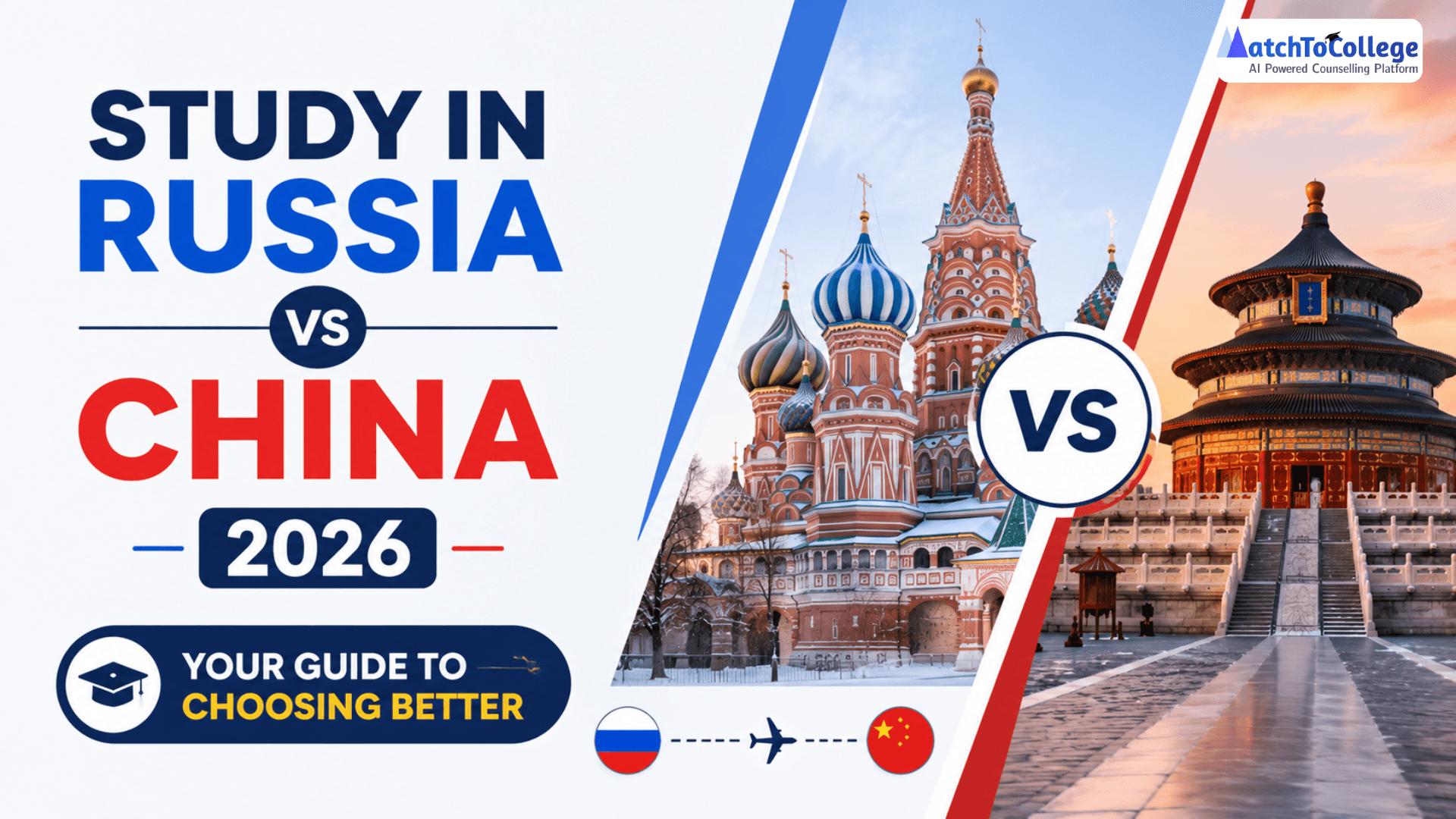
Study in Russia vs China 2026
As the global education landscape continues to evolve, Russia and China stand out as two formidable powerhouses attracting millions of international students. Both nations offer unique academic strengths, cultural experiences, and career opportunities, making the decision between them a significant one for aspiring students and their families. Choosing the right destination for your higher education journey in 2026 requires careful consideration of various factors, from academic programs and living costs to cultural immersion and post-study prospects.
This comprehensive guide from MatchToCollege aims to demystify the complexities involved in comparing study abroad options in Russia versus China. We understand that every student's ambition is unique, whether you're eyeing a challenging Engineering degree, a world-class Medical program, an MBA, or specialized research opportunities. Our goal is to provide you with an authoritative, data-driven comparison, highlighting the distinct advantages and potential challenges of each country. By dissecting key aspects like university rankings, scholarship availability, student life, and career trajectories, we empower you to make an informed decision that aligns perfectly with your academic goals and personal aspirations. Let MatchToCollege, your AI-powered higher education counselling platform, be your trusted partner in navigating this exciting journey towards a brighter future.
Academic Excellence & Program Variety
Both Russia and China boast a robust higher education system with globally recognized universities. Russia is particularly renowned for its excellence in STEM fields, especially Engineering, Physics, Mathematics, and Medical programs. Universities like Lomonosov Moscow State University and Saint Petersburg State University consistently rank high globally, offering extensive English-taught courses, particularly in specialized fields. The country also provides strong theoretical foundations and research opportunities.
China, on the other hand, has rapidly ascended in global university rankings, excelling in areas like Technology, Artificial Intelligence, Business, and Traditional Chinese Medicine. Institutions such as Tsinghua University, Peking University, and Fudan University are world leaders in innovation and research, backed by significant government investment. While many programs are taught in Mandarin, the availability of English-medium programs, especially at the postgraduate level, is steadily increasing. Students seeking cutting-edge research and tech-focused degrees often find China an attractive destination for their international education.
Cost of Education & Living: An Investment Comparison
One of the most critical factors for international students and parents is the financial commitment. Generally, studying in Russia tends to be more affordable in terms of tuition fees compared to many Western countries, and often slightly less than in China for comparable programs. Annual tuition fees can range from $2,000 to $6,000 for bachelor's degrees and slightly higher for specialized medical or postgraduate programs. The cost of living in major Russian cities like Moscow and St. Petersburg can be moderate, but generally lower in smaller cities.
China also offers competitive tuition fees, typically ranging from $2,500 to $8,000 per year, though elite universities and specific programs can be more expensive. However, China provides a vast array of scholarships, most notably the Chinese Government Scholarship (CGS), which can cover tuition, accommodation, and provide a living stipend. Russia also offers government scholarships for international students, though perhaps fewer in sheer volume. The cost of living in China varies significantly; major cities like Shanghai and Beijing are comparable to or slightly higher than major Russian cities, while smaller cities offer a much lower cost of living. Both countries present excellent opportunities for scholarships for international students.
Culture, Language & Student Life
Studying abroad is not just about academics; it's about cultural immersion. Russia offers a rich historical and artistic heritage, with a vibrant student life deeply rooted in traditions. Learning the Russian language can significantly enhance the experience, though English is becoming more common in university settings. International students often find the local hospitality warm, especially outside the biggest cities, and enjoy exploring its vast landscapes, arts, and winter sports. However, the initial language barrier might be a challenge.
China presents a dynamic blend of ancient traditions and rapid modernization. Its culture is profoundly different from Western norms, offering a truly unique experience. Students can explore diverse regional cuisines, ancient sites, and bustling modern cities. While Mandarin is the official language, major cities and university campuses often have a higher prevalence of English speakers. Integrating into Chinese society might require an open mind and patience with cultural differences. Both countries offer distinct cultural adventures, promising a transformative experience for global education seekers.
Visa, Admission & Post-Study Prospects
The career opportunities after graduation depend largely on your chosen field and language proficiency. In Russia, graduates in Engineering, IT, and Medical fields are in demand, particularly within the country and in former Soviet bloc nations. Opportunities in international companies operating in Russia also exist, especially for those proficient in Russian. Post-study work visa regulations can vary, and it's essential to research specific requirements for your field and nationality.
China offers increasingly attractive career prospects, especially for graduates in technology, business, and finance, given its booming economy and global influence. Companies across Asia and worldwide value degrees from top Chinese universities. The Chinese government has also made efforts to retain international talent, with evolving policies for post-study work permits. Proficiency in Mandarin can significantly boost employability in both local and multinational companies within China. For those interested in a global career, a degree from either nation can open doors, but understanding the local job market and visa policies is key.
Making Your Informed Choice with MatchToCollege
Navigating the admission process for higher education in Russia or China can be complex, involving numerous documents, language proficiency tests (like TORFL for Russian or HSK for Mandarin, alongside IELTS/TOEFL for English programs), and strict deadlines. Typically, applications open months in advance, requiring prospective students to meticulously prepare academic transcripts, recommendation letters, essays, and visa applications.
This is where MatchToCollege shines. Our AI-powered platform simplifies this intricate process by offering personalized guidance. Based on your academic profile, career aspirations (e.g., MBA, Engineering, Medical), and budget, MatchToCollege can recommend the best universities and programs in both Russia and China. We provide expert advice on scholarship opportunities, application requirements, and visa procedures, ensuring you have all the information needed to make an informed decision. Let our technology and experienced counsellors guide you to your ideal study abroad destination in 2026, making your dream of international education a reality.
Share this Article
FAQFrequently Asked Questions
Q: Is studying in Russia or China cheaper for international students?
Generally, Russia tends to be slightly more affordable in terms of tuition fees and overall living costs compared to China, especially outside of major metropolitan areas. However, China offers a greater number of comprehensive scholarships, such as the Chinese Government Scholarship, which can significantly reduce the financial burden for international students. The final cost depends heavily on the university, program, city, and scholarship eligibility.
Q: Which country offers better career opportunities after graduation, Russia or China?
Both countries offer distinct career opportunities. Russia is strong for careers in STEM fields (Engineering, Medicine) within Russia and neighboring regions. China, with its booming economy, offers excellent prospects in technology, business, AI, and finance, particularly for those proficient in Mandarin. The 'better' option depends on your specific field of study, career goals, and willingness to learn the local language. MatchToCollege can help assess which aligns best with your post-graduation aspirations.
Q: What are the main differences in academic quality between Russian and Chinese universities?
Russian universities are historically strong in theoretical sciences, engineering, and medicine, known for their rigorous academic foundations. Chinese universities, especially the top-tier ones, have rapidly advanced in technology, AI, business, and research, often backed by significant government investment and modern facilities. Both offer high-quality education, but their areas of specialization and pedagogical approaches can differ. Researching specific program rankings and university strengths is crucial.
Get More Info About Study in Russia vs China 2026
Recommended Reading

Best Online MBA Specializations for High-Paying Careers 2026
Discover the most lucrative online MBA specializations for 2026-27. Compare ROI, career growth, and use our AI tools to find your perfect management path.

Top Career Opportunities After an Online MBA in 2026-27
Discover high-paying career paths and roles after an online MBA in 2026-27. Explore salary trends, ROI, and tools to navigate your future professional success.

Tax Deductions on Higher Education: 2026-27 India Guide
Maximize your savings with our guide on tax deductions for higher education fees in India for FY 2026-27. Learn about Section 80C, 80E, and upskilling benefits.