

Scholarship Scams: 3 Red Flags of Fake 'Guaranteed' Offers
Admission & Info Tools
Need Expert Assistance?
Our counselors can help you with fee structures, eligibility guidelines, and upcoming admission cutoffs instantly.
Direct Application Tools
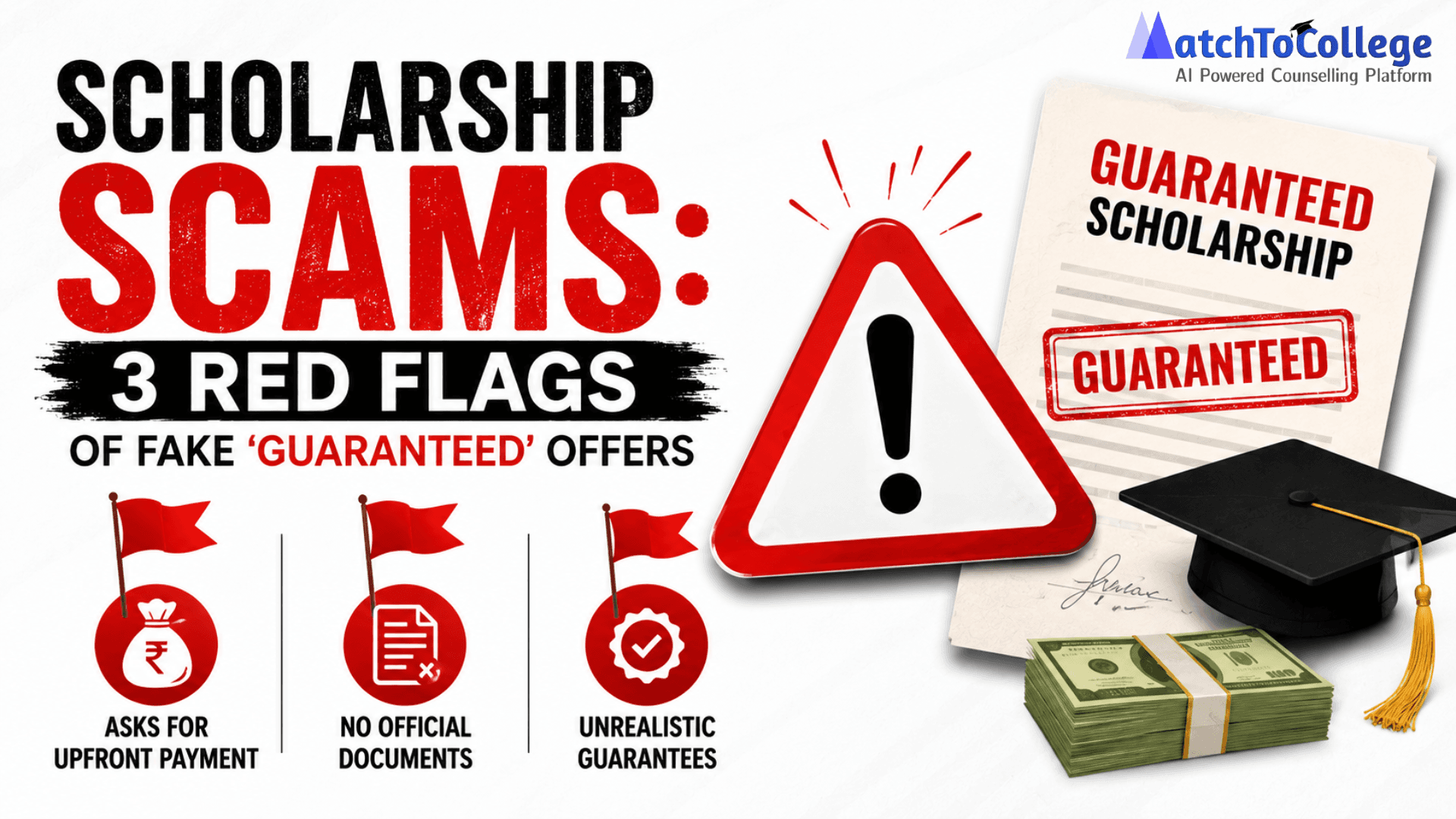
Scholarship Scams
The dream of higher education is often accompanied by the daunting reality of its cost. For millions of students and parents worldwide, scholarships represent a beacon of hope – the chance to pursue an MBA, Engineering, Medical degree, or study abroad without the crushing burden of debt. Unfortunately, where there's hope and financial need, predators often lurk. Scholarship scams are a pervasive and insidious threat, preying on the very aspirations of students desperate for financial aid. These deceptive schemes promise "guaranteed" money, often through unsolicited emails, only to steal your personal information, money, or both.
At MatchToCollege, your trusted AI-powered higher education counseling platform, we believe that navigating the path to your dream university should be empowering, not perilous. Our mission is to provide you with the resources and guidance to make informed decisions, secure legitimate funding, and avoid the pitfalls that can derail your academic journey. Understanding how to differentiate between genuine scholarship opportunities and fraudulent offers is paramount in today's digital landscape. Falling victim to a scholarship scam not only results in financial loss but can also lead to identity theft, costing you far more than just the "application fee."
This comprehensive guide is designed to equip you with critical knowledge. We will expose the most common tactics employed by scholarship scammers and empower you to recognize the tell-tale signs of a fake offer. By the end of this post, you'll be able to confidently identify three major red flags that signal a "guaranteed scholarship" email is nothing more than a dangerous ploy. Protect your future, safeguard your finances, and let MatchToCollege help you find the legitimate pathways to academic success.
Red Flag #1: They Ask for Money Upfront
One of the most iron-clad rules of legitimate scholarships is this: you should never, ever have to pay money to receive a scholarship. Scholarships are designed to provide financial aid, not solicit it. Scammers often disguise their intentions by asking for various "fees" – an application fee, an administrative fee, a processing fee, or even a 'tax' on your 'winnings.' They might claim these small charges are necessary to release your 'guaranteed' funds.
Think about it logically: if someone genuinely wants to give you money to help with your college tuition, why would they demand payment first? Legitimate scholarship providers, foundations, and universities are funded to distribute money to deserving students, not collect it. If an email or website insists on a payment via credit card, wire transfer, or money order before revealing or releasing a scholarship, it's almost certainly a scam. True scholarships have application processes, but these are typically free, or at most, involve a nominal fee as part of a broader university application, which is a different scenario entirely.
Red Flag #2: "Guaranteed" Scholarships or Awards Without Application
Receiving an email that proudly declares, "Congratulations! You've been selected for a $10,000 scholarship!" can feel like a dream come true. However, if you didn't apply for that specific scholarship, it's an immediate, flashing red light. Legitimate scholarship awards are competitive and almost always require a detailed application process, including essays, transcripts, letters of recommendation, and specific eligibility criteria. There are no "guaranteed" scholarships unless you specifically applied for a non-competitive award you already qualified for (which is rare to be unsolicited).
Scammers exploit the natural desire for easy money for higher education. They bank on the excitement overriding critical thinking. If an offer claims you've won or are guaranteed a scholarship that you don't recall applying for, or if the "criteria" for selection seems vague or universal, proceed with extreme caution. These unsolicited offers are classic bait-and-switch tactics, designed to draw you in before demanding personal information or fees. Always verify the source and remember that genuine opportunities require your active participation in an application process.
Red Flag #3: Requests for Highly Sensitive Financial Data
While legitimate financial aid applications like the FAFSA or CSS Profile do require extensive personal and financial information, including Social Security Numbers and income details, there's a clear boundary. Scholarship scammers often push beyond this, demanding bank account numbers, credit card details (including the CVV), or even your PIN, ostensibly to "deposit" your scholarship funds. This is a critical red flag for identity theft and financial fraud.
A legitimate scholarship provider will never ask for your bank account PIN, credit card CVV, or other highly sensitive data that could grant them direct access to your funds. While they might request bank details for direct deposit after you have been officially awarded and verified, this typically happens through secure portals and only after a rigorous, transparent award process. If an email or form asks for such deep-level financial information upfront or in an insecure manner, close it immediately. Protect your identity and financial security by only providing necessary information through verified, secure channels, and only to institutions you trust, like your college's financial aid office or reputable scholarship organizations.
Share this Article
FAQFrequently Asked Questions
Q: How can I find legitimate scholarships?
You can find legitimate scholarships through trusted sources such as your high school guidance counselor, college financial aid offices, reputable scholarship search engines (like Fastweb, College Board, or Scholarships.com), and platforms like MatchToCollege that connect you with verified opportunities. Always check the official websites of organizations and colleges directly.
Q: What should I do if I suspect a scholarship scam?
If you suspect a scholarship scam, do not engage further. Do not click on any links, download attachments, or reply to the email. You should report the scam to the Federal Trade Commission (FTC), your state's Attorney General, and the Federal Student Aid Information Center. Mark the email as spam and block the sender. Protect your personal and financial information diligently.
Get More Info About Scholarship Scams
Recommended Reading

Best Online MBA Specializations for High-Paying Careers 2026
Discover the most lucrative online MBA specializations for 2026-27. Compare ROI, career growth, and use our AI tools to find your perfect management path.

Top Career Opportunities After an Online MBA in 2026-27
Discover high-paying career paths and roles after an online MBA in 2026-27. Explore salary trends, ROI, and tools to navigate your future professional success.

Tax Deductions on Higher Education: 2026-27 India Guide
Maximize your savings with our guide on tax deductions for higher education fees in India for FY 2026-27. Learn about Section 80C, 80E, and upskilling benefits.