

Right Career After 12th: Science, Commerce, Arts Guide
Admission & Info Tools
Need Expert Assistance?
Our counselors can help you with fee structures, eligibility guidelines, and upcoming admission cutoffs instantly.
Direct Application Tools
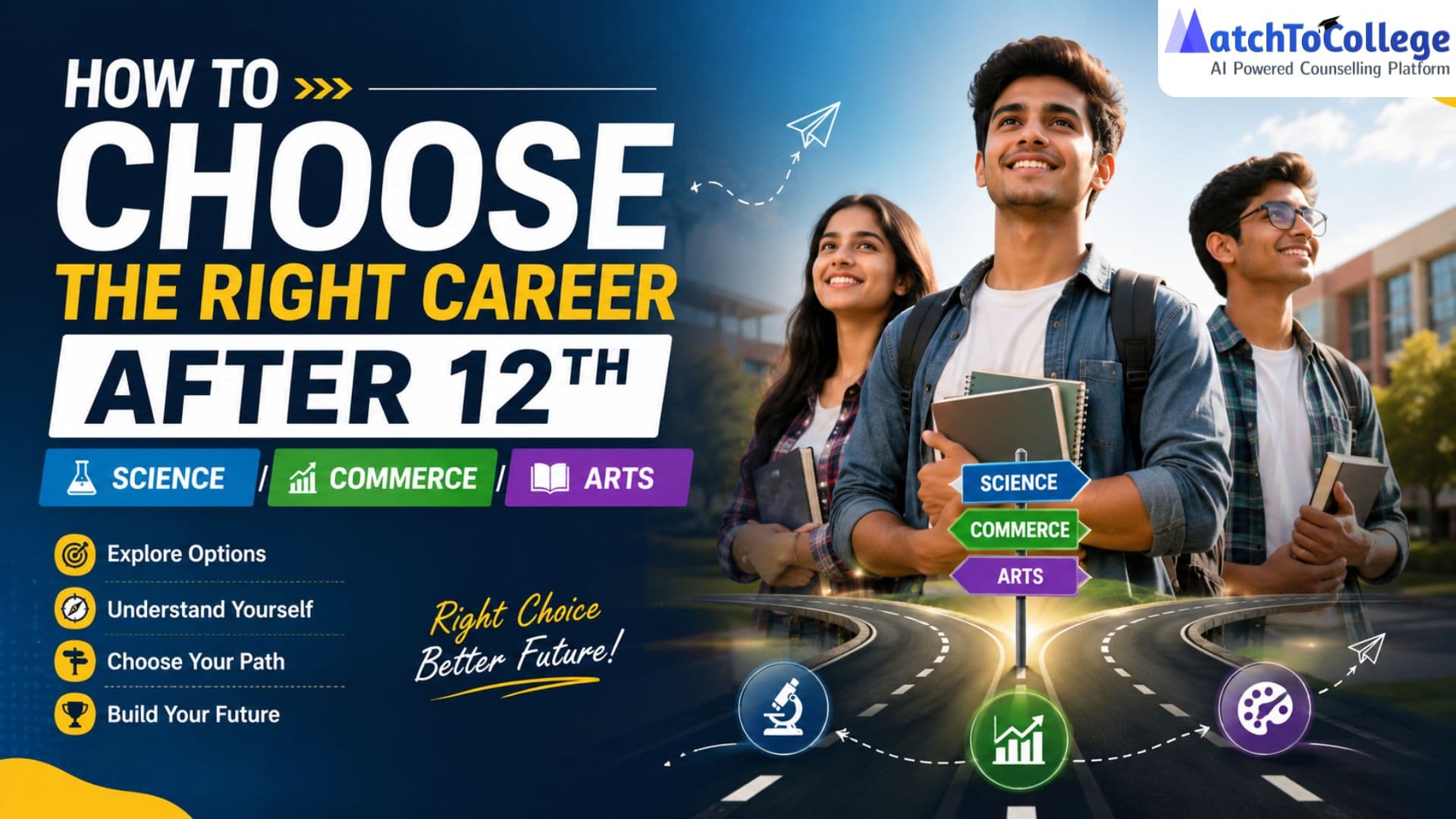
Choose Smart, Shape Your Future
Completing 12th grade is a major turning point in a student’s life. It is the stage where academic learning transitions into career planning. Choosing the right path after 12th is not just about selecting a course—it is about shaping your future, aligning with your strengths, and building a meaningful career.
With multiple options available today, students often feel confused or pressured. The right decision requires self-awareness, awareness of career options, and understanding of future opportunities.
Why Career Choice After 12th is Important
- It defines your higher education direction
- It influences long-term career growth
- It impacts financial stability and job satisfaction
- It helps align passion with profession
- It reduces chances of career switching later
Key Factors to Consider Before Choosing a Career
Before selecting a stream or course, evaluate:
- Interest – What subjects do you enjoy?
- Strengths – What are you naturally good at?
- Personality – Analytical, creative, leadership-oriented, etc.
- Career scope – Future job opportunities and industry demand
- Skills required – Technical, creative, or business-related skills
- Lifestyle goals – Work environment and long-term aspirations
Major Career Options After 12th
Stream-wise Career Overview
| Stream | Popular Career Options | Key Fields | Future Scope |
| Science | Engineering, Medical, Data Science, AI, Pharmacy, Architecture | Technology, Healthcare, Research | High demand in tech and healthcare industries |
| Commerce | CA, CS, CMA, Banking, Finance, Business Management, Economics | Finance, Accounting, Business | Strong opportunities in corporate and financial sectors |
| Arts / Humanities | Journalism, Psychology, Law, Design, Civil Services, Teaching | Media, Social Sciences, Creative Fields | Growing demand in creative and public service roles |
Common Challenges Students Face
- Too many career options
- Peer and parental pressure
- Lack of proper guidance
- Uncertainty about future job market
- Confusion between passion and practicality
How to Make the Right Decision
A smart career decision should be:
- Based on self-analysis, not pressure
- Supported by proper career counseling
- Aligned with long-term goals
- Flexible to adapt with future opportunities
- Backed by research on industry trends
Role of Career Guidance Platforms
Modern AI-powered career guidance tools help students by:
- Analyzing strengths and interests
- Suggesting suitable career paths
- Providing personalized recommendations
- Reducing confusion and decision stress
- Offering clarity about future opportunities
Such platforms help students make informed and confident choices after 12th.
Choosing the right career after 12th is a crucial life decision. It requires careful thinking, self-awareness, and proper guidance. Whether you come from Science, Commerce, or Arts, the right career is the one that matches your abilities, interests, and future goals.
The Crossroads After 12th: Why Career Guidance Matters
Finishing 12th grade is an important milestone, but it also marks the beginning of a critical decision-making phase: choosing the right career path. This choice is not limited to selecting a college—it involves identifying a direction that fits your interests, abilities, values, and long-term goals.
Without proper guidance, many students make choices based on peer influence, parental expectations, or short-term trends. Such decisions can lead to dissatisfaction, academic difficulty, or later career changes, which often result in wasted time, effort, and financial resources.
Career counseling helps students make informed and confident decisions by providing structured guidance, clarity about available options, and insights into personal strengths. With increasing competition in higher education and the job market, having a clear plan is essential for long-term success.
Platforms like MatchToCollege use AI-based analysis to support students with data-driven career insights, helping them explore suitable academic and professional pathways more effectively.
Key Comparison: Without vs With Career Guidance
| Aspect | Without Career Guidance | With Career Guidance |
| Decision-making approach | Based on guesswork, peer influence, or pressure | Based on structured assessment of interests and abilities |
| Career clarity | Often unclear or confusing | Clear understanding of suitable career options |
| Risk of wrong choice | High | Significantly reduced |
| Academic performance | May suffer due to lack of interest | Generally improved due to better alignment |
| Long-term satisfaction | Uncertain, may lead to frequent changes | Higher satisfaction and stability |
| Awareness of options | Limited knowledge of available fields | Wide exposure to multiple career paths |
| Planning approach | Unstructured | Strategic and goal-oriented |
Role of Career Counseling
- Identifies your interests, strengths, and personality traits
- Suggests suitable academic streams and career options
- Provides clarity on admission processes and eligibility requirements
- Helps set realistic short-term and long-term goals
- Reduces confusion and decision-related stress
Why It Matters After 12th Grade
- It is the foundation stage for your professional journey
- Choices made now can influence lifelong career opportunities
- The education and job market are highly competitive and rapidly evolving
- Informed decisions improve both academic success and career satisfaction
Modern Support Tools
- AI-powered platforms like MatchToCollege analyze student profiles
- Data-driven recommendations help match students with suitable courses
- Technology simplifies complex career planning decisions
Understanding Yourself: The First Step to a Fulfilling Career
Before exploring career options outside, the most important step is self-understanding. A clear awareness of your interests, abilities, personality, and values forms the foundation for making informed and satisfying career choices.
When you understand yourself well, it becomes easier to identify careers that genuinely fit you rather than those chosen due to pressure or trends.
Key Areas of Self-Assessment
| Area | What to Reflect On | Example Questions |
| Interests | Activities and subjects you enjoy | Do I prefer problem-solving, creativity, working with people, or data analysis? |
| Strengths & Weaknesses | Your natural abilities and challenges | Which subjects or tasks come easily to me? Where do I struggle? |
| Personality Type | How you behave and work best | Am I more extroverted or introverted? Do I prefer teamwork or independent work? Do I enjoy leading or supporting roles? |
| Values | What matters most in your career | Do I value financial stability, social impact, creativity, innovation, or work-life balance? |
Tools That Help in Self-Understanding
| Tool | Purpose | Benefit |
| Aptitude Tests | Measure natural abilities in different areas | Helps identify strengths and suitable fields |
| Psychometric Assessments | Analyze personality traits and behavior patterns | Matches careers with personality type |
| Self-reflection Exercises | Encourage deeper thinking about goals and preferences | Builds clarity and personal awareness |
| Career Counseling Platforms (e.g., MatchToCollege) | Combine multiple assessments using AI | Provide data-driven career suggestions based on your profile |
Why Self-Assessment Matters
- It reduces confusion when choosing between multiple career options
- It helps avoid decisions based on peer pressure or external influence
- It increases the likelihood of long-term career satisfaction
- It aligns your education path with your natural strengths and interests
Strong self-awareness ensures that your career choice is not random, but aligned with who you are. This alignment leads to better academic performance, improved motivation, and greater long-term success in your chosen fiel
Top Career Options After 12th for Science Stream Students
The Science stream offers a wide range of career opportunities, which vary depending on whether you studied PCM (Physics, Chemistry, Mathematics) or PCB (Physics, Chemistry, Biology). Each combination opens distinct academic and professional pathways.
Understanding these options helps students choose courses that match their interests and long-term goals.
Career Options for PCM Students
| Field | Course Options | Overview | Key Entrance/Requirements |
| Engineering | B.Tech / B.E. (Computer Science, Mechanical, Civil, Electrical, Electronics, Chemical, Aeronautical, etc.) | One of the most popular career paths with strong industry demand | JEE Main / JEE Advanced |
| Architecture | B.Arch | Focuses on building design, planning, and construction with creativity and math | NATA / JEE Paper 2 |
| Pure Sciences | B.Sc (Physics, Chemistry, Mathematics, Statistics, Computer Science, Data Science, Environmental Science) | Suitable for research, teaching, and technical careers | College/university entrance criteria |
| Aviation | Commercial Pilot Training | High-responsibility career in aviation industry | DGCA medical and entrance requirements |
Career Options for PCB Students
| Field | Course Options | Overview | Key Entrance/Requirements |
| Medicine | MBBS / BDS | Highly respected career in healthcare as doctors or dentists | NEET |
| Pharmacy | B.Pharm | Focus on drug development, research, and pharmaceutical industry roles | University/entrance exams |
| Allied Health Sciences | BPT (Physiotherapy), B.Sc Nursing, Optometry, Nutrition & Dietetics, Medical Lab Technology | Support roles in healthcare system with strong demand | Institute-specific criteria |
| Biotechnology & Bioinformatics | Specialized courses in biological sciences + technology | Research-oriented field combining biology and tech | University-level exams |
| Pure Sciences | B.Sc (Zoology, Botany, Microbiology, Biochemistry, Genetics, Forensic Science) | Leads to research, lab work, academia, or higher studies | College admissions |
Emerging Interdisciplinary Fields (PCM & PCB)
| Field | Overview | Relevance |
| Data Science | Study of data analysis, statistics, and machine learning | High demand across industries |
| Artificial Intelligence & Machine Learning | Development of intelligent systems and algorithms | Rapidly growing tech sector |
| Robotics | Combines engineering and computer science for automation | Used in manufacturing, healthcare, and defense |
| Cybersecurity | Protecting systems and networks from cyber threats | Critical in digital economy |
| Renewable Energy | Focus on sustainable energy solutions | Important for environmental and energy sectors |
The Science stream offers both traditional and emerging career paths. The right choice depends on your interests, aptitude, and long-term goals, not just popularity or pressure.
Platforms like MatchToCollege help students explore these options in detail, including course structure, eligibility, college choices, and future career scope, making decision-making more structured and informed.
Top Career Options After 12th for Commerce Stream Students
The Commerce stream offers strong pathways into careers in business, finance, management, and economics. It builds essential skills such as financial analysis, decision-making, market understanding, and organizational management—making it suitable for both traditional professions and modern, tech-driven roles.
Core Career Options in Commerce
| Course | Focus Area | Career Direction | Key Highlights |
| B.Com (Bachelor of Commerce) | Accounting, Finance, Economics, Marketing, HR | Foundation for finance, banking, and corporate jobs | Strong base for higher studies like M.Com, MBA, CA |
| BBA (Bachelor of Business Administration) | Business management and administration | Prepares for managerial and leadership roles | Ideal pathway for MBA aspirants |
| BA/B.Sc Economics | Economic theory, data analysis, policy studies | Research, finance, government, and analytics roles | Suitable for students with strong math and analytical skills |
Professional Courses After Commerce
| Course | Full Form | Focus Area | Career Opportunities |
| CA | Chartered Accountancy | Accounting, auditing, taxation, finance | Auditor, tax consultant, financial advisor |
| CS | Company Secretary | Corporate law, governance, compliance | Corporate legal advisor, compliance officer |
| CMA | Cost and Management Accountancy | Cost control, business strategy, performance management | Cost accountant, financial strategist |
Law-Based Career Options
| Course | Focus | Career Scope |
| BBA LLB / B.Com LLB (Integrated Law Programs) | Business + legal studies | Corporate law, taxation law, litigation, legal advisory |
Emerging Career Fields in Commerce
| Field | Description Industry | Application |
| Digital Marketing | Online branding, SEO, social media strategy | E-commerce, advertising, startups |
| FinTech (Financial Technology) | Technology-driven financial services | Banking apps, payment systems, digital finance |
| Business Analytics | Data-driven business decision-making | Consulting, corporate strategy, operations |
| Supply Chain Management | Logistics, procurement, and operations management | Manufacturing, retail, global trade |
Commerce today is no longer limited to traditional accounting and banking roles. It now combines finance, law, technology, and analytics, offering a wide range of stable and high-growth career options.
Choosing the right path depends on your interests in numbers, business strategy, law, or technology, along with your long-term career goals.
Platforms like MatchToCollege help students understand these options better by providing structured insights into courses, eligibility, career scope, and future opportunities, enabling more informed and confident decisions
Top Career Options After 12th for Arts/Humanities Stream Students
The Arts and Humanities stream is often underrated, but it offers a wide and meaningful range of career opportunities. It builds essential skills such as critical thinking, communication, creativity, empathy, and analytical reasoning, which are valuable across many industries.
With the right direction, Arts students can pursue both traditional and modern careers in media, law, education, social sciences, design, and public service.
Core Career Options in Arts & Humanities
| Course | Focus Area | Career PathKey | Highlights |
| BA (Bachelor of Arts) | Wide range of subjects like Psychology, Sociology, History, Political Science, English, Philosophy, Economics, Journalism | Flexible foundation for multiple careers | Can lead to higher studies and specialization in diverse fields |
| BAJMC (Journalism & Mass Communication) | Media, reporting, communication, PR, advertising | Journalist, content creator, PR specialist, media professional | Strong focus on communication and media ethics |
| BA LLB (Integrated Law) | Law + humanities subjects | Lawyer, legal advisor, public prosecutor, judiciary roles | Develops strong reasoning and argumentative skills |
| BSW / MSW (Social Work) | Community development, welfare, social justice | Social worker, NGO professional, policy advocate | Focus on societal impact and human development |
| B.Ed (Education) | Teaching methodology and pedagogy | Teacher or educator in schools and institutions | Requires further qualification after graduation |
Creative & Design-Oriented Careers
| Field | Course Options | Career Opportunities |
| Fashion Design | Fashion Design / Fashion Technology | Fashion designer, stylist, merchandiser |
| Graphic Design & Animation | Graphic Design, Animation, Multimedia | Digital artist, animator, UI/UX designer |
| Fine Arts | BFA (Bachelor of Fine Arts) | Painter, sculptor, illustrator, art teacher, curator |
Service & Management-Oriented Fields
| Field | Focus | Career Scope |
| Hospitality & Tourism Management | Hotels, travel, airlines, event management | Hotel manager, travel consultant, event planner |
Competitive & Public Service Careers
| Path | Description | Why Arts Helps |
| Civil Services (UPSC, IAS, IPS, etc.) | Prestigious government careers through competitive exams | Strong humanities background supports general studies and essay writing |
Arts and Humanities offer flexibility to combine creativity, communication, and analytical thinking. This allows students to build unique career paths tailored to their interests and strengths rather than following a fixed route.
With proper guidance, Arts students can succeed in diverse fields such as media, law, education, design, public service, and social work.
Platforms like MatchToCollege help students identify the most suitable career direction by analyzing their interests, strengths, and goals, making the decision-making process clearer and more structured.
Key Factors to Consider Before Making Your Final Decision
Choosing a career is one of the most important decisions after school, and it should be made in a structured and thoughtful way. Along with understanding your interests, strengths, and academic options, it is equally important to evaluate practical factors that influence long-term success and satisfaction.
A balanced approach ensures that your decision is both personally fulfilling and professionally sustainable.
Key Factors to Consider When Choosing a Career
| Factor | What It Means | Why It Matters |
| Market Demand & Future Scope | Growth trends and demand in industries | Ensures job opportunities and long-term relevance of skills |
| Salary & Growth Potential | Entry-level pay and long-term earning capacity | Supports financial stability and career advancement |
| Educational Requirements | Entrance exams, eligibility, course duration, difficulty level | Helps you understand effort, time, and preparation needed |
| Financial Investment | Tuition fees, living costs, loans, and scholarships | Ensures affordability and reduces financial stress |
| Work-Life Balance | Working hours, stress levels, lifestyle impact | Affects health, satisfaction, and long-term well-being |
| Location & Mobility | Need to relocate or work abroad/other cities | Influences convenience, exposure, and opportunities |
| Family & Peer Influence vs Personal Choice | Balancing external expectations with personal goals | Ensures decisions align with your true interests and aspirations |
Why These Factors Matter
- Career success is not only about passion but also about practicality
- Different professions offer different lifestyles, pressures, and rewards
- Early planning reduces the risk of switching careers later
- Informed choices lead to better confidence and long-term satisfaction
Making a Balanced Decision
A strong career decision comes from combining:
- Self-awareness (interests, strengths, personality)
- Academic understanding (stream and course options)
- Practical evaluation (market demand, salary, lifestyle, cost)
A well-informed career choice is not made based on a single factor, but through a careful evaluation of multiple personal and external considerations. When these elements are balanced properly, students are more likely to build stable, fulfilling, and successful careers.
Platforms like MatchToCollege integrate all these dimensions using AI-driven analysis, helping students compare options and make decisions that align with both their personal goals and real-world opportunities.
How MatchToCollege's AI Transforms Your Career Search
After 12th grade, choosing the right career path can often feel confusing and overwhelming. With so many courses, exams, and career options available, students may struggle to identify what truly suits them. This is where AI-powered platforms like MatchToCollege can provide structured and personalized guidance.
Rather than offering generic suggestions, MatchToCollege is designed to understand each student individually and support informed decision-making with data-driven insights.
How MatchToCollege Supports Career Decision-Making
| Feature | What It Does | How It Helps Students |
| Personalized Aptitude & Interest Mapping | Analyzes academic performance, interests, personality, and goals | Creates a clear profile of suitable career directions |
| Data-Driven Career Recommendations | Suggests careers and courses across Science, Commerce, and Arts | Helps identify realistic and suitable career paths with future scope |
| College Matching & Admission Guidance | Recommends colleges based on profile, budget, and preferences | Simplifies college selection and admission planning |
| Information on Emerging Fields | Covers trends like data science, AI, fintech, and other high-demand careers | Keeps students updated with modern industry opportunities |
| Objective Decision Support | Uses AI-based analysis to reduce bias and confusion | Helps students avoid pressure-based or trend-driven choices |
Key Benefits of Using an AI Career Guidance Platform
- Provides personalized career suggestions instead of generic advice
- Helps students explore both traditional and emerging career options
- Reduces confusion caused by too many conflicting opinions
- Supports informed decisions using structured, data-backed insights
- Makes college and course selection more organized and efficient
Why This Approach Matters
Career decisions after 12th should be based on a combination of:
- Personal interests and strengths
- Academic performance and aptitude
- Future job opportunities and industry trends
- Practical factors like cost, location, and admission requirements
AI-powered platforms like MatchToCollege bring all these elements together in one place, making the decision-making process more clear, logical, and student-focused.
Instead of relying on guesswork or external pressure, students can use structured guidance systems to make confident and well-informed choices. With the right support, selecting a career after 12th becomes a planned journey rather than a stressful decision.
Share this Article
FAQFrequently Asked Questions
Q: Is an aptitude test really helpful for career selection after 12th?
Yes, aptitude tests are highly beneficial. They provide an objective assessment of your natural strengths, cognitive abilities, and potential in various domains. When combined with interest assessments and personalized counseling (like that offered by MatchToCollege), they offer valuable insights that complement self-reflection and help in making a more informed career decision after 12th grade.
Q: How can MatchToCollege help me choose the best career path after 12th?
MatchToCollege utilizes AI to offer a comprehensive, personalized career guidance experience. We analyze your academic performance, interests, personality, and skills to recommend suitable career paths and higher education programs across Science, Commerce, and Arts streams. Our platform also provides insights into market trends, college matching, and admission guidance, ensuring you make a data-driven and confident choice for your future.
Get More Info About Right Career After 12th
Recommended Reading
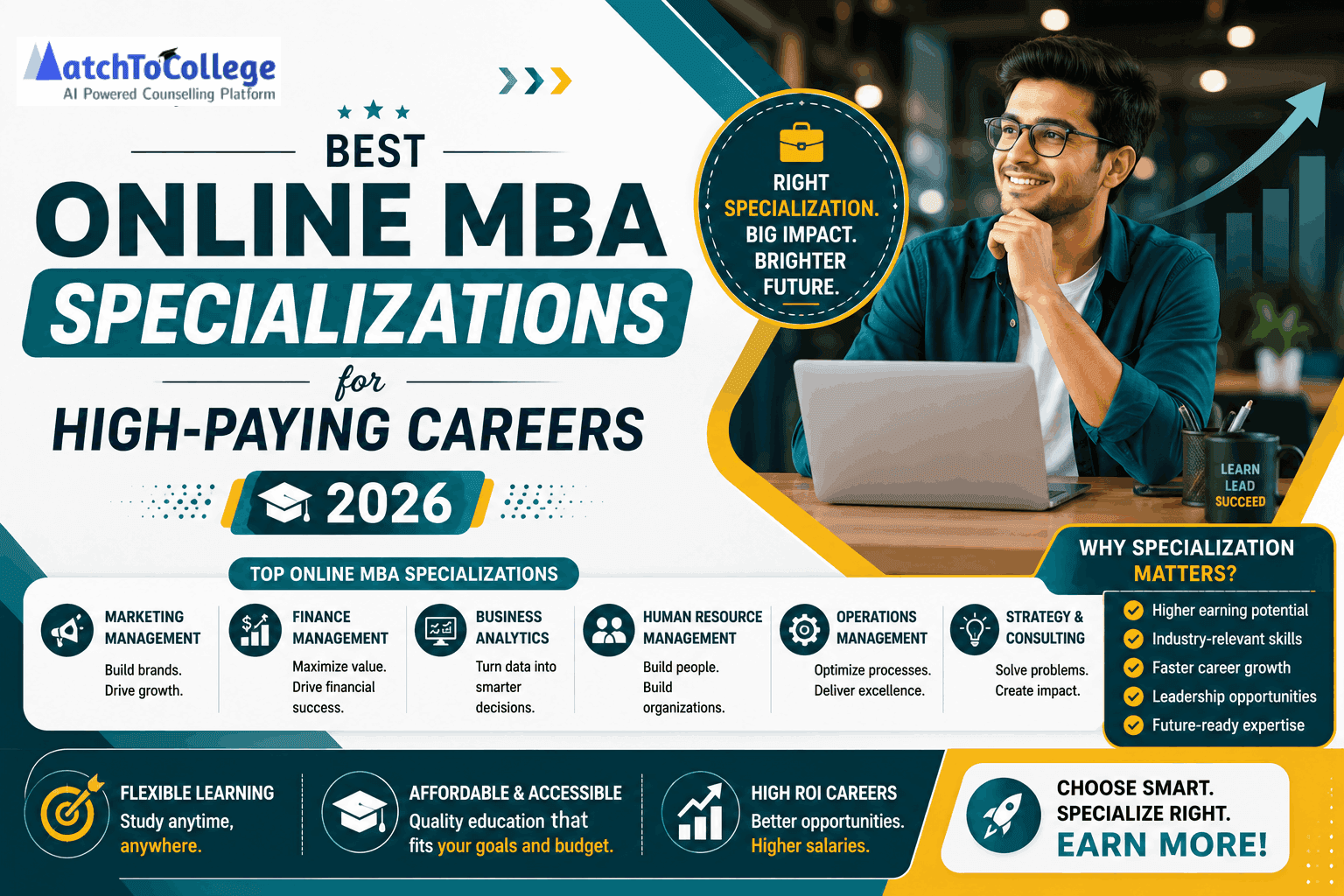
Best Online MBA Specializations for High-Paying Careers 2026
Discover the most lucrative online MBA specializations for 2026-27. Compare ROI, career growth, and use our AI tools to find your perfect management path.
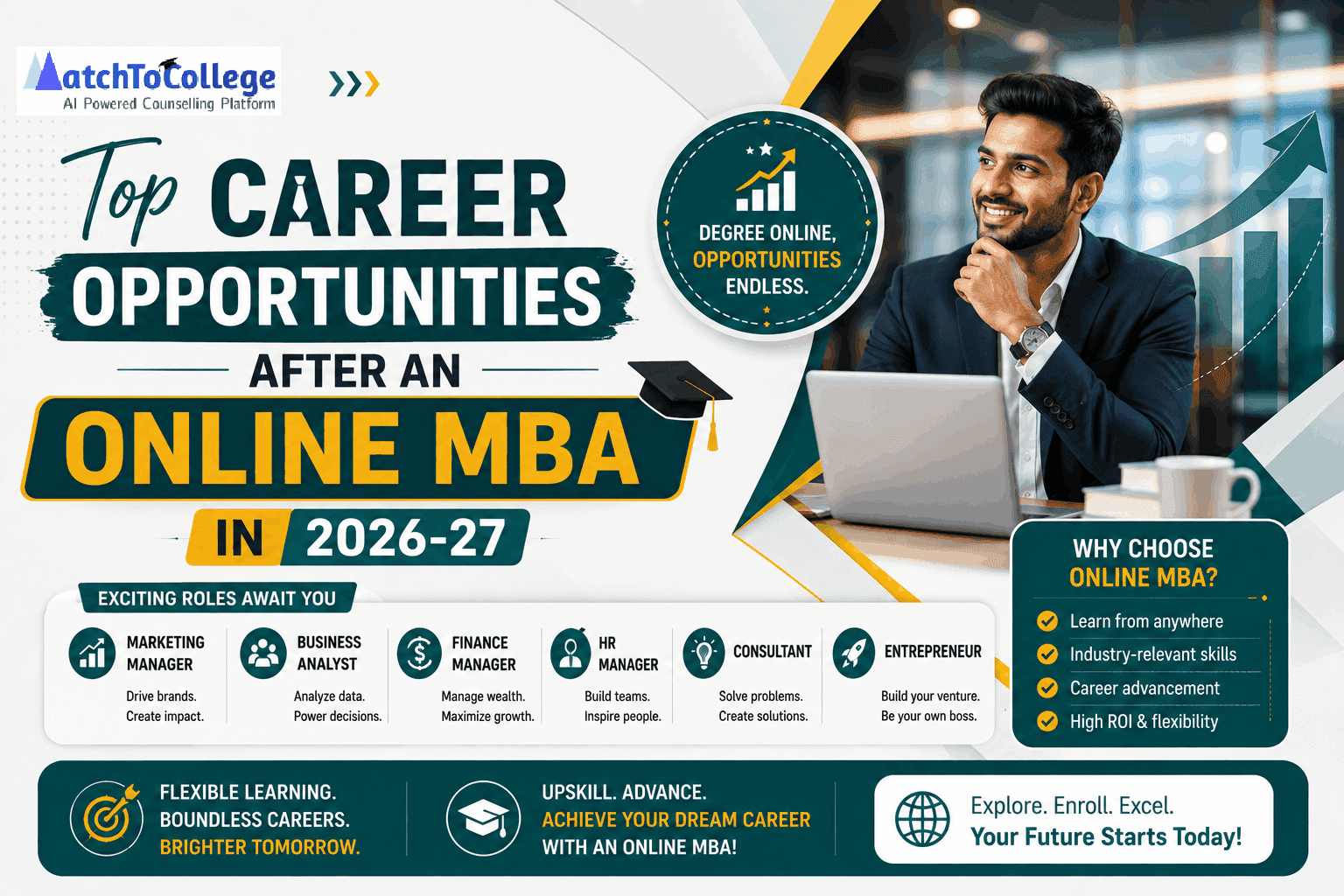
Top Career Opportunities After an Online MBA in 2026-27
Discover high-paying career paths and roles after an online MBA in 2026-27. Explore salary trends, ROI, and tools to navigate your future professional success.
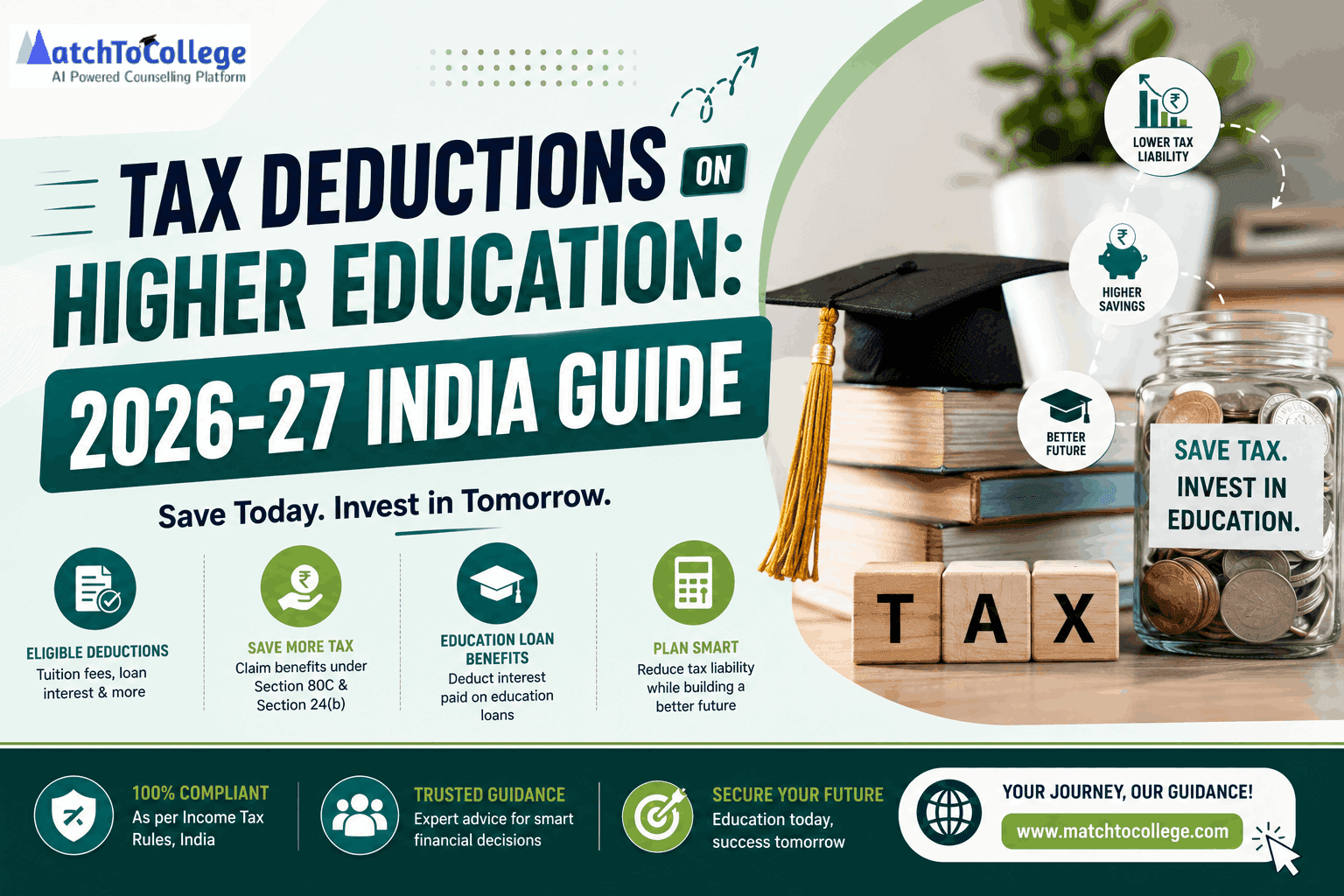
Tax Deductions on Higher Education: 2026-27 India Guide
Maximize your savings with our guide on tax deductions for higher education fees in India for FY 2026-27. Learn about Section 80C, 80E, and upskilling benefits.