

Regular vs. Online vs. Distance MBA: Your Ultimate Guide
Admission & Info Tools
Need Expert Assistance?
Our counselors can help you with fee structures, eligibility guidelines, and upcoming admission cutoffs instantly.
Direct Application Tools
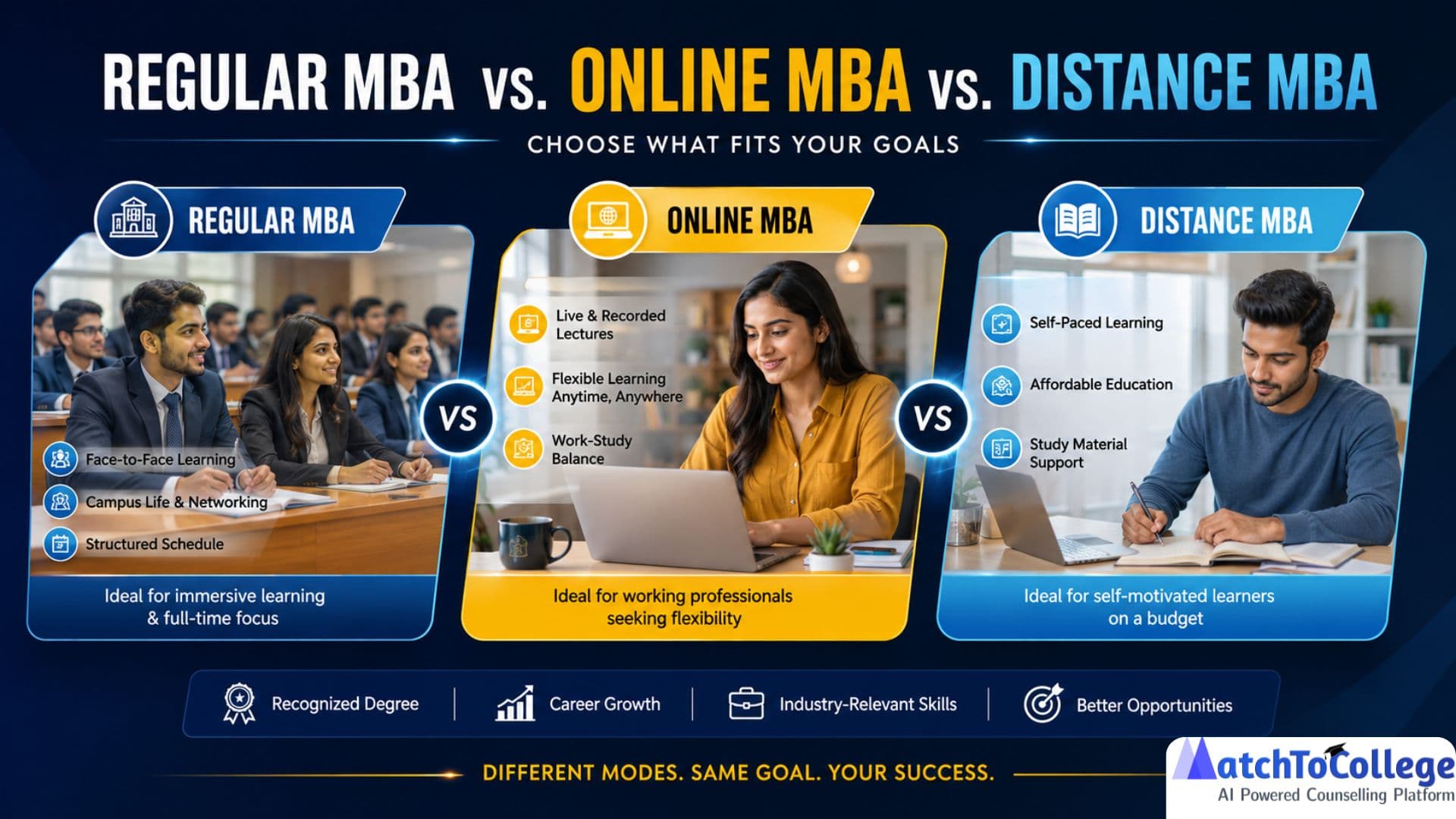
MBA comparison
The pursuit of a Master of Business Administration (MBA) remains a pivotal step for professionals aiming to elevate their careers, refine their leadership skills, and expand their professional networks. However, the landscape of MBA programs has diversified significantly over the past decade, moving beyond the traditional full-time, on-campus model.
Today, aspiring business leaders are presented with a crucial choice: the immersive experience of a Regular MBA, the flexible structure of an Online MBA, or the self-paced nature of a Distance MBA. Each option carries distinct advantages and caters to different life circumstances, career goals, and learning preferences. Navigating these distinctions is essential for making an informed decision that aligns with your professional aspirations and personal commitments.
This comprehensive guide by MatchToCollege aims to demystify the intricacies of each MBA format, providing you with the clarity needed to choose the program that best propels your career forward. We understand that this isn't just about obtaining a degree; it's about investing in your future, enhancing your career advancement, and securing a stronger position in a competitive global market. Whether you're a recent graduate, a mid-career professional looking for a pivot, or an executive seeking to formalize your experience, understanding the nuances of MBA program types is your first step.
We’ll delve into the MBA structure, program duration, cost of MBA, accreditation, and the overall student experience, ensuring you're equipped with the knowledge to make a confident choice. MatchToCollege’s AI-powered platform can further personalize this journey, matching you with programs that fit your unique profile and ambitions.
Understanding Regular (Full-time) MBA Programs
The Regular MBA, often synonymous with a Full-time MBA, is the traditional gold standard. Typically spanning one to two years, this immersive program requires students to attend classes on campus during standard working hours. It's designed for individuals who can commit entirely to their studies, stepping away from full-time employment.
Key features include:
- Immersive Campus Experience: Students benefit from direct interaction with professors, cohort-based learning, and a vibrant campus experience.
- Unparalleled Networking Opportunities: Extensive opportunities for building connections with classmates, alumni, faculty, and industry leaders through events, clubs, and career fairs.
- Robust Career Services: Dedicated career services teams work intensely with students for internships and full-time placements, often leading to significant career advancement.
- Experiential Learning: Emphasis on case studies, group projects, internships, and global immersions.
- High ROI Potential: While the upfront cost of MBA and opportunity cost (lost wages) can be substantial, the ROI of MBA for top programs is often very high, leading to substantial salary increases and leadership roles.
This path is ideal for those seeking a career change, aiming for leadership positions in large corporations, or aspiring to join highly competitive industries like investment banking or consulting, where the network and brand of a top MBA program are crucial.
Exploring Online MBA Programs: Flexibility Meets Quality
The Online MBA has rapidly gained traction, offering a compelling alternative for professionals who cannot pause their careers or relocate for a degree. These programs deliver the curriculum virtually, using a blend of live online sessions, pre-recorded lectures, discussion forums, and digital resources. Important aspects include:
- Flexibility: Designed for working professionals, allowing students to balance their studies with existing job commitments and personal lives. Many offer self-paced learning modules.
- Accessibility: Students can pursue an MBA from a top-tier university regardless of their geographic location.
- Diverse Cohorts: Often brings together professionals from a wider range of industries, geographies, and experience levels than a traditional program.
- Growing Reputation & Accreditation: Many reputable universities now offer fully accredited online MBA programs, ensuring the quality and recognition of the degree.
- Varying Formats: Some are 100% asynchronous, while others include synchronous (live) sessions or optional campus residencies (blended learning).
An Online MBA is perfect for mid-career professionals looking for upward mobility within their current company, entrepreneurs, or those seeking to develop new skills without interrupting their income stream. The work-life balance offered is a significant advantage.
Distance MBA: Understanding the Legacy Format
While often conflated with Online MBA, the Distance MBA typically refers to a more traditional, non-campus-based learning model, predating the widespread use of high-speed internet and sophisticated learning management systems.
These programs are often characterized by:
- Correspondence-Based Learning: Historically involved mailed study materials, textbooks, and assignments. Modern versions may use basic online portals but lack the interactive elements of a true Online MBA.
- Limited Interaction: Generally offers less direct interaction with faculty and peers compared to both Regular and modern Online MBAs. The student experience can be more solitary.
- Self-Study Focus: Heavily relies on independent study and self-discipline.
- Lower Cost: Often the most affordable MBA option due to minimal infrastructure and technology requirements.
- Varying Recognition: While some Distance MBA programs from well-established institutions are recognized, the market perception and future career prospects can sometimes be less robust than for accredited Online or Regular MBAs.
A Distance MBA might suit individuals with significant budget constraints, those in very remote areas with limited internet access, or professionals who prioritize a formal qualification over intensive networking and experiential learning. It's crucial to thoroughly vet the accreditation and reputation of any distance learning institution.
Key Differences: Regular vs. Online vs. Distance MBA at a Glance
To summarize, here’s a breakdown of how these MBA program types compare:
| Feature | Regular (Full-time) MBA | Online MBA | Distance MBA |
| Learning Mode | On-campus, immersive | Virtual, interactive, blended learning possible | Primarily self-study, often correspondence-based |
| Flexibility | Low (requires full commitment) | High (suited for working professionals, work-life balance) | High (self-paced, minimal structured interaction) |
| Networking | Extensive, in-person | Good, virtual platforms, occasional residencies | Limited, mostly self-initiated |
| Cost | Highest (tuition + living + opportunity cost) | Mid-range (tuition, fewer living costs) | Lowest (tuition, minimal other costs) |
| Interaction | High (faculty, peers, industry) | Moderate to High (virtual discussions, live classes) | Low (primarily individual study) |
| Target Audience | Career changers, aspiring leaders, young professionals | Working professionals, managers, entrepreneurs | Budget-conscious, remote learners, basic qualification seekers |
| Accreditation | Generally strong from reputable institutions | Varies, but many top universities offer accredited online MBAs | Can be inconsistent, requires careful vetting |
Understanding these fundamental differences is crucial for assessing which MBA structure aligns best with your individual circumstances and career goals.
Which MBA Path is Right For You? MatchToCollege Can Help
Choosing between a Regular MBA, Online MBA, or Distance MBA is a highly personal decision. It depends on factors like your current career stage, financial situation, geographic flexibility, learning style, and ultimate future career prospects. Do you prioritize an immersive campus life and extensive in-person networking, or is the flexibility to continue working while studying more important? Are you aiming for a major career pivot or seeking to enhance your skills in your current role?
At MatchToCollege, we leverage advanced AI to simplify this complex decision-making process. Our platform considers your academic background, professional experience, financial capabilities, and personal preferences to match you with MBA programs that are truly the best fit. From analyzing admission requirements (like GMAT/GRE scores) to exploring scholarship opportunities and comparing top colleges, we provide personalized guidance every step of the way. Don't leave your future to chance. Let MatchToCollege empower you to make an informed choice for your MBA journey and unlock your full potential. Start your personalized MBA program search today!
Share this Article
FAQFrequently Asked Questions
Q: What is the main difference between an Online MBA and a Distance MBA?
While both are non-traditional, an Online MBA leverages modern interactive digital platforms, often including live classes, group projects, and extensive virtual networking, making it highly interactive. A Distance MBA, historically, relied more on correspondence and self-study materials, offering less interaction and sometimes using older technology, leading to a less immersive <strong>student experience</strong>.
Q: Is an Online MBA degree less reputable than a Regular MBA degree?
Not necessarily. The reputation of an <strong>Online MBA</strong> largely depends on the institution offering it. Many top-tier, <strong>accredited universities</strong> now offer robust online programs with curricula and faculty equivalent to their full-time counterparts. The key is to check for proper <strong>accreditation</strong> and the university's overall standing, rather than dismissing it solely based on its online format.
Q: What are the typical admission requirements for these MBA programs?
<strong>Admission requirements</strong> generally include a bachelor's degree, professional work experience (especially for Regular and Online MBAs), letters of recommendation, essays, and often a competitive <strong>GMAT/GRE</strong> score. Some programs offer waivers for experienced professionals. Transcripts and a strong resume highlighting <strong>career advancement</strong> are also crucial. Requirements can vary significantly by program type and institution.
Q: How does the cost of MBA differ across these formats?
A <strong>Regular (Full-time) MBA</strong> typically incurs the highest cost due to tuition, living expenses, and the opportunity cost of not working. <strong>Online MBA programs</strong> are generally less expensive, saving on relocation and living costs, and allowing continued employment. <strong>Distance MBA programs</strong> are often the most affordable, with lower tuition fees and minimal additional expenses, though their market value can vary.
Get More Info About Regular vs. Online vs. Distance MBA
Recommended Reading
Best Online MBA Specializations for High-Paying Careers 2026
Discover the most lucrative online MBA specializations for 2026-27. Compare ROI, career growth, and use our AI tools to find your perfect management path.
Top Career Opportunities After an Online MBA in 2026-27
Discover high-paying career paths and roles after an online MBA in 2026-27. Explore salary trends, ROI, and tools to navigate your future professional success.
Tax Deductions on Higher Education: 2026-27 India Guide
Maximize your savings with our guide on tax deductions for higher education fees in India for FY 2026-27. Learn about Section 80C, 80E, and upskilling benefits.