

Private vs Public Universities: Which is Right for You?
Admission & Info Tools
Need Expert Assistance?
Our counselors can help you with fee structures, eligibility guidelines, and upcoming admission cutoffs instantly.
Direct Application Tools
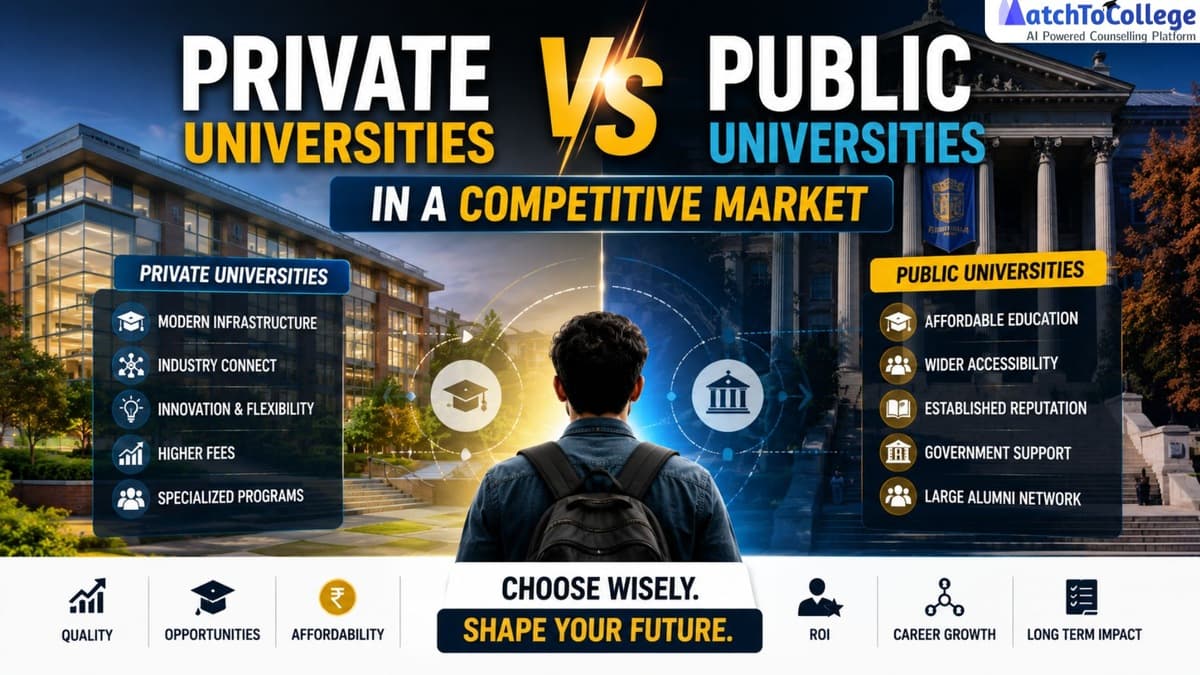
Private vs public universities showdown
Choosing between a private and a public university is one of the most important decisions in your higher education journey. The right choice depends on your academic goals, budget, career plans, and preferred learning environment.
Public universities are generally more affordable and offer a wide range of courses, while private universities often provide smaller class sizes, specialized programs, and personalized support. Each has its own advantages, making it essential to look beyond tuition fees and rankings.
Whether you're planning to pursue an MBA, Engineering, Medicine, or study abroad, comparing all aspects of a university will help you make a smarter decision.
Private vs. Public Universities at a Glance
| Factor | Public University | Private University |
| Tuition Fees | Usually more affordable | Generally higher |
| Class Size | Larger classes | Smaller, more personalized classes |
| Programs | Wide variety of courses | Specialized and niche programs |
| Funding | Government-funded | Privately funded |
| Student Experience | Diverse campus community | More individualized learning experience |
How MatchToCollege Helps
MatchToCollege's AI-powered platform helps students compare universities based on:
- Academic profile and career goals
- Tuition fees and financial aid
- Placement records and ROI
- Campus facilities and student experience
- Course quality and specialization
With the right insights, you can choose the university that best fits your ambitions, budget, and long-term career success.
Understanding the Core Differences: Private vs. Public
The biggest difference between private and public universities is how they are funded. Public universities receive government funding, making them more affordable, especially for in-state students. They usually have larger campuses, diverse student populations, and offer a wide range of academic programs.
Private universities rely mainly on tuition fees, donations, endowments, and research funding. They often provide smaller class sizes, personalized learning, specialized programs, and strong alumni networks. Although tuition fees are generally higher, many private universities offer generous scholarships and financial aid that can reduce the actual cost.
Private vs. Public Universities
| Factor | Public University | Private University |
| Funding | Government-funded | Tuition, donations, and endowments |
| Tuition Fees | Generally lower | Usually higher, with financial aid options |
| Class Size | Larger classes | Smaller, more personalized classes |
| Academic Programs | Wide range of courses | Specialized and flexible programs |
| Student-Faculty Ratio | Higher | Lower, allowing more individual attention |
| Campus Environment | Large and diverse | Close-knit and community-focused |
| Research & Networking | Strong research opportunities | Strong alumni networks and career support |
Choosing between a public and private university depends on your budget, learning preferences, career goals, and financial aid opportunities. Evaluating all these factors will help you find the best fit for your future.
Weighing Your Options: Key Factors to Consider
Choosing between a private and public university requires looking beyond rankings and tuition fees. Consider these important factors to find the best fit for your goals.
Factors to Compare
| Factor | Why It Matters |
| Cost & Financial Aid | Compare the net cost after scholarships, grants, and financial aid—not just the tuition fee. |
| Academic Programs | Choose a university with strong programs, experienced faculty, research opportunities, and flexible curriculum in your field of interest. |
| Campus Culture | Consider class size, student-faculty ratio, extracurricular activities, and whether you prefer a large or close-knit campus. |
| Location | Think about proximity to home, urban or rural setting, and access to internships and industry opportunities. |
| Career Outcomes | Review placement rates, career services, graduate salaries, and the strength of the alumni network. |
| Admission Requirements | Public universities often have broader admission criteria, while private universities are usually more selective. |
The best university is one that aligns with your academic interests, career goals, learning style, and budget. Evaluating these factors carefully will help you make a confident and well-informed decision.
Making the Right Choice with MatchToCollege's AI Power
Choosing the right university doesn't have to be complicated. MatchToCollege's AI-powered platform makes the process easier by providing personalized recommendations based on your academic profile, career goals, and budget.
Whether you're planning to pursue an MBA, Engineering, Medicine, or study abroad, MatchToCollege compares thousands of data points to help you find the best-fit universities. Beyond rankings, it evaluates factors like academic programs, campus environment, financial aid, placement records, and career outcomes.
Why Choose MatchToCollege?
| Feature | Benefit |
| Personalized AI recommendations | Find universities that match your profile and career goals |
| Smart university comparison | Compare courses, fees, scholarships, and campus life |
| Career-focused insights | Evaluate placements, ROI, and graduate success rates |
| Financial guidance | Explore scholarships, financial aid, and affordable options |
| Study in India & Abroad | Discover the best universities based on your preferences |
With MatchToCollege, you can make informed, data-driven decisions and confidently choose a university that supports your academic success, career growth, and long-term aspirations.
Share this Article
FAQFrequently Asked Questions
Q: Are private universities always more expensive than public universities?
While private universities often have a higher 'sticker price' for tuition, they also tend to offer more generous institutional financial aid, grants, and scholarships. Many students find that their net cost (what they actually pay after aid) at a private university can be comparable to, or even less than, an out-of-state public university. It's crucial to apply for financial aid and compare aid packages before making a decision based solely on published tuition fees.
Q: Do private or public universities offer better job prospects?
The job prospects for graduates depend more on the specific program, the student's performance, and the university's career services and alumni network rather than simply whether it's private or public. Both types of institutions can boast impressive graduate employment rates. Private universities often have strong connections within specific industries due to smaller, specialized programs, while large public universities might offer broader alumni networks across diverse fields. Researching the career services and post-graduation success rates for your intended major at specific institutions is key.
Q: Which type of university is better for specific fields like Engineering or Medicine?
There isn't a definitive 'better' type for all fields. Many top-ranked engineering and medical programs exist at both private and public universities. For engineering, large public universities often have vast research facilities and industry partnerships, while private institutions might offer highly specialized, intimate research opportunities. Medical schools at both are highly competitive, with success depending on faculty, research opportunities, clinical placements, and affiliations. MatchToCollege can help you find programs tailored to your specific academic and career goals in any field.
Get More Info About Private vs Public Universities
Recommended Reading

Best Online MBA Specializations for High-Paying Careers 2026
Discover the most lucrative online MBA specializations for 2026-27. Compare ROI, career growth, and use our AI tools to find your perfect management path.

Top Career Opportunities After an Online MBA in 2026-27
Discover high-paying career paths and roles after an online MBA in 2026-27. Explore salary trends, ROI, and tools to navigate your future professional success.

Tax Deductions on Higher Education: 2026-27 India Guide
Maximize your savings with our guide on tax deductions for higher education fees in India for FY 2026-27. Learn about Section 80C, 80E, and upskilling benefits.