

The "Prestige" Gap: Does an employer care if your degree says "Online" on the certificate?
Admission & Info Tools
Need Expert Assistance?
Our counselors can help you with fee structures, eligibility guidelines, and upcoming admission cutoffs instantly.
Direct Application Tools
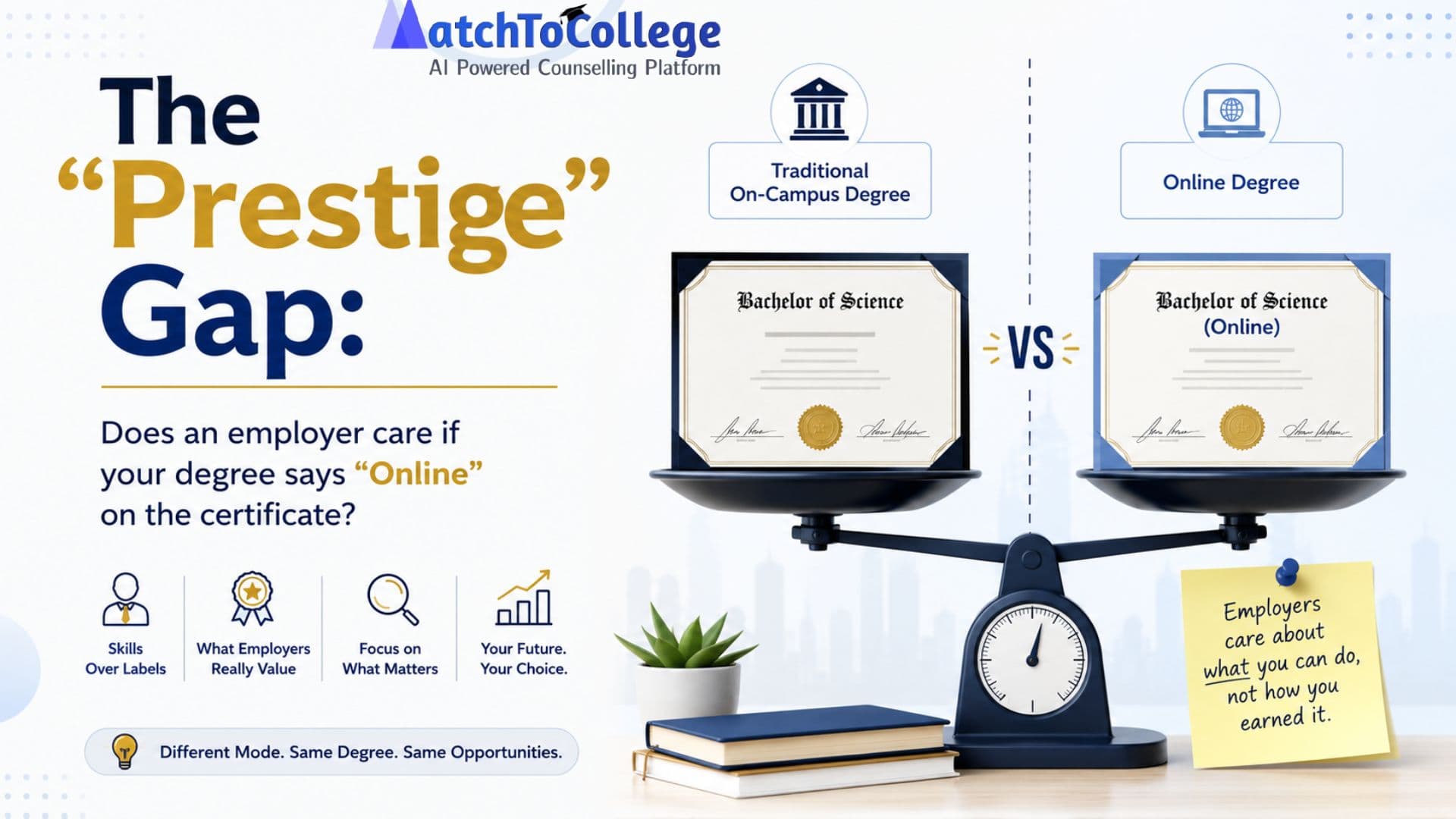
Online Degree vs Traditional: Does It Matter?
Online degrees are now a common part of higher education. Many top universities offer online programs with the same syllabus, faculty, and academic standards as regular on-campus courses. Still, many students wonder whether employers see an online degree differently.
The answer depends less on the word “online” and more on the quality of the institution and your skills. Today, many recruiters focus on what you can do — not just how you studied.
What Employers Usually Consider
| Factor | Why It Matters |
| University Reputation | A recognized institution carries more trust |
| Accreditation | Validates the degree officially |
| Skills | Practical ability often matters most |
| Experience | Internships and projects add value |
| Communication | Your confidence during hiring matters |
In most cases, employers do not reject candidates simply because their degree was earned online. What matters more is whether the program is from a credible university and whether you have the knowledge to perform the job.
The perception around online education has changed significantly, especially after remote learning became mainstream. A strong profile, relevant skills, and practical experience often outweigh the “online” label on the certificate.
The Evolving Landscape: Online Education's New Normal
Online education is no longer seen as a second option. Today, many leading universities offer online programs in business, engineering, and other fields with the same curriculum as campus courses.
What matters most is not whether the degree was online, but whether the university is recognized and accredited. A valid degree from a trusted institution is generally accepted by employers.
Why Employer Views Are Changing
| Factor | Impact |
| University Accreditation | Confirms the program’s credibility |
| Same Curriculum | Shows equal academic standards |
| Flexible Learning | Builds self-discipline |
| Digital Skills | Useful for modern workplaces |
| Time Management | Valued by employers |
Online learning also shows that students can manage time, work independently, and adapt to digital tools. These are important skills in today’s hybrid and remote work environments.
As online education grows, employers are focusing more on qualifications, practical skills, and experience — not just the learning format.
What Employers *Really* Care About: Beyond the 'Online' Label
Most employers do not focus only on whether your degree was online or offline. Their hiring decision usually depends on the value you bring to the role.
Key Factors Employers Consider
| Factor | Why It Matters |
| Accreditation | Confirms the degree is officially recognized |
| University Reputation | Trusted institutions add credibility |
| Skills | Practical knowledge matters most |
| Experience | Internships and projects strengthen your profile |
| Academic Performance | Good grades show consistency |
| Soft Skills | Communication and teamwork are essential |
Employers mainly want candidates who can perform well in the job. If your degree comes from a recognized university and you have the right skills, the learning mode often becomes less important.
Today, many companies value real-world abilities, project experience, and adaptability more than whether the course was completed online or on campus.
The Critical Role of Accreditation and Program Quality
The most important factor in any online degree is accreditation. It confirms that the university and program meet accepted academic standards.
A degree from an accredited institution is more likely to be accepted by employers and higher education institutions. Without proper recognition, a degree may have limited value in jobs or future studies.
Why It Is Important
| Point | Importance |
| Official Recognition | Makes the degree valid |
| Employer Trust | Builds confidence in your qualification |
| Higher Studies | Helps in future admissions |
| Career Value | Improves job acceptance |
| Quality Standard | Shows the program meets approved norms |
Before joining any online course, always check whether the university and program are officially accredited. A recognized degree gives your education long-term value.
Highlighting Your Online Degree Effectively on Your Resume
If you completed an online degree, list it with confidence. Most employers care more about your qualification and skills than the learning mode.
Best Way to Mention It
| What to Include | How to Present |
| Degree Name | Mention course and specialization |
| University | Add the institution name clearly |
| Achievements | Highlight GPA, projects, and awards |
| Skills | Mention technical and practical abilities |
| Experience | Add internships and relevant work |
In most cases, there is no need to mention “online” unless the certificate specifically states it or the employer asks. Many universities issue the same certificate for both online and campus programs.
You can also highlight the strengths gained through online learning, such as self-discipline, time management, digital collaboration, and independent learning. These are valuable skills in today’s workplace.
Beyond the Certificate: Skills, Experience, and Networking
A degree can help you get noticed, but skills and experience play a bigger role in long-term career growth. Whether your degree is online or on-campus, employers look for what you can actually do.
What Builds Strong Career Value
| Area | Why It Matters |
| Skills | Shows practical job readiness |
| Internships | Adds real work experience |
| Projects | Demonstrates applied learning |
| Networking | Creates career opportunities |
| Communication | Helps in interviews and teamwork |
Online students can build strong profiles by joining internships, virtual projects, professional communities, and career events. Many online programs also include industry projects and practical assignments.
In the end, your knowledge, confidence, and ability to apply your learning matter far more than whether your degree was earned online.
MatchToCollege: Guiding Your Higher Education Choices
MatchToCollege helps students compare traditional, online, and hybrid programs based on career goals, academic interests, and future opportunities.
The platform gives personalized guidance so students can make informed decisions about courses, universities, and career paths.
How It Supports Students
| Feature | Benefit |
| Course Matching | Finds programs aligned with your goals |
| Career Guidance | Connects education to job outcomes |
| University Insights | Helps compare institutions |
| Accreditation Check | Confirms program credibility |
| Personalized Support | Simplifies decision-making |
Choosing the right degree is not only about study mode. It is about selecting a recognized program that supports your long-term career plans. MatchToCollege helps make that choice easier and more informed.
Share this Article
FAQFrequently Asked Questions
Q: Do employers know if my degree was earned online?
Often, employers do not explicitly know if a degree was earned online unless it is stated on the transcript or diploma, or if the program itself is specifically marketed as an 'online-only' institution. Many reputable universities issue identical diplomas for online and on-campus graduates. What truly matters to employers is the accreditation of the institution and the quality of the program, not necessarily the delivery method.
Q: Is an online degree less valuable than a traditional one?
Not inherently. The value of any degree, online or traditional, primarily depends on the institution's accreditation, its academic rigor, the skills you acquire, and the relevance of your studies to your career goals. An online degree from a well-respected, accredited university can be just as valuable, if not more so, due to the flexibility and self-discipline it often requires, which are highly valued by employers.
Q: How can I make my online degree stand out to employers?
To make your online degree stand out, focus on highlighting the skills you gained (e.g., self-discipline, time management, tech proficiency), relevant projects or internships, your academic achievements (GPA), and any professional networking you engaged in. Emphasize how your online learning experience prepared you for the demands of the modern workplace, rather than focusing on the 'online' aspect itself.
Get More Info About The "Prestige" Gap
Recommended Reading
Best Online MBA Specializations for High-Paying Careers 2026
Discover the most lucrative online MBA specializations for 2026-27. Compare ROI, career growth, and use our AI tools to find your perfect management path.
Top Career Opportunities After an Online MBA in 2026-27
Discover high-paying career paths and roles after an online MBA in 2026-27. Explore salary trends, ROI, and tools to navigate your future professional success.
Tax Deductions on Higher Education: 2026-27 India Guide
Maximize your savings with our guide on tax deductions for higher education fees in India for FY 2026-27. Learn about Section 80C, 80E, and upskilling benefits.