

Multiple Entry/Exit System (MEES): A student’s guide to taking a "Gap Year" without losing credits.
Admission & Info Tools
Need Expert Assistance?
Our counselors can help you with fee structures, eligibility guidelines, and upcoming admission cutoffs instantly.
Direct Application Tools
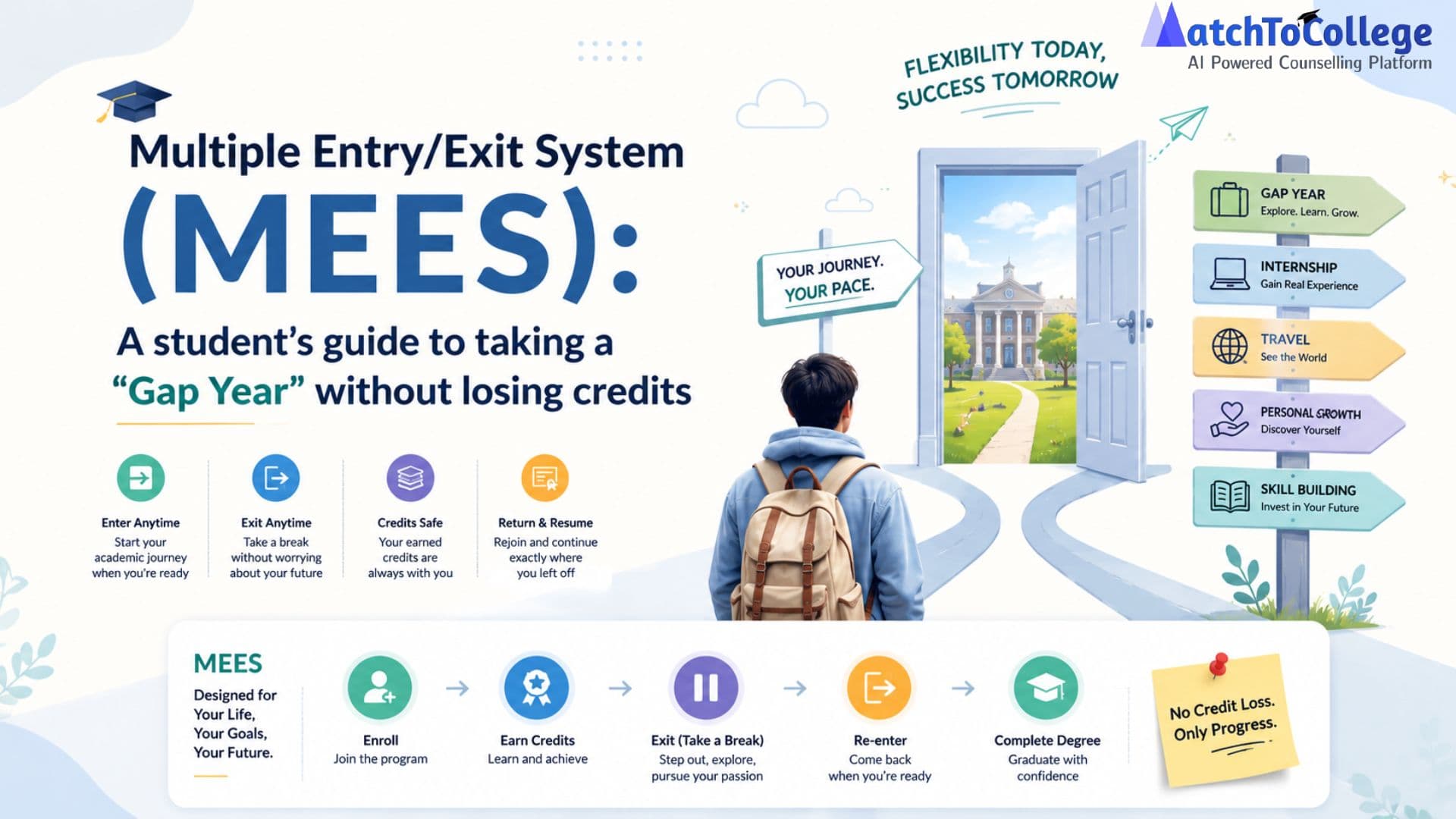
Flexible Learning Without Losing Credits
For many students in India, higher education has always felt like a fixed path — once you start college, you are expected to continue without breaks. Taking a gap year often meant losing time, facing re-admission issues, or even losing completed credits.
That is changing under National Education Policy 2020. The new Multiple Entry/Exit System (MEES) gives students the flexibility to pause and restart their studies without starting over.
MEES supports a more practical approach to education. Students can take a break for internships, work experience, family reasons, health, skill-building, or personal growth — and return later with their academic credits protected.
A key part of this system is the Academic Bank of Credits, which stores earned credits digitally so they can be used when the student resumes the course.
How MEES works
| Stage | What it means |
| Entry | Join a degree program as usual |
| Pause | Leave after a semester/year if needed |
| Credit Storage | Completed credits are saved in ABC |
| Re-entry | Return later and continue from where you stopped |
| Completion | Finish degree without losing earlier progress |
Why students may choose a gap year now
| Reason | How MEES helps |
| Internship | Gain industry experience and return |
| Competitive exam prep | Take time without losing credits |
| Financial reasons | Pause and resume when ready |
| Personal well-being | Reduce burnout and stress |
| Skill learning | Take certified courses before rejoining |
Benefits for students
- No need to restart the entire course
- Previously earned credits remain secure
- Flexible study path based on personal needs
- Easier career exploration during breaks
- Better balance between academics and life
How MatchToCollege helps
MatchToCollege helps students understand changing education policies like MEES and choose the right academic path.
The platform can support students by:
- Comparing colleges using flexible credit systems
- Guiding on gap year planning
- Matching courses with career goals
- Helping students make informed college decisions
What is the Multiple Entry/Exit System (MEES)?
The Multiple Entry/Exit System (MEES), introduced under National Education Policy 2020, makes higher education more flexible for students in India.
Earlier, degree courses followed one fixed route — students had to study continuously until completion. If someone dropped out midway, they often lost both time and academic credits. MEES changes this by allowing students to leave a course at different stages and return later without losing progress.
Under this system, students can exit with a recognized qualification based on how much of the course they have completed.
Exit options under MEES
| Study duration completed | Qualification received |
| 1 year | Certificate |
| 2 years | Diploma |
| 3 years | Bachelor’s Degree |
| 4 years | Bachelor’s Degree with Research (where applicable) |
Role of Academic Bank of Credits (ABC)
The Academic Bank of Credits supports MEES by securely storing all earned academic credits in a digital account.
Think of it as a virtual academic locker. Credits earned from approved colleges and universities are saved there, so students can use them later to continue studies.
Why this matters
MEES gives students the freedom to:
- Pause studies for work, internships, or personal reasons
- Shift between institutions participating in ABC
- Continue education after a break
- Earn valid qualifications even if they exit early
- Complete degrees at their own pace
This makes higher education more student-friendly, reducing pressure and allowing learning to fit real life rather than forcing a single rigid timeline.
How MEES Transforms the "Gap Year" Concept
In India, taking a gap year was often seen negatively — many students worried it would delay their degree, create admission problems, or cause loss of credits.
With National Education Policy 2020 and the Multiple Entry/Exit System (MEES), that has changed. A gap year is now a planned academic pause, not a setback.
Since credits are stored safely in the Academic Bank of Credits, students can leave their course for some time and return later without losing what they have already completed.
Why students may take a gap year under MEES
| Purpose | Benefit |
| Internship | Gain practical work experience |
| Career exploration | Try different fields before continuing |
| Entrepreneurship | Work on a startup or project |
| Personal reasons | Manage health, family, or finances |
| Mental well-being | Take a break and avoid burnout |
How MEES changes the gap year experience
| Before MEES | After MEES |
| Risk of losing credits | Credits remain secure in ABC |
| Complex re-admission | Easy re-entry into studies |
| Gap seen as academic loss | Gap becomes productive learning time |
| Fixed course timeline | Flexible study path |
Why it matters
MEES gives students more control over their education. They can take time to learn outside the classroom, build skills, gain experience, or focus on personal growth — and still return to complete their degree.
A gap year is no longer a risky break. With MEES, it becomes a smart option for students to shape their future at their own pace.
Strategic Benefits of a MEES-Empowered Break
The Multiple Entry/Exit System (MEES) under National Education Policy 2020 allows students in India to take a break from studies without losing academic progress. This makes a gap year more useful and purposeful.
Key benefits of a MEES-supported gap year
| Benefit | How it helps students |
| Personal growth | Time for self-discovery, confidence, and life planning |
| Career clarity | Explore industries through internships or jobs |
| Mental well-being | Take a break from academic stress and burnout |
| Skill development | Learn coding, languages, design, or other practical skills |
| Financial support | Work and save money for future studies |
Why students are choosing this option
- Gain real-world experience
- Internships, freelance work, or apprenticeships help students understand industries before finishing their degree.
- Improve decision-making
- Students can explore interests and make better academic or career choices after the break.
- Build stronger profiles
- Extra certifications, projects, and work experience improve resumes and college applications.
- Focus on well-being
- A break can help students recover from stress and return with better focus.
- Manage finances better
- Some students use this time to earn and support their education costs.
MatchToCollege’s perspective
MatchToCollege sees a MEES-enabled gap year as a positive opportunity, not a delay.
With proper planning, students can use the break to grow personally, gain practical skills, and return to their studies with stronger goals and better career readiness.
Planning Your MEES-Enabled Break: Essential Steps
The Multiple Entry/Exit System (MEES) offers flexibility, but students should plan carefully before taking a break. Proper preparation ensures a smooth return to studies without confusion or credit issues.
Important steps before taking a break
| Step | What to do |
| Check college policy | Understand how your institution applies MEES |
| Verify credits | Make sure all credits are updated in ABC |
| Set goals | Decide what you want to achieve during the break |
| Speak to advisors | Take guidance before exiting the course |
| Plan return | Know when and how you will rejoin |
Things students should focus on
1. Understand your college’s MEES rules
Every college or university may apply MEES differently. Check exit options, re-entry timelines, and credit transfer rules with your institution.
2. Track your credits in ABC
The Academic Bank of Credits stores your earned credits. Before taking a break, confirm all completed credits are correctly recorded.
3. Decide the purpose of your gap year
A planned break works best when there is a goal.
Examples:
- Internship
- Job experience
- Skill learning
- Competitive exam preparation
- Personal or family needs
4. Talk to academic experts
Meet faculty members or advisors to understand how the break may affect your course progression and degree completion.
5. Keep a re-entry plan ready
Know the expected return date and required steps to continue studies. This avoids delays when rejoining.
Why planning matters
A gap year can become a valuable part of your academic journey when used wisely. Instead of interrupting studies, it can add experience, skills, and clarity.
MatchToCollege helps students understand flexible education pathways under National Education Policy 2020 and make better decisions about college, courses, and future plans.
Share this Article
FAQFrequently Asked Questions
Q: Can I take a gap year at any point during my degree program with MEES?
Yes, the Multiple Entry/Exit System (MEES) allows students to pause their studies after completing certain academic levels (e.g., after one year for a certificate, two years for a diploma). You can then exit with the corresponding qualification and re-enter later to continue towards a higher degree, with your accumulated credits preserved in the Academic Bank of Credits (ABC).
Q: How does the Academic Bank of Credits (ABC) ensure my credits aren't lost?
The Academic Bank of Credits (ABC) is a digital repository that stores academic credits earned by students from various Higher Education Institutions (HEIs) across India. When you take a break, your earned credits are securely recorded. Upon re-entry, you can retrieve these credits and redeem them towards your chosen program, preventing any loss and ensuring continuity of your academic journey.
Q: Will all colleges and universities in India adopt MEES?
The National Education Policy (NEP) 2020 mandates the implementation of MEES across all Higher Education Institutions (HEIs) in India. While the transition may vary in pace, the goal is universal adoption to provide students with greater flexibility and autonomy over their educational paths. It's always wise to confirm the specific MEES implementation status with your target institution.
Get More Info About Multiple Entry/Exit System (MEES)
Recommended Reading

Best Online MBA Specializations for High-Paying Careers 2026
Discover the most lucrative online MBA specializations for 2026-27. Compare ROI, career growth, and use our AI tools to find your perfect management path.

Top Career Opportunities After an Online MBA in 2026-27
Discover high-paying career paths and roles after an online MBA in 2026-27. Explore salary trends, ROI, and tools to navigate your future professional success.
Tax Deductions on Higher Education: 2026-27 India Guide
Maximize your savings with our guide on tax deductions for higher education fees in India for FY 2026-27. Learn about Section 80C, 80E, and upskilling benefits.