

MBBS vs BDS: Your Guide to Medical Career Paths
Admission & Info Tools
Need Expert Assistance?
Our counselors can help you with fee structures, eligibility guidelines, and upcoming admission cutoffs instantly.
Direct Application Tools
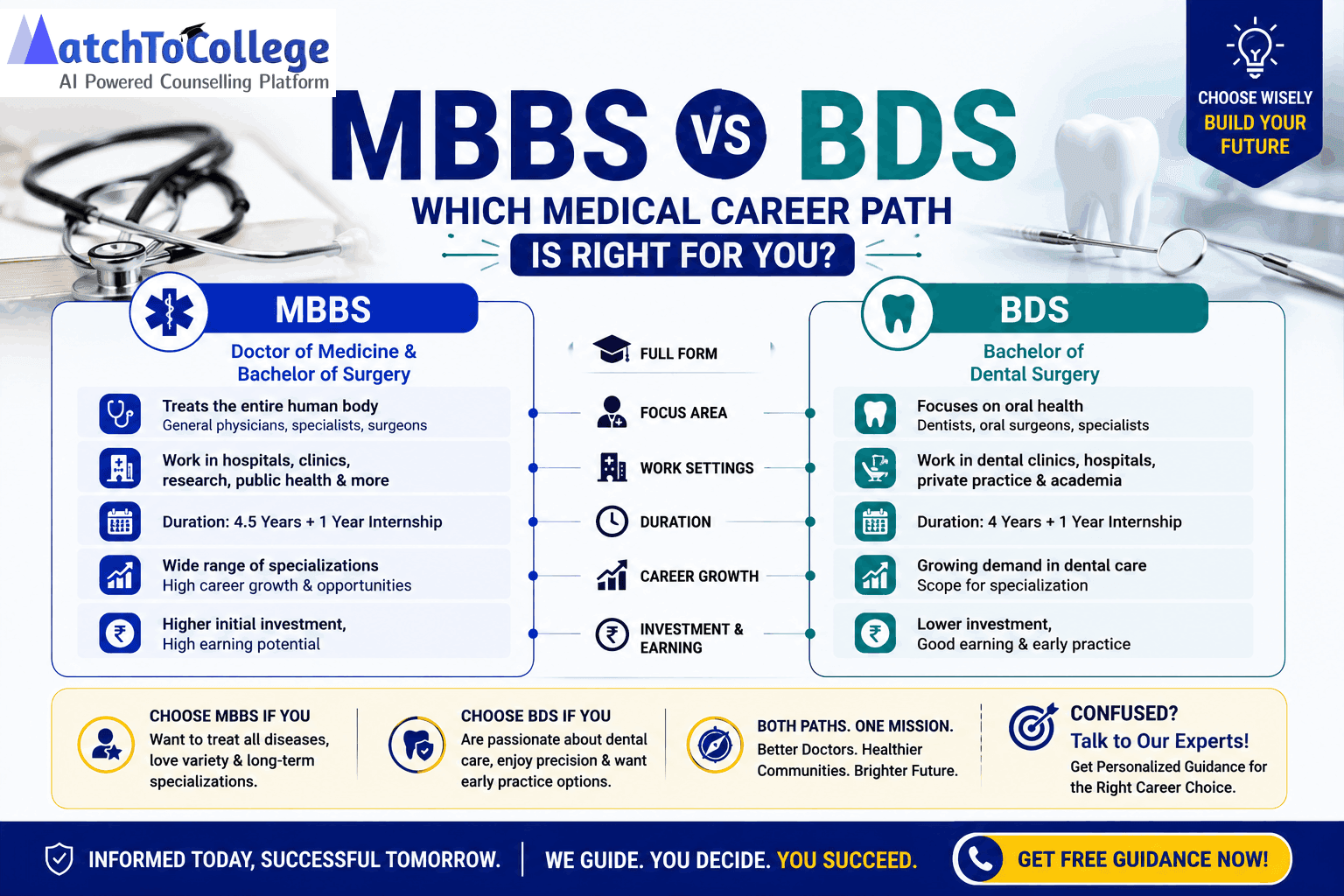
Embarking on a career in medicine is a noble and highly rewarding pursuit, but the first major hurdle for aspiring healthcare professionals often lies in choosing the right path. For many students in India, this crucial decision boils down to two primary options: Bachelor of Medicine, Bachelor of Surgery (MBBS) and Bachelor of Dental Surgery (BDS).
Both degrees open doors to respected medical professions, yet they lead to distinct specializations, career trajectories, and daily responsibilities. Understanding the fundamental differences between MBBS and BDS is vital to making an informed choice that aligns with your passion, aptitude, and long-term career aspirations. This comprehensive guide from MatchToCollege will delve into the intricacies of each course, helping you weigh the pros and cons, explore career prospects, and ultimately decide which medical career path is truly for you.
As you navigate this important decision, remember that personalized guidance can make all the difference. Explore your admission chances and discover top medical colleges tailored to your NEET score with our advanced MBBS College Predictor.
Understanding MBBS: The Path to Becoming a Doctor
MBBS is the foundational degree for aspiring doctors, covering a vast spectrum of human health. The curriculum is extensive, typically spanning 5.5 years (4.5 years of academic study and 1 year of compulsory rotating internship), focusing on anatomy, physiology, biochemistry, pathology, pharmacology, microbiology, forensic medicine, community medicine, and clinical subjects like general medicine, general surgery, pediatrics, obstetrics & gynecology, and various super-specialties.
Graduates with an MBBS degree can pursue various specializations such as cardiology, neurology, oncology, dermatology, orthopedics, and many more, requiring further postgraduate studies (MD/MS). Career opportunities are immense, ranging from clinical practice in hospitals and private clinics to research, public health, medical education, and administrative roles. The demand for qualified doctors remains consistently high, offering significant career growth and the profound satisfaction of saving lives and alleviating suffering.
Exploring BDS: A Deep Dive into Dental Sciences
BDS is the undergraduate program dedicated to oral health, preparing students to become dentists. This 5-year course (4 years of academic study and 1 year of compulsory rotating internship) focuses specifically on the diagnosis, prevention, and treatment of diseases and conditions affecting the oral cavity, including teeth, gums, and surrounding structures. Key subjects include dental anatomy, dental materials, oral pathology, periodontology, orthodontics, oral surgery, prosthodontics, and pediatric dentistry.
After completing BDS, graduates can pursue higher education (MDS) in specializations like orthodontics (braces), endodontics (root canal treatments), oral and maxillofacial surgery, periodontics (gum diseases), and prosthodontics (artificial teeth). Dentists can establish private practices, work in hospitals, join the armed forces, or contribute to public health initiatives. The field offers a good work-life balance and the satisfaction of enhancing smiles and improving overall oral health.
Key Differences: MBBS vs. BDS at a Glance
While both are respected medical fields, their scope, focus, and daily work differ significantly:
- Scope: MBBS deals with the entire human body and its systems, while BDS specializes in the oral and maxillofacial region.
- Patient Interaction: MBBS doctors typically handle a broader range of medical conditions and emergencies, often in a hospital setting. BDS dentists focus on oral health, often in clinic settings.
- Specializations: MBBS offers a vast array of medical and surgical specializations. BDS offers specific dental specializations.
- Work Environment: MBBS doctors may work in hospitals, emergency rooms, or private clinics. BDS dentists predominantly work in dental clinics, hospitals, or academic institutions.
- Demand: Both professions are in high demand, but the nature of the demand and patient care differs.
Choosing between these two requires introspection into your interests. Are you fascinated by systemic diseases and broad medical interventions, or is your passion more directed towards intricate procedures within the oral cavity? Your aptitude for precision, patience, and direct patient interaction will also play a role.
How to Choose: Factors to Consider
Making the right choice involves evaluating several factors:
- Passion & Interest: Do you have a stronger interest in general medicine and surgery, or are you drawn to dental procedures and oral care?
- Aptitude: MBBS often requires strong analytical and problem-solving skills for complex systemic diagnoses. BDS demands fine motor skills, precision, and an artistic touch for dental procedures.
- Future Goals: Consider the type of lifestyle and work environment you envision. Are you comfortable with long, unpredictable hours often associated with MBBS specializations, or do you prefer a more structured clinic-based schedule?
- Financial Investment & Returns: Both degrees require significant investment in time and money. Research average earnings for both professions in your region to set realistic expectations.
- Work-Life Balance: While both professions can be demanding, certain dental specializations might offer a more predictable work schedule compared to some medical fields.
To further refine your decision and assess your chances of admission into top colleges, don't forget to leverage our powerful MBBS College Predictor. It's an indispensable tool for understanding your options based on your NEET scores.
Unlock Your Future: Use the <a href="https://matchtocollege.com/tools/neet-college-predictor">MBBS College Predictor</a>
At MatchToCollege, we understand that this is one of the most significant decisions of your academic life. Our AI-powered platform is designed to provide you with personalized guidance, helping you cut through the confusion and make a choice that sets you up for success. Whether you're leaning towards becoming a doctor or a dentist, having a clear understanding of your admission prospects is crucial.
Our advanced MBBS College Predictor is more than just a tool; it's your gateway to understanding which medical and dental colleges you might qualify for based on your NEET performance. By analyzing historical data and complex algorithms, it offers accurate predictions, helping you strategize your college applications effectively.
Don't leave your future to chance. Explore your best college matches, understand cut-offs, and make informed decisions with MatchToCollege. Take the first step towards a fulfilling medical career today – your journey starts with an informed choice and the right tools. Access the MBBS College Predictor now!
Share this Article
FAQFrequently Asked Questions
Q: Is MBBS harder than BDS?
Both MBBS and BDS are challenging courses requiring dedication. MBBS covers a broader scope of the human body and systemic diseases, often perceived as more demanding due to the vastness of medical knowledge. BDS requires high precision, fine motor skills, and an in-depth understanding of oral anatomy and procedures. The difficulty is subjective and depends on individual aptitude and interest.
Q: Which has better scope, MBBS or BDS?
Both fields have excellent scope. MBBS offers diverse career paths in medicine, surgery, research, and public health, with high demand for specialists. BDS offers stable career opportunities in private practice, hospitals, and specialized dental fields. The 'better' scope depends on your personal definition of success, interest in the field, and desired work-life balance.
Q: What is the average salary for MBBS vs BDS graduates in India?
Salaries vary significantly based on specialization, experience, location, and type of employer (government vs. private). Generally, an MBBS graduate starting as a junior resident might earn around ₹40,000-₹70,000 per month, increasing substantially with specialization and experience (₹1-5 lakhs+ for specialists). A BDS graduate starting out might earn ₹25,000-₹50,000 per month, with private practice owners potentially earning much more over time. These figures are approximate and subject to change.
Q: Can I switch from BDS to MBBS?
No, you cannot directly switch from a BDS degree to an MBBS degree. They are distinct undergraduate programs. If you wish to pursue MBBS after completing BDS, you would need to reappear for the NEET UG exam and qualify for admission into an MBBS program, starting the course from the first year, similar to any other new applicant.
Get More Info About MBBS vs BDS
Recommended Reading

Best Online MBA Specializations for High-Paying Careers 2026
Discover the most lucrative online MBA specializations for 2026-27. Compare ROI, career growth, and use our AI tools to find your perfect management path.

Top Career Opportunities After an Online MBA in 2026-27
Discover high-paying career paths and roles after an online MBA in 2026-27. Explore salary trends, ROI, and tools to navigate your future professional success.

Tax Deductions on Higher Education: 2026-27 India Guide
Maximize your savings with our guide on tax deductions for higher education fees in India for FY 2026-27. Learn about Section 80C, 80E, and upskilling benefits.