

MBBS Abroad vs. India Private Colleges: 2026 Cost Guide
Admission & Info Tools
Need Expert Assistance?
Our counselors can help you with fee structures, eligibility guidelines, and upcoming admission cutoffs instantly.
Direct Application Tools
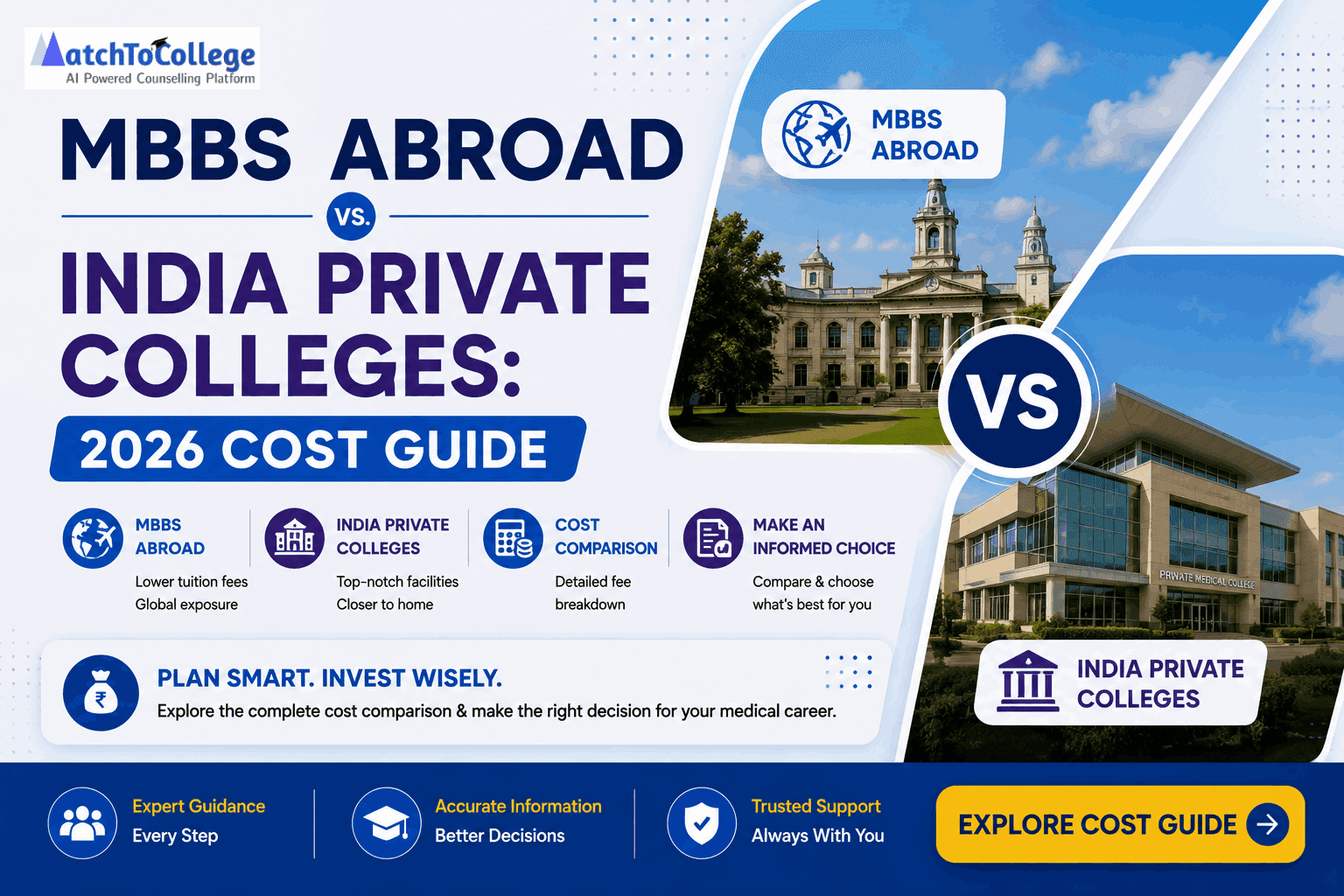
For thousands of Indian medical aspirants, the dream of wearing a white coat often hits a financial roadblock. As we look ahead to the 2026-27 academic session, the disparity between government medical seats and the number of qualified NEET candidates continues to widen. This gap forces a difficult choice: pay the exorbitant fees of Indian private medical colleges or venture across borders for an MBBS degree. The central question remains—is MBBS abroad really cheaper than Indian private colleges, or are there hidden costs that even the most diligent parents overlook?
In 2026, the landscape of medical education is shifting. Inflation, updated regulatory norms by the National Medical Commission (NMC), and the global economic climate have impacted tuition fees both at home and abroad. While Indian private institutions offer the comfort of staying in one's home country, their price tags have reached levels that many middle-class families find unsustainable. Conversely, destinations like Georgia, Russia, Kazakhstan, and Uzbekistan have streamlined their offerings to attract international students, positioning themselves as high-value alternatives.
At MatchToCollege, we utilize AI-driven data to provide students with a realistic, transparent view of their educational investments. This guide doesn't just look at tuition fees; it deep-dives into the total cost of ownership of a medical degree, including living expenses, licensing exam coaching, and the return on investment (ROI) for the 2026-27 cycle. Whether you are a NEET high-scorer or someone looking for a second chance, understanding these financial dynamics is crucial for your career trajectory.
The Financial Reality of Indian Private Medical Colleges in 2026
Indian private medical colleges have long been known for their high entry barriers—not just academically, but financially. For the 2026-27 session, tuition fees in reputable private institutions are projected to range from ₹60 lakhs to over ₹1.2 crores for the entire 4.5+1 year duration. This does not include the 'Management Quota' or 'NRI Quota' seats, where prices can skyrocket even further. When you factor in hostel fees, mess charges, and annual 'miscellaneous' deposits, a middle-class family is often looking at a total expenditure exceeding ₹1.5 crores.
One of the biggest financial traps in Indian private education is the 'hidden increment.' Many colleges have a policy of increasing tuition fees by 5% to 10% every year, meaning the fee you sign up for in your first year isn't necessarily what you'll pay in your final year. Additionally, the competition for even these expensive seats is fierce. With nearly 25 lakh students expected to appear for NEET by 2026, the demand-supply mismatch allows private colleges to maintain high price points without necessarily improving clinical infrastructure.
Furthermore, many Indian private colleges are located in suburban areas where the cost of living is rising. Students often find themselves spending significantly on transport, specialized books, and mandatory equipment. When compared to the salary of a junior resident in India (averaging ₹40,000 to ₹60,000 per month), the ROI on a ₹1 crore investment can take over a decade to break even. This realization is what is driving the massive exodus of Indian students to foreign medical universities.
Breaking Down the Costs of MBBS Abroad: 2026 Estimates
Studying MBBS abroad is frequently marketed as a 'budget-friendly' option, but is it realistically so for 2026? The short answer is yes, but with caveats. In popular destinations like Russia, Uzbekistan, and Kazakhstan, the total tuition fee for a 6-year program typically ranges between ₹18 lakhs and ₹35 lakhs. Even in premium European destinations like Georgia or Poland, the costs stay well within the ₹40 lakhs to ₹60 lakhs bracket. This is roughly one-third to one-half the cost of a private seat in India.
For the 2026-27 session, countries like Uzbekistan have become hotspots due to government-subsidized education and modern infrastructure built specifically to meet NMC (National Medical Commission) guidelines. These universities offer the 'English Medium' curriculum which is a mandatory requirement for Indian students to be eligible for the NExT (National Exit Test). Unlike Indian colleges, most foreign universities have fixed tuition fees for the duration of the course, providing financial predictability to parents.
However, it is vital to account for the 'Real Cost.' A realistic budget for MBBS abroad in 2026 must include: 1) Tuition Fees, 2) Hostel and Food (approx. ₹2-3 lakhs/year), 3) Annual Flight Tickets (₹60k-₹1 lakh), and 4) Visa Renewal Fees. Even after adding these, the total cost for a 6-year degree in a country like Kyrgyzstan might be around ₹35 lakhs total, which is still significantly lower than the *cheapest* private college in India. The primary financial advantage of going abroad is the absence of 'capitation fees' or 'donations,' which remain an unofficial reality in many Indian private sectors.
Share this Article
FAQFrequently Asked Questions
Q: What is the average cost of MBBS in Indian private colleges in 2026?
For the 2026-27 session, the average cost ranges from ₹60 lakhs to ₹1.2 crores, excluding hostel and hidden charges. Premium private universities may charge even more under management quotas.
Q: Which are the cheapest countries for MBBS abroad for Indian students in 2026?
Russia, Uzbekistan, Kazakhstan, and Kyrgyzstan remain the most affordable, with total package costs (tuition + hostel) ranging between ₹20 lakhs and ₹35 lakhs for the entire duration.
Q: Does the NMC recognize MBBS degrees from abroad in 2026?
Yes, provided the university is recognized by the WHO and the specific country's medical council, and the course meets the NMC's Foreign Medical Graduate Licentiate (FMGL) Regulations, which include a 54-month course duration and English medium instruction.
Q: Is the NExT exam mandatory for both Indian and abroad medical students?
Yes, starting from the batches graduating around 2026-28, the National Exit Test (NExT) will be the uniform licentiate exam for all medical graduates in India, regardless of where they studied.
Top Colleges Covered in this Blog

Manipal University
Manipal University
Online Manipal Jaipur offers UGC-entitled degrees fully online, combining academic rigour, flexible delivery, and a robust LMS, with programs designed to meet industry standards through skilled faculty and global mentors
Total Fees
₹80K - ₹1.8L
Total Courses
5
Get More Info About MBBS Abroad vs. India Private Colleges
Recommended Reading

Best Online MBA Specializations for High-Paying Careers 2026
Discover the most lucrative online MBA specializations for 2026-27. Compare ROI, career growth, and use our AI tools to find your perfect management path.

Top Career Opportunities After an Online MBA in 2026-27
Discover high-paying career paths and roles after an online MBA in 2026-27. Explore salary trends, ROI, and tools to navigate your future professional success.

Tax Deductions on Higher Education: 2026-27 India Guide
Maximize your savings with our guide on tax deductions for higher education fees in India for FY 2026-27. Learn about Section 80C, 80E, and upskilling benefits.