

MBA Specializations: Finance vs Marketing vs PM vs Analytics
Admission & Info Tools
Need Expert Assistance?
Our counselors can help you with fee structures, eligibility guidelines, and upcoming admission cutoffs instantly.
Direct Application Tools
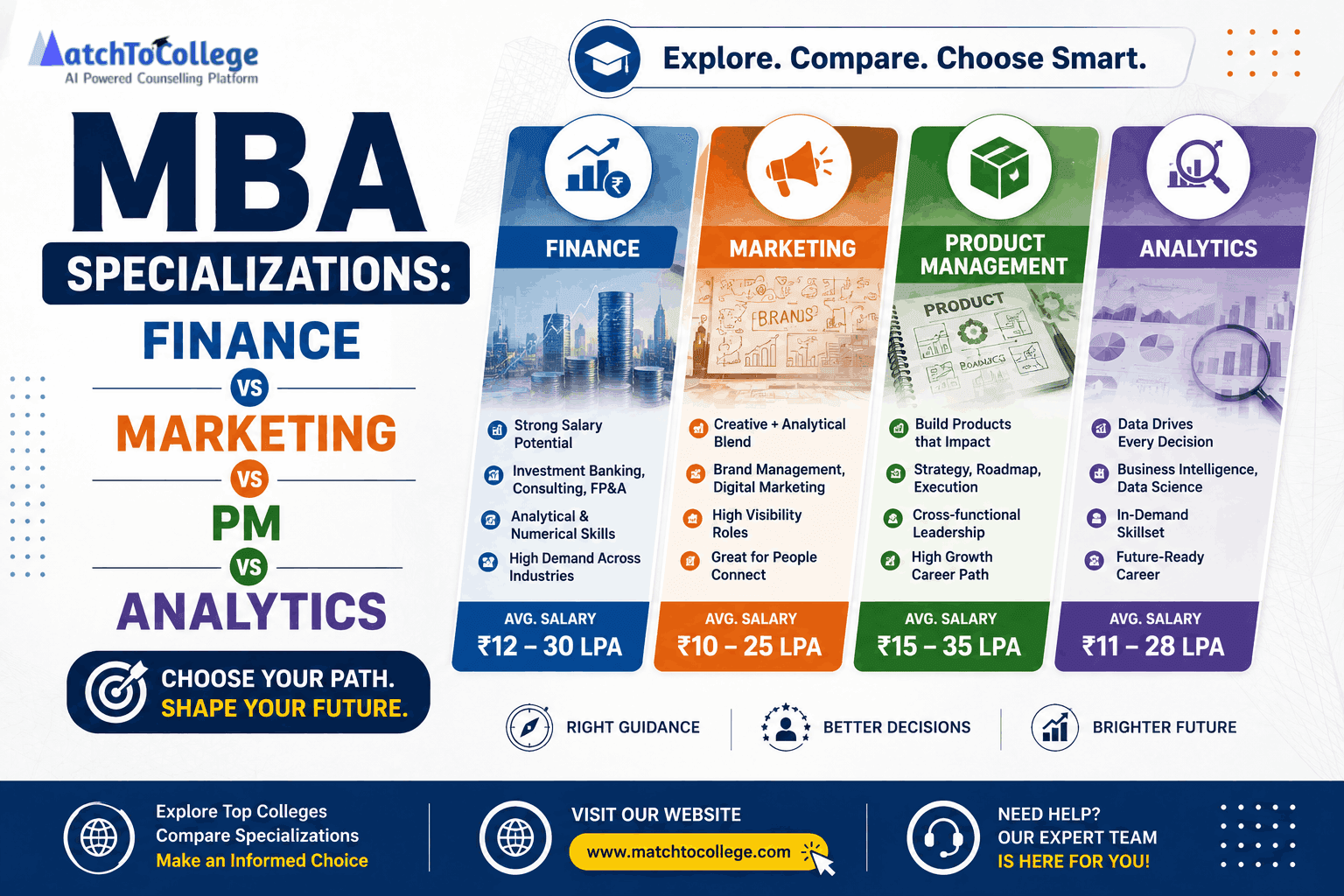
In 2024, the Graduate Management Admission Council (GMAC) reported that while traditional Finance remains a cornerstone of the MBA landscape, demand for Business Analytics and Product Management has surged by over 21% in tech-heavy markets like Bangalore, San Francisco, and London.
Choosing between these four pillars—Finance, Marketing, Product Management, and Business Analytics—is no longer just about personal preference; it is about calculating the precise intersection of skill sets and market demand. For instance, an MBA in Finance at a top-tier Indian institute might command an average starting package of ₹28 Lakhs, whereas a specialized Product Management role in the SaaS sector could potentially start at ₹32 Lakhs for those with prior technical experience.
At MatchToCollege, we monitor the specific intake shifts of premier B-schools through our CAT College Predictor, ensuring that candidates match their academic profile with the specialization that yields the highest institutional placement record. Unlike generic counseling, we evaluate how your undergraduate CGPA translates into eligibility for these competitive tracks using tools like the CGPA to Percentage Calculator to meet strict university screening criteria.
The landscape of 2026 admissions suggests that multi-disciplinary skills are the new gold standard. A Finance major is now expected to understand FinTech analytics, and a Marketing professional is incomplete without mastery of data attribution models. This guide breaks down the core competencies, salary benchmarks, and long-term career trajectories for each of these four dominant specializations to help you identify which path aligns with your quantitative or qualitative strengths. We also integrate critical financial planning resources, such as the Education Loan EMI Calculator, to help you visualize the fiscal reality of these high-stakes degrees before you sign an admission offer.
As you navigate these choices, consider that the 'best' specialization is a function of the Return on Investment (ROI). You can specifically Calculate Your University ROI Compare to see how an MBA in Business Analytics stacks up against a traditional Marketing degree in terms of debt-to-income ratio over a five-year horizon. This deep dive focuses on the actual mechanics of the roles, the industries currently hiring, and the specific academic requirements you must meet today to secure a seat in tomorrow's elite cohorts.
The Finance Track: Quantitative Rigor and Capital Markets
An MBA in Finance remains the most sought-after specialization for those aiming for roles in Investment Banking (IB), Private Equity (PE), and Corporate Finance. In the current fiscal cycle, the global financial sector has shown resilience, with a specific focus on Risk Management and ESG (Environmental, Social, and Governance) investing.
Finance professionals are tasked with managing asset portfolios, analyzing financial statements, and overseeing mergers and acquisitions. The curriculum typically involves intensive modules on Derivatives, Fixed Income Securities, and Advanced Macroeconomics. For students aiming for international markets, understanding the conversion of high-value compensation packages is essential; you can use our million to rupees calculator to gauge how a $150,000 Wall Street salary translates into domestic purchasing power.
Career progression in Finance is often structured, moving from Associate to Vice President and eventually Managing Director. However, the barrier to entry is high, often requiring a stellar quantitative background. If you are questioning your fit, the Career Pathway Matcher can help determine if your analytical temperament suits the high-pressure environment of a trading floor or the meticulous nature of equity research.
Historically, Finance has the most stable ROI, though the work-life balance is frequently cited as the most challenging among the four specializations. Top recruiters include firms like Goldman Sachs, J.P. Morgan, and Morgan Stanley, where placement is highly dependent on your B-school ranking, often tracked through the CAT College Predictor for Indian applicants. Success in this field requires not just an affinity for numbers but a deep understanding of global regulatory frameworks and the ability to forecast market shifts based on geopolitical events.
Marketing: The Fusion of Psychology and Digital Strategy
Marketing has evolved from a creative endeavor into a data-driven science. A modern MBA in Marketing focuses heavily on Consumer Behavior, Digital Ecosystems, and Brand Management. Unlike Finance, which is largely internally focused on capital, Marketing is externally focused on the customer journey. According to LinkedIn's 2024 Emerging Jobs Report, roles in Digital Growth and Brand Strategy have seen a 14% increase in demand. Students in this specialization learn to leverage social media analytics, SEO, and omnichannel distribution to drive revenue.
If you are considering an online or executive track for this field, it is vital to evaluate the completion probability using the Online Degree Passing Predictor, as these programs require high self-discipline. Marketing is ideal for those with high emotional intelligence and strong communication skills. The career path often leads to roles like Brand Manager, Product Marketer, or Chief Marketing Officer (CMO). In terms of remuneration, while starting salaries may be slightly lower than Finance or Product Management, the ceiling for successful marketers in the FMCG (Fast-Moving Consumer Goods) or Tech sectors is exceptionally high.
When comparing domestic vs. international opportunities, our million to lakhs calculator provides a quick way to compare brand manager salaries across borders. Furthermore, for those looking at diversified educational options, exploring domestic colleges can reveal niche marketing programs that specialize in the burgeoning rural marketing or e-commerce sectors in India. The key differentiator for Marketing in the 2020s is the integration of MarTech—using software to automate and optimize marketing tasks—making a baseline understanding of analytics almost mandatory for any marketing professional.
Product Management: The Modern Intersection of Tech and Business
Product Management (PM) has emerged as the most popular MBA specialization for those coming from a technical or engineering background. Often referred to as the 'Mini-CEO' of a product, a PM is responsible for the entire lifecycle of a product—from conception and engineering to marketing and sales. This role requires a unique blend of technical literacy, business acumen, and user experience (UX) empathy.
In the tech hubs of the world, PM roles often offer the highest entry-level salaries for MBA graduates. To ensure your undergraduate grades meet the requirements of top-tier PM programs, use our GPA to Percentage Calculator. The daily life of a PM involves prioritizing feature roadmaps, conducting A/B testing, and managing cross-functional teams of designers and developers.
This specialization is particularly lucrative in the SaaS, Fintech, and HealthTech sectors. For students transitioning from an engineering background, the JEE Rank Predictor history often correlates with the high-analytical aptitude expected in top PM cohorts. However, the competition is fierce, and candidates often need to supplement their MBA with certifications in Agile or Scrum methodologies. You can evaluate the cost-benefit of these additional certifications with the Online Courses ROI Calculator.
The ultimate goal for most in this track is to reach the 'Product Leader' or 'Head of Product' level, where they dictate the strategic direction of entire software ecosystems. Unlike Marketing, PM is less about 'selling' and more about 'building the right thing' for the market, making it a critical role in any innovation-led company.
Business Analytics: Decoding the Big Data Economy
Business Analytics (BA) is the fastest-growing MBA specialization, driven by the global explosion of big data. By 2026, the global data analytics market is projected to reach over $500 billion. An MBA in Business Analytics prepares students to use statistical tools, machine learning, and data visualization to solve complex business problems.
This track is less about the 'what' and more about the 'why' behind business trends. Students learn Python, R, SQL, and Tableau alongside traditional business modules like Operations and Supply Chain Management. For those concerned about the mathematical intensity, checking your academic alignment via the SGPA to Percentage Calculator can provide a clearer picture of your quantitative standing.
Career roles include Data Scientist (Management), Business Intelligence Manager, and Strategy Consultant. The salary trajectory for Business Analytics is steeply upward, often rivaling Finance in terms of hourly compensation. Use the million to crore calculator to visualize the massive budget sizes analytics managers handle in multinational corporations. Furthermore, if you are looking to enter this field through specialized exams, keeping an eye on the GATE College Predictor or CUET PG College Predictor is essential for those eyeing data-centric master's programs that bridge the gap to an MBA.
Business Analytics is the ideal choice for someone who enjoys problem-solving through evidence rather than intuition. It offers the most flexibility across industries, as every sector—from healthcare to retail—now requires high-level data interpretation to remain competitive in a digital-first economy.
Comparing ROI and Financial Feasibility
When choosing between these four paths, the financial implications are as important as the curriculum. A Finance MBA might require higher upfront costs due to the prestige of the institutions offering the best placements, while a Business Analytics degree might offer a faster break-even point due to the current supply-demand gap for data professionals.
To accurately plan your journey, you must consider the long-term debt servicing. Our Education Loan EMI Calculator allows you to input your expected tuition and compare it against the median starting salaries of these specializations. For instance, if you take a loan of ₹40 Lakhs for a Marketing MBA, your EMI might consume a significant portion of your initial post-tax income compared to a Product Management role where signing bonuses are more common.
Additionally, for those considering international exposure, the study abroad section of MatchToCollege provides insights into how these specializations perform in the US, UK, and European markets. It is also worth checking the Online Courses ROI Calculator if you are opting for a hybrid or distance learning model, which is becoming increasingly popular for Business Analytics.
Ultimately, your choice should be a balance of your innate skill set—identified through the Career Pathway Matcher—and the financial reality of the industry you wish to enter. Whether it is the high-stakes world of Finance or the data-driven realm of Analytics, the goal is to ensure that your degree serves as a launchpad for a sustainable and lucrative career.
Share this Article
Get More Info About MBA Specializations
Recommended Reading

Direct vs Agency MBBS Abroad: Avoid Admission Scams & Traps
Learn to distinguish between direct university admissions and agency-led traps for MBBS abroad. Identify hidden costs and avoid fraudulent consultancy scams.

2026 Exam Strategy: NEET & JEE Rank Predictors & ROI Guide
Master the 2026 JEE and NEET landscapes with data-driven prep strategies, OMR precision tools, and ROI-focused college selection for engineering and medical aspirants.

BSMI Review 2026-27: Fees, FMGE Rates & Indian Mess
Get an in-depth BSMI review for 2026-27. Explore Bukhara State Medical Institute fees, Indian mess facilities, hostel quality, and FMGE/NExT passing rates.