

MBA After Engineering: Best Career Options & Salary (2024)
Admission & Info Tools
Need Expert Assistance?
Our counselors can help you with fee structures, eligibility guidelines, and upcoming admission cutoffs instantly.
Direct Application Tools
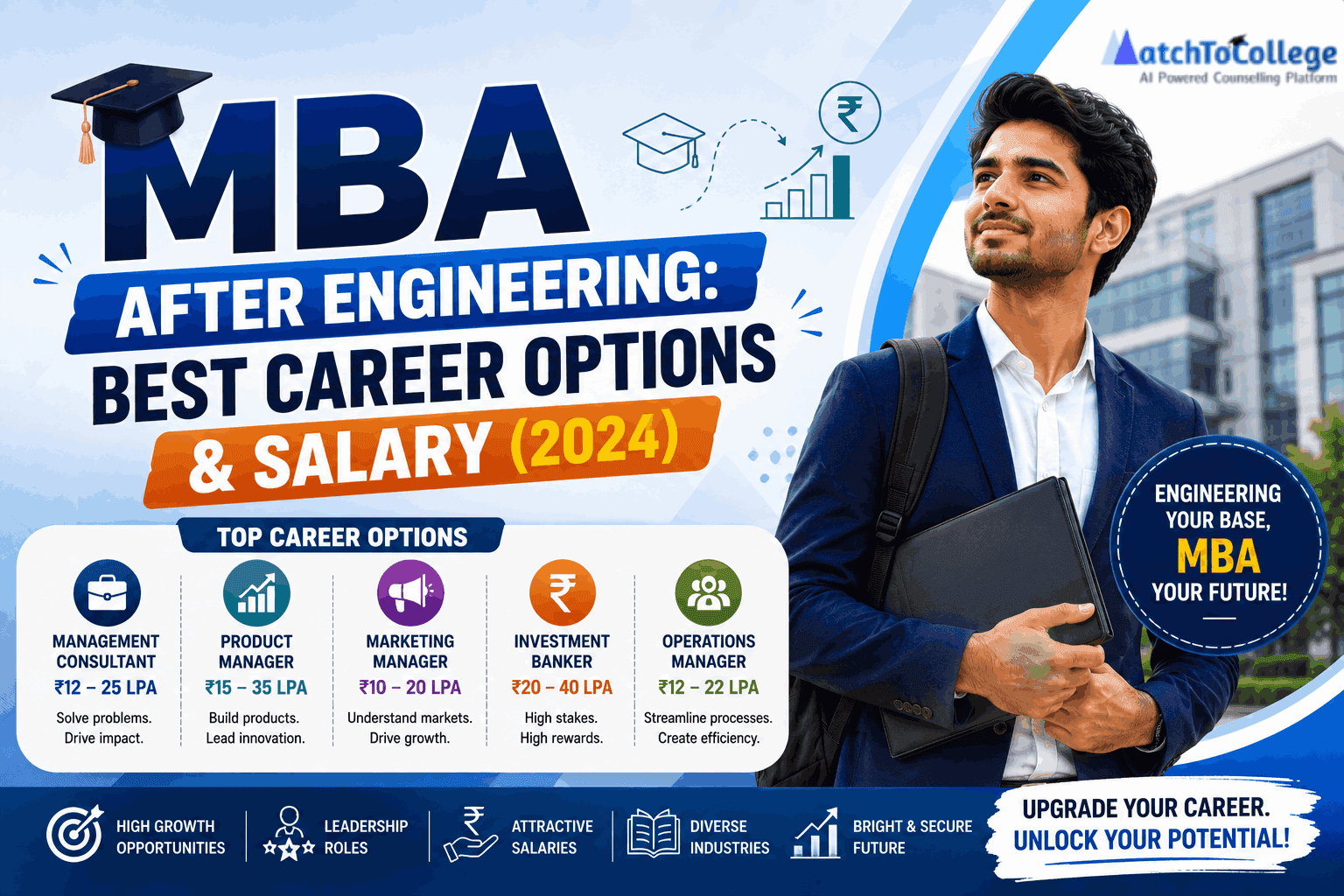
The combination of a Bachelor of Technology (B.Tech) and a Master of Business Administration (MBA) is one of the most powerful academic duos in the global job market. For many engineers, the journey began with the rigorous grind of entrance exams, often utilizing tools like the JEE Main Rank Predictor to secure a spot in a top-tier institute.
However, as careers progress, many professionals find that technical expertise alone isn't enough to reach the C-suite. This is where an MBA becomes a game-changer.
Transitioning from a technical role to a managerial one requires a shift in mindset. Whether you are looking to stay in the tech industry as a Product Manager or pivot entirely into Finance or Consulting, an MBA provides the necessary toolkit.
Before diving into this investment, it is crucial to assess your trajectory using a Career Pathway Matcher to ensure your goals align with the curriculum. In this guide, we explore the most lucrative career paths for engineers who choose the management route.
Why Engineers are Preferred for MBA Programs
Engineers often possess strong analytical, mathematical, and problem-solving skills—qualities that are highly valued in management.
Top B-schools globally actively recruit engineering graduates because they can bridge the gap between technical execution and business strategy. If you are currently applying and need to convert your technical grades, our CGPA to Percentage Calculator can help standardize your application for various university requirements.
Furthermore, the data-driven approach learned in engineering helps in complex decision-making processes within a business environment. To see if you are ready for the competitive landscape of top management institutes, you can check your chances using the CAT College Predictor.
Top High-Paying Career Paths After MBA
- Product Management: Ideal for engineers who want to stay close to technology while making strategic product decisions.
- Management Consulting: Firms like McKinsey and BCG love engineers for their logical structured thinking.
- Operations & Supply Chain: Leveraging technical understanding to optimize manufacturing and logistics.
- Investment Banking: For those with high quantitative aptitude looking for top-tier salaries.
Before committing to a program, it is vital to Calculate Your University ROI to compare different colleges and their placement outcomes.
If you are considering an MBA from a technical standpoint, you might also be interested in how it compares to technical masters like M.Tech; you can explore potential outcomes using the GATE College Predictor for a comparative analysis.
Financial Planning and Salary Expectations
An MBA is a significant financial commitment. Most students opt for financing to cover the tuition fees of premier institutes.
To plan your finances effectively, utilize our Education Loan EMI Calculator. Post-MBA salaries for engineers typically see a 50% to 150% jump compared to their pre-MBA technical roles.
For those looking at international options, check our Study Abroad section to find global programs that offer the best global career mobility. If you are still unsure about the transition, use the Online Degree Passing Predictor to see if a flexible learning path suits your current professional commitments.
Share this Article
FAQFrequently Asked Questions
Q: Is an MBA worth it for an engineer?
Yes, an MBA helps engineers move into leadership roles, significantly increases salary potential, and provides a broader understanding of business operations beyond technical execution.
Q: Which MBA specialization is best for engineers?
Product Management, Operations, Data Analytics, and Finance are the most popular and lucrative specializations for engineering graduates.
Q: Do I need work experience for an MBA after B.Tech?
While some programs (like those in India) admit freshers, most global MBA programs prefer 2-5 years of work experience to ensure students can contribute to classroom discussions.
Get More Info About MBA After Engineering
Recommended Reading

LBSIM Delhi & GIBS 2027 Admissions Open: Apply Online Now
LBSIM Delhi and GIBS Bangalore open 2027 admissions. Explore PGDM, MBA, and BBA application details, early bird offers, and WBJEE/TNEA 2026 counseling updates.

Best Online MBA Specializations for High-Paying Careers 2026
Discover the most lucrative online MBA specializations for 2026-27. Compare ROI, career growth, and use our AI tools to find your perfect management path.

Top Career Opportunities After an Online MBA in 2026-27
Discover high-paying career paths and roles after an online MBA in 2026-27. Explore salary trends, ROI, and tools to navigate your future professional success.