

Is NEET Mandatory for MBBS Abroad? 2026-27 Rules
Admission & Info Tools
Need Expert Assistance?
Our counselors can help you with fee structures, eligibility guidelines, and upcoming admission cutoffs instantly.
Direct Application Tools
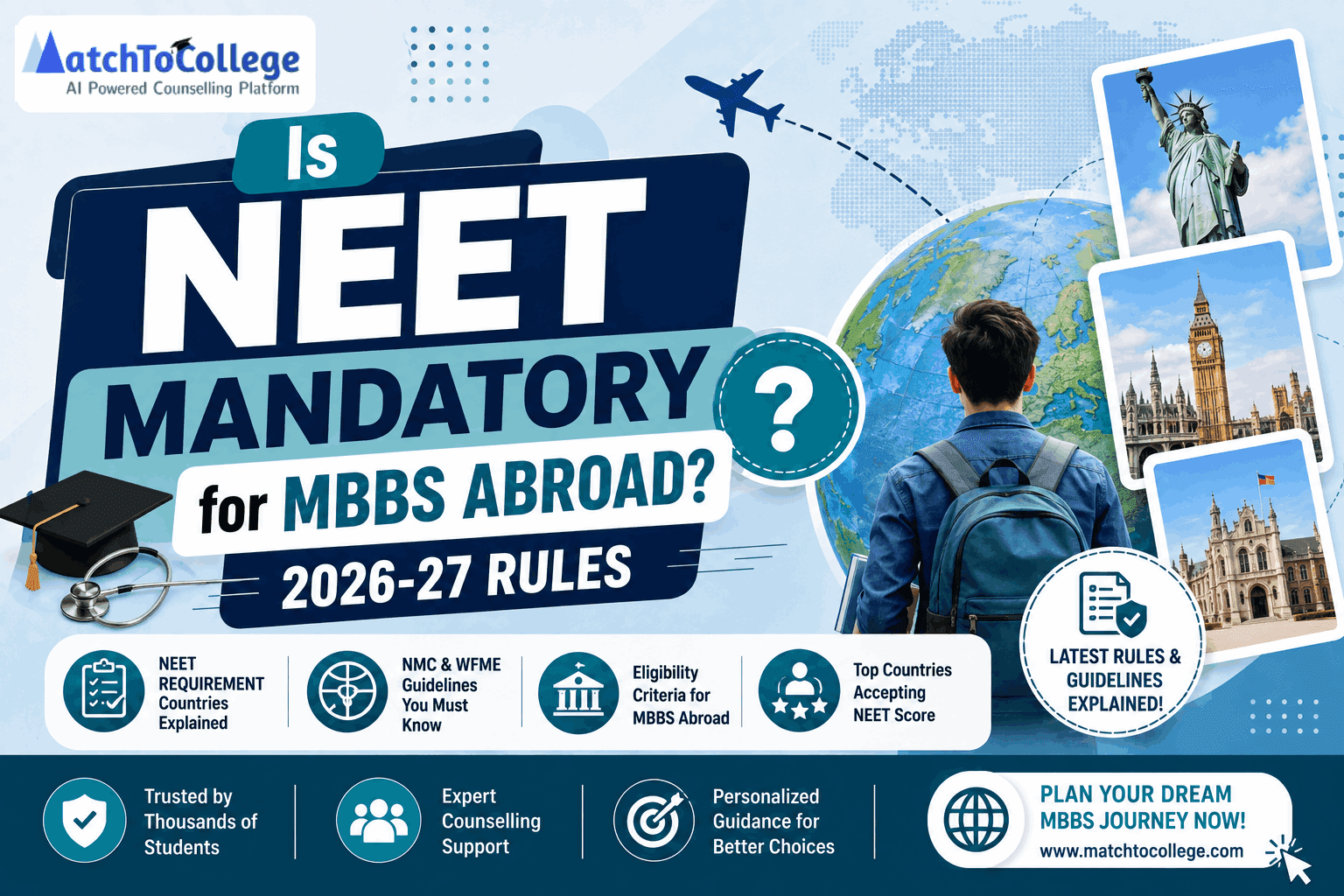
Choosing to pursue a medical degree outside of India has become a popular and strategic path for thousands of Indian students every year. With the increasing competition for limited seats in government medical colleges and the high costs of private institutions within the country, international destinations like Georgia, Russia, Kazakhstan, Uzbekistan, and various European nations have emerged as viable alternatives.
However, the most critical question that haunts every medical aspirant and their parents is: Is NEET qualification mandatory for MBBS abroad in the 2026-27 academic session? The short answer is a definitive yes, but the nuances of the regulations, validity periods, and official guidelines from the National Medical Commission (NMC) require a much deeper exploration to ensure your career is secure.
As we approach the 2026-27 admission cycle, the regulatory landscape for Foreign Medical Graduates (FMGs) continues to evolve. The transition from the Medical Council of India (MCI) to the National Medical Commission (NMC) brought about stringent rules designed to standardize the quality of medical professionals returning to India. For students, this means that the decision to study abroad is no longer just about finding an affordable university; it is about ensuring that the degree obtained is recognized by Indian authorities.
At MatchToCollege, we leverage AI-powered insights to help students navigate these complex regulatory frameworks, ensuring that their chosen path aligns perfectly with Indian licensure requirements. This guide serves as a comprehensive roadmap for understanding the NEET mandate and the associated legalities for the upcoming academic years.
The NEET-UG (National Eligibility cum Entrance Test) has been established as the single-point entry for medical education for Indian citizens, regardless of whether they study in India or abroad. In the past, students were required to obtain an 'Eligibility Certificate' from the medical council before heading overseas. Today, the NEET scorecard itself acts as the eligibility certificate. Without a 'Qualified' status in NEET, an Indian student pursuing an MBBS degree abroad effectively closes the door on practicing medicine in India.
This introductory analysis will delve into why this rule exists, how it impacts your future, and what specific guidelines the NMC has laid out for the 2026-27 intake. We will also discuss the role of AI in streamlining this decision-making process, helping you avoid the pitfalls of unrecognized institutions and non-compliant courses.
The NMC Mandate: Is NEET Compulsory for MBBS Abroad?
According to the official gazette notifications released by the National Medical Commission (and formerly the MCI), any Indian citizen wishing to pursue a primary medical qualification from any medical institution outside India must qualify for the NEET-UG exam.
This rule, which came into full effect in 2019, stipulates that qualifying NEET is a prerequisite for the grant of eligibility to seek admission in an MBBS course abroad. For the 2026-27 session, this mandate remains the cornerstone of international medical admissions for Indian students. The rationale behind this is to ensure that students going abroad possess a minimum level of aptitude and foundational knowledge required for the rigorous field of medicine.
Many students often confuse 'appearing' for NEET with 'qualifying' for NEET. To satisfy the NMC guidelines, a student must secure at least the 50th percentile (for General category) or the 40th percentile (for Reserved categories) in the NEET-UG exam. Simply taking the test is not enough. If a student proceeds to an international university without a qualifying NEET score, their degree will not be recognized by the NMC upon their return to India.
This means they will be ineligible to sit for the National Exit Test (NExT) or the Foreign Medical Graduate Examination (FMGE), which are mandatory for obtaining a license to practice medicine in India. In essence, skipping NEET or failing to qualify renders the foreign degree locally invalid for clinical practice.
Furthermore, it is vital to understand that the NMC's jurisdiction applies to those who intend to return to India to practice. If a student has no intention of ever returning to India and plans to practice in the country where they study or move to a third country (like the US via USMLE or UK via PLAB), some might argue that NEET is unnecessary.
However, we strongly advise against this. Life plans change, and having a NEET-qualified status provides a crucial safety net, allowing you the option to return to your home country. For the 2026-27 cycle, universities in popular destinations are increasingly making the NEET scorecard a mandatory document during the initial application phase to protect the future interests of their Indian students.
AI-Powered Counseling: Choosing the Right University in 2026
The sheer volume of information and the complexity of NMC guidelines can be overwhelming for students. This is where AI-powered counselling platforms like MatchToCollege change the game. Instead of relying on biased local agents, students can use data-driven insights to compare universities based on multiple parameters: NMC compliance, historical FMGE/NExT passing rates, faculty-to-student ratios, clinical exposure, and total cost of living. For the 2026-27 academic session, our AI algorithms have been updated to reflect the latest global rankings and the most recent feedback from Indian students currently studying abroad.
The AI tool analyzes a student's NEET score, financial budget, and lifestyle preferences to generate a 'Match Score' for various international universities. For instance, if a student has a NEET score just above the qualifying mark, the AI might suggest countries like Kazakhstan or Uzbekistan, which offer high-quality education at a lower price point but still maintain strict NMC compliance.
Conversely, for students with higher scores and budgets, the AI might prioritize top-tier universities in Georgia or Poland. This personalized approach ensures that the student is not just a number in an agent's quota but is placed in an environment where they can thrive academically and professionally.
Moreover, the AI platform provides a transparent 'Compliance Checklist' for every university. This includes verifying if the university offers a 54-month course, an English-medium curriculum, and if it facilitates the local license required by the FMGL Regulations 2021. In an era where regulations can change with a single gazette notification, having an AI partner that monitors these updates in real-time is an invaluable asset. This technology-first approach minimizes the risk of human error and ensures that the student’s path to becoming a doctor in India remains unobstructed.
Actionable Steps for 2026-27 MBBS Aspirants
If you are planning to pursue MBBS abroad in the 2026-27 session, your journey begins with the NEET-UG exam. Ensure you dedicate sufficient time to qualify, as this is your non-negotiable entry ticket. Once you have your qualified scorecard, the next step is to research countries that are currently in the 'Good Books' of the NMC. Avoid countries with ongoing geopolitical instability or those whose medical degrees have recently faced scrutiny. Use the MatchToCollege platform to filter institutions that explicitly follow the 54-month study + 12-month internship rule.
Document preparation is equally crucial. You will need your 10th and 12th mark sheets (with at least 50% in PCB for General category), your NEET scorecard, a valid passport, and various apostille/attestation documents depending on the country. Start this process early, ideally 6-8 months before the intake. Most foreign universities have two intakes: September/October and January/February.
For the 2026 session, the primary focus should be the September intake, as it aligns better with the Indian academic cycle and the declaration of NEET results.
Finally, always keep an eye on the official NMC website (nmc.org.in) for any last-minute circulars. While platforms like MatchToCollege provide summarized and actionable insights, staying informed as a primary stakeholder is essential. Remember, the goal is not just to get an 'MBBS' tag, but to become a competent medical professional recognized globally and at home.
By following the NEET mandate and choosing a compliant institution, you are securing a future where you can serve patients with honor and legal standing.
Share this Article
FAQFrequently Asked Questions
Q: Is NEET mandatory for MBBS abroad in 2026?
Yes, as per the National Medical Commission (NMC) guidelines, qualifying NEET-UG is mandatory for any Indian student wishing to pursue MBBS abroad if they intend to practice medicine in India.
Q: What is the validity of the NEET score for studying abroad?
For students seeking admission to medical courses abroad, the NEET-UG result is valid for a period of three years from the date of the result declaration.
Q: Can I practice in India if I study MBBS abroad without qualifying NEET?
No. If you do not qualify NEET before going abroad, you will not be eligible to appear for the FMGE or NExT exam, and consequently, you cannot get a license to practice in India.
Q: What happens if I fail NEET but still go abroad for MBBS?
You may get admission in some foreign universities, but your degree will not be recognized by the NMC, and you will be legally barred from practicing medicine in India.
Q: Does the 54-month rule apply to the 2026-27 batch?
Yes, the FMGL Regulations 2021, which mandate a minimum 54-month course duration and a 12-month internship in the same country, apply to all current and future batches including 2026-27.
Get More Info About Is NEET Mandatory for MBBS Abroad? 2026-27 Rules
Recommended Reading

Best Online MBA Specializations for High-Paying Careers 2026
Discover the most lucrative online MBA specializations for 2026-27. Compare ROI, career growth, and use our AI tools to find your perfect management path.

Top Career Opportunities After an Online MBA in 2026-27
Discover high-paying career paths and roles after an online MBA in 2026-27. Explore salary trends, ROI, and tools to navigate your future professional success.

Tax Deductions on Higher Education: 2026-27 India Guide
Maximize your savings with our guide on tax deductions for higher education fees in India for FY 2026-27. Learn about Section 80C, 80E, and upskilling benefits.