

Is Canada Still Viable for Indian Students in 2026?
Admission & Info Tools
Need Expert Assistance?
Our counselors can help you with fee structures, eligibility guidelines, and upcoming admission cutoffs instantly.
Direct Application Tools
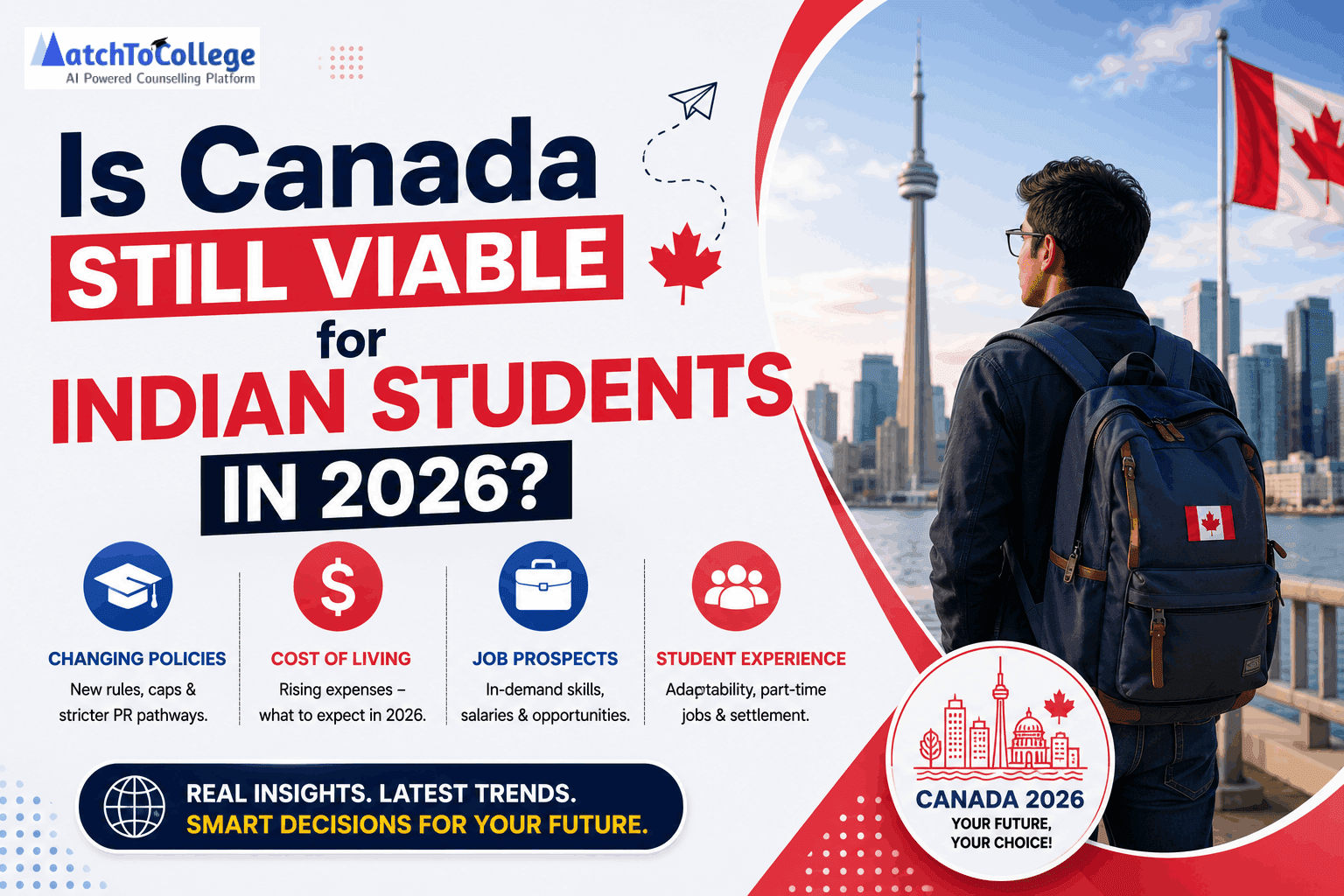
For decades, Canada has stood as a beacon of opportunity for Indian students, offering world-class education, a welcoming multicultural environment, and a relatively straightforward path to permanent residency. However, as we approach the 2026-27 academic cycle, the landscape has undergone a seismic shift.
The Canadian government, through Immigration, Refugees and Citizenship Canada (IRCC), has implemented a series of rigorous policy changes aimed at managing the volume of temporary residents and ensuring the sustainability of the country’s infrastructure. This transition has left many Indian families wondering: Is Canada still a viable destination for higher education, or has the 'Maple Leaf' dream become too difficult to achieve?
The year 2026 marks a pivotal moment in Canadian immigration history. Following the record-breaking influx of international students in 2023, the federal government introduced an intake cap on study permit applications, which has been further refined for the 2025 and 2026 periods. For Indian students, who historically represent the largest cohort of international learners in Canada, these changes are particularly impactful. The focus has shifted from mere quantity to 'strategic quality,' where the choice of program, the location of the institution, and the alignment with Canada’s labor market needs are now the primary determinants of success.
At MatchToCollege, we understand that navigating these updates can be overwhelming. As an AI-powered counseling platform, we utilize real-time data to help students align their academic goals with these shifting regulations. In this comprehensive guide, we will break down the complexities of the 2026-27 visa caps, the revamped Post-Graduation Work Permit (PGWP) rules, and the financial requirements that now define the Canadian study experience. Whether you are aiming for an MBA, a STEM degree, or a specialized diploma, understanding these nuances is essential for making an informed decision in 2026.
The short answer to the viability question is yes—but with a significant caveat. Canada is no longer a 'one-size-fits-all' destination. It has become a market for the strategic and the well-prepared. The days of using a random diploma as a guaranteed ticket to PR are over. In 2026, the Canadian government is looking for students who contribute to high-demand sectors like healthcare, technology, trades, and education. If your profile aligns with these needs, Canada remains one of the most rewarding destinations globally. If not, the path becomes considerably more challenging. This blog explores everything you need to know to navigate this new era of Canadian international education.
Understanding the 2026 Visa Caps and Intake Targets
The most significant change facing Indian students in 2026 is the continuation and tightening of the national study permit cap. For the 2026-27 academic year, the Canadian government has set a target to further reduce the number of study permits issued by 10% compared to the 2025 target. This means the total number of new study permits for 2026 is expected to be approximately 437,000, covering all levels of education including university and college programs. This is a sharp contrast to the uncapped era of 2022 and 2023.
What does this mean for you? First, the competition for Provincial Attestation Letters (PAL) will be fiercer than ever. Each province is allocated a specific portion of the national cap, and institutions within those provinces must compete for these slots. Historically, provinces like Ontario and British Columbia have seen the largest cuts because they hosted the highest concentration of international students. For 2026, students may find better luck and faster processing times by looking toward Atlantic Canada or the Prairies (Alberta, Saskatchewan, Manitoba), where the provincial governments are still eager to attract talent to boost local economies.
Furthermore, the 2026 caps now include Master’s and Doctoral students, who were previously exempt in the initial 2024 rollout. While these advanced degree seekers are still prioritized and allocated a portion of the cap, they are no longer outside the regulatory framework. This change emphasizes that the Canadian government wants a balanced distribution of students across all levels of study. Indian applicants must now apply earlier than ever—ideally 8 to 10 months before their start date—to ensure they secure a PAL before their chosen institution hits its provincial limit. At MatchToCollege, our AI tools track these provincial quotas in real-time, helping you identify colleges that still have available capacity and high PAL issuance rates.
Strategic Steps: How to Succeed in the 2026-27 Intake
Success in 2026 is built on three pillars: Alignment, Timing, and Excellence. First, alignment: your choice of study must align with Canada’s National Occupational Classification (NOC) codes that are in high demand. Healthcare workers, software engineers, and skilled tradespeople are the current 'golden ticket' holders for both PGWPs and future PR invitations through the Express Entry category-based draws. If you are passionate about a field outside these, you must ensure you are attending a top-tier university where the institutional reputation carries weight.
Second, timing: with the PAL system and the national cap, the 'last-minute application' is dead. You need to begin your process at least 12 months in advance. This includes clearing your English proficiency exams (aiming for CLB 8 or 9 to be safe), securing your GIC funds, and obtaining your admission letter. Third, excellence: as the number of seats shrinks, institutions are becoming more selective. Higher GPAs and relevant work experience in India will differentiate your application from the thousands of others competing for the same provincial attestation slot.
Finally, leverage technology. The 2026 landscape is too complex for manual research. MatchToCollege uses AI to analyze your profile against current IRCC trends, provincial labor needs, and college acceptance rates. We don't just find you a college; we find you a 'match' that leads to a career. By focusing on provinces with robust Provincial Nominee Programs (PNP) and choosing programs that offer co-op placements, you can still secure a prosperous future in Canada despite the new restrictions. Canada is still viable—provided you have a map for the new terrain.
Share this Article
FAQFrequently Asked Questions
Q: What is the study permit cap for Canada in 2026?
The Canadian government has set a target to reduce study permit issuances by 10% from 2025 levels, aiming for approximately 437,000 new permits in 2026. This cap includes Master's and Doctoral students.
Q: Can I get a PGWP for a business diploma in 2026?
In 2026, college graduates are only eligible for a PGWP if their field of study aligns with specific labor shortages, such as STEM, healthcare, or trades. General business diplomas from colleges may no longer qualify.
Q: What is the GIC amount required for 2026-27?
The cost-of-living requirement (GIC) is $20,635 CAD for a single applicant, in addition to the first year of tuition fees.
Q: Is the IELTS requirement higher for Canada in 2026?
While entry requirements vary by college, the IRCC now requires a CLB 7 (for university) or CLB 5 (for college) for PGWP eligibility upon graduation.
Q: Can my spouse work while I study in Canada in 2026?
Spousal Open Work Permits (SOWP) are now largely restricted to the spouses of students in Master's, Doctoral, and specific professional programs.
Get More Info About Is Canada Still Viable for Indian Students in 2026?
Recommended Reading

Best Online MBA Specializations for High-Paying Careers 2026
Discover the most lucrative online MBA specializations for 2026-27. Compare ROI, career growth, and use our AI tools to find your perfect management path.

Top Career Opportunities After an Online MBA in 2026-27
Discover high-paying career paths and roles after an online MBA in 2026-27. Explore salary trends, ROI, and tools to navigate your future professional success.
Tax Deductions on Higher Education: 2026-27 India Guide
Maximize your savings with our guide on tax deductions for higher education fees in India for FY 2026-27. Learn about Section 80C, 80E, and upskilling benefits.