

MBBS Abroad Reality Check: Safety, Food & Climate 2027
Admission & Info Tools
Need Expert Assistance?
Our counselors can help you with fee structures, eligibility guidelines, and upcoming admission cutoffs instantly.
Direct Application Tools
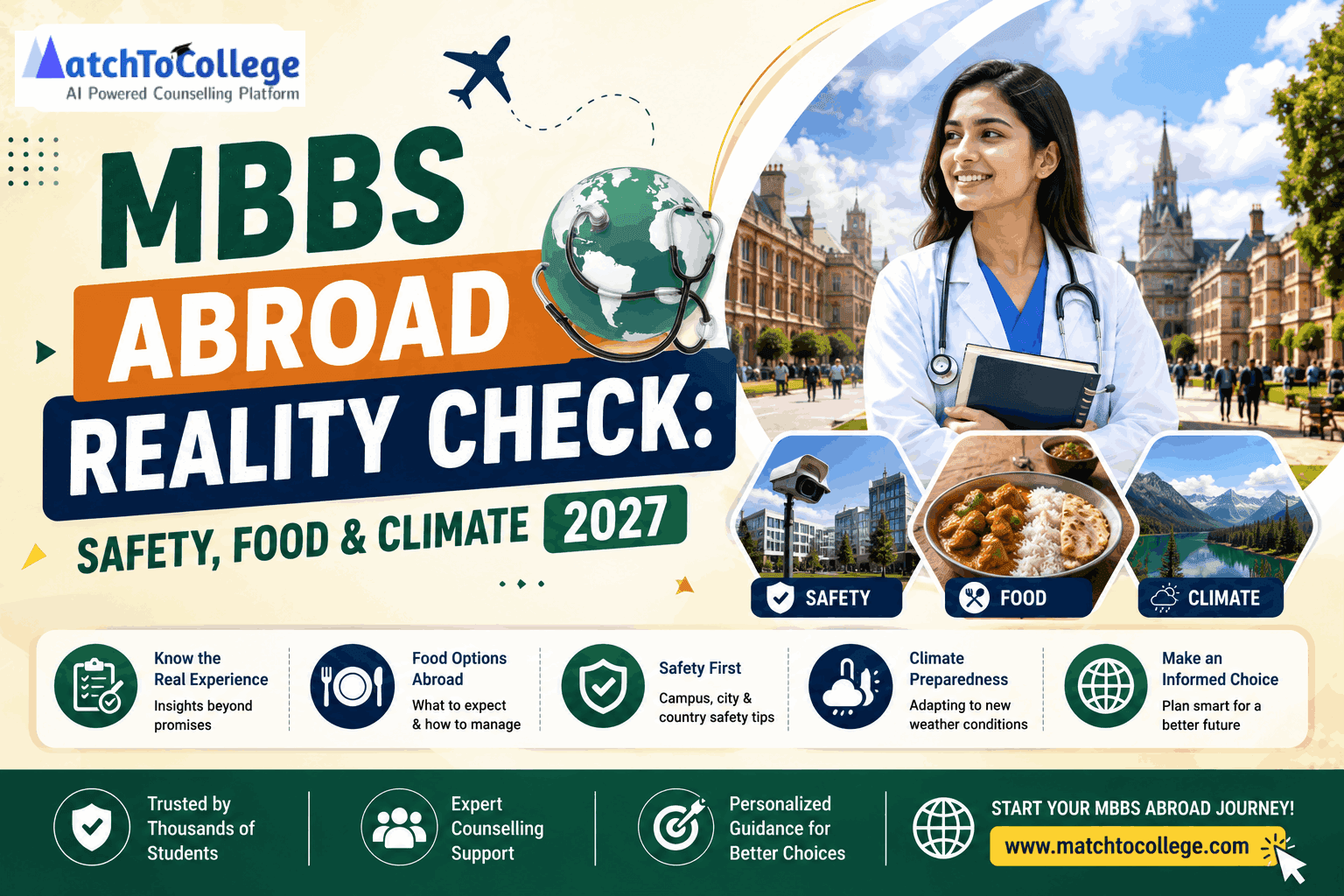
As we approach the 2026-27 academic session, the landscape of global medical education for Indian students has shifted significantly. With the competitive nature of NEET-UG remaining at an all-time high, thousands of aspiring doctors are looking toward international horizons in countries like Georgia, Uzbekistan, Kazakhstan, Egypt, and the Philippines. However, the decision to study MBBS abroad is no longer just about tuition fees and MCI/NMC recognition; it is increasingly about the quality of life, safety, and cultural integration.
At MatchToCollege, our AI-driven platform has seen a surge in queries regarding the 'non-academic' side of living abroad—specifically hostel safety, the availability of familiar food, and the physical toll of extreme climates.
For the modern Indian student, the transition from a protected home environment to an independent life in a foreign land is a monumental step. In 2026, educational technology and AI-powered counseling have made it easier to bridge this gap, but the physical reality on the ground requires a nuanced understanding.
This blog serves as a comprehensive guide for students and parents who are navigating the complexities of international medical education. We delve into the micro-details that can make or break a student's mental and physical well-being over a six-year course. From the importance of biometric security in dormitories to the logistics of sourcing 'atta' and 'dal' in Tashkent or Tbilisi, we cover it all.
The MatchToCollege philosophy is rooted in transparency. We believe that an informed student is a successful student. By using our proprietary AI algorithms, we help students match with universities that don't just offer great anatomy labs but also provide a safe and comfortable 'home away from home.' In this reality check for 2026-27, we look past the glossy brochures and provide a deep dive into the daily life of an Indian medical student abroad. Whether you are worried about the freezing temperatures of a Siberian winter or the security of a private hostel in Manila, this guide provides the authoritative insights you need to make a confident decision for your medical career.
Hostel Safety: Evaluating Security Infrastructure in 2026-27
In the 2026-27 landscape, student safety has become the primary concern for Indian parents, and universities abroad have responded by upgrading their infrastructure. Modern medical university hostels in countries like Georgia and Kazakhstan have transitioned toward high-tech security measures.
We are seeing a widespread implementation of biometric access control systems, where entry into student wings is restricted via fingerprint or facial recognition. This prevents unauthorized entry and ensures that only registered students can access living quarters. Furthermore, 24/7 CCTV surveillance in common areas, hallways, and entry points has become a standard requirement for institutions looking to attract international talent.
However, safety isn't just about technology; it's about the 'Warden System.' Traditional hostels often employ local wardens who may have a language barrier with Indian students. In the current cycle, many 'Indian-friendly' universities have started hiring bilingual Indian floor managers or student coordinators. These individuals act as intermediaries, helping students navigate local laws and emergency protocols.
At MatchToCollege, we recommend that students verify if their chosen university has separate wings for male and female students, as this remains a cultural preference for many Indian families. We also emphasize checking the 'Fire Safety Compliance' of older Soviet-era buildings, which are common in Eastern Europe. Upgraded wiring and smoke detectors are non-negotiable safety features to look for in 2026.
Beyond the hostel walls, 'city safety' is equally vital. AI-driven safety indices now allow us to map the crime rates in university neighborhoods. For instance, cities like Almaty and Tbilisi have seen a significant increase in street lighting and police patrolling in 'university zones.' Students are advised to utilize campus-linked mobile apps that feature 'panic buttons' or SOS signals connected directly to campus security. When evaluating a destination, parents should look for universities that offer airport pick-up services and mandatory orientation programs that teach students how to navigate the local environment safely during their first month.
The Indian Food Reality: From University Messes to Self-Catering
One of the biggest challenges for Indian medical students is the 'palate shock.' In 2026-27, the availability of Indian food abroad has improved, but it remains a significant recurring expense and a logistical hurdle. Most universities with a high density of Indian students now offer dedicated 'Indian Mess' facilities.
These messes typically serve a standard rotation of dal, roti, rice, and a vegetable dish, often managed by Indian contractors who understand regional tastes. However, the quality of these messes can vary significantly. Some students find that the food becomes repetitive over a six-year period, leading many to transition toward self-catering by their second or third year.
For those choosing to cook for themselves, the 'Global Indian Grocery' network has expanded. In 2026, it is much easier to find specialized stores selling Basmati rice, MDH or Everest spices, and even fresh paneer in major student hubs like Bishkek or Yerevan. Local supermarkets have also started dedicating 'International Aisles' to cater to the thousands of Indian students. However, students must prepare for the 'Climate-Food' link—certain fresh Indian vegetables like okra (bhindi) or bitter gourd (karela) may be expensive or seasonally unavailable in colder climates.
This requires a shift in dietary habits, incorporating local winter vegetables like beetroot, cabbage, and potatoes.
MatchToCollege data suggests that students who learn basic cooking skills before flying out have a 40% higher satisfaction rate with their international experience. Being able to cook a simple meal not only saves money—reducing monthly expenses by nearly $100—but also serves as a vital stress-buster during exam periods. Furthermore, we are seeing a rise in 'Cloud Kitchens' run by senior Indian students or local entrepreneurs who deliver home-cooked Indian meals to hostels via apps.
This hybrid model—part university mess, part self-cooking, and part delivery—is the reality for the 2026-27 batch. Students should also be aware of the 'Water Quality' in their destination, as many regions require the use of filtered or bottled water for cooking and drinking to avoid stomach-related illnesses.
Climate Adaptation: Surviving Extreme Winters and Seasonal Shifts
Climate is perhaps the most underrated factor in the MBBS abroad journey. For a student from Mumbai or Chennai, a winter in Kyrgyzstan or Russia where temperatures drop to -20°C can be a physical and psychological shock. In 2026-27, climate change has made weather patterns less predictable, with some regions experiencing longer, harsher winters or unexpected heatwaves.
The 'Climate Reality Check' involves understanding the heating infrastructure of your accommodation. Centralized heating (Radiators) is common in Eastern Europe and Central Asia, and while it keeps the indoors warm, it also leads to extremely dry air, which can cause skin issues and respiratory discomfort for those unaccustomed to it.
Proper 'Winter Layering' is a science that Indian students must master. Investing in high-quality thermals, down jackets, and waterproof boots is essential. Many students make the mistake of buying winter gear in India; however, gear designed for the Indian winter often fails in the sub-zero temperatures of the Eurasian steppe. We advise students to buy their heavy-duty parkas and boots upon arrival in the host country, where the products are designed for the local environment.
Additionally, 'Seasonal Affective Disorder' (SAD) is a real phenomenon where the lack of sunlight during short winter days (where the sun might set by 3:30 PM) affects a student's mood and concentration. Taking Vitamin D supplements and using 'bright light therapy' are becoming standard recommendations for medical students in these regions.
On the flip side, destinations like the Philippines or Egypt offer a tropical or Mediterranean climate that is much closer to what Indian students are used to. However, these regions come with their own challenges, such as high humidity and monsoon-related diseases. Understanding the 'Disease Landscape' of the destination is part of the medical student's training. For example, students in Southeast Asia must be vigilant about dengue, while those in Central Asia need to be prepared for dry-skin conditions and frostbite prevention.
At MatchToCollege, our AI filters allow students to view climate data for the last five years for any university city, helping them choose a destination where they can physically thrive.
Share this Article
FAQFrequently Asked Questions
Q: Is it safe for Indian girls to study MBBS abroad in 2026?
Yes, many destinations like Georgia, Uzbekistan, and the Philippines are considered very safe. Universities often have dedicated female-only hostel wings and 24/7 biometric security. However, it is essential to check specific university safety ratings on MatchToCollege before applying.
Q: How much does Indian food cost in countries like Kazakhstan or Georgia?
University messes typically charge between $100 and $150 per month for three Indian meals a day. Self-cooking can be cheaper, around $60-$80, but requires sourcing ingredients from local or Indian grocery stores.
Q: What is the average winter temperature in Eastern European medical universities?
Temperatures can range from 0°C to -25°C between December and February. Most buildings have excellent central heating, but students must invest in high-quality local winter clothing to commute to classes.
Q: Can I use AI tools like MatchToCollege to find the best hostel?
Absolutely. MatchToCollege uses AI algorithms to filter universities based on student reviews of hostels, safety infrastructure, and proximity to Indian messes, providing a personalized 'comfort score' for each institution.
Get More Info About MBBS Abroad Reality Check
Recommended Reading
Best Online MBA Specializations for High-Paying Careers 2026
Discover the most lucrative online MBA specializations for 2026-27. Compare ROI, career growth, and use our AI tools to find your perfect management path.
Top Career Opportunities After an Online MBA in 2026-27
Discover high-paying career paths and roles after an online MBA in 2026-27. Explore salary trends, ROI, and tools to navigate your future professional success.
Tax Deductions on Higher Education: 2026-27 India Guide
Maximize your savings with our guide on tax deductions for higher education fees in India for FY 2026-27. Learn about Section 80C, 80E, and upskilling benefits.