

How to Choose the Right College: 20 Essential Factors
Admission & Info Tools
Need Expert Assistance?
Our counselors can help you with fee structures, eligibility guidelines, and upcoming admission cutoffs instantly.
Direct Application Tools
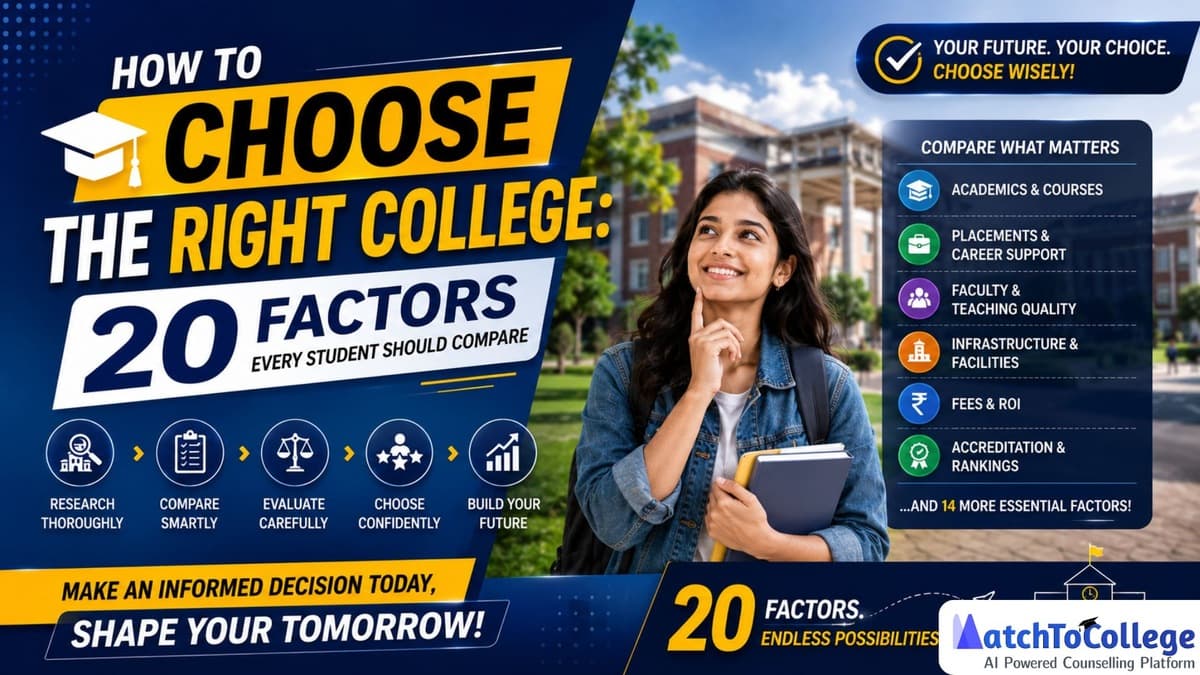
How to choose the right college
Choosing a college is one of the most important decisions in a student’s life. With so many options worldwide, it can quickly become confusing and overwhelming. The right college can support your growth, shape your skills, and open strong career opportunities. The wrong choice may lead to dissatisfaction, academic difficulty, or even transferring later.
A smart, well-informed approach is essential. Instead of relying only on rankings, students should focus on personal fit—academics, finances, campus life, and long-term goals.
Platforms like MatchToCollege use AI to help students find better-matched colleges based on individual preferences and goals. However, before using any tool, it’s important to understand what factors truly matter in college selection.
Key Idea
Focus on fit, not just popularity or rankings.
Why College Choice Matters
| Factor | Impact |
| Academic fit | Affects learning success and interest in studies |
| Environment | Influences comfort, motivation, and mental well-being |
| Cost | Impacts financial stress and debt |
| Career outcomes | Determines job and internship opportunities |
| Long-term fit | Reduces risk of transferring or dropping out |
20 Important Factors to Compare When Choosing a College
| Factor | What to Compare |
| 1. Academic Programs | Check if the college offers your desired course or major with a strong curriculum and relevant specializations. |
| 2. Faculty Quality | Evaluate the experience, qualifications, research background, and teaching methods of the faculty. |
| 3. Curriculum Structure | Review the course structure, electives, practical learning, projects, and industry-relevant subjects. |
| 4. Accreditation & Reputation | Ensure the college is accredited by recognized authorities and has a strong academic reputation. |
| 5. Location | Consider the city, climate, safety, travel convenience, and overall lifestyle. |
| 6. Tuition Fees | Compare the total cost, including tuition, examination fees, books, and other expenses. |
| 7. Scholarships & Financial Aid | Check for scholarships, grants, education loans, and other financial assistance options. |
| 8. Campus Facilities | Assess the quality of libraries, laboratories, classrooms, hostels, sports facilities, and technology infrastructure. |
| 9. Placement & Career Support | Review placement records, internship assistance, career counseling, and recruiter partnerships. |
| 10. Industry Connections | Look for collaborations with companies, industry projects, guest lectures, and corporate tie-ups. |
| 11. Internship Opportunities | Verify whether internships are included in the curriculum and supported by the institution. |
| 12. Alumni Network | A strong alumni network can provide mentorship, networking opportunities, and career referrals. |
| 13. Class Size | Smaller class sizes often allow better interaction with faculty and personalized learning. |
| 14. Campus Life | Explore student clubs, cultural events, sports activities, and extracurricular opportunities. |
| 15. Diversity & Inclusion | Consider the diversity of students, inclusive campus culture, and equal opportunities for all. |
| 16. Accommodation | Evaluate hostel quality, affordability, safety, amenities, and availability. |
| 17. Safety | Check campus security, emergency services, surveillance systems, and the safety of the surrounding area. |
| 18. Flexibility | Look for options such as electives, minors, dual degrees, online learning, or interdisciplinary programs. |
| 19. Study Abroad Opportunities | Check for student exchange programs, international collaborations, and global learning opportunities. |
| 20. Personal Fit | Choose a college that aligns with your goals, values, interests, learning style, and overall comfort level. |
Choosing a college is not just about getting admitted—it’s about finding the right environment for your growth. Take time to compare carefully, think long-term, and focus on what truly fits your goals and personality.
If needed, I can also turn this into a checklist, infographic, or decision worksheet.
I. Academic Fit & Program Quality: Matching Your Intellectual Journey
Your primary reason for attending college is education. Therefore, the academic environment should be your first priority. Ensure the institution can adequately prepare you for your desired career path.
| Academic Factor | What to Evaluate |
| Academic Programs & Majors | Ensure the college offers your desired major, has a strong department, provides interdisciplinary options, and allows flexibility to change majors if needed. |
| Faculty Expertise & Student-Faculty Ratio | Research faculty qualifications, industry experience, and research contributions. A lower student-faculty ratio often means more personalized attention and better mentorship. |
| Research & Internship Opportunities | Look for undergraduate research, internships, co-op programs, industry collaborations, and practical learning opportunities that enhance career readiness. |
| Accreditation & Reputation | Verify that the institution and its programs are accredited. A strong academic reputation can improve credit transfer, professional licensing, and career prospects. |
| Learning Environment & Teaching Style | Consider whether the college offers large lectures or small seminars, emphasizes practical or theoretical learning, and matches your preferred learning style. MatchToCollege can help identify institutions that best align with your academic preferences. |
II. Campus Life & Environment: Finding Your Second Home
College is more than just classes; it's about personal growth, social development, and finding a community where you belong. The campus environment plays a huge role in your overall experience.
| Campus Life Factor | What to Evaluate |
| Location (Urban, Rural, or Suburban) | Consider whether you prefer a city, suburban, or rural campus. Evaluate access to transportation, internships, entertainment, and essential amenities. |
| Campus Size & Student Diversity | Compare the size of the student population and the diversity of backgrounds, cultures, and perspectives. A diverse campus enhances both learning and personal growth. |
| Campus Culture & Social Life | Explore student clubs, cultural events, sports, arts, leadership opportunities, and the overall campus atmosphere to ensure it aligns with your interests and values. |
| Student Support Services | Review the availability of academic advising, career counseling, mental health support, tutoring, disability services, and other resources that contribute to student success. |
| Housing & Dining Options | Check the quality, affordability, and availability of hostels or dormitories, meal plans, and accommodation options for different years of study. |
| Safety & Campus Security | Research campus security measures, emergency response systems, surveillance, and the overall safety of the campus and surrounding neighborhood. |
III. Financials, Outcomes & Future Readiness: Investing in Your Success
Higher education is a significant investment. Understanding the costs, financial aid, and potential return on that investment is critical for long-term success.
| Financial & Career Factor | What to Evaluate |
| Cost of Attendance & Financial Aid | Compare the total cost, including tuition, accommodation, books, transportation, and living expenses. Review available grants, scholarships, education loans, and work-study programs. |
| Scholarship Opportunities | Explore merit-based, need-based, sports, and talent scholarships offered by the institution, as well as external funding opportunities. |
| Return on Investment (ROI) & Career Outcomes | Analyze graduation rates, placement records, employment rates, average starting salaries, and long-term career prospects for graduates. |
| Alumni Network & Post-Graduation Support | A strong alumni network provides mentorship, networking opportunities, career referrals, and lifelong professional support. |
| Admission Requirements & Application Process | Review eligibility criteria, entrance exams, essays, recommendation letters, and application deadlines. MatchToCollege's AI can help assess your admission chances and simplify the application process. |
| Personal Growth & Leadership Opportunities | Look for leadership programs, volunteering opportunities, student governance, community engagement, and skill-development initiatives beyond academics. |
| Health & Wellness Facilities | Check the availability of medical services, mental health counseling, fitness centers, sports facilities, and wellness programs on campus. |
| Extracurricular Activities & Student Organizations | Explore clubs, societies, cultural events, sports teams, competitions, and other activities that support holistic development. |
| Overall Campus Fit & Student Experience | Visit the campus (or take a virtual tour) to assess the environment, culture, values, and whether the college feels like the right fit for your goals and personality. |
| International Student Support (For Study Abroad) | If planning to study abroad, evaluate visa assistance, orientation programs, accommodation support, cultural integration services, language assistance, and dedicated international student resources. |
Making Your Informed Decision with MatchToCollege
Choosing the right college isn't about finding the 'best' college; it's about finding the 'best fit' for you. By systematically comparing these 20 factors, you'll gain a holistic understanding of each institution and how it aligns with your unique profile.
Remember, this process doesn't have to be overwhelming. MatchToCollege takes the guesswork out of your college search by leveraging advanced AI to match your academic profile, aspirations, and preferences with institutions that truly fit. From personalized recommendations to expert guidance, we're here to help you navigate every step of this exciting journey.
Don't leave your future to chance. Start exploring your options today with confidence, armed with knowledge and the power of MatchToCollege. Your ideal higher education experience awaits!
Share this Article
FAQFrequently Asked Questions
Q: What are the most important factors when choosing a college?
While individual priorities vary, the most important factors generally fall into three categories: academic fit (majors, faculty, research opportunities), campus environment (location, culture, support services), and financial considerations (cost, aid, career outcomes). It's crucial to balance these to find a holistic match.
Q: How can MatchToCollege help me choose the right university?
MatchToCollege utilizes AI to analyze your academic profile, preferences, and career goals to provide personalized recommendations for universities that are the best fit for you. We help you compare institutions based on critical factors, streamline your search, and offer expert counseling to guide your admission journey.
Q: Is it better to choose a college for its reputation or for specific program strength?
While overall reputation is important, prioritizing the strength of your specific program of interest is often more beneficial. A strong, specialized program at a less famous university can provide better resources, faculty expertise, and career outcomes for your field than a general program at a highly-ranked but less specialized institution. Always consider programmatic accreditation as well.
Get More Info About How to Choose the Right College
Recommended Reading

Best Online MBA Specializations for High-Paying Careers 2026
Discover the most lucrative online MBA specializations for 2026-27. Compare ROI, career growth, and use our AI tools to find your perfect management path.

Top Career Opportunities After an Online MBA in 2026-27
Discover high-paying career paths and roles after an online MBA in 2026-27. Explore salary trends, ROI, and tools to navigate your future professional success.

Tax Deductions on Higher Education: 2026-27 India Guide
Maximize your savings with our guide on tax deductions for higher education fees in India for FY 2026-27. Learn about Section 80C, 80E, and upskilling benefits.