

Govt vs Private MBBS: Your Ultimate Choice Filling Guide
Admission & Info Tools
Need Expert Assistance?
Our counselors can help you with fee structures, eligibility guidelines, and upcoming admission cutoffs instantly.
Direct Application Tools
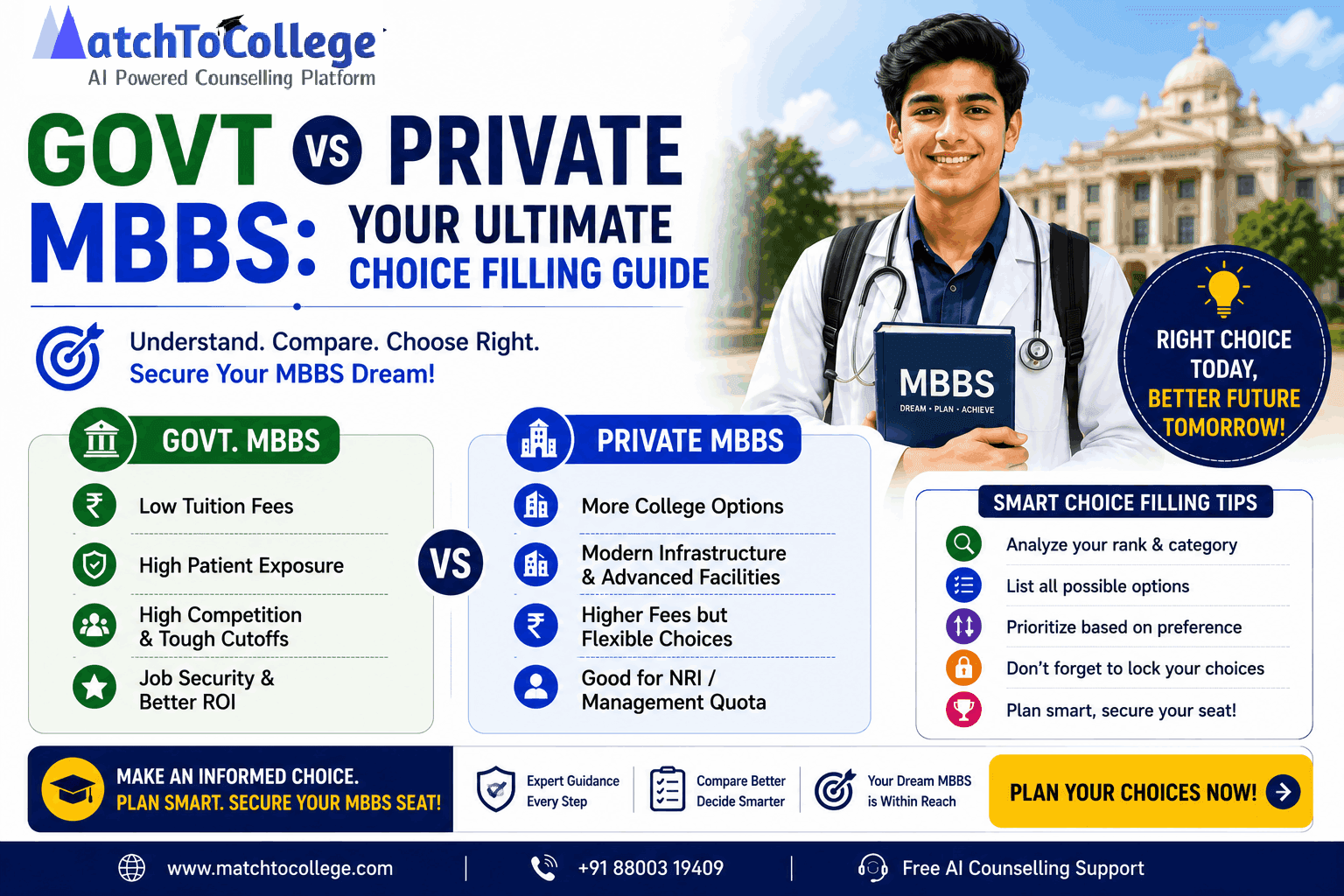
The journey to becoming a doctor is paved with dedication, hard work, and, crucially, strategic decision-making. After clearing the NEET UG exam, one of the most pivotal moments arrives: the choice filling process for MBBS admissions. This stage often leaves aspirants and their parents grappling with a fundamental dilemma – whether to opt for a government medical college or a private one. Both avenues offer the coveted MBBS degree, but they come with distinct advantages, disadvantages, and implications for your academic journey and future career.
Understanding the nuances between government and private institutions is not just about fees; it encompasses factors like faculty quality, patient exposure, infrastructure, campus life, and long-term career prospects. A well-informed choice can significantly impact your five-and-a-half years of medical education and beyond. Rushing this decision or relying solely on hearsay can lead to missed opportunities or regrets.
At MatchToCollege, we understand the complexities of NEET counseling. That's why we've developed advanced AI-powered tools to simplify your decision-making. Before we dive deep into the strategies, we highly recommend you leverage our powerful resource: Unlock Your Dream MBBS Seat: Use our MBBS College Predictor to find your best-fit college! This tool, built on years of data and sophisticated algorithms, can give you a realistic estimate of your chances in various colleges, both government and private, based on your NEET score and other preferences. Don't leave your future to chance – empower your choices with data-driven insights.
In this comprehensive guide, we'll dissect the pros and cons of government versus private MBBS colleges and equip you with an unbeatable choice filling strategy to secure your dream medical seat. Let's make your medical admission journey as smooth and successful as possible.
Understanding Government Medical Colleges: Pros & Cons
For decades, government medical colleges have been the aspiration of countless NEET candidates, and for good reason. They are renowned for their affordability, high patient exposure, and often, a legacy of academic excellence.
Advantages of Government Medical Colleges:
- Affordable Fees: This is arguably the biggest draw. Annual tuition fees are significantly lower compared to private institutions, making quality medical education accessible to a broader demographic.
- High Patient Load & Diverse Cases: Government hospitals are typically tertiary care centers, handling a vast and varied patient population. This provides students with unparalleled clinical exposure and hands-on learning experiences across a spectrum of diseases and medical conditions.
- Experienced Faculty & Research: Many government colleges boast highly experienced faculty, often pioneers in their fields, and are hubs for cutting-edge medical research and innovation.
- Strong Alumni Network: Established colleges often have powerful alumni networks that can be invaluable for future career guidance, mentorship, and job opportunities.
- Postgraduate Opportunities: Government colleges often have well-established postgraduate programs and residency opportunities, making the transition from MBBS to specialization smoother.
Disadvantages of Government Medical Colleges:
- Intense Competition & Higher Cut-offs: Due to lower fees and high demand, securing a seat in a government college is extremely challenging, requiring very high NEET scores.
- Infrastructure & Amenities: While clinical exposure is top-notch, some older government colleges might have dated infrastructure, laboratories, or hostel facilities compared to modern private institutions.
- Large Batch Sizes: Larger batch sizes can sometimes mean less individualized attention from faculty.
Navigating the cut-offs for government colleges can be daunting. To gauge your chances accurately and understand which government colleges are within your reach, it's essential to use reliable tools. Our NEET College Predictor provides data-driven insights to help you identify your best options.
Exploring Private Medical Colleges: An Emerging Landscape
Private medical colleges have rapidly grown in number and reputation, offering an alternative pathway for NEET aspirants. While they come with a higher price tag, many offer state-of-the-art facilities and a unique learning environment.
Advantages of Private Medical Colleges:
- Modern Infrastructure & Technology: Many private colleges invest heavily in modern infrastructure, advanced laboratories, simulation centers, and digital learning resources, providing a comfortable and technologically advanced learning environment.
- Better Student-Teacher Ratio: Often, private colleges have smaller batch sizes, leading to more personalized attention from faculty and better mentor-mentee relationships.
- Comfortable Amenities: From air-conditioned hostels to well-equipped libraries and sports complexes, private colleges often provide a higher standard of living and extracurricular facilities.
- Lower Cut-offs (Generally): While top private colleges are highly competitive, many others have relatively lower cut-offs compared to government institutions, opening doors for more students.
- Focus on Specific Fields: Some private institutions might specialize or have a stronger focus on certain emerging medical fields.
Disadvantages of Private Medical Colleges:
- High Fee Structure: This is the primary hurdle. Fees can range from several lakhs to over a crore for the entire MBBS program, making it a significant financial commitment.
- Variable Patient Load: While many private hospitals are now bustling, some might have a relatively lower patient inflow compared to established government hospitals, potentially impacting clinical exposure.
- Quality Concerns: The quality of education can vary significantly between private colleges. Thorough research is crucial to avoid institutions that lack proper accreditation or faculty.
- Bond Agreements: Some private colleges may require students to sign a service bond after graduation, obligating them to work for their associated hospitals for a certain period.
Making an informed decision about private colleges requires careful consideration of their accreditation, faculty, infrastructure, and hospital attachments. Before making any choices, always cross-reference your options with our NEET College Predictor to ensure it aligns with your preferences and scores.
Your Strategic NEET MBBS Choice Filling Plan
Your Strategic NEET MBBS Choice Filling Plan
The choice filling process is more than just listing colleges; it's a strategic game that can determine your medical future. Here’s how to approach it:
- Thorough Research is Key: Beyond just government vs. private, delve into individual college specifics. Look at past year cut-offs, fee structures, location, accreditation, faculty-student ratio, hospital patient load, and post-graduate options.
- Prioritize Your Preferences: Create a personal preference list. Do you prioritize low fees (government) over modern facilities (private)? Or is location paramount? Rank colleges based on your priorities, irrespective of whether they are government or private initially.
- Balance Aspirations with Reality: While it's good to aim high, ensure a healthy mix of aspirational, realistic, and safety colleges in your list. Use data from previous years' counseling to understand trends.
- Fill Maximum Possible Choices: Do not limit your options. Fill in as many colleges as you are comfortable attending. This increases your chances of securing a seat, especially if higher preferences don't materialize.
- Utilize Prediction Tools: This is where technology becomes your biggest ally. A reliable NEET College Predictor like the one offered by MatchToCollege can analyze your NEET score, category, and preferences against historical data to suggest colleges where you have the highest chances. This tool is invaluable for making informed choices.
- Stay Updated with Counseling Notifications: Counseling rules and schedules can change. Regularly check official counseling websites and reliable platforms like MatchToCollege for the latest updates.
Your strategic choices during counseling are as important as your NEET score. Empower yourself with accurate information and advanced tools to make the best decision for your medical career. Don't just fill choices; strategize them!
Share this Article
FAQFrequently Asked Questions
Q: What's the main difference in fees between government and private MBBS colleges?
Government medical colleges typically have significantly lower fees, often ranging from tens of thousands to a few lakhs per year. In contrast, private colleges can charge substantially more, ranging from several lakhs to over a crore for the entire MBBS course.
Q: Can I get a good quality MBBS education in a private medical college?
Absolutely! Many private medical colleges offer excellent infrastructure, modern facilities, advanced technology, and experienced faculty, providing a high-quality education comparable to, or sometimes even surpassing, government institutions. However, it's crucial to thoroughly research their accreditation, faculty credentials, clinical exposure, and hospital tie-ups before making a decision.
Get More Info About Govt vs Private MBBS
Recommended Reading

Best Online MBA Specializations for High-Paying Careers 2026
Discover the most lucrative online MBA specializations for 2026-27. Compare ROI, career growth, and use our AI tools to find your perfect management path.

Top Career Opportunities After an Online MBA in 2026-27
Discover high-paying career paths and roles after an online MBA in 2026-27. Explore salary trends, ROI, and tools to navigate your future professional success.

Tax Deductions on Higher Education: 2026-27 India Guide
Maximize your savings with our guide on tax deductions for higher education fees in India for FY 2026-27. Learn about Section 80C, 80E, and upskilling benefits.