

Future CEO Checklist: MBA Skills You Need Now
Admission & Info Tools
Need Expert Assistance?
Our counselors can help you with fee structures, eligibility guidelines, and upcoming admission cutoffs instantly.
Direct Application Tools
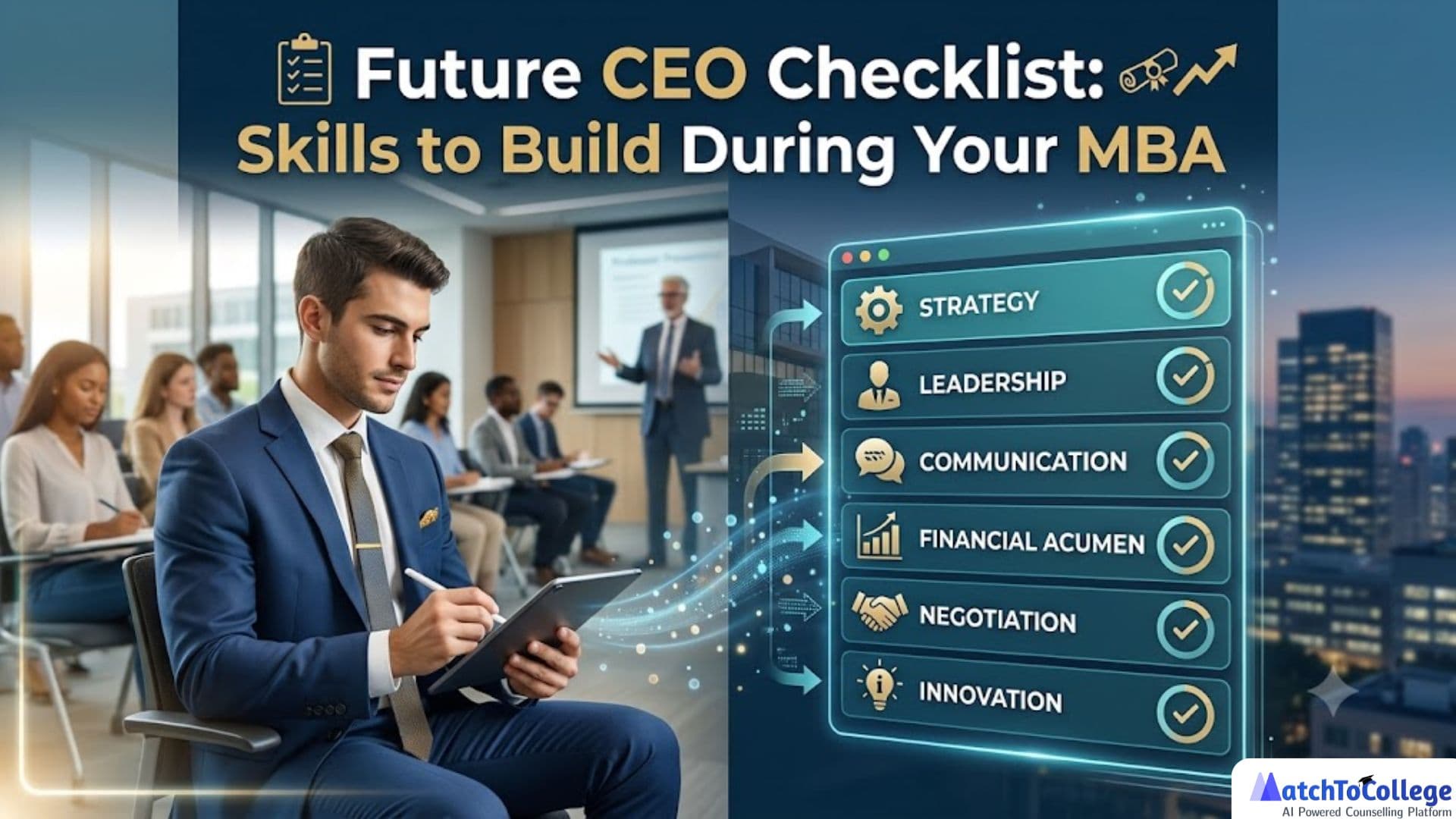
Future CEO MBA skills checklist.
For many ambitious professionals, becoming a Chief Executive Officer (CEO) represents the pinnacle of leadership. CEOs are responsible for defining organizational vision, making high-impact decisions, driving innovation, and leading businesses through constant change. In today's rapidly evolving global economy, reaching the C-suite requires much more than experience—it demands a combination of strategic thinking, business expertise, leadership, adaptability, and lifelong learning.
An MBA is one of the most effective pathways to develop these capabilities. Beyond classroom learning, an MBA provides opportunities to solve real business challenges, collaborate with diverse teams, strengthen decision-making abilities, and build a powerful professional network. It transforms students into future business leaders by equipping them with the skills needed to navigate complexity and inspire organizational growth.
However, earning an MBA alone does not automatically prepare someone for executive leadership. The true value lies in intentionally developing the competencies that successful CEOs consistently demonstrate throughout their careers.
This guide outlines the essential skills every aspiring CEO should cultivate during an MBA and highlights how MatchToCollege helps students choose programs that support their long-term leadership ambitions through personalized, AI-powered guidance.
Future CEO Skill Checklist
| Leadership Skill | Why It Matters |
| Strategic Thinking | Enables leaders to identify long-term opportunities, anticipate market changes, and make informed business decisions. |
| Financial Acumen | Builds the ability to understand financial performance, manage investments, evaluate risks, and drive sustainable growth. |
| Leadership & Team Management | Develops the confidence to motivate teams, manage organizational change, and build high-performing cultures. |
| Decision-Making Under Uncertainty | Prepares leaders to evaluate complex situations, balance risks, and make timely decisions with limited information. |
| Communication & Influence | Strengthens presentation, negotiation, stakeholder management, and executive communication skills. |
| Innovation & Change Management | Encourages creative thinking, digital transformation, and the ability to lead organizations through disruption. |
| Emotional Intelligence | Enhances self-awareness, empathy, conflict resolution, and relationship-building across diverse teams. |
| Global Business Perspective | Develops an understanding of international markets, cross-cultural leadership, and global business strategy. |
| Digital & Data Literacy | Enables future leaders to leverage data, emerging technologies, and AI-driven insights for better decision-making. |
| Ethical Leadership | Promotes responsible governance, integrity, sustainability, and long-term organizational trust. |
How an MBA Helps Build CEO Capabilities
| MBA Experience | Leadership Benefit |
| Case Studies | Develop strategic thinking by solving real-world business challenges. |
| Team Projects | Strengthen collaboration, communication, and leadership skills. |
| Internships | Gain practical experience and exposure to business operations. |
| Industry Networking | Build relationships with peers, alumni, executives, and mentors. |
| Leadership Clubs & Activities | Practice leading teams, organizing initiatives, and managing responsibilities. |
| Global Learning Opportunities | Develop international business awareness and cross-cultural communication skills. |
How MatchToCollege Supports Future Business Leaders
| Feature | How It Helps |
| AI-Powered MBA Recommendations | Matches students with MBA programs aligned with their leadership goals and career aspirations. |
| Personalized University Selection | Recommends institutions based on academic profile, specialization preferences, and long-term objectives. |
| Career Roadmaps | Provides structured guidance from MBA admissions to executive career planning. |
| Skill Gap Analysis | Identifies leadership competencies to strengthen before and during the MBA journey. |
| Industry Insights | Offers information on emerging leadership trends, executive roles, and future business opportunities. |
The journey to becoming a CEO is built over years of continuous learning, strategic decision-making, and purposeful leadership development. An MBA provides an exceptional platform to cultivate these qualities, but its true value depends on how intentionally students use every opportunity to build the skills that define successful executives.
Future CEOs are not distinguished solely by technical expertise—they stand out because they combine strategic vision, financial understanding, emotional intelligence, ethical leadership, adaptability, and the ability to inspire others toward a shared purpose.
With personalized guidance from MatchToCollege, aspiring leaders can choose MBA programs that align with their ambitions, strengthen the competencies that matter most, and confidently prepare for leadership roles that shape the future of business.
1. Strategic Vision & Critical Thinking
At the core of every successful CEO is an unparalleled ability to think strategically and critically. An MBA program is a crucible for developing this skill, pushing you beyond day-to-day operations to consider long-term implications, market trends, and competitive landscapes. Courses in strategic management, corporate strategy, and competitive analysis provide frameworks like Porter's Five Forces and SWOT analysis, enabling future leaders to dissect complex problems and formulate coherent, actionable plans. You'll learn to anticipate market shifts, identify emerging opportunities, and pivot organizational direction effectively. Case studies are integral here, offering real-world scenarios to hone your decision-making under pressure and develop a robust problem-solving mindset crucial for executive leadership.
2. Financial Acumen & Data-Driven Decision Making
A CEO must speak the language of finance fluently. While you don't need to be a CFO, a solid grasp of financial statements, budgeting, investment analysis, and corporate finance is non-negotiable. MBA programs rigorously cover these areas, teaching you how to interpret financial data, assess risk, and make sound capital allocation decisions that drive profitability and shareholder value. Beyond traditional finance, modern leadership demands proficiency in data analytics. Understanding how to leverage big data, AI, and predictive analytics allows for informed, evidence-based decision-making, moving beyond intuition to measurable outcomes. Developing this quantitative skill set ensures you can confidently steer your organization through economic uncertainties and capitalize on market intelligence.
3. Transformative Leadership & Emotional Intelligence
Leading a company means more than just managing operations; it's about inspiring people, fostering a positive culture, and navigating complex human dynamics. An MBA emphasizes the development of transformative leadership skills, moving beyond hierarchical command-and-control to empower and motivate diverse teams. Critical to this is Emotional Intelligence (EQ), which includes self-awareness, empathy, motivation, and social skills. Courses in organizational behavior, leadership development, and negotiation equip you to build consensus, resolve conflicts, and effectively communicate your vision. Ethical leadership and corporate social responsibility are also vital components, preparing you to lead with integrity and make decisions that consider all stakeholders, ensuring long-term sustainability and trust.
4. Innovation & Digital Dexterity
In an era defined by rapid technological advancements, a future CEO must be an agent of innovation and possess strong digital dexterity. MBA programs increasingly integrate modules on digital transformation, entrepreneurship, and technology management. You'll explore emerging technologies like AI, blockchain, and cloud computing, understanding their strategic implications and how they can disrupt industries or create new opportunities. Developing an entrepreneurial mindset—one that embraces calculated risks, fosters creativity, and drives continuous improvement—is paramount. This involves learning how to foster a culture of innovation within an organization, identify market gaps, and strategically invest in R&D to maintain a competitive edge and ensure future relevance.
5. Global Mindset & Cross-Cultural Communication
The global marketplace is intricately interconnected, making a global mindset an indispensable skill for any aspiring CEO. An MBA often provides invaluable exposure to international business practices, diverse economic landscapes, and cross-cultural communication challenges. Through international residencies, global business strategy courses, and working with a diverse cohort, you learn to appreciate cultural nuances, adapt management styles, and navigate the complexities of international trade and geopolitics. Developing strong cross-cultural communication skills is key to building successful global teams, forging international partnerships, and expanding your organization's reach into new markets. This perspective ensures you can lead effectively in any corner of the world, understanding both universal business principles and localized market dynamics.
Share this Article
FAQFrequently Asked Questions
Q: Is an MBA necessary to become a CEO?
While not strictly mandatory, an MBA significantly accelerates the path to CEO by providing comprehensive business acumen, strategic frameworks, and a robust network. It's a proven catalyst for developing the multifaceted skills required for executive leadership in today's complex corporate environment.
Q: Which MBA programs are best for aspiring CEOs?
The 'best' program depends on your specific career goals and desired industry. Look for programs with strong leadership development curricula, emphasis on strategic thinking, robust alumni networks, and faculty expertise in areas like innovation and global business. MatchToCollege can help you find tailored recommendations.
Q: How can I develop emotional intelligence during my MBA?
Many MBA programs incorporate leadership modules, team projects, and executive coaching designed to enhance EQ. Actively participate in group work, seek feedback on your leadership style, and consider elective courses in organizational behavior or negotiation to sharpen these vital soft skills.
Q: What is the return on investment (ROI) for an MBA focusing on CEO skills?
The ROI for an MBA focused on CEO skills is often substantial, including significant salary increases, faster career progression, and access to top executive roles. Beyond financial gains, it provides an invaluable network, strategic insights, and personal development that are crucial for long-term career success and leadership impact.
Get More Info About Future CEO Checklist
Recommended Reading
Best Online MBA Specializations for High-Paying Careers 2026
Discover the most lucrative online MBA specializations for 2026-27. Compare ROI, career growth, and use our AI tools to find your perfect management path.
Top Career Opportunities After an Online MBA in 2026-27
Discover high-paying career paths and roles after an online MBA in 2026-27. Explore salary trends, ROI, and tools to navigate your future professional success.
Tax Deductions on Higher Education: 2026-27 India Guide
Maximize your savings with our guide on tax deductions for higher education fees in India for FY 2026-27. Learn about Section 80C, 80E, and upskilling benefits.