

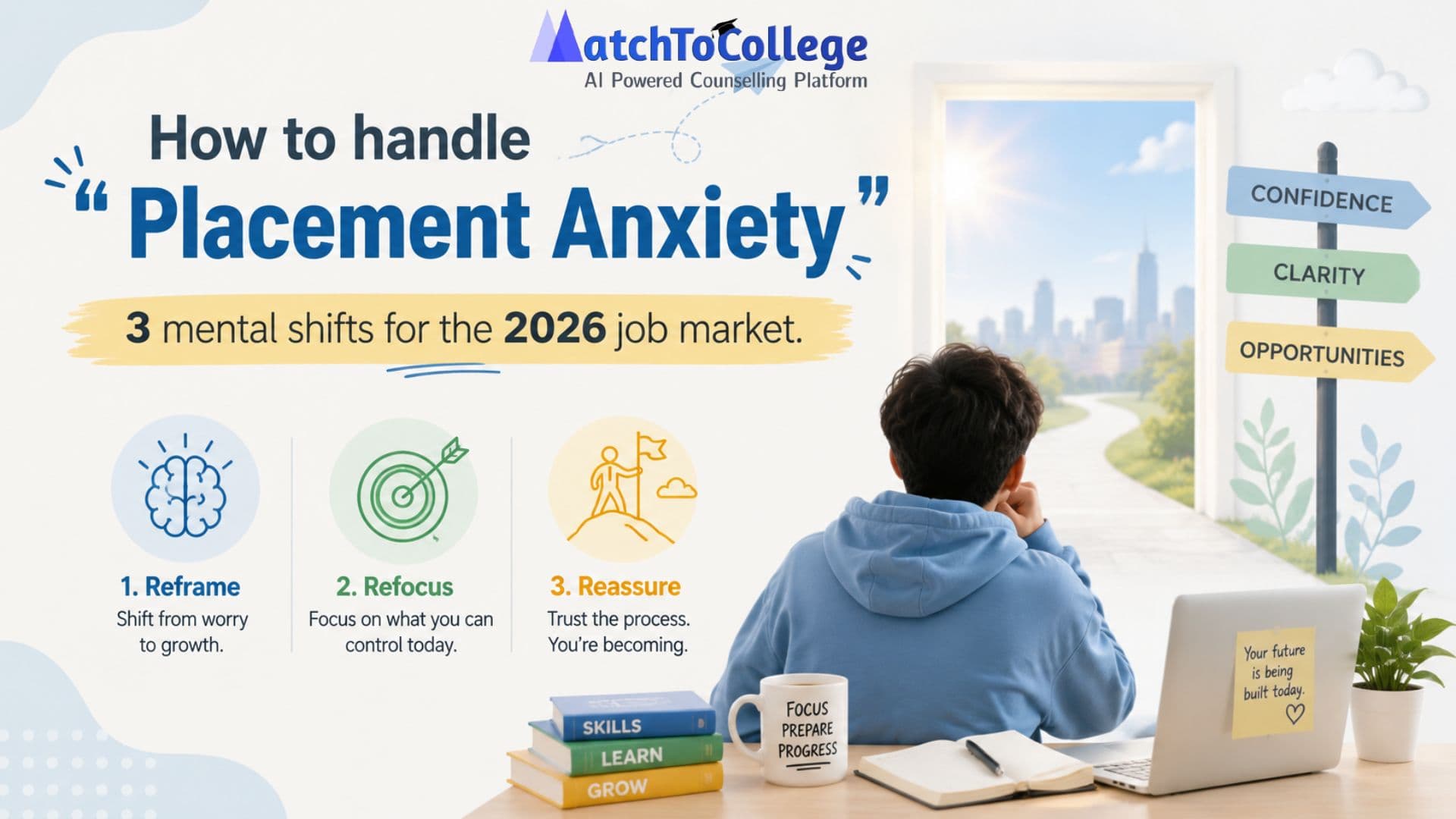
How to handle "Placement Anxiety": 3 mental shifts for the 2026 job market.
Admission & Info Tools
Need Expert Assistance?
Our counselors can help you with fee structures, eligibility guidelines, and upcoming admission cutoffs instantly.
Direct Application Tools
Handle Placement Stress with Confidence
Worrying about placements is common for many students today. The 2026 job market is changing fast, with AI, automation, and new skill demands shaping how companies hire. Because of this, many students feel uncertain about their future.
The good news is placement anxiety can be managed by changing how you think about careers and preparation.
Why students feel anxious
| Common reason | What causes stress |
| Job uncertainty | Changing industries |
| High competition | More skilled applicants |
| AI disruption | Fear of jobs changing |
| Career confusion | Too many options |
| Social pressure | Family and peer expectations |
3 mental shifts to handle placement anxiety
1. Focus on skills, not only degrees
A degree is important, but employers increasingly look for practical skills.
Students should focus on:
- Communication
- Problem solving
- Digital skills
- Adaptability
- Real-world experience
2. Think long-term, not only first job
The first job is only the start. Career growth matters more than immediate placement.
| Old mindset | Better mindset |
| One job decides future | Careers evolve over time |
| Placement equals success | Learning creates growth |
| Immediate salary focus | Long-term skills matter |
3. Build confidence through preparation
Anxiety reduces when students prepare consistently.
Helpful actions:
- Learn industry-relevant skills
- Practice interviews
- Work on projects
- Build internships
- Explore emerging careers
What the 2026 market may value
- Practical skills
- Adaptability
- Problem solving
- Digital knowledge
- Communication
- Continuous learning
How MatchToCollege helps
MatchToCollege helps students align courses with future industries, identify career-focused colleges, and plan for changing job markets.
Placement anxiety is understandable, but future careers depend more on adaptability and learning than one placement season. Students who focus on skills, preparation, and long-term growth will be better positioned for the 2026 job market.
1. Shift from 'Securing a Job' to 'Building a Dynamic Career'
A major reason students feel placement anxiety is the pressure to get one job immediately after graduation. But the 2026 job market is changing — careers are becoming more flexible, and the first job may not define long-term success.
The better mindset is to focus on building a career over time.
Change the way you think
| Old thinking | Better thinking |
| I need one perfect job | I need to keep growing |
| First placement decides future | Career develops step by step |
| Job title matters most | Skills matter more |
| Immediate success | Long-term progress |
Why this shift matters
The future workforce will reward people who can learn, adapt, and move across different opportunities.
Students should focus on:
- Learning transferable skills
- Exploring projects
- Building practical experience
- Developing industry exposure
- Growing confidence over time
Focus on skills over labels
Instead of only targeting one company or title, ask:yourself
- What skills am I building?
- What problems can I solve?
- What industries interest me?
How can I improve each year?
Helpful actions
To reduce placement stress:
- Take internships
- Build side projects
- Learn new tools
- Connect with mentors
- Stay open to multiple roles
Why this helps in 2026
The future job market may involve frequent role changes. Students who build strong skills can adapt more easily.
MatchToCollege helps students choose courses and colleges aligned with long-term career growth, not just immediate placements.
The first job is important, but it is only one part of a larger journey. Students who focus on learning and adaptability are more likely to succeed in the changing 2026 job market.
2. Embrace 'Skill Stacks' Over 'Degree Alone'
A college degree still matters, but in the 2026 job market, employers are expected to look beyond marks and qualifications. They increasingly want candidates who can apply skills in real situations.
The second mindset shift is understanding that your degree opens the door — your skills help you move forward.
Degree vs skill stack
| Degree gives | Skills add |
| Academic knowledge | Practical ability |
| Subject understanding | Real-world application |
| Eligibility | Competitive advantage |
| Foundation | Career flexibility |
What employers may value
Along with academic performance, companies may look for:
- Critical thinking
- Problem solving
- Communication
- Digital literacy
- Data handling
- Teamwork
- Emotional intelligence
- Adaptability
Ask yourself
A simple self-check can reduce placement anxiety.
Question
- What am I good at?
- Which skills need improvement?
- What can I demonstrate to employers?
- How am I building experience?
Ways to build your skill stack
Students can strengthen their profile through:
- Online certifications
- Internships
- Freelance projects
- Volunteer work
- Personal portfolios
- Industry workshops
Why this matters
The 2026 workforce may reward candidates who show both learning and practical readiness.
A student with strong applied skills may often stand out more than someone relying only on a degree.
MatchToCollege support
MatchToCollege helps students choose courses that align with future industry skills and identify programs that improve employability.
A degree remains important, but long-term success increasingly depends on building practical skills. Students who keep learning beyond the classroom will be better prepared for future opportunities.
3. Network for 'Insights & Mentorship,' Not Just 'Openings'
Many students think networking only means asking for job referrals. This often creates pressure and awkward conversations. In the 2026 job market, networking is more useful when it is about learning, guidance, and long-term relationships.
The better mindset is to see networking as building connections, not just searching for openings.
Change the purpose of networking
| Old thinking | Better thinking |
| Ask for jobs | Learn from professionals |
| Immediate referral | Long-term connection |
| One-time contact | Ongoing relationship |
| Job request | Career guidance |
Why this matters
Good connections can help students understand industries, trends, and career paths before placements begin.
Students can gain:
- Industry insights
- Career advice
- Mentorship
- Skill suggestions
- Future opportunities
Better ways to network
Students can connect through:
- LinkedIn conversations
- Alumni interactions
- Industry webinars
- Virtual events
- College communities
- Informational interviews
Questions students can ask
Instead of asking directly for jobs, ask:
Useful questions
- How did you start your career?
- Which skills matter most now?
- What should students prepare for?
- What changes are happening in your field?
This creates more meaningful conversations.
Why it reduces anxiety
Networking becomes easier when students focus on learning rather than immediate placement outcomes. Over time, strong relationships often create opportunities naturally.
Build a professional support system
A good network can support:
- Career decisions
- Industry awareness
- Future role transitions
- Confidence building
- Personal growth
MatchToCollege support
MatchToCollege helps students choose future-focused education paths and understand career trends that shape networking opportunities.
Networking works best when students focus on building genuine relationships. Learning from professionals can reduce placement anxiety and create stronger career opportunities over time.
Share this Article
FAQFrequently Asked Questions
Q: What is placement anxiety?
Placement anxiety is a form of stress and apprehension experienced by students regarding their ability to secure a job or internship after graduation, particularly in a competitive or rapidly changing job market. It stems from concerns about future career success, skill relevance, and the job search process itself.
Q: What skills are most important for the 2026 job market?
For the 2026 job market, critical skills include adaptability, problem-solving, critical thinking, digital literacy (including AI proficiency), data analysis, communication, emotional intelligence, creativity, and a strong capacity for continuous learning. Developing a diverse 'skill stack' is more valuable than relying on a single specialization.
Get More Info About How to handle "Placement Anxiety"
Recommended Reading
Best Online MBA Specializations for High-Paying Careers 2026
Discover the most lucrative online MBA specializations for 2026-27. Compare ROI, career growth, and use our AI tools to find your perfect management path.
Top Career Opportunities After an Online MBA in 2026-27
Discover high-paying career paths and roles after an online MBA in 2026-27. Explore salary trends, ROI, and tools to navigate your future professional success.
Tax Deductions on Higher Education: 2026-27 India Guide
Maximize your savings with our guide on tax deductions for higher education fees in India for FY 2026-27. Learn about Section 80C, 80E, and upskilling benefits.