

Hospital Bed Capacity: Key to Clinical Rotations Abroad
Admission & Info Tools
Need Expert Assistance?
Our counselors can help you with fee structures, eligibility guidelines, and upcoming admission cutoffs instantly.
Direct Application Tools
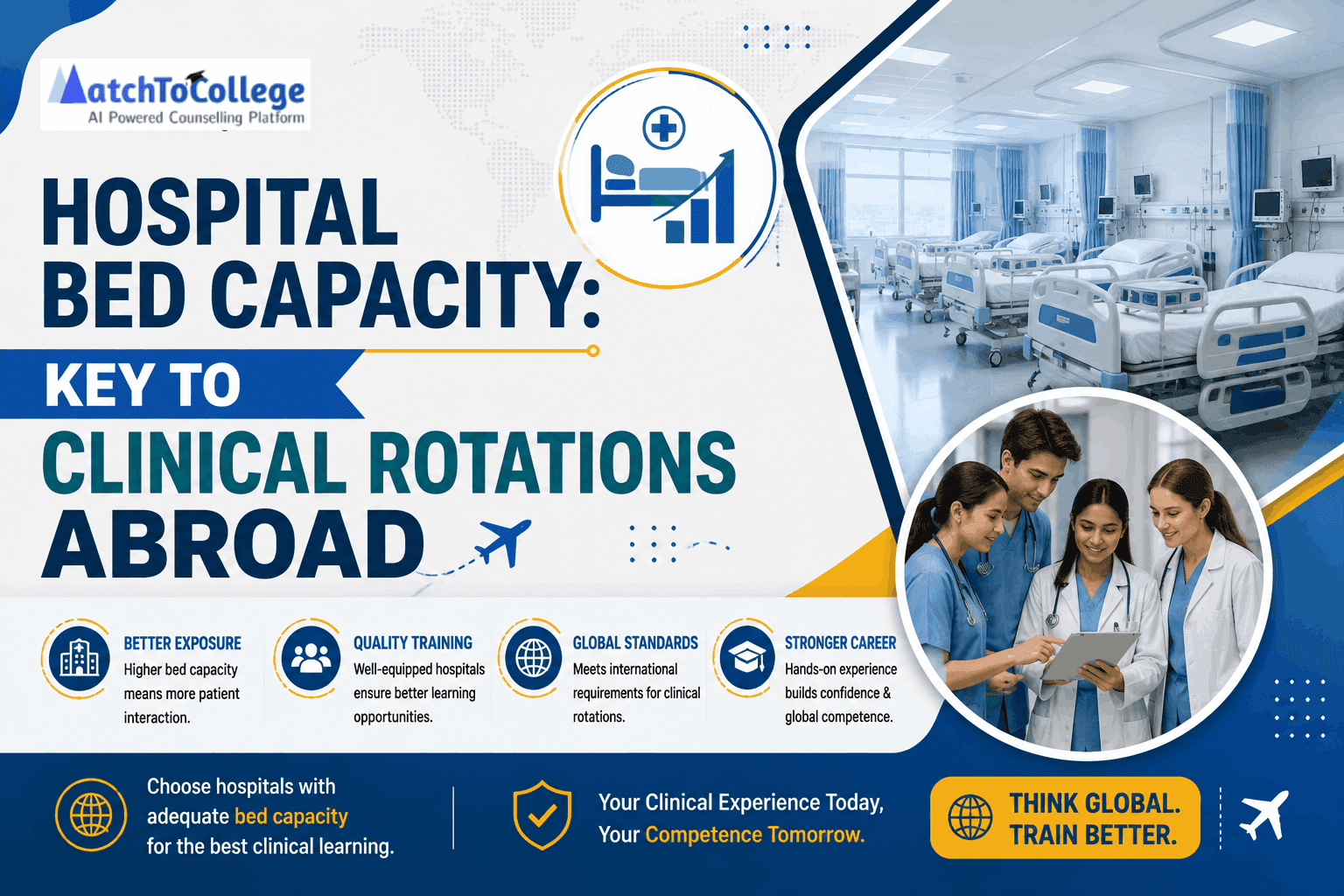
Choosing to study MBBS abroad is a monumental decision that shapes your professional trajectory as a healthcare provider. While many students focus primarily on tuition fees, hostel facilities, or the climate of the host country, one critical academic metric often remains overlooked: the hospital bed capacity of the university’s affiliated teaching hospitals.
For the 2026-27 academic session, as medical education becomes increasingly competitive, understanding the correlation between bed count and clinical proficiency is paramount. Clinical rotations are the bridge between theoretical knowledge and real-world application. Without a high patient inflow—driven by a significant bed capacity—medical students risk completing their degrees with high grades but insufficient hands-on experience.
Before embarking on this journey, it is essential to evaluate your current standing. Tools like the 2026-27 NEET College Predictor and the NEET 2026 Rank Predictor help students determine if they should pursue options within India or look toward global horizons. If your path leads abroad, the quality of clinical rotations becomes your most valuable asset. Bed capacity isn't just a number; it is a direct indicator of the volume and variety of clinical cases you will encounter. In countries like Russia, Kazakhstan, Uzbekistan, or Georgia, where many Indian students seek medical degrees, the discrepancy between the theoretical curriculum and clinical exposure can be vast if the affiliated hospital is under-equipped.
At MatchToCollege, we emphasize that a medical degree is only as good as the clinical training that accompanies it. A university affiliated with a 1,000-bed hospital offers a significantly different learning environment than one with a 200-bed facility. This difference manifests in your ability to perform physical examinations, assist in surgeries, and witness rare pathologies.
Furthermore, for those aiming to return to India, the National Exit Test (NExT) or the FMGE requires a deep understanding of clinical scenarios that can only be mastered at the bedside. Using the NEET OMR Score Calculator can give you an early start on planning, but the long-term planning must include an audit of your target university's clinical infrastructure. This comprehensive guide explores why hospital bed capacity should be at the top of your checklist when selecting a university for MBBS abroad.
The Direct Correlation Between Bed Capacity and Clinical Exposure
In the realm of medical education, 'clinical exposure' is the heartbeat of learning. Hospital bed capacity serves as the primary metric for measuring the potential for this exposure. A larger bed capacity generally signifies a higher volume of patient admissions, which in turn leads to a more diverse range of clinical cases.
For a student in their 3rd to 6th year of MBBS, every additional bed represents a new opportunity to learn about patient history taking, diagnostic reasoning, and the nuances of bedside manners. When a hospital has a high occupancy rate and a large number of beds, students are not just observers; they become active participants in a high-traffic healthcare ecosystem.
Consider the difference between a specialized clinic and a general tertiary care hospital. While a clinic might offer deep insights into a specific niche, a massive multi-specialty teaching hospital provides a panoramic view of medicine. From emergency trauma care to chronic disease management, the sheer volume of patients allows students to see 'textbook cases' in real life, making the information stick.
If you are comparing universities using our MBBS Abroad listing pages, always cross-reference the university's claims with the actual bed count of their primary teaching hospital. A low bed-to-student ratio can result in students 'fighting' for patient access, which severely diminishes the quality of the rotation.
Moreover, high bed capacity often attracts better medical technology and more experienced consultants. Hospitals that manage thousands of patients daily are more likely to be equipped with the latest MRI machines, robotic surgery units, and advanced pathology labs. This exposure is vital for the modern medical student who must be tech-savvy. Without this environment, students may find themselves outdated before they even graduate. By using tools like the Career Pathway Matcher, you can see how different specialties require different levels of clinical intensity, all of which are grounded in the capacity of the training facility.
Diversity of Cases: Quality vs. Quantity in International Rotations
While quantity (the number of beds) is important, the diversity of cases—often a byproduct of high capacity—is what truly builds a doctor's intuition. In hospitals with limited bed capacity, students might see the same common ailments repeatedly. While mastering common diseases is necessary, the ability to recognize rare or complex conditions is what separates an average practitioner from a specialist.
Universities located in major urban centers abroad usually have higher bed capacities because they serve as referral centers for entire regions. This means they receive complex cases that smaller hospitals cannot handle, providing an invaluable learning ground for international students.
For students planning their education through 2026 and 2027, the shift toward integrated clinical exams means that simply memorizing facts won't suffice. You must be able to synthesize information from various departments. High-capacity hospitals usually have robust departments in Internal Medicine, Surgery, Pediatrics, Obstetrics and Gynecology, and Psychiatry all under one roof. This allows for a multidisciplinary approach to learning. If you use the NEET Result Checker and find that you are eligible for top-tier foreign universities, prioritize those that list 'Tertiary Care' status for their hospitals.
Furthermore, the variety of patients in high-capacity hospitals often includes different age groups, socio-economic backgrounds, and ethnicities. This diversity is crucial for developing cultural competence—a skill highly valued if you plan to practice in diverse countries like the UK, USA, or even return to a diverse India. Clinical rotations in a 1,500-bed hospital in a capital city offer a vastly different educational ROI than a 300-bed hospital in a remote town. You can evaluate this financial and educational balance using our University ROI Calculator, which helps compare the long-term value of your degree based on the quality of training received.
Impact on Licensing Exams: FMGE, NExT, and USMLE Preparation
The ultimate goal for most Indian students studying abroad is to clear the Foreign Medical Graduate Examination (FMGE) or the upcoming National Exit Test (NExT). These exams are increasingly focusing on clinical vignettes—questions that describe a patient's symptoms and ask for a diagnosis or treatment plan.
If your clinical rotations were spent in a hospital with low bed capacity and few patients, you will find these questions significantly more difficult. Real-world clinical experience translates directly into the ability to solve these vignettes quickly and accurately. The sounds of a heart murmur, the appearance of a specific skin rash, or the tactile feel of an abdominal mass are things that can't be learned from a screen or a book; they are learned in the wards of a busy hospital.
Students who have had extensive clinical rotations in high-capacity hospitals often perform better in the practical components of licensing exams. For instance, the USMLE Step 2 CS (or its equivalent clinical skills assessments) and the NExT Step 2 are entirely focused on clinical skills. A university that ensures its students spend 20-30 hours a week in a high-traffic hospital is essentially providing built-in exam prep. Before you commit, use the Online Degree Passing Predictor logic to think about your success rate: higher clinical exposure equals higher exam confidence.
Additionally, the documentation and case-study requirements in large hospitals are more rigorous. Learning to maintain patient records in a high-pressure environment is a skill that will serve you throughout your career. Many students find that the discipline required in a 2,000-bed hospital makes the transition to internship in India much smoother. If you are worried about the costs associated with these high-tier universities, the Education Loan EMI Calculator can help you plan your finances to ensure you don't compromise on the quality of your education just to save a few thousand dollars initially.
Evaluating Infrastructure: Beyond the Number of Beds
While the total number of beds is a vital 'shorthand' for hospital quality, it is important to look at how those beds are utilized. A 'teaching bed' is different from a regular bed. In many top-tier universities abroad, specifically those listed in our Study Abroad section, the ratio of students to beds is carefully managed. If a hospital has 1,000 beds but 5,000 students, the advantage of the bed capacity is negated. The ideal scenario is a high bed count combined with a small batch size, ensuring that every student gets dedicated time with patients and attending physicians.
You should also inquire about the 'Bed Occupancy Rate.' A hospital might have 1,000 beds, but if only 300 are occupied on average, your clinical exposure is limited. High-ranking universities in Russia and Central Europe often boast occupancy rates of over 85%, ensuring a constant flow of patients. This infrastructure also includes the availability of diagnostic labs and surgical theaters. As a student, you want to be in a place where you can follow a patient from the emergency room to the diagnostic lab, to the surgery suite, and finally to the recovery ward. This 'continuum of care' is best observed in large-scale medical centers.
When researching universities, don't hesitate to use the Career Pathway Matcher to see which clinical environments best suit your intended specialty. For example, if you aspire to be a surgeon, a university with a high-capacity trauma center is non-negotiable. If you are leaning toward JEE or other technical fields as a backup, our JEE Main College Predictor and JEE Rank Predictor are available, but for those committed to medicine, the hospital's infrastructure remains the single most important factor for university selection in 2026.
How MatchToCollege Helps You Select the Right University
Navigating the sea of international medical universities is daunting. Many consultants will promise high-quality education, but few will provide data on hospital bed capacity or patient inflow. MatchToCollege uses AI-driven insights to filter universities based on real academic and clinical metrics. We don't just look at the university's age; we look at its current affiliations, its accreditation by bodies like the World Directory of Medical Schools (WDOMS), and the actual clinical facilities available to Indian students. By utilizing our NEET College Predictor, you can first see your options in India and then seamlessly transition to exploring high-capacity international options if needed.
Our platform also provides tools to manage the administrative side of your application. From the Age Calculator for eligibility checks to the CGPA to Percentage Calculator for transcript conversions, we simplify the technicalities. But more importantly, our MBBS Abroad Guides provide the qualitative data you need. We help you ask the right questions: What is the student-to-bed ratio? Is the hospital located on-campus? Are the rotations conducted in the local language or English?
For the 2026-27 admission cycle, we have updated our database to include detailed hospital stats for universities in top destinations. We believe that an informed student is a successful student. Whether you are using the NEET OMR Calculator to check your current performance or looking at Domestic Colleges as a primary choice, our goal is to ensure that wherever you go, your clinical training is of the highest standard. The path to becoming a doctor is long, and we are here to ensure your first step—university selection—is grounded in facts and clinical reality.
Share this Article
FAQFrequently Asked Questions
Q: What is a good hospital bed capacity for an MBBS abroad university?
A university should ideally be affiliated with a hospital having at least 500-1000 beds to ensure adequate clinical exposure for its students. Higher capacity usually correlates with a greater variety of medical cases.
Q: Does hospital bed capacity affect FMGE or NExT results?
Yes, directly. These exams focus on clinical scenarios. Students who train in high-capacity hospitals have better hands-on experience, making it easier to solve clinical vignette-based questions.
Q: Is the bed-to-student ratio important?
Absolutely. A high number of beds is less effective if there are too many students. A lower student-to-bed ratio ensures each student gets more time for patient interaction and practical learning.
Q: Can I check my NEET 2026 eligibility for these universities?
Yes, you can use the MatchToCollege NEET College Predictor and NEET Rank Predictor to estimate your standing and see which international universities with high-capacity hospitals you qualify for.
Q: How do I verify the bed capacity of a foreign university hospital?
You can check the university's official website, look for WDOMS listings, or use the MatchToCollege MBBS Abroad listing pages which aggregate clinical data for prospective students.
Get More Info About Hospital Bed Capacity
Recommended Reading

Best Online MBA Specializations for High-Paying Careers 2026
Discover the most lucrative online MBA specializations for 2026-27. Compare ROI, career growth, and use our AI tools to find your perfect management path.

Top Career Opportunities After an Online MBA in 2026-27
Discover high-paying career paths and roles after an online MBA in 2026-27. Explore salary trends, ROI, and tools to navigate your future professional success.

Tax Deductions on Higher Education: 2026-27 India Guide
Maximize your savings with our guide on tax deductions for higher education fees in India for FY 2026-27. Learn about Section 80C, 80E, and upskilling benefits.