

Balance CA, CS, CFA & College: Your Dual Success Guide
Admission & Info Tools
Need Expert Assistance?
Our counselors can help you with fee structures, eligibility guidelines, and upcoming admission cutoffs instantly.
Direct Application Tools
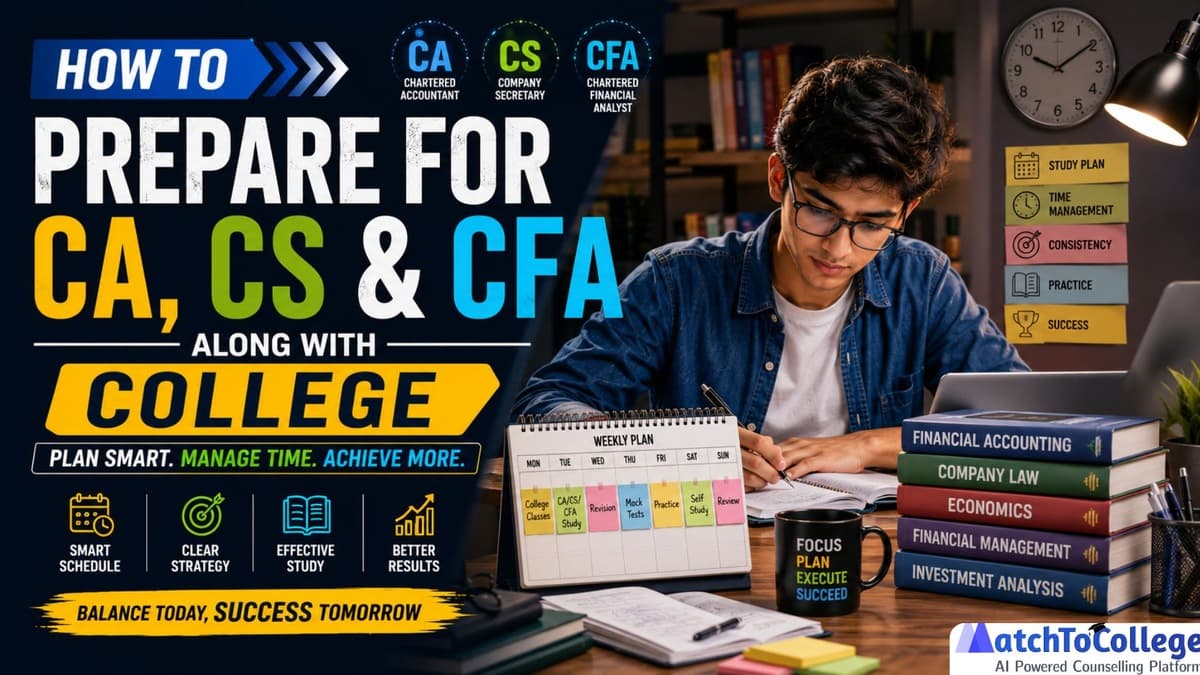
Balance College and Professional Success
Many students aspire to earn a professional qualification such as Chartered Accountancy (CA), Company Secretary (CS), or Chartered Financial Analyst (CFA) while completing their college degree. These certifications can significantly enhance career prospects in finance, accounting, investment management, corporate governance, and business leadership. Although balancing college studies with professional exam preparation can be challenging, it is achievable with proper planning, discipline, and consistency.
Why Pursue Professional Certifications During College?
Completing a professional qualification alongside your degree offers several advantages:
| Benefit | Impact |
| Competitive Advantage | Stand out in the job market |
| Early Career Preparation | Gain industry-relevant knowledge and skills |
| Better Employment Opportunities | Access higher-paying and specialized roles |
| Professional Credibility | Build expertise and industry recognition |
| Time Efficiency | Complete academic and professional goals simultaneously |
Understanding the Difference Between CA, CS, and CFA
| Qualification | Focus AreaIdeal | Career Paths |
| CA (Chartered Accountancy) | Accounting, Auditing, Taxation, Finance | Chartered Accountant, Auditor, Financial Consultant |
| CS (Company Secretary) | Corporate Law, Governance, Compliance | Company Secretary, Compliance Officer, Corporate Advisor |
| CFA (Chartered Financial Analyst) | Investment Management, Financial Analysis | Investment Analyst, Portfolio Manager, Financial Research Analyst |
Effective Strategies for Balancing College and Professional Exams
1. Create an Integrated Study Plan
Instead of treating college and professional studies separately, create a unified schedule.
| Activity | Recommended Focus |
| College Classes | Attend regularly and maintain academic performance |
| Professional Exam Preparation | Daily focused study sessions |
| Revision | Weekly review of completed topics |
| Mock Tests | Regular practice and performance evaluation |
2. Prioritize High-Impact Topics
Identify overlapping concepts between your college syllabus and professional course curriculum. Subjects such as accounting, finance, economics, business law, and taxation often complement each other.
3. Manage Your Time Effectively
| Time Management Technique | Benefit |
| Time Blocking | Dedicated study periods for each goal |
| Weekly Planning | Better workload distribution |
| Goal Setting | Maintains focus and motivation |
| Progress Tracking | Identifies improvement areas |
4. Utilize Quality Learning Resources
Use reliable study materials, online lectures, mock tests, and practice papers. Focus on conceptual understanding rather than memorization.
5. Stay Consistent
Consistency is more effective than occasional long study sessions. Even 2–3 focused hours daily can produce significant results over time.
Common Challenges and Solutions
| Challenge | Solution |
| Academic Pressure | Follow a structured study schedule |
| Exam Stress | Practice mock tests and maintain realistic goals |
| Lack of Time | Eliminate distractions and prioritize tasks |
| Burnout | Maintain a healthy study-life balance |
| Information Overload | Focus on important concepts and exam patterns |
Maintaining Physical and Mental Well-Being
Success depends not only on studying but also on maintaining your health.
| Habit | Benefit |
| Adequate Sleep | Improves concentration and memory |
| Regular Exercise | Reduces stress and increases productivity |
| Healthy Diet | Supports sustained energy levels |
| Scheduled Breaks | Prevents burnout and fatigue |
How MatchToCollege Can Help
MatchToCollege's AI-powered platform helps students align their academic and professional goals by providing:
| Feature | Benefit |
| Career Guidance | Identify suitable professional pathways |
| Course Recommendations | Match educational choices with career goals |
| Personalized Planning | Create structured academic roadmaps |
| Industry Insights | Understand career opportunities and market trends |
| Higher Education Support | Explore future specialization and postgraduate options |
Preparing for CA, CS, or CFA alongside college is challenging but highly rewarding. With effective time management, a well-structured study plan, consistent effort, and the right support system, students can successfully achieve both academic and professional excellence. The combination of a college degree and a professional qualification creates a strong foundation for long-term career growth, leadership opportunities, and success in the competitive business and finance world.
Demystifying CA, CS, and CFA: What You Need to Know
Before diving into preparation, it's crucial to understand the scope and commitment each professional course demands. Chartered Accountancy (CA) is a highly respected qualification, primarily focused on accounting, auditing, taxation, and financial management. It involves multiple levels (Foundation, Intermediate, Final) and a mandatory practical training period. A Company Secretary (CS) plays a vital role in corporate governance, legal compliance, and secretarial practices within an organization, also comprising multiple stages (Foundation, Executive, Professional). The Chartered Financial Analyst (CFA) program, recognized globally, is ideal for those aspiring to careers in investment management, portfolio management, and financial analysis. It has three levels, each requiring significant study hours.
All three demand a strong conceptual understanding, analytical skills, and a commitment to continuous learning. While CA and CS often align well with commerce or business administration degrees (like B.Com or BBA), CFA can complement a broader range of degrees, including economics or engineering, for those with a passion for finance. Understanding these distinct pathways is the first step in creating a coherent career planning strategy.
Strategic Planning: Mastering Time & Study Schedules
The cornerstone of balancing professional courses with college is impeccable time management. Without a well-structured study schedule, burnout is inevitable. Start by mapping out your college timetable, including classes, assignments, and exams. Then, strategically allocate dedicated slots for your CA, CS, or CFA exam preparation. Consider an early start, perhaps even during your first year of college, to spread the workload.
Key strategies for effective time management include:
- Daily Planner: Break down your study goals into daily, achievable tasks. Prioritize topics based on difficulty and weightage.
- Integrated Study: Look for syllabus overlaps between your college subjects and professional course material. This can save significant study time.
- Weekend Power Sessions: Utilize weekends for deeper dives into complex professional course topics or for mock tests.
- Short Bursts: Even 30-60 minute study sessions during college breaks can accumulate significant progress.
- Revision Cycles: Incorporate regular revision slots into your weekly schedule to reinforce learning and aid retention.
Self-discipline is paramount. Stick to your timetable as much as possible, but also be flexible enough to adjust when unexpected college commitments arise. This strategic approach ensures consistent progress without compromising either academic front.
Leveraging Resources & Building a Support System
You don't have to navigate this challenging path alone. Utilizing the right resources and building a strong support system can significantly enhance your chances of success. Consider the following:
- Coaching Institutes: Reputable online or offline coaching classes provide structured learning, expert guidance, and exam-focused strategies. They can be invaluable for understanding complex concepts and staying on track with your CA, CS, or CFA exam prep.
- Study Groups: Collaborating with peers preparing for the same exams can provide mutual support, clarify doubts, and facilitate group discussions that deepen understanding.
- Mentorship: Seek advice from individuals who have successfully balanced similar pursuits. Their insights into effective study techniques and stress management can be incredibly motivating.
- Online Platforms & Study Materials: Leverage high-quality online resources, question banks, previous year papers, and official study materials from the respective institutes.
- College Faculty: Communicate openly with your college professors about your ambitions. They might offer understanding and flexibility where possible.
Remember, MatchToCollege is also here to provide personalized guidance, helping you choose the best resources and craft a tailored plan that aligns with your specific academic strengths and career aspirations.
Maintaining Well-being and Motivation
The intense pressure of preparing for demanding professional courses like CA, CS, and CFA alongside college can take a toll on your mental and physical health. It's crucial to prioritize your well-being to avoid burnout and sustain long-term motivation. Implement strategies for stress management and self-care:
- Scheduled Breaks: Integrate short breaks into your study sessions and ensure you have designated downtime each week for relaxation and hobbies.
- Healthy Lifestyle: Don't underestimate the power of adequate sleep, a balanced diet, and regular physical activity. These are vital for maintaining focus and energy levels.
- Set Realistic Goals: Understand that perfection is unattainable. Celebrate small victories and be kind to yourself when you face setbacks.
- Stay Connected: Maintain connections with friends and family. A strong social support network can provide emotional respite.
- Mindfulness & Hobbies: Engage in activities that help you relax and recharge, whether it's reading, listening to music, or practicing mindfulness.
Perseverance is key. There will be challenging days, but by managing your well-being proactively, you can maintain the motivation needed to achieve your dual academic and professional goals.
Share this Article
FAQFrequently Asked Questions
Q: Is it really possible to pursue CA/CS/CFA along with a regular college degree?
Yes, it is definitely possible and many successful professionals have achieved this. However, it requires immense dedication, meticulous time management, and a robust, integrated study plan. Balancing both simultaneously is challenging but highly rewarding in terms of career prospects and personal growth.
Q: Which course (CA, CS, CFA) is best suited to pursue with a B.Com/BBA degree?
For students pursuing a B.Com or BBA degree, CA (Chartered Accountancy) and CS (Company Secretary) are often considered excellent complements due to significant syllabus overlap with commerce subjects. CFA (Chartered Financial Analyst) is also a popular choice, especially for those aiming for careers in investment banking, portfolio management, and financial analysis. The 'best' course ultimately depends on your specific career goals, interests, and aptitude for the subject matter.
Get More Info About Balance CA, CS, CFA & College
Recommended Reading

Best Online MBA Specializations for High-Paying Careers 2026
Discover the most lucrative online MBA specializations for 2026-27. Compare ROI, career growth, and use our AI tools to find your perfect management path.

Top Career Opportunities After an Online MBA in 2026-27
Discover high-paying career paths and roles after an online MBA in 2026-27. Explore salary trends, ROI, and tools to navigate your future professional success.

Tax Deductions on Higher Education: 2026-27 India Guide
Maximize your savings with our guide on tax deductions for higher education fees in India for FY 2026-27. Learn about Section 80C, 80E, and upskilling benefits.