

From Analyst to Architect: Deciphering Modern Job Titles
Admission & Info Tools
Need Expert Assistance?
Our counselors can help you with fee structures, eligibility guidelines, and upcoming admission cutoffs instantly.
Direct Application Tools
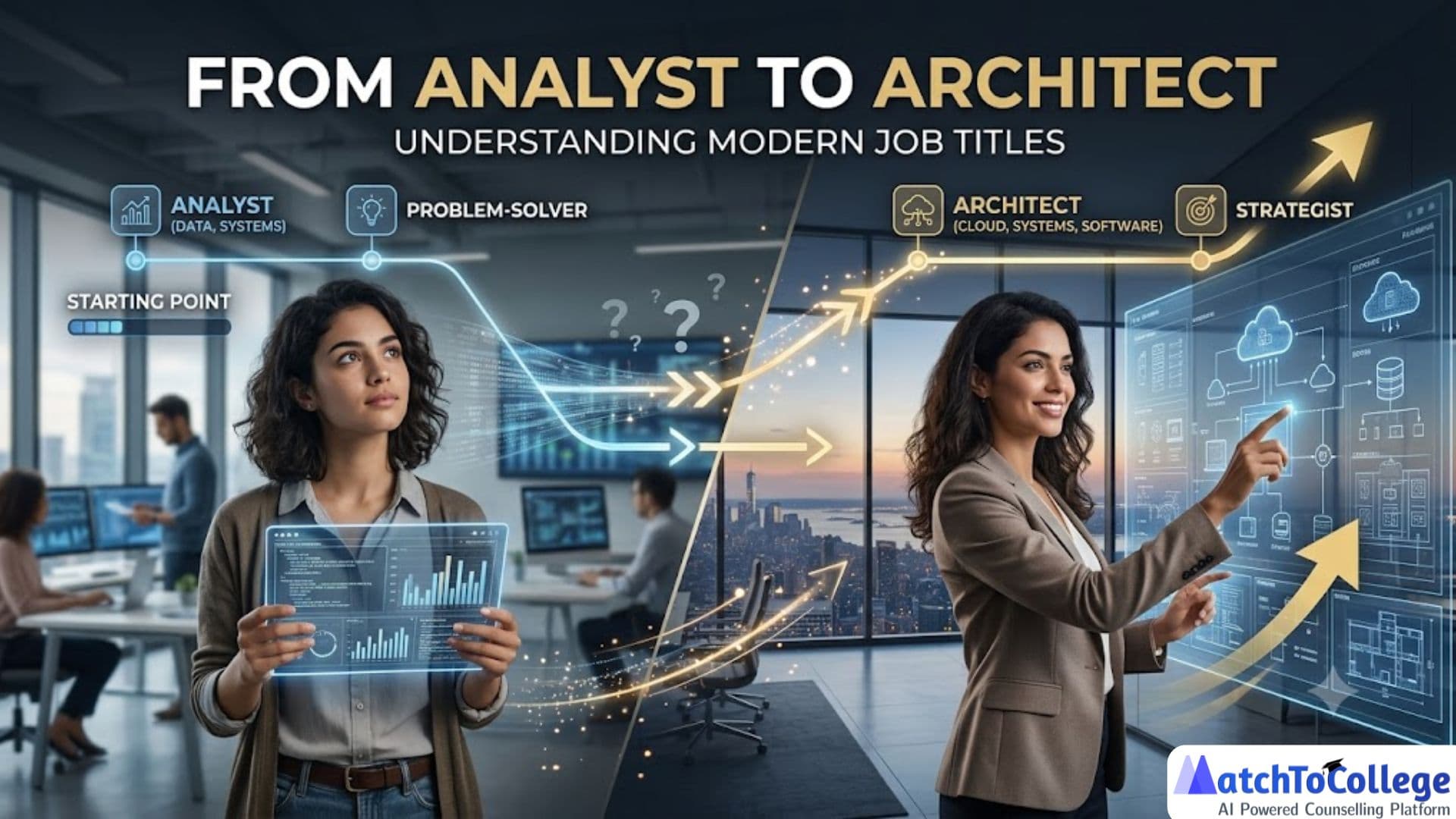
From data analyst to system architect.
The professional world is changing quickly. New technologies, industries, and business needs are creating new job roles with evolving titles.
Terms like Data Analyst, Business Intelligence Analyst, Solutions Architect, and Cloud Architect can be confusing for students planning their careers. Understanding these roles helps students choose the right education, skills, and career direction.
Today, success requires more than choosing a broad field. Students need to understand specific job roles, required skills, and future career growth opportunities.
Analyst vs Architect: Understanding the Difference
| Role Type | Main Focus | Key Responsibilities |
| Analyst | Understanding data and solving problems | Collects information, analyzes trends, finds insights, and supports decision-making. |
| Architect | Designing solutions and systems | Creates strategies, designs frameworks, and builds solutions for complex business or technology challenges. |
Examples of Modern Job Roles
| Job Title | What They Do | Important Skills |
| Data Analyst | Studies data to identify trends and support business decisions. | Data analysis, statistics, Excel, SQL, visualization |
| Business Intelligence Analyst | Converts business data into useful insights for organizations. | Data tools, reporting, business understanding |
| Solutions Architect | Designs technology solutions that solve business problems. | System design, technology knowledge, communication |
| Cloud Architect | Creates and manages cloud-based technology systems. | Cloud platforms, security, infrastructure design |
How Job Roles Have Evolved
| Earlier Approach | Modern Approach |
| Choosing only a broad field (e.g., technology, business) | Understanding specific roles and career paths |
| Focusing only on degrees | Developing skills, experience, and specialization |
| Preparing for fixed job descriptions | Building adaptability for changing industries |
Why Understanding Job Titles Matters
- Helps students select the right courses and specializations.
- Provides clarity about required skills and qualifications.
- Helps align education choices with career goals.
- Makes career planning more focused and practical.
How MatchToCollege Helps
| Feature | Support Provided |
| Career Role Insights | Helps students understand modern job roles and responsibilities. |
| Education Matching | Connects career goals with suitable degree programs and specializations. |
| Skill Planning | Identifies skills needed for future career opportunities. |
| Personalized Guidance | Helps students create a clear academic and career roadmap. |
Modern careers are no longer defined by simple job titles. Whether you become an analyst, architect, strategist, or specialist, success depends on understanding the role, developing the right skills, and choosing an education path that supports your goals. Clear career awareness helps students make smarter decisions for a successful future.
The Evolving World of 'Analyst' Roles
The term 'Analyst' traditionally evoked images of number crunching and detailed reporting. While these core functions remain, modern analyst roles have become significantly more specialized and strategic. Today, we see a spectrum:
| Job Role | Primary Focus | Key Responsibilities | Important Skills/Tools |
| Data Analyst | Analyzing data to support decision-making | Collects, processes, and analyzes large datasets to identify trends and insights. | SQL, Python, R, data visualization, statistics |
| Business Analyst | Connecting business needs with technology solutions | Identifies business problems, gathers requirements, designs solutions, and improves communication between teams. | Communication, problem-solving, business understanding, requirement analysis |
| Financial Analyst | Evaluating financial information and investments | Analyzes financial data, assesses investment opportunities, and supports financial decision-making. | Financial modeling, economics, market analysis, financial knowledge |
| Operations Analyst | Improving business processes and efficiency | Studies workflows, identifies inefficiencies, and recommends improvements to increase productivity and reduce costs. | Process analysis, problem-solving, data analysis, optimization skills |
What unites these roles is a foundation in critical thinking, data interpretation, and the ability to translate complex information into actionable insights. While often entry-to-mid level, they are pivotal for organizational intelligence and frequently serve as stepping stones to more senior or specialized roles.
Embracing Leadership: The 'Architect' Spectrum
The 'Architect' role, by contrast, signifies a shift from tactical analysis to strategic design and oversight. Architects are visionaries who design complex systems and solutions, ensuring they are robust, scalable, and align with an organization's long-term goals. This role requires extensive experience, deep technical expertise, and strong leadership qualities.
| Job Role | Primary Focus | Key Responsibilities | Important Skills/Knowledge |
| Software Architect | Designing the structure of software systems | Defines software components, interfaces, and data flow while ensuring performance, security, and reliability. | Software design, system architecture, programming concepts, security, scalability |
| Solution Architect | Creating complete solutions for business problems | Designs end-to-end solutions by integrating different systems and technologies to meet business needs. | Technical knowledge, business understanding, problem-solving, system integration |
| Cloud Architect | Designing cloud-based infrastructure | Builds and manages cloud solutions while optimizing cost, security, and performance on platforms like AWS, Azure, and Google Cloud. | Cloud platforms, networking, security, infrastructure management |
| Enterprise Architect | Aligning technology strategy with business goals | Creates organization-wide technology plans and ensures IT systems support overall business objectives. | Business strategy, IT planning, leadership, enterprise systems |
Architects are not just skilled technicians; they are strategic thinkers, problem solvers, and mentors who guide development teams and influence major technological decisions. The path to becoming an Architect often involves years of hands-on experience as an Analyst, Developer, or Engineer, coupled with continuous learning and a knack for leadership.
Chart Your Course: How MatchToCollege Guides Your Career
Understanding the nuances between an 'Analyst' and an 'Architect' role, and the many variations in between, is the first step towards building a successful career. But how do you bridge the gap between aspirational job titles and the educational path that leads there?
This is where MatchToCollege becomes your indispensable partner. Our AI-powered platform does more than just recommend colleges; it helps you:
| Feature | How It Helps Students |
| Demystify Career Paths | Provides clear information about modern job roles, required skills, and educational backgrounds needed for careers like Data Analyst, Cloud Architect, and other emerging professions. |
| Personalized Program Matching | Recommends suitable undergraduate and graduate programs based on students’ interests, academic profile, and career goals. |
| Skill Gap Analysis | Identifies skills students need to develop and suggests programs or learning opportunities to achieve career objectives. |
| Strategic Career Planning | Helps students create a clear roadmap for MBA, Engineering, Medical, Study Abroad, or other higher education pathways. |
Don't let confusing job titles deter you. Let MatchToCollege empower you with the clarity and direction needed to transform your dreams into a well-defined higher education and career reality. Explore your potential today and build the future you envision.
Share this Article
FAQFrequently Asked Questions
Q: What's the main difference between an 'Analyst' and an 'Architect' role?
An 'Analyst' typically focuses on examining data, processes, or systems to derive insights and solve specific problems, often requiring strong analytical and reporting skills. An 'Architect' designs and oversees the overall structure and strategy of complex systems or solutions, requiring extensive experience, strategic thinking, and leadership to ensure long-term goals are met.
Q: How can MatchToCollege help me understand modern job titles and choose a career path?
MatchToCollege's AI-powered platform provides personalized guidance by analyzing your academic interests and career aspirations. It demystifies modern job titles, outlines required skills and educational backgrounds, and matches you with specific higher education programs globally that prepare you for your desired roles. This helps you make informed decisions and build a clear path to your career goals.
Get More Info About From Analyst to Architect
Recommended Reading

Best Online MBA Specializations for High-Paying Careers 2026
Discover the most lucrative online MBA specializations for 2026-27. Compare ROI, career growth, and use our AI tools to find your perfect management path.

Top Career Opportunities After an Online MBA in 2026-27
Discover high-paying career paths and roles after an online MBA in 2026-27. Explore salary trends, ROI, and tools to navigate your future professional success.

Tax Deductions on Higher Education: 2026-27 India Guide
Maximize your savings with our guide on tax deductions for higher education fees in India for FY 2026-27. Learn about Section 80C, 80E, and upskilling benefits.