

Active Recall vs. Re-reading: The Smart Study Showdown
Admission & Info Tools
Need Expert Assistance?
Our counselors can help you with fee structures, eligibility guidelines, and upcoming admission cutoffs instantly.
Direct Application Tools
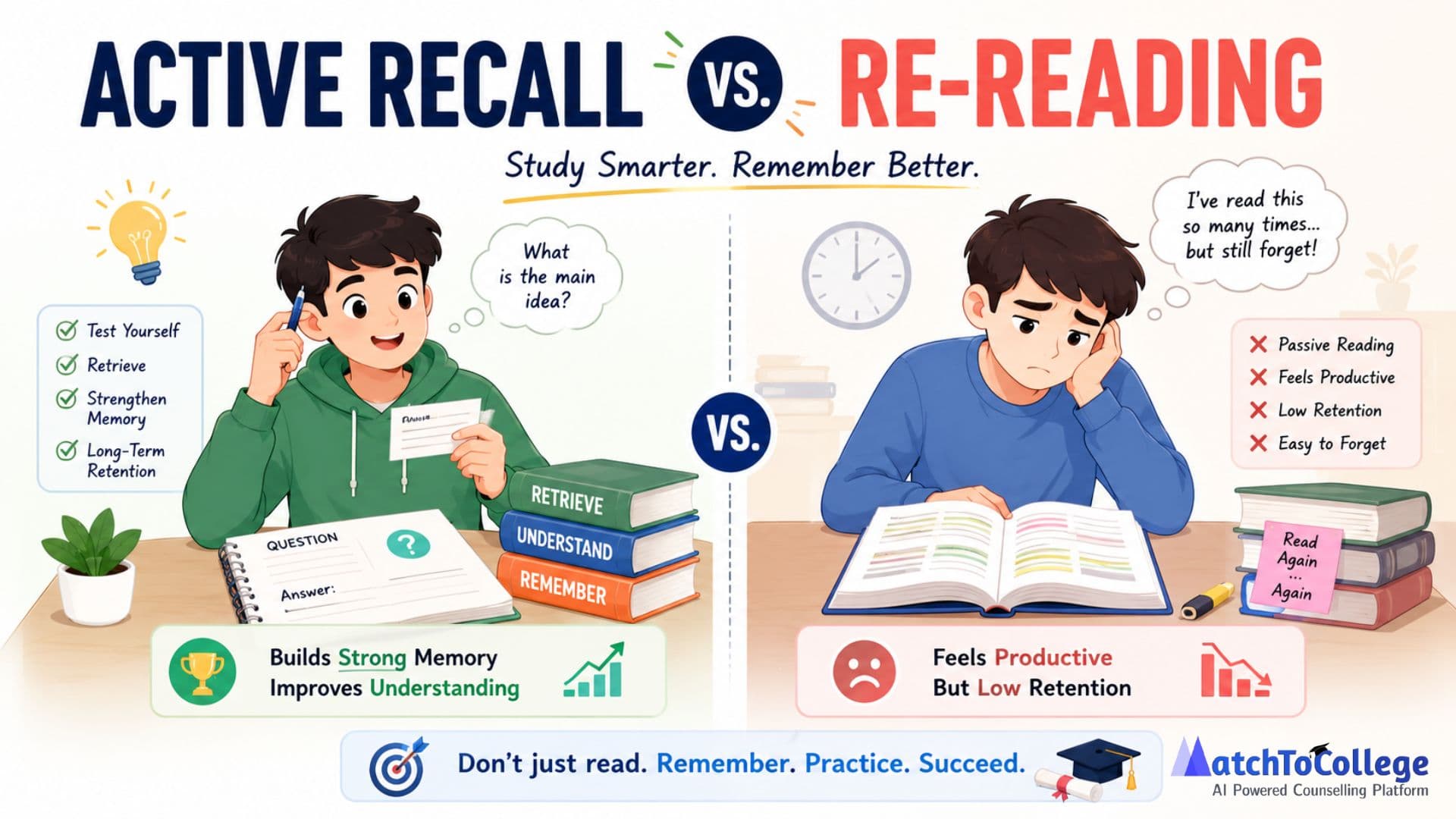
Recall wins over passive reading
Many students spend hours reading the same notes repeatedly and feel productive. But during exams, they often struggle to remember what they studied. This happens because re-reading creates familiarity, not strong memory.
A more effective method is active recall — testing your brain by trying to remember information without looking at notes.
Quick comparison
| Method | How it works | Result |
| Active Recall | Retrieve information from memory | Strong retention |
| Re-reading | Read same material repeatedly | Temporary familiarity |
Why re-reading feels useful
Re-reading makes content look familiar. This can create a false sense of understanding.
Common issue:
- You recognize information
- But cannot recall during exams
- Learning stays superficial
Why active recall works better
Active recall forces the brain to retrieve information actively. That strengthens long-term memory.
Examples:
- Closing notes and answering questions
- Explaining a topic aloud
- Writing from memory
- Solving without seeing solutions
- Using flashcards
Best use for students
Especially useful for:
- Entrance exams
- Semester exams
- Competitive exams
- Interviews
- Skill-based learning
Practical comparison
| Situation | Re-reading | Active recall |
| Quick review | Useful | Better |
| Long retention | Weak | Strong |
| Exam performance | Moderate | High |
| Confidence | False confidence | Real confidence |
How to use active recall daily
Simple routine:
| Step | Action |
| Study topic | Understand concept |
| Close material | Recall key points |
| Write answers | From memory |
| Check mistakes | Correct gaps |
| Repeat | Strengthen learning |
Best study combination
Students can combine:
- Active recall
- Spaced revision
- Mock tests
- Previous papers
- Short notes
Common mistake
Many students only read repeatedly.
Better approach:
- Read once carefully
- Recall repeatedly
- Practice frequently
- Revise strategically
Active recall is usually more effective than re-reading because it trains memory retrieval, not just recognition. For exams, the goal is not to recognize information on the page — it is to recall it when needed.
Understanding Active Recall: The Power of Retrieval Practice
At its core, active recall, also known as retrieval practice, is the act of deliberately retrieving information from your memory. Instead of passively absorbing information by simply re-reading, active recall forces your brain to work, strengthening the neural pathways associated with that knowledge. Think of it like a muscle: the more you exercise it, the stronger it becomes. When you practice active recall, you're essentially 'exercising' your memory, making it easier to retrieve that information when it truly matters – during an exam or when applying concepts in a complex problem.
This method doesn't just help you remember; it helps you understand. By attempting to recall information, you're actively engaging with the material, identifying gaps in your knowledge, and solidifying your comprehension. Common active recall techniques include:
- Flashcards: Writing questions on one side and answers on the other, then quizzing yourself.
- Self-Quizzing: After reading a chapter, close the book and try to answer questions about what you just learned.
- Blurting: Write down everything you can remember about a topic without looking at your notes.
- Practice Questions: Working through problems or questions from textbooks, past papers, or online resources.
- Teaching Others: Explaining a concept aloud to someone else (or even to an imaginary audience) forces you to articulate and organize your thoughts.
The benefits of this effective learning strategy are profound, leading to enhanced long-term memory retention, deeper understanding, and superior academic performance. It's a key ingredient for students aiming for competitive entrance exams and rigorous university programs.
The Pitfalls of Passive Re-reading: Why It Falls Short
Re-reading is arguably the most common study method among students worldwide. It feels intuitive, productive, and reassuring. However, despite its popularity, extensive research in cognitive psychology consistently demonstrates that re-reading is one of the least effective study habits for long-term retention and deep understanding. Why does it fall short?
The primary culprit is the illusion of fluency. When you re-read material, especially familiar text, your brain processes it quickly, leading to a feeling of familiarity. You might think, 'Oh, I know this!' or 'I've seen this before, so I must understand it.' But familiarity is not the same as mastery. This passive exposure doesn't require your brain to retrieve or apply the information, meaning the neural connections for recall are never truly strengthened. You recognize the words, but you haven't truly learned the concepts in a way that allows you to reconstruct them from scratch.
Furthermore, re-reading is incredibly inefficient. It's time-consuming with a low return on investment. Hours spent repeatedly going over the same text could be far more effectively used with strategies that actively challenge your memory. It promotes superficial processing rather than genuine engagement with the material, which is critical for complex subjects found in higher education. Students often confuse the ease of processing information they've seen before with genuine learning, leading to disappointment during exams where active recall of facts and concepts is required.
How to Implement Active Recall Effectively in Your Study Routine
Transitioning from passive re-reading to active recall requires a conscious shift in your study routine. Here's how you can integrate this powerful learning technique for maximum impact:
- Transform Your Notes: Instead of just highlighting, turn your notes into questions. After a lecture or reading, write questions in the margins that the text answers. Later, cover the answers and try to recall them.
- Use Technology Wisely: Digital flashcard apps like Anki or Quizlet are excellent tools for active recall, especially when combined with spaced repetition. They intelligently schedule reviews based on your performance, maximizing efficiency.
- Regular Self-Assessment: Don't wait for a major exam to test your knowledge. Regularly quiz yourself using practice problems, end-of-chapter questions, or questions you generate. This is crucial for identifying knowledge gaps early.
- Collaborative Learning: Study groups can be highly effective for active recall if structured correctly. Instead of simply sharing notes, quiz each other, explain concepts to one another, and challenge each other's understanding.
- Vary Your Practice: Don't stick to just one method. Mix flashcards with blurting, self-quizzing with teaching. The variety keeps your brain engaged and tests different aspects of your memory.
By consistently applying these techniques, you'll find that your information recall improves dramatically, paving the way for better exam success and a deeper engagement with your academic material.
Beyond Active Recall: Combining Strategies for Optimal Learning
While active recall is a foundational element of effective learning, its power is amplified when combined with other evidence-based study strategies. One of the most potent combinations is active recall with spaced repetition. Spaced repetition involves reviewing information at increasing intervals over time. Instead of cramming, this method strategically revisits material just before you're about to forget it, solidifying it in your long-term memory. Flashcard apps often incorporate spaced repetition algorithms automatically.
Another valuable technique is interleaving, which means mixing different subjects or topics during your study sessions rather than focusing on one subject for a long block. For example, instead of studying math for two hours, you might study math for 30 minutes, then switch to history for 30, then back to math. This helps your brain discriminate between different types of problems and strengthens your ability to apply knowledge in varied contexts, a vital skill for higher-level academic challenges.
Additionally, elaboration – explaining concepts in your own words and connecting them to what you already know – enhances understanding. Techniques like mind mapping and creating analogies also fall under elaboration, helping to build a richer, more interconnected knowledge base. By integrating these strategies, students can build a robust framework for student success, ensuring not just rote memorization but true mastery.
Share this Article
FAQFrequently Asked Questions
Q: What's the biggest difference between active recall and re-reading?
The biggest difference is active engagement. Active recall (retrieval practice) forces your brain to actively retrieve information from memory, strengthening neural connections and identifying knowledge gaps. Re-reading, conversely, is a passive process that merely exposes you to information, creating an illusion of familiarity without genuinely consolidating the knowledge for long-term retention or application.
Q: Can I use both active recall and re-reading in my study routine?
While active recall should be your primary and most frequent study method, a brief initial read (not re-read) of new material can be useful for gaining context before you apply active recall techniques. However, relying on repeated re-reading after this initial exposure is generally inefficient and less effective for deep learning and long-term memory compared to consistent active recall, spaced repetition, and other evidence-based strategies.
Get More Info About Active Recall vs. Re-reading
Recommended Reading

Best Online MBA Specializations for High-Paying Careers 2026
Discover the most lucrative online MBA specializations for 2026-27. Compare ROI, career growth, and use our AI tools to find your perfect management path.

Top Career Opportunities After an Online MBA in 2026-27
Discover high-paying career paths and roles after an online MBA in 2026-27. Explore salary trends, ROI, and tools to navigate your future professional success.

Tax Deductions on Higher Education: 2026-27 India Guide
Maximize your savings with our guide on tax deductions for higher education fees in India for FY 2026-27. Learn about Section 80C, 80E, and upskilling benefits.