

JEE Main 2027: Your Definitive Guide to a 'Good Score' for NITs, IIITs & GFTIs
Admission & Info Tools
Need Expert Assistance?
Our counselors can help you with fee structures, eligibility guidelines, and upcoming admission cutoffs instantly.
Direct Application Tools

Share this Article
🎯 MatchToCollege AI Recommendation: Planning your counselling or choice filling? Check your seat allotment probability across premier colleges using the JEE Main College Predictor.
Key Highlights: Decoding a 'Good Score' in JEE Main
Defining a 'good score' in JEE Main is subjective, varying significantly based on individual aspirations, category, and the specific engineering program or institute one targets. However, a score that facilitates admission into desirable branches at National Institutes of Technology (NITs), Indian Institutes of Information Technology (IIITs), and Government Funded Technical Institutes (GFTIs) is generally considered excellent.
Based on past trends and JEE Main 2026 results, a score of 270 or higher is often deemed outstanding, opening doors to highly competitive branches in top NITs like Rourkela and Delhi. For a broader perspective, securing 250+ marks is considered very good, while aiming for 280+ marks positions you among the top performers.
JEE Main 2027 Overview
| Parameter | Details |
| Exam Name | Joint Entrance Examination (JEE) Main |
| Conducting Body | National Testing Agency (NTA) |
| Exam Frequency | Twice a year (January & April sessions) |
| Total Marks | 300 Marks |
| Question Type | Multiple Choice Questions (MCQs) & Numerical Value Questions |
| Marking Scheme | +4 for correct, -1 for incorrect, 0 for unattempted |
JEE Main Marks, Percentile & Rank: The Interplay
Understanding the relationship between your raw score, percentile, and eventual rank is crucial for JEE Main. Your raw score is the total marks obtained. This score is then converted into a percentile, which indicates the percentage of candidates who scored equal to or below you in that particular session. Your All India Rank (AIR) is derived from your best percentile across the two sessions.
Several factors influence what constitutes a 'good' percentile and rank, including the total number of candidates appearing, the difficulty level of the exam sessions, and the specific category you belong to.
Expected JEE Main Marks vs. Percentile (Based on Trends)
| Marks Range | Expected Percentile |
| 280-300 | 99.95 - 100 |
| 250-279 | 99.5 - 99.9 |
| 200-249 | 99 - 99.5 |
| 180-199 | 98 - 99 |
| 150-179 | 97 - 98 |
| 120-149 | 95 - 97 |
| 100-119 | 93 - 95 |
| 80-99 | 90 - 93 |
Note: This table provides an estimation based on previous year trends and is subject to change with actual exam difficulty and candidate performance.
Expected JEE Main Marks vs. Rank (Based on Trends)
| Marks Range | Expected Rank Range |
| 280-300 | 1 - 500 |
| 250-279 | 501 - 2,000 |
| 200-249 | 2,001 - 10,000 |
| 180-199 | 10,001 - 20,000 |
| 150-179 | 20,001 - 35,000 |
| 120-149 | 35,001 - 60,000 |
| 100-119 | 60,001 - 90,000 |
| 80-99 | 90,001 - 1,50,000 |
Note: This table provides an estimation based on previous year trends and is subject to change. The actual rank depends on the total number of candidates and their performance.
Eligibility, Cutoffs & Admission Pathways to Top Institutions
While there is no minimum percentage required in Class 12 for *appearing* in JEE Main, candidates must understand a critical distinction: for *admission* to NITs, IIITs, GFTIs, and IITs, a minimum of 75% marks in Class 12 (or being in the top 20 percentile of their respective board) is mandatory. Many other institutes, however, may offer admission with lower Class 12 percentages alongside your JEE Main score.
JEE Main Qualifying Cutoff for JEE Advanced (Based on Previous Year)
| Category | Previous Year Qualifying Percentile |
| Unreserved (UR) | 93.1023262 |
| Gen-EWS | 80.3830119 |
| OBC-NCL | 79.4313582 |
| SC | 61.1526933 |
| ST | 47.9026465 |
| UR-PwD | 0.0079349 |
These cutoffs represent the minimum percentile required to qualify for JEE Advanced. Candidates scoring above these percentiles become eligible to appear for JEE Advanced, which is the gateway to the prestigious IITs.
Home State Quota & Admission
For NITs, a significant advantage exists through the Home State quota. Your home state is determined by the state from which you appear for your Class 12 board examination or the state to which you belong. Candidates availing this quota are required to submit proof of domicile during the admission process.
Even if you don't qualify for JEE Advanced, a good JEE Main score can still secure you a seat in NITs, IIITs, and GFTIs through JoSAA counselling. However, admission to IITs is exclusively through JEE Advanced.
To get a clearer picture of your admission chances based on your expected JEE Main score or rank, we highly recommend using the official JEE Main College Predictor by MatchToCollege. This tool can help you identify the best B.Tech colleges for your profile.
Strategic Preparation for JEE Main Success
Achieving a 'good score' in JEE Main 2027 demands a well-structured and consistent preparation strategy. It's not just about studying hard, but studying smart.
- Master the Syllabus: Thoroughly understand the JEE Main syllabus for Physics, Chemistry, and Mathematics. Prioritize high-weightage topics and ensure conceptual clarity.
- Consistent Practice: Regular practice is non-negotiable. Solve a wide variety of problems daily to build speed and accuracy.
- Previous Year Question Papers (PYQs): Dedicate significant time to solving JEE Main previous year papers. This helps you understand the exam pattern, question types, and time management. Analyze your mistakes and learn from them.
- Mock Tests: Regularly take full-length mock tests under timed conditions. This simulates the actual exam environment, helps identify weak areas, and refines your test-taking strategy.
- Daily Revision: Consolidate your learning through daily revision of concepts and formulas. Short, frequent revisions are more effective than cramming.
- Maintain a Healthy Routine: A balanced routine that includes adequate sleep, healthy food, and short breaks is crucial. Avoid burnout and ensure your physical and mental well-being throughout the preparation journey.
- Seek Clarification: Never hesitate to clarify doubts. Whether it's from teachers, mentors, or study groups, addressing uncertainties immediately strengthens your foundation.
Navigating Admissions & Future Prospects
Once you have your JEE Main score and rank, the next step is navigating the admission process through JoSAA (Joint Seat Allocation Authority) counselling. Your rank, category, and preferred branch will determine your college allocation.
Specialized branches like Computer Science Engineering (CSE), Electronics & Communication Engineering (ECE), and Mechanical Engineering typically have higher cutoffs due to intense competition. Conversely, some emerging or niche branches might have slightly lower cutoffs.
Example JEE Main Cutoffs for Top NITs (Open Category, Based on Past Trends)
| Institute & Branch | Closing Rank (Home State) |
| MNNIT Allahabad CSE | 5627 |
| MNNIT Allahabad CSE | 4254 (Other State) |
| MNIT Jaipur CSE | 5610 |
| MNIT Jaipur CSE | 4631 (Other State) |
Note: These are illustrative closing ranks for the Open Category from previous years and are subject to change for JEE Main 2027.
Career Scope & Placements
An engineering degree from a reputable NIT, IIIT, or GFTI opens up a world of opportunities. Graduates are highly sought after in various sectors, including IT, core engineering, manufacturing, finance, and research. The average placement packages vary significantly based on the institute, branch, and individual skills, but top institutes consistently report impressive placement statistics with leading national and international companies.
Beyond placements, an engineering education fosters critical thinking, problem-solving abilities, and innovation, preparing you for diverse career paths, entrepreneurship, or further higher education like M.Tech or MBA.
🏛️ Looking for Admissions & College Cutoffs? Explore verified fee structures, seat matrices, and real student reviews across top institutions on the MatchToCollege Top Colleges & Universities in India Directory.
Frequently Asked Questions
Q: Why might my JEE Main rank differ from estimated marks vs. percentile data?
The National Testing Agency (NTA) does not officially release marks vs. rank data. The estimations available online are provided by educational experts and are subject to variations based on factors like the total number of candidates, exam difficulty across sessions, and the normalization process. Your actual rank is determined by your best percentile score.
Q: How can I estimate my JEE Main percentile and rank?
While official data is released by NTA, you can use reliable tools and analyses provided by educational platforms. MatchToCollege offers a JEE Main College Predictor that can help you estimate your admission chances based on your expected score or rank, drawing from extensive past year data and expert analysis.
Q: What are the category-wise qualifying cutoffs in JEE Main?
The JEE Main qualifying cutoffs, which determine eligibility for JEE Advanced, vary by category. Based on previous year trends, the cutoffs were approximately: Unreserved (UR) 93.10 percentile, Gen-EWS 80.38 percentile, OBC-NCL 79.43 percentile, SC 61.15 percentile, ST 47.90 percentile, and UR-PwD 0.0079 percentile. These are minimums and can fluctuate.
Q: What is the JEE Main Cutoff?
The JEE Main cutoff refers to two distinct aspects: first, the minimum percentile score required to qualify for the JEE Advanced exam (released with the April session result); and second, the closing ranks for admission to various branches in NITs, IIITs, and GFTIs, which are released during JoSAA counselling.
Q: Can I secure admission to any institute if I don't meet the JEE Main cutoff for JEE Advanced?
Yes, absolutely. Candidates who do not score above the JEE Main qualifying cutoff for JEE Advanced are still eligible for admission to NITs, IIITs, and GFTIs based on their JEE Main rank through JoSAA counselling. However, to appear in the admission process for IITs, you must qualify for and clear the JEE Advanced exam.
Q: What are the JEE Main cutoffs for NITs and IIITs?
The cutoffs for NITs and IIITs vary significantly based on the specific institute, engineering branch, and the candidate's category (General, OBC, SC, ST, EWS, PwD). Highly sought-after branches like Computer Science and Electronics Engineering generally have higher cutoffs. For instance, top NITs like MNNIT Allahabad and MNIT Jaipur have closing ranks for CSE in the range of 4,000-6,000 for the Open Category (Other State/Home State). These cutoffs are released by JoSAA after each counselling round.
Related Topics
Featured Mentioned Colleges
Explore institutions featured and discussed in this article


With an educational trajectory spanning 65 years since its inception in 1961, National Institute of Technology, Rourkela serves as a prominent seat of learning in Sundaragada, Odisha. Conforming to regulatory norms of All India Council for Technical Education (AICTE) through its affiliation with Odisha State University, the institution offers students an integrated foundation across engineering innovation, applied science, computational systems, and advanced technical research. The campus is equipped with state-of-the-art computational centers, robotics and IoT laboratories, and core engineering workshops, creating an immersive environment for scholarly development and collaborative innovation. By combining academic discipline with practical exposure, it equips emerging scholars to meet evolving demands in industry, academia, and public service.
Total Fees
Contact for Fees
Total Courses
6


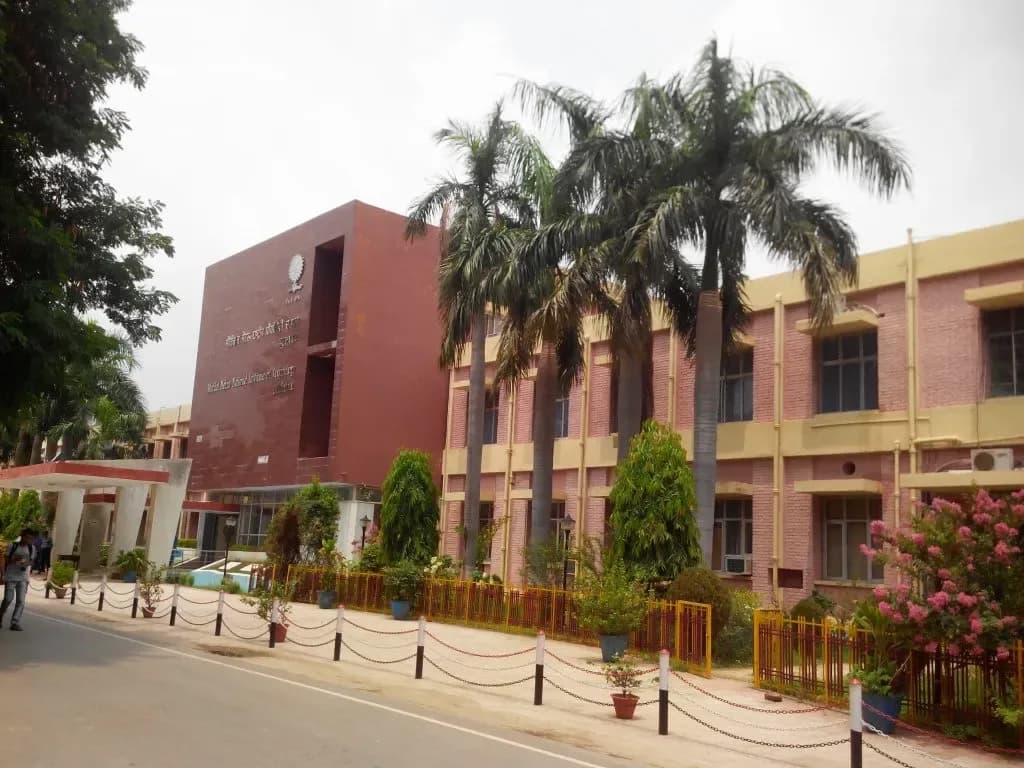

Motilal Nehru National Institute of Technology (MNNIT), Allahabad is one of the top National Institutes of Technology in India and is recognized as an Institute of National Importance. Established in 1961, the institute offers undergraduate, postgraduate, and doctoral programs in engineering, management, sciences, and applied disciplines.
Total Fees
Contact for Fees
Total Courses
5


Established in 1963, Malviya National Institute of Technology, Jaipur is a distinguished institution situated in Jaipur, West Bengal. Operating under the academic aegis of West Bengal State University and recognized by All India Council for Technical Education (AICTE), it provides structured degree programs emphasizing engineering innovation, applied science, computational systems, and advanced technical research. With modern campus amenities encompassing state-of-the-art computational centers, robotics and IoT laboratories, and core engineering workshops, the institution actively bridges conceptual instruction with empirical application. Graduates of Malviya National Institute of Technology, Jaipur emerge as competent, socially conscious professionals poised to assume impactful roles in diverse professional domains.
Total Fees
Contact for Fees
Total Courses
8
Get More Info About JEE Main 2027
Recommended Articles

JEE Main B.Planning Guide: Architecture & Planning Admissions in India
Unlock your path to a B.Planning degree with our comprehensive guide. Understand JEE Main Paper 2B, eligibility, top colleges, and career opportunities in urban and regional planning.

MBA Placements Unveiled: Understanding ROI, Packages & Career Paths
Navigating MBA placements requires a clear understanding of salary expectations, from the highest to the foundational packages. This MatchToCollege guide helps you decode placement reports and make informed decisions for your management career.

MBA Admissions: Navigating Top B-Schools Without CAT Sectional Cutoffs
Many aspiring MBA candidates worry about CAT sectional cutoffs. Discover leading B-schools in India that prioritize your overall performance, opening doors to diverse management careers.