


UGC Approves 33 New Healthcare Courses; BPT Extended to 5 Years
Admission & Info Tools
Need Expert Assistance?
Our counselors can help you with fee structures, eligibility guidelines, and upcoming admission cutoffs instantly.
Direct Application Tools
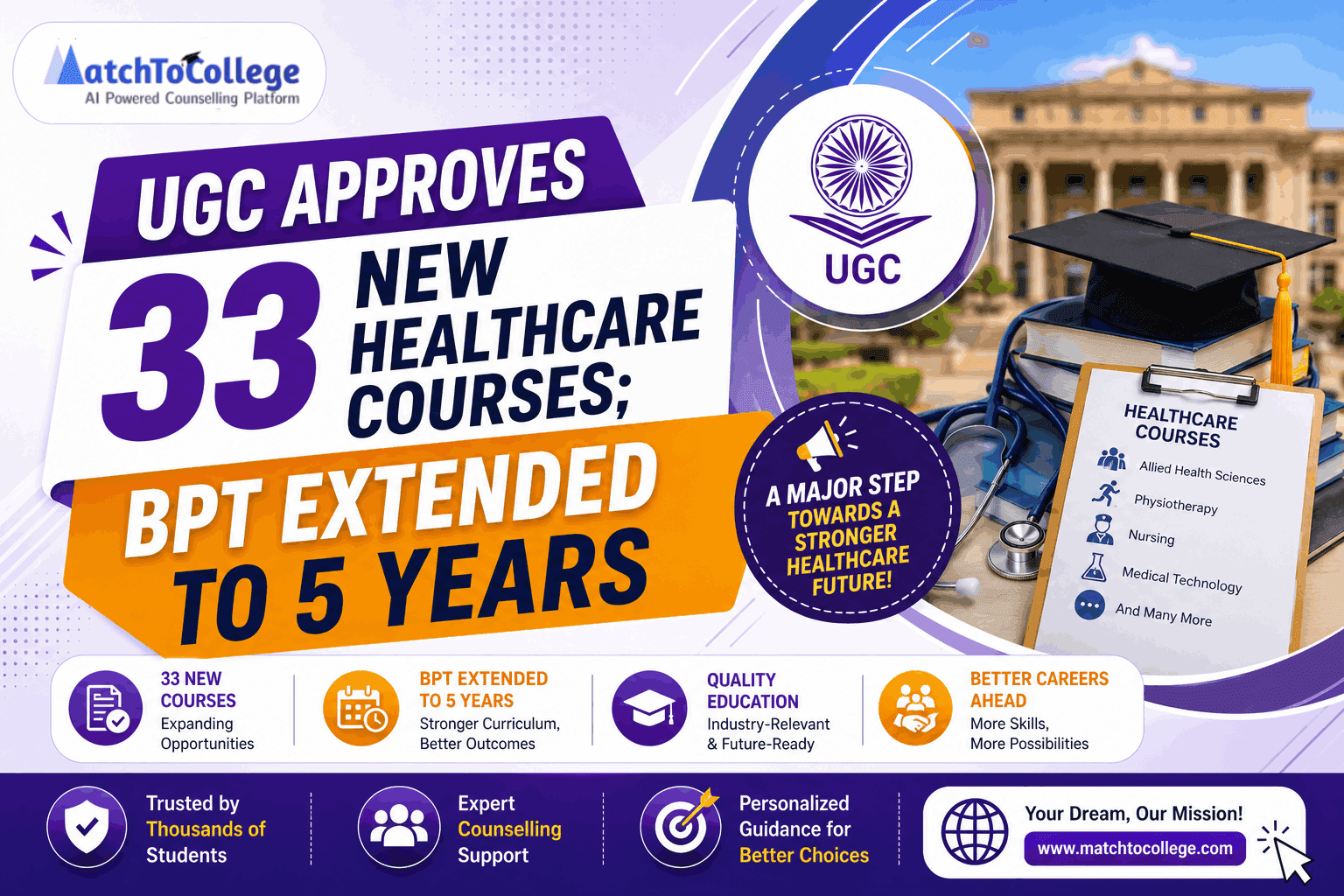
In a landmark move that is set to redefine the landscape of medical education in India, the University Grants Commission (UGC) has officially approved 33 new allied and healthcare degree courses. This initiative, proposed by the National Commission for Allied and Healthcare Professions (NCAHP), aims to standardise healthcare education across the country under the 'One Nation, One Curriculum' vision by 2030-31.
One of the most significant changes includes the extension of the Bachelor of Physiotherapy (BPT) and Bachelor of Occupational Therapy (BOT) from 4.5 years to a full 5-year duration, effective from the 2026-27 academic session. For students aiming for medical seats, using the NEET College Predictor and NEET Rank Predictor has become more crucial than ever to navigate these shifting academic timelines.
The Ministry of Health and Family Welfare, through the NCAHP, is driving these changes to eliminate confusion caused by varying course names and curricula across different states. Parallelly, the Medical Counselling Committee (MCC) is moving swiftly with its 2026 schedule, having just released the NEET MDS 2026 Round 1 provisional seat allotment. Candidates are on a tight clock, with an objection window closing at 12:30 PM on September 2, 2026. Whether you are an aspiring physiotherapist or a post-graduate dental candidate, these updates necessitate immediate action and long-term planning. To ensure you are on the right path, explore the Career Pathway Matcher to align your skills with these new healthcare verticals.
Major Shift in Duration: BPT, BOT, and Optometry Now 5 Years
Starting from the 2026-27 academic session, students enrolling in the Bachelor of Physiotherapy (BPT), Bachelor of Occupational Therapy (BOT), and Bachelor of Optometry (BOptom) will face an extended academic journey. The UGC has mandated that BPT and BOT, which were previously 4.5-year programs (including internships), will now span 5 years.
Similarly, the Bachelor of Optometry has been increased from 4 years to 5 years. This extension is designed to incorporate more rigorous clinical training and a standardized national curriculum, ensuring that Indian graduates meet global healthcare standards. For those concerned about the financial implications of an extra year, utilizing the Education Loan EMI Calculator can help in long-term financial planning.
This change is not just about time; it is about depth. The added six months to a year will allow for specialized modules in rehabilitative sciences and advanced clinical diagnostics. Universities offering postgraduate degrees like MPT and MOT are also required to restructure their offerings to align with the new undergraduate nomenclature.
Aspiring students should use the NEET OMR Score Calculator to get an early estimate of their scores and plan their applications according to these new durations. The alignment with NCAHP norms means that degrees will only be recognized if they follow the newly specified titles and durations, making it imperative for students to check the Domestic Colleges listing to find compliant institutions.
The 33 New Courses: Expanding the Allied Healthcare Horizon
The UGC notification introduces 33 new allied and healthcare degree courses across 17 medical disciplines. This expansion covers a vast array of fields including medicine, surgery, Ayurveda, Unani, homeopathy, pharmacy, and nursing. The goal is to provide a common framework for professions that were previously unregulated or inconsistently named across different states.
By 2030-31, the government intends to have every healthcare college in India teaching the same curriculum for these disciplines. This 'One Nation, One Curriculum' strategy will facilitate easier mobility for students and professionals across state lines and even internationally. Students interested in these emerging fields can compare the value of different programs using the Online Courses ROI Calculator to see which specializations offer the best career growth.
For candidates looking toward 2026 admissions, this news opens up several niche career paths in paramedical sciences that were previously not formalized as full degrees. As the healthcare sector grows more tech-reliant, these courses will likely integrate AI and digital health modules. If you are targeting top-tier institutions, keeping track of rank trends via the NEET Rank Predictor is essential. Furthermore, for those considering options beyond Indian borders, the MBBS Abroad and Study Abroad portals provide a comparative view of how these new Indian standards stack up against global certifications.
NEET MDS 2026: Critical Updates on Round 1 Allotment
While the UGC reshapes undergraduate healthcare, the Medical Counselling Committee (MCC) is managing the current needs of post-graduate dental aspirants. The NEET MDS 2026 Round 1 provisional seat allotment is now live on mcc.nic.in. This is a high-stakes update as the objection window is remarkably brief, closing at 12:30 PM on September 2, 2026.
Any candidate identifying discrepancies in their allotted college, course, or category must use the official Candidate Login Portal to file a grievance. MCC has explicitly stated that emails or offline complaints will not be entertained. If you are also appearing for other exams, check your status using the NEET Result Checker to stay updated on all fronts.
Following the resolution of objections, the final allotment list will be published. Successful candidates must physically report to their designated colleges between September 3 and September 11, 2026. Failure to report within this window results in a forfeiture of the seat, which will then be moved to the Round 2 vacancy pool. It is critical to have all original documents and category proofs ready. For students who didn't get their first choice, tools like the JoSAA College Predictor or the IP University College Predictor offer insights into other counselling rounds and alternative institutional options.
Implementation Challenges and State Council Formation
Despite the UGC’s national notification, the implementation of these new norms faces a significant hurdle: the formation of State Allied and Healthcare Councils. While the National Commission (NCAHP) sets the standards, the enforcement and actual admission processes are managed at the state level. Many states have yet to fully constitute these councils, which could lead to a staggered rollout of the 5-year BPT and BOT programs. Candidates must remain vigilant and check for updates from their respective state medical authorities. You can stay ahead of these administrative shifts by using the Maharashtra College Predictor or other state-specific tools like the TS EAMCET Predictor to understand local admission trends.
The shift to a 5-year duration for BPT also impacts the eligibility for government jobs and international licensing exams (like the NPTE in the USA). Historically, the 4.5-year duration was a point of contention for foreign credential evaluation; the move to 5 years aligns India with international professional standards. This makes the degree more robust for those planning to move abroad. Ensure your academic records are in order by using the CGPA to Percentage Calculator, as many international and state bodies require specific percentage conversions for registration.
Share this Article
FAQFrequently Asked Questions
Q: When will the BPT and BOT courses be extended to 5 years?
The new 5-year duration for Bachelor of Physiotherapy (BPT) and Bachelor of Occupational Therapy (BOT) will take effect from the 2026-27 academic session as per the latest UGC notification.
Q: What is the 'One Nation, One Curriculum' goal?
It is an initiative by the NCAHP and UGC to standardize all allied and healthcare course names, durations, and curricula across India by the year 2030-31.
Q: How can I raise an objection for NEET MDS 2026 Round 1 allotment?
Candidates must log in to the official MCC portal (mcc.nic.in) and use the Candidates Grievances and Query Redressal System before 12:30 PM on September 2, 2026.
Q: Will the change in duration affect students currently enrolled in BPT?
No, the revised nomenclature and duration are applicable for fresh admissions starting from the 2026-27 session. Current students will follow their existing 4.5-year curriculum.
Get More Info About UGC Approves 33 New Healthcare Courses; BPT Extended to 5 Years
Recommended Reading
NEET MDS 2026 Round 1 Allotment Out: Raise Objections Now
MCC has released the NEET MDS 2026 Round 1 provisional allotment. Learn how to raise objections by 12:30 PM today and prepare for reporting at colleges.
AUEET 2026 Final Phase Counselling Registration Guide
Register for AUEET 2026 Final Phase counselling at audoa.andhrauniversity.edu.in. Check last dates, fees, and documentation for AU B.Tech admissions.
CENTAC NEET UG 2026 Final Merit List Released: Check Now
CENTAC Puducherry has released the NEET UG 2026 Final Merit List. Candidates must edit their course preferences by 1 PM today. Use our AI tools to predict your college seat.