


UGC Flags 32 Fake Universities: Guard Your Career Future
Admission & Info Tools
Need Expert Assistance?
Our counselors can help you with fee structures, eligibility guidelines, and upcoming admission cutoffs instantly.
Direct Application Tools
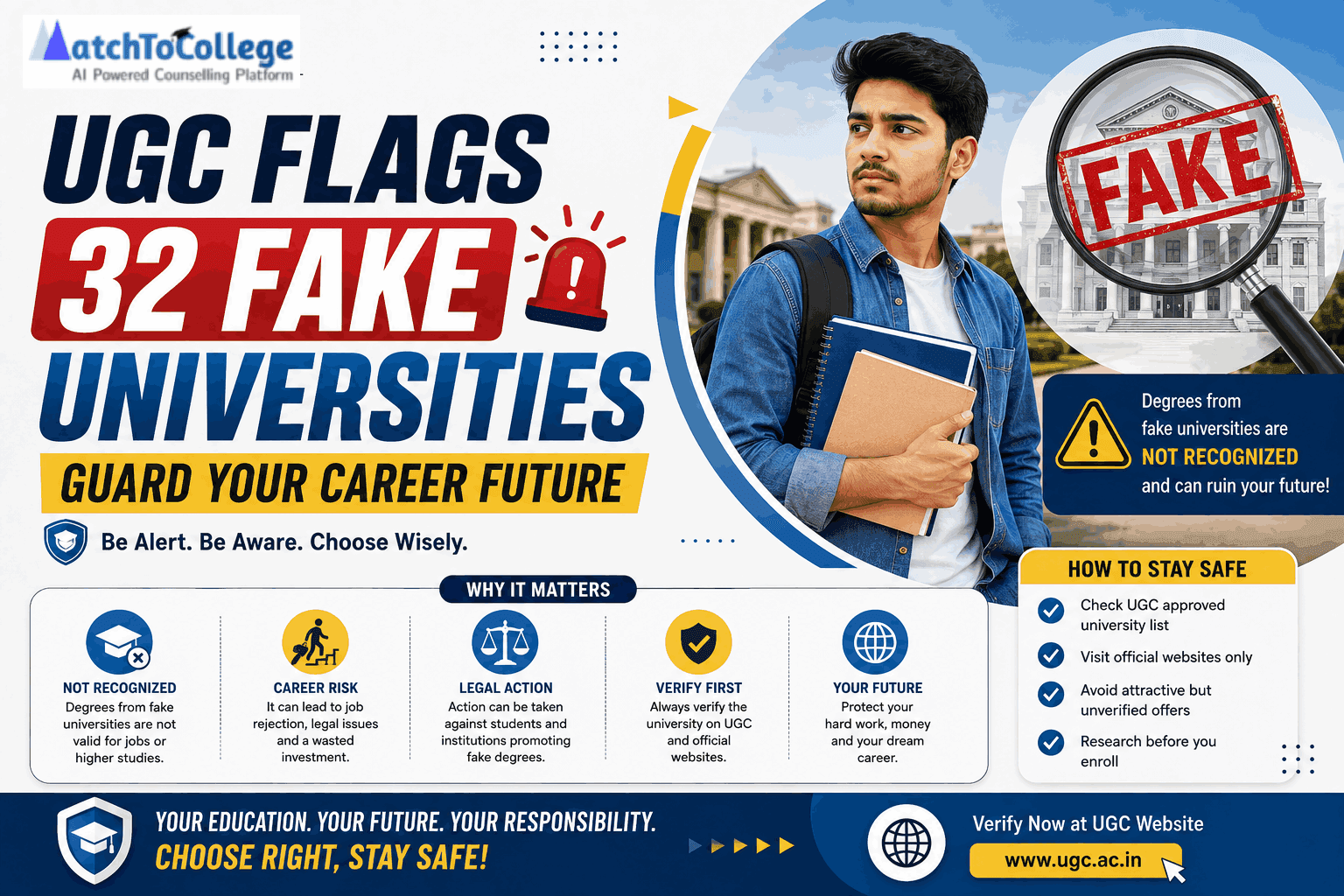
In an era where educational aspirations are at an all-time high, the landscape of Indian higher education is currently navigating a period of intense scrutiny. The University Grants Commission (UGC), the apex regulatory body for higher education in India, has recently released a critical list identifying 32 'fake' universities operating across the country.
This announcement comes as a stern warning to students, parents, and stakeholders about the risks of falling prey to unauthorized institutions that lack the legal standing to grant degrees. Simultaneously, the Central Government has issued a sharp advisory against misleading advertisements by EdTech platforms, which often promise 'guaranteed placements' or 'fast-track degrees' that may not hold weight in the professional world. As we look toward the 2026-27 academic cycle, the implications of these invalid degrees are profound, potentially stalling careers before they even begin.
For students utilizing platforms like MatchToCollege, the message is clear: data-driven, ethical counseling is no longer just a luxury—it is a necessity for survival in a complex academic market. The rise of digital learning has democratized access to education, but it has also provided a veil for unscrupulous actors to operate. These institutions often adopt names that sound similar to prestigious national universities, creating a facade of legitimacy that can easily deceive the untrained eye. The UGC’s latest list includes institutions spread across various states, with high concentrations in Delhi, Uttar Pradesh, and West Bengal, highlighting that this is a systemic issue rather than a localized problem.
The government's crackdown on EdTech advertisements is another crucial development. Many online learning platforms have been flagged for using aggressive marketing tactics that overpromise and under-deliver. These platforms often collaborate with foreign universities or private entities without the required approvals from the AICTE or UGC, leading to degrees and certificates that are unrecognized for government jobs or further higher education. At MatchToCollege, we emphasize the importance of due diligence. Our AI-powered platform is designed to filter through these complexities, ensuring that every recommendation we provide leads to a legitimate, recognized, and valuable qualification.
This blog post serves as a comprehensive guide to understanding the UGC's recent directives, identifying the red flags of fake institutions, and learning how to protect your academic investments. Whether you are an aspiring MBA student, an engineering candidate, or looking into medical programs, understanding the regulatory landscape is the first step toward a secure and successful career. We will delve into the specifics of the 32 identified universities, the nature of the government's warnings to EdTech companies, and the critical verification steps every student must take before paying a single rupee in tuition fees.
Analyzing the UGC List of 32 Fake Universities
The University Grants Commission (UGC) is the only body authorized by the Parliament of India to regulate the standards of university education. Under Section 22 of the UGC Act, 1956, only universities established by a Central, State, or Provincial Act, or an institution deemed to be a university under Section 3, have the right to confer degrees.
The recent identification of 32 fake universities underscores a persistent challenge in the Indian education sector: the proliferation of unaccredited institutions that exploit student desperation. These institutions are technically 'degree mills'—entities that sell certificates without providing standard education or having the legal authority to do so.
The distribution of these fake universities is particularly concerning. States like Delhi and Uttar Pradesh have historically topped this list, often housing institutions with grand names like 'Commercial University Ltd.' or 'United Nations University.' The UGC emphasizes that these entities are not 'universities' in the legal sense. For a student, the consequences of enrolling in such an institution are catastrophic.
Not only is the time and money spent lost, but the resulting degree is legally invalid for any form of employment, competitive exams like the UPSC, or for pursuing higher studies in India or abroad. The UGC maintains a public list on its website, which is updated periodically to reflect new findings by its vigilance cell.
Moreover, the UGC has warned that many of these fake universities operate through clandestine study centers or online portals. They often use high-pressure sales tactics, claiming that their 'degrees' are recognized through 'international collaborations' or 'autonomous status.' It is vital to understand that 'autonomous' does not mean a college can grant its own degree; it must still be affiliated with a recognized university.
MatchToCollege urges students to cross-reference every institution against the UGC's consolidated list of State and Central universities before proceeding with any application. If a university's name appears on the 'Fake Universities' list, it is a non-negotiable red flag that should lead to immediate withdrawal of interest.
The Centre's Crackdown on Misleading EdTech Advertisements
The Ministry of Education and the Ministry of Information and Broadcasting have jointly raised alarms regarding the marketing practices of several EdTech giants. In a recent advisory, the government flagged advertisements that make unsubstantiated claims regarding job guarantees and the legal status of online degrees.
The core of the issue lies in the distinction between a 'Certificate Course,' a 'Diploma,' and a 'Degree.' Many EdTech platforms market their courses as 'equivalent to a degree' or use misleading terminology like 'Master’s in Management' for programs that are not recognized by the UGC as an MBA.
Misleading ads often target students from tier-2 and tier-3 cities, promising them a path to high-paying tech or management jobs in exchange for exorbitant fees. These ads frequently feature logos of premium institutions like the IITs or IIMs, suggesting a partnership that might only be a limited 'executive certificate' program, not a full-fledged degree. The Central Consumer Protection Authority (CCPA) has been empowered to take action against such false advertisements.
Students are warned that any degree obtained through a platform that is not explicitly authorized to offer 'Online Degrees' under the UGC (Open and Distance Learning Programmes and Online Programmes) Regulations, 2020, will be considered invalid for the 2026-27 academic session and beyond.
The government has also highlighted the 'debt trap' associated with EdTech financing. Many platforms push students into 'No-Cost EMI' loans without fully disclosing that these are high-interest personal loans. When the promised placement fails to materialize, students are left with a heavy financial burden and a degree that has zero market value. At MatchToCollege, we advocate for transparency. We believe that technology should be used to simplify the college search, not to obfuscate the truth. Our platform provides a clear breakdown of the accreditation status of our partner institutions, ensuring that students are never misled by flashy marketing or false promises.
Why the 2026-27 Degrees Face Invalidation Risks
The warning regarding invalid degrees for the 2026-27 cohort stems from a combination of regulatory changes and the expiration of temporary recognitions. The UGC has recently tightened the norms for 'Equivalence' regarding foreign degrees and online certifications. For instance, any online degree that does not comply with the 'four-year undergraduate program' (FYUP) structure introduced under the National Education Policy (NEP) 2020 may face scrutiny during the 2026 graduation cycle.
Furthermore, degrees obtained through 'franchise arrangements'—where a university outsources its teaching to a private coaching center or an EdTech platform—are strictly prohibited and will not be recognized.
Another critical factor is the 'Academic Bank of Credits' (ABC). Starting from the upcoming academic sessions, every student must have an ABC ID, and their credits must be digitally stored in this government-regulated locker. If an institution is not registered with the National Academic Depository (NAD) or fails to upload credits due to lack of recognition, the student will find it impossible to transfer credits or receive a valid final degree in 2027.
This digitalization is designed to weed out fake degrees, but it also means that students currently enrolled in dubious programs will find themselves at a dead end when they reach their final year.
Students must also be wary of 'Dual Degree' programs that do not follow the UGC's specific guidelines. While the UGC now allows students to pursue two degrees simultaneously, there are strict rules regarding one being regular and the other being online/distance.
If both are regular or if the online degree is from an unauthorized provider, both degrees could be invalidated. The 2026-27 deadline serves as a cut-off point where the government expects full compliance with NEP 2020 standards. This makes the present moment the most critical time for degree verification. MatchToCollege provides the tools necessary to ensure your credit pathway is secure and your future degree is recognized by the government of India.
How to Verify Your University: A Step-by-Step Guide
Protecting yourself from educational fraud requires a proactive approach. The first step is to visit the official UGC website (ugc.ac.in). Under the 'Universities' tab, you can find categorized lists: Central Universities, State Universities, Deemed Universities, and Private Universities.
If the institution you are considering is not on one of these lists, it is not a recognized university. For technical programs, including Engineering and Management, you must also check the AICTE (All India Council for Technical Education) website to ensure the specific course has approval. Lack of AICTE approval can make an engineering degree worthless for government jobs and gate exams.
Secondly, verify the accreditation status through the National Assessment and Accreditation Council (NAAC) and the National Board of Accreditation (NBA). While a lack of NAAC accreditation doesn't necessarily make a university 'fake,' a high NAAC grade (A, A+, or A++) is a strong indicator of quality and legitimacy. For online and distance learning, students must check the Distance Education Bureau (DEB) portal.
The DEB publishes a list of 'Higher Education Institutions (HEIs) recognized to offer programs in ODL and Online mode.' If your online program is not listed there for the specific academic year of your enrollment, your degree will not be recognized as equivalent to a regular degree.
Thirdly, use the 'MatchToCollege Verification Checklist.' We recommend checking the university's physical infrastructure, faculty profiles on LinkedIn, and searching for the institution in the National Institutional Ranking Framework (NIRF). Genuine universities are transparent about their faculty and placement records. Finally, always look for the 'Academic Bank of Credits' (ABC) registration.
A legitimate university will ask for your ABC ID during the admission process. By following these steps, you can shield yourself from the 32 fake universities and the countless others operating under the radar. Remember, a degree is an investment in your future; don't let a 'fake' shortcut ruin your career prospects.
Share this Article
FAQFrequently Asked Questions
Q: Where can I find the official list of fake universities identified by UGC?
The official list of fake universities is maintained and periodically updated on the University Grants Commission (UGC) website (ugc.ac.in) under the 'Notices' or 'University' section. As of the latest update, 32 institutions have been flagged as unauthorized.
Q: What happens if I have already obtained a degree from one of these fake universities?
A degree from a fake university is legally invalid. It cannot be used for government employment, admission to higher education, or for obtaining a visa for study abroad. Unfortunately, there is no legal way to 'validate' such a degree; students are advised to seek admission in a recognized institution.
Q: Are all online degrees offered by EdTech companies invalid?
No, not all online degrees are invalid. However, an EdTech company itself cannot grant a degree. They must be in a legitimate partnership with a UGC-recognized university that has specific approval from the Distance Education Bureau (DEB) to offer that particular course online.
Q: How can I check if an EdTech advertisement is misleading?
Check if the ad promises '100% job guarantee,' 'degree in one year,' or uses the logos of top-tier colleges for programs that are only 'certificates.' Verify the actual degree-granting institution's status on the UGC website and read the fine print regarding placement claims.
Q: What is the importance of the Academic Bank of Credits (ABC) for the 2026-27 batch?
The ABC is a mandatory digital repository for student credits. For the 2026-27 graduation cycle, degrees will likely be issued only to students whose credits are accurately reflected in the ABC. If your college is not on the ABC platform, it is a sign of non-compliance or lack of recognition.
Get More Info About UGC Flags 32 Fake Universities
Recommended Reading
BHU UG Round 2 Cutoff 2026: Check Dates & Fee Details
BHU UG Round 2 Cutoff 2026 is now live at admission.bhu.ac.in. Learn how to check your merit status, the last date to pay the fee, and admission next steps.
NEET SS 2025: MCC Withdraws Notice & Revises Schedule
MCC withdraws the August 3 notice for NEET SS 2025 counselling and revises the Round 2 schedule for the 2026-27 session. Stay updated with MatchToCollege.
Delhi Govt Free JEE & NEET Coaching 2026-27: Complete Guide
Delhi government announces free residential coaching for JEE and NEET 2026-27 aspirants. Learn about eligibility, registration, and benefits for Class 12 students.