


Major Entrance Exam Reforms: Board Marks to Get 50% Weightage?
Admission & Info Tools
Need Expert Assistance?
Our counselors can help you with fee structures, eligibility guidelines, and upcoming admission cutoffs instantly.
Direct Application Tools
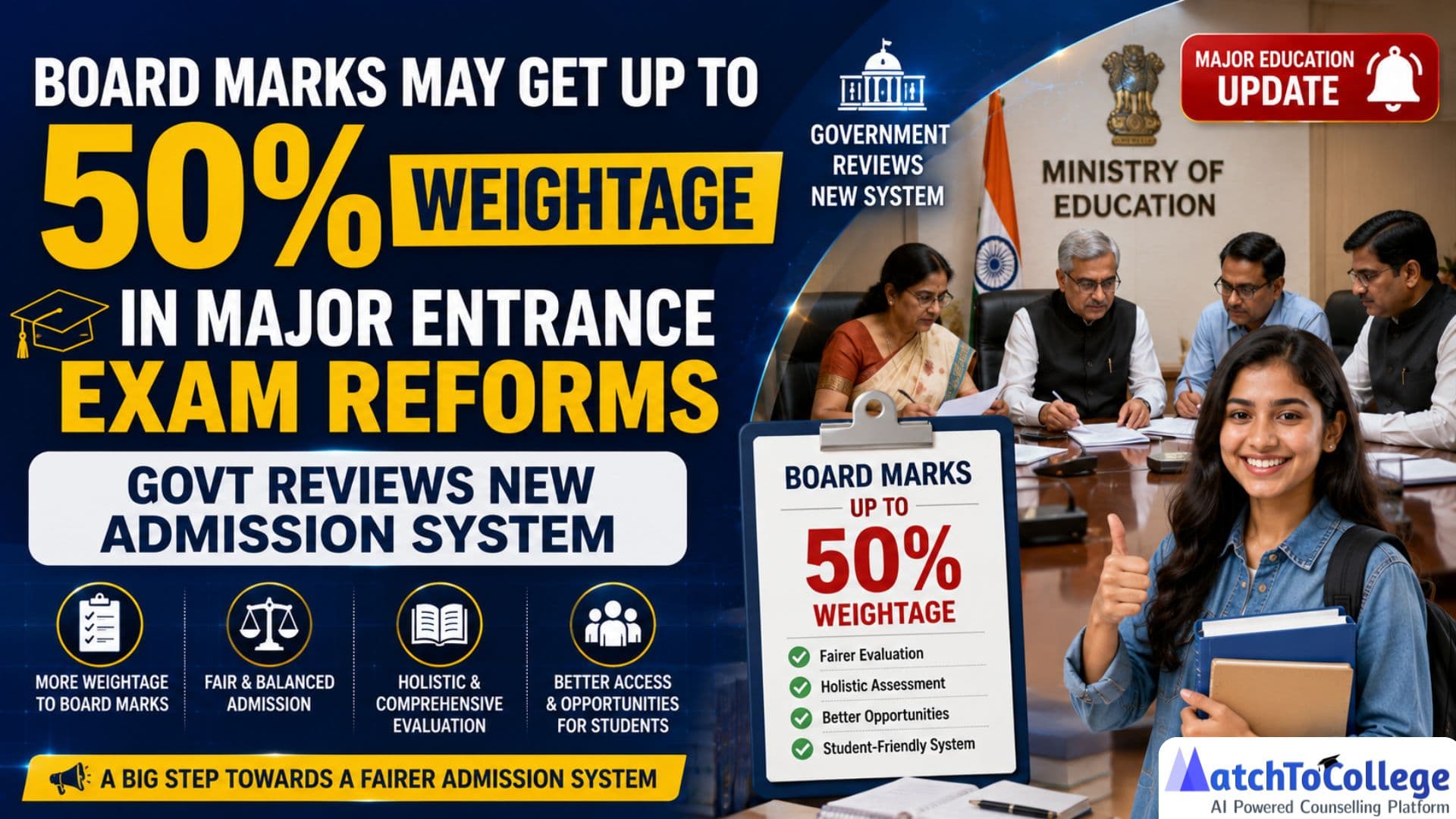
Board marks get up to 50% weightage
The Central Government is reportedly considering a major overhaul of India's entrance examination system, with a proposal to give up to 50% weightage to Class 12 board examination marks in admissions to major professional courses. The reforms are being reviewed under the guidance of the Prime Minister's Office (PMO) and the Ministry of Education (MoE) as part of a broader effort to improve transparency, reduce dependence on coaching institutes, and align admissions with the objectives of the National Education Policy (NEP) 2020.
It is important to note that no final decision has been announced yet. These are proposals currently under review and will require official approval before implementation.
According to recent reports, the government is evaluating several recommendations that could significantly change how admissions are conducted for competitive examinations such as JEE Main and NEET UG.
Among the key proposals is giving up to 50% weightage to Class 12 board marks, while the remaining weightage would come from entrance examination scores. The objective is to create a more balanced admission process that values consistent academic performance along with competitive examination results.
Proposed Reforms at a Glance
| Proposal | Details |
| Board Exam Weightage | Up to 50% weightage for Class 12 board marks (under consideration) |
| Entrance Exam Weightage | Remaining weightage through entrance examination scores |
| Target Exams | JEE Main, NEET UG and other national entrance examinations (proposed) |
| Objective | Reduce dependence on coaching and encourage school-based learning |
| Current Status | Proposal under government review; not yet approved |
Why Is the Government Considering These Changes?
The proposed reforms are intended to address several concerns surrounding India's entrance examination system.
Key objectives include:
- Reducing excessive dependence on coaching institutes.
- Giving greater importance to consistent academic performance in schools.
- Aligning entrance examination syllabi more closely with the NCERT curriculum.
- Lowering stress associated with a single high-stakes examination.
- Creating a fairer and more transparent admission process.
These recommendations are also consistent with the broader vision of the National Education Policy (NEP) 2020.
Other Major Reforms Under Review
Apart from board exam weightage, the government is examining several additional reforms.
1. Multiple Attempts
Students may be allowed to appear for major entrance examinations more than once each year, allowing them to improve their scores.
2. Adaptive Computer-Based Testing
Authorities are considering introducing adaptive online examinations, where the difficulty level of questions adjusts according to a candidate's responses.
3. NCERT-Based Syllabus Alignment
The government is exploring closer alignment between school curricula and entrance examinations to reduce syllabus mismatch and lessen the need for extensive coaching.
4. On-Demand Testing
Future entrance examinations may move towards an on-demand computer-based model, enabling candidates to take exams at different times during the year.
How Could This Affect Students?
If implemented, the proposed reforms could:
- Increase the importance of Class 12 board examination performance.
- Encourage students to focus equally on school studies and entrance exam preparation.
- Reduce reliance on private coaching.
- Make admissions more holistic by considering both academic consistency and competitive exam performance.
However, since the reforms are still under review, students appearing for upcoming entrance examinations should continue preparing according to the existing examination pattern until an official notification is issued.
Will These Changes Apply to NEET and JEE in 2027?
At present, there is no official confirmation regarding the implementation timeline. The proposals are under discussion, and no notification has been released specifying whether they will apply from the 2027 admission cycle or a later academic year. Any change will be announced by the concerned authorities after formal approval.
Current Admission System
Currently:
- JEE Main admissions are based primarily on entrance examination performance, subject to eligibility criteria.
- NEET UG admissions are determined by NEET scores and counselling, while Class 12 marks are used mainly to satisfy eligibility requirements.
The proposed reforms would represent a significant departure from the existing system if adopted.
What Students Should Do Now
Students preparing for national entrance examinations should:
- Continue preparing according to the current official syllabus and examination pattern.
- Focus on achieving strong Class 12 board examination results.
- Follow announcements from the Ministry of Education, the National Testing Agency (NTA), and other official authorities.
- Avoid relying on unofficial reports until formal guidelines are released.
The proposal to assign up to 50% weightage to Class 12 board examination marks is part of a broader review of India's entrance examination framework. While the reforms aim to create a more balanced, student-friendly admission process, they remain proposals and have not yet been approved. Students should continue preparing under the existing admission rules until official notifications confirm any changes.
How MatchToCollege Can Help You Prepare for the Future
While the final decision on these reforms is still pending, it's wise to prepare for the possibility. Here's what you can do:
- Prioritize Class 12 Boards: Treat your board exams with the utmost seriousness. Aim for excellence across all subjects.
- Strengthen Fundamentals: A strong grasp of your core subjects (Physics, Chemistry, Math/Biology) is crucial for both board and competitive exams.
- Practice Regularly: Solve previous year's board papers to understand the pattern and improve writing skills. Simultaneously, practice entrance exam questions to build speed and accuracy.
- Seek Expert Guidance: Utilize platforms like MatchToCollege for personalized counselling. Our AI-driven insights can help you understand how potential changes might affect your college prospects and guide you in optimizing your preparation.
- Stay Updated: Keep an eye on official announcements from the government and education bodies regarding these reforms.
The future of higher education admissions is dynamic, but with the right strategy and guidance, you can navigate any changes successfully. MatchToCollege is your trusted partner in this journey, ensuring you are always ahead of the curve and well-prepared for your dream university.
Share this Article
FAQFrequently Asked Questions
Q: Are these entrance exam reforms, specifically the 50% weightage for board marks, officially confirmed?
As of now, the proposal for board marks to carry up to 50% weightage in major entrance exams is under review by the government. It has not been officially confirmed or implemented. Students and parents should stay updated through official government and educational board announcements, and MatchToCollege will continue to provide the latest information as it becomes available.
Q: How might these changes affect specific competitive exams like JEE, NEET, or CUET?
If implemented, these reforms would significantly impact how scores for JEE, NEET, and CUET are calculated. Instead of solely relying on the entrance exam score, a substantial portion (potentially up to 50%) of the final admission score would be derived from Class 12 board examination marks. This means a strong performance in board exams would become crucial for securing a high rank in these competitive tests. Students would need to balance their preparation to excel in both their school academics and the competitive exam format.
Get More Info About Major Entrance Exam Reforms
Recommended Reading

Jharkhand NEET UG 2026 Round 1 Deadline Extended: New Dates
JCECEB has extended the Jharkhand NEET UG 2026 Round 1 registration deadline. Explore the revised schedule, seat allotment dates, and expert counselling tips.

Tamil Nadu NEET MDS 2026 Rank List Released: Download PDF
The Tamil Nadu NEET MDS 2026 Provisional Rank List is officially out! Download the PDF and discover the next steps for TN MDS Counseling 2026-27 here.

WBJEE BPharm Round 3 Counselling 2026: Apply at wbjeeb.nic.in
WBJEE BPharm Round 3 Counselling 2026 registration begins at wbjeeb.nic.in. Follow our comprehensive guide for choice filling and pharmacy admissions steps.