


FMGE June 2026: Low Pass Rate Sparks Doctor Protests
Admission & Info Tools
Need Expert Assistance?
Our counselors can help you with fee structures, eligibility guidelines, and upcoming admission cutoffs instantly.
Direct Application Tools
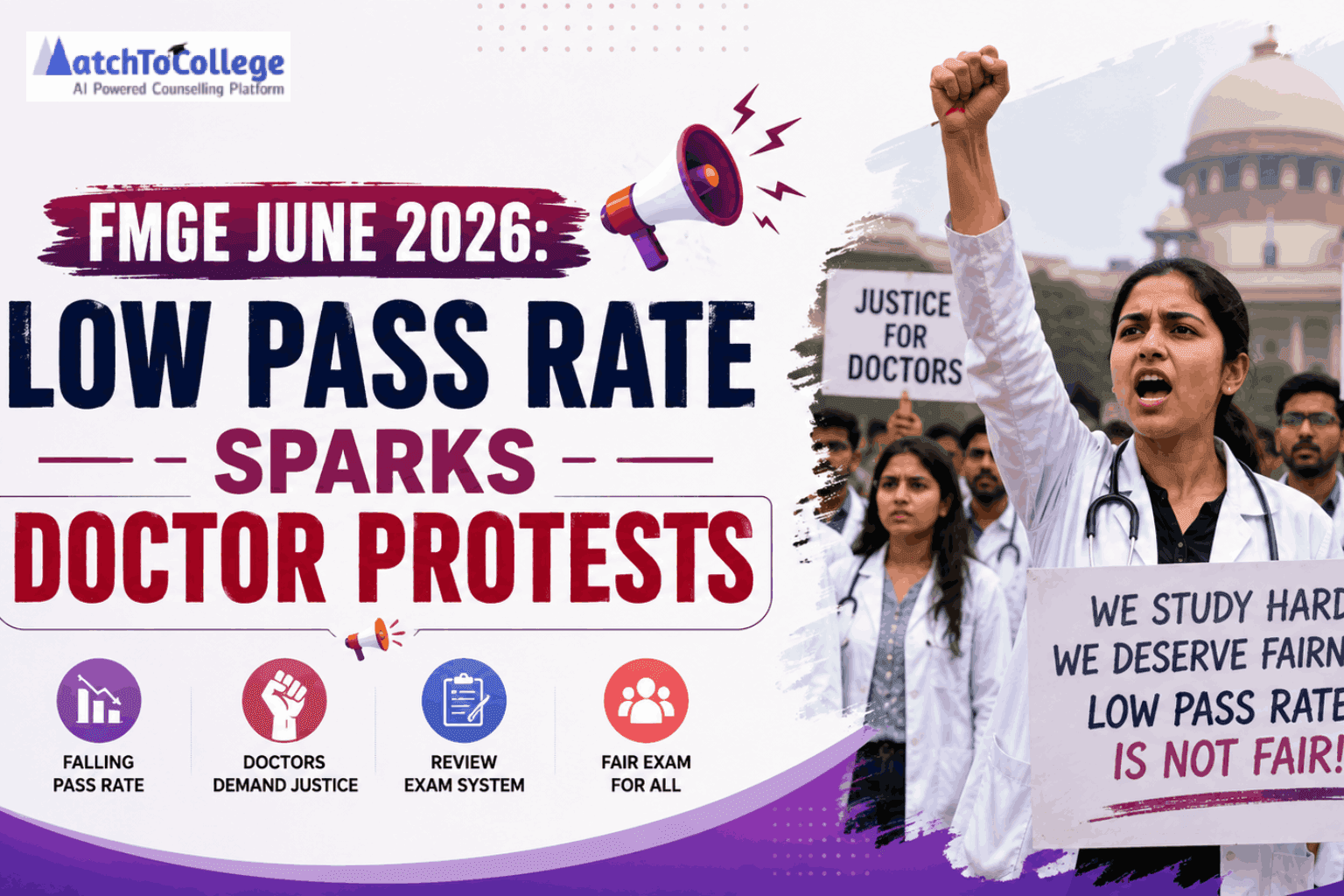
The Foreign Medical Graduate Examination (FMGE) June 2026 session has sent shockwaves through the Indian medical community. As the results were announced earlier this week, the data revealed a staggering and unprecedented decline in the qualifying percentage, leading to widespread frustration among thousands of candidates who spent years studying abroad.
The FMGE, conducted by the National Board of Examinations (NBE) and monitored by the National Medical Commission (NMC), serves as the mandatory screening test for Indian citizens with medical degrees from foreign universities to practice medicine in India. In 2026, however, the examination's difficulty level reached new heights, sparking allegations of an intentionally high barrier to entry designed to limit the number of practicing foreign medical graduates (FMGs).
For the 2026-27 academic cycle, the implications of this low pass rate are profound. At MatchToCollege, our AI-powered counseling analytics suggest that the success rate has dipped below 10%, a significant drop from the historical average which usually fluctuates between 15% and 25%. This statistical anomaly has not only left students in a state of professional limbo but has also raised serious questions about the alignment between international medical curricula and the Indian standard. The outcry has moved from digital forums to the streets, as young doctors and their families demand transparency, a re-evaluation of the scoring system, and a more standardized approach to the transition toward the proposed National Exit Test (NExT).
The protests have gained momentum in major hubs like New Delhi, Chennai, and Mumbai, where medical associations have joined hands with FMG groups to voice their grievances. The central theme of these protests is the perceived 'unfavorable' nature of the June 2026 paper, which many claim focused on obscure clinical minutiae rather than core competency. As the national medical body prepares its official response, the future of thousands of prospective doctors remains uncertain. This detailed report explores the roots of the protest, the official justification for the low pass rates, and what this means for the medical landscape of 2026-27. For those caught in this crisis, understanding the policy shift is the first step toward navigating a career path that may now require significant redirection or intensified preparation strategies.
The Unprecedented Crisis of the June 2026 FMGE Cycle
The June 2026 FMGE cycle will likely be remembered as one of the most challenging in the history of the screening test. Early data indicates that out of the approximately 35,000 candidates who appeared for the exam, only a small fraction managed to cross the 150-mark threshold.
This 'mass failure' has been attributed to a radical shift in the question pattern. Candidates reported that the June 2026 paper moved away from the traditional format of factual medical knowledge toward highly complex, multi-step clinical vignettes. These questions often required deep familiarity with specific Indian hospital protocols and pharmaceutical brand names that are not typically covered in foreign medical curricula, especially in countries like Russia, China, and the Philippines where many Indian students pursue their MBBS.
The statistical drop is not just a numbers game; it represents a systemic bottleneck. Experts suggest that the NBE has been gradually increasing the difficulty of the FMGE to align it with the standards of the upcoming National Exit Test (NExT), which is intended to replace both the FMGE and the NEET-PG. However, the suddenness of this transition in the June 2026 session left students unprepared.
Many argue that while the goal of improving healthcare standards is noble, the lack of a bridge curriculum or adequate preparatory resources from the national medical body has created an unfair playing field. The 2026-27 session has thus become a flashpoint for the long-standing debate on how India treats its foreign-educated medical professionals.
The financial and emotional toll on these students cannot be overstated. After spending six years abroad and investing tens of lakhs in tuition and living expenses, being unable to clear a screening test—which some call a 'licensing wall'—has led to a mental health crisis within the FMG community. This has fueled the intensity of the protests, as candidates feel they are being penalized for a global education that was once encouraged by the lack of affordable medical seats in India.
As we analyze the 2026 data, it becomes clear that without a revision of the qualifying criteria or a more transparent moderation process, the 'brain drain' might reverse in a negative way, leaving qualified individuals without the right to serve their home country.
Why Doctors are Protesting: The Core Grievances and Demands
The protests sparked by the June 2026 results are characterized by a sense of deep-seated injustice. Thousands of doctors gathered outside the National Medical Commission (NMC) headquarters and the Ministry of Health, carrying placards that highlight the 'discriminatory' nature of the exam. One of the primary grievances is the lack of a standardized syllabus.
Unlike NEET-UG or PG, the FMGE syllabus is often described as 'everything under the sun,' making it difficult for students to prepare effectively when the goalposts are constantly moving. In 2026, the inclusion of several 'out-of-syllabus' questions from niche specialties like nuclear medicine and advanced genetics sparked particular outrage.
Furthermore, the protesters are demanding a transparent re-totaling and an independent audit of the June 2026 paper. There are widespread allegations of technical glitches during the computer-based test, with some students claiming that images in the clinical questions did not load properly, or that the interface was laggy, costing them precious time.
The demand for 'one nation, one exam' with a common difficulty level for both Indian medical graduates and foreign medical graduates has reached a fever pitch. Protesters argue that if the FMGE is significantly harder than the internal university exams of Indian government colleges, it constitutes a violation of the right to equality under the law.
Another significant demand is the reduction of the qualifying marks from 50% to 40% for this specific cycle, given the perceived anomaly in the paper's difficulty. Medical associations representing FMGs have pointed out that in many other professional fields, such as law or accounting, the qualifying criteria are moderated based on the difficulty of the specific session.
By maintaining a rigid 150/300 pass mark regardless of the paper’s complexity, the NBE is accused of using the FMGE as a tool for 'population control' within the medical profession rather than a genuine assessment of competency. The protests have also called for a mandatory internship stipend for FMGs, adding a layer of economic struggle to the academic one.
The National Medical Body's Official Stance and Response
NMC Defends Higher Standards
In response to the growing unrest, the National Medical Commission and the NBE released a joint statement defending the integrity of the June 2026 FMGE. The national medical body emphasized that the primary responsibility of the commission is to ensure that every doctor practicing in India meets a minimum standard of clinical excellence to protect patient safety.
They argued that the 'difficulty' of the exam is subjective and that the paper was vetted by a panel of senior medical educators who confirmed its validity. According to the NMC, the shift toward clinical vignettes is a necessary evolution to ensure that doctors are capable of applying theoretical knowledge to real-world medical scenarios.
Regarding the protests, the official stance has remained firm: there will be no lowering of the qualifying marks. The body stated that the FMGE is a qualifying exam, not a competitive one, and lowering the bar would compromise the quality of healthcare in the country. However, in a slight concession, the NMC has agreed to form a committee to look into the technical grievances reported by students.
They have promised to investigate claims of server lag and image loading issues, stating that if any technical errors are found to have affected scores, 'corrective measures' will be taken. However, they were quick to clarify that this does not imply a general re-evaluation of the medical content of the exam.
The response has also touched upon the transition to NExT. The national medical body indicated that the 2026-27 period is a 'bridge year' where the FMGE will gradually merge into the NExT format. They urged students to adapt to the new clinical-case-study model of learning rather than relying on rote memorization. This response has done little to calm the protesters, who feel that the NMC is being dismissive of the specific challenges faced by FMGs. The standoff continues as the body maintains its focus on 'quality over quantity,' while students argue that 'quality' is being used as a pretext for exclusion.
Navigating the 2026-27 Academic Year: Alternatives for FMGs
For the thousands of students who did not qualify in the June 2026 FMGE, the path forward requires a blend of resilience and strategic planning. The first and most obvious step is preparing for the December 2026 session. However, given the clear shift in question patterns, traditional coaching methods may no longer suffice. Students are now being advised to integrate clinical rotations or observerships (where legal) into their study routine.
At MatchToCollege, we recommend focusing on 'integrated learning,' where subjects like Anatomy and Physiology are studied in the context of Surgery and Medicine, mirroring the NExT-style format that the NBE is now favoring.
Beyond retaking the exam, some FMGs are exploring alternative career paths within the healthcare ecosystem. These include pursuing Master’s degrees in Public Health (MPH), Hospital Administration, or Health Data Analytics.
These fields often do not require an FMGE qualification and offer lucrative careers in India and abroad. For those determined to practice clinically, some are looking at postgraduate opportunities in the countries where they studied or in other international markets like the UK (PLAB/MRCP) or the US (USMLE), where the licensing process, although rigorous, is often perceived as more transparent and consistent than the current FMGE landscape.
Another emerging trend for the 2026-27 cycle is the use of AI-driven preparatory tools. These platforms use machine learning to identify a student’s weak areas and provide high-yield clinical scenarios that mimic the new FMGE format. Students are also encouraged to participate in mock tests that emphasize the 'Indian context' of medicine. While the road is undoubtedly tougher, the 2026-27 session offers a chance for a 'reboot' in how FMGs approach their professional development. The focus must shift from merely passing a test to becoming a globally competitive clinician who can thrive under any regulatory framework.
The Role of AI Counselling in Overcoming FMGE Setbacks
In this era of academic uncertainty, data-driven guidance has become more critical than ever. MatchToCollege’s AI-powered platform is designed to help students navigate exactly these kinds of crises. For those who failed the June 2026 FMGE, our AI tools can analyze their previous performance, study habits, and academic background to provide a personalized 'Success Roadmap.'
By identifying whether the failure was due to a lack of clinical knowledge, poor time management, or a misunderstanding of the exam pattern, we help students pivot their strategy for the 2026-27 cycle. Counselling is no longer just about choosing a college; it’s about career sustainability in a volatile regulatory environment.
Our AI platform also provides insights into 'Plan B' options that many students might not consider in the heat of a protest or the depths of disappointment.
Whether it is identifying the best global markets for clinical practice or finding non-clinical healthcare roles that match their specific medical interests, the AI takes the emotion out of the decision-making process. For parents, the platform offers a transparent view of the ROI (Return on Investment) of further attempts versus alternative qualifications. In a year where the national medical body’s response has been rigid, having an agile, AI-driven support system can make the difference between a stalled career and a successful transition into the workforce.
Future Outlook: The Impact on India’s Healthcare Workforce
Officials attributed the recurring struggle largely to gaps in clinical training abroad rather than exam design. NMC said many institutions overseas do not provide adequate clinical exposure, with the first two to two-and-a-half years of many foreign medical courses being largely theoretical. Students are then sent into hospital settings where the patient profile, language, and disease patterns differ sharply from what they will eventually encounter in India.
However, they were careful to add that this isn’t true of every foreign medical college, or graduate, but said the shortcoming is a recurring pattern.
Officials also noted that foreign curricula may differ from India’s in public health priorities, disease patterns and clinical practices — which the FMGE is designed to test for safe practice in India.
On the protests, a senior National Medical Commission official acknowledged the students’ concerns, saying the number of FMGE candidates has risen from a few thousand annually to tens of thousands, creating a growing backlog and uncertainty over career prospects.
The protest is over as the officials said an independent committee has been constituted to examine the grievances and recommend measures to the National Board, which will implement feasible recommendations within the existing legal and statutory framework. The committee will currently review the issues.
Share this Article
FAQFrequently Asked Questions
Q: What was the pass rate for FMGE June 2026?
While official figures are still being finalized, preliminary data suggests the pass rate for the FMGE June 2026 session dropped to an all-time low, estimated to be below 10%.
Q: Why are doctors protesting against the June 2026 FMGE results?
Protests are driven by the exceptionally high difficulty of the exam, allegations of technical glitches during the test, and a shift toward complex clinical questions without prior notice or a revised syllabus.
Q: Has the NMC responded to the FMGE protests?
Yes, the National Medical Commission (NMC) defended the exam's difficulty as necessary for maintaining healthcare standards but agreed to investigate technical grievances and server-related issues.
Q: Will the qualifying marks for FMGE 2026 be lowered?
The NMC has currently stated that there will be no lowering of the 50% qualifying threshold, despite demands from students and medical associations.
Q: Is FMGE being replaced by NExT in 2027?
The national medical body has indicated that the FMGE is gradually being aligned with the NExT format, with a full transition expected in the 2027-28 academic cycle.
Get More Info About FMGE June 2026
Recommended Reading
AIIMS MSc Nursing 2026 Round 1 Seat Allotment Results Out
AIIMS MSc Nursing 2026 Round 1 Seat Allotment results are live at aiimsexams.ac.in. Discover the steps to accept your seat and secure your future in nursing.

BHU UG Round 2 Cutoff 2026: Check Dates & Fee Details
BHU UG Round 2 Cutoff 2026 is now live at admission.bhu.ac.in. Learn how to check your merit status, the last date to pay the fee, and admission next steps.
NEET SS 2025: MCC Withdraws Notice & Revises Schedule
MCC withdraws the August 3 notice for NEET SS 2025 counselling and revises the Round 2 schedule for the 2026-27 session. Stay updated with MatchToCollege.