


DU BTech 2026 Spot Round 1 Revised Schedule Details
Admission & Info Tools
Need Expert Assistance?
Our counselors can help you with fee structures, eligibility guidelines, and upcoming admission cutoffs instantly.
Direct Application Tools
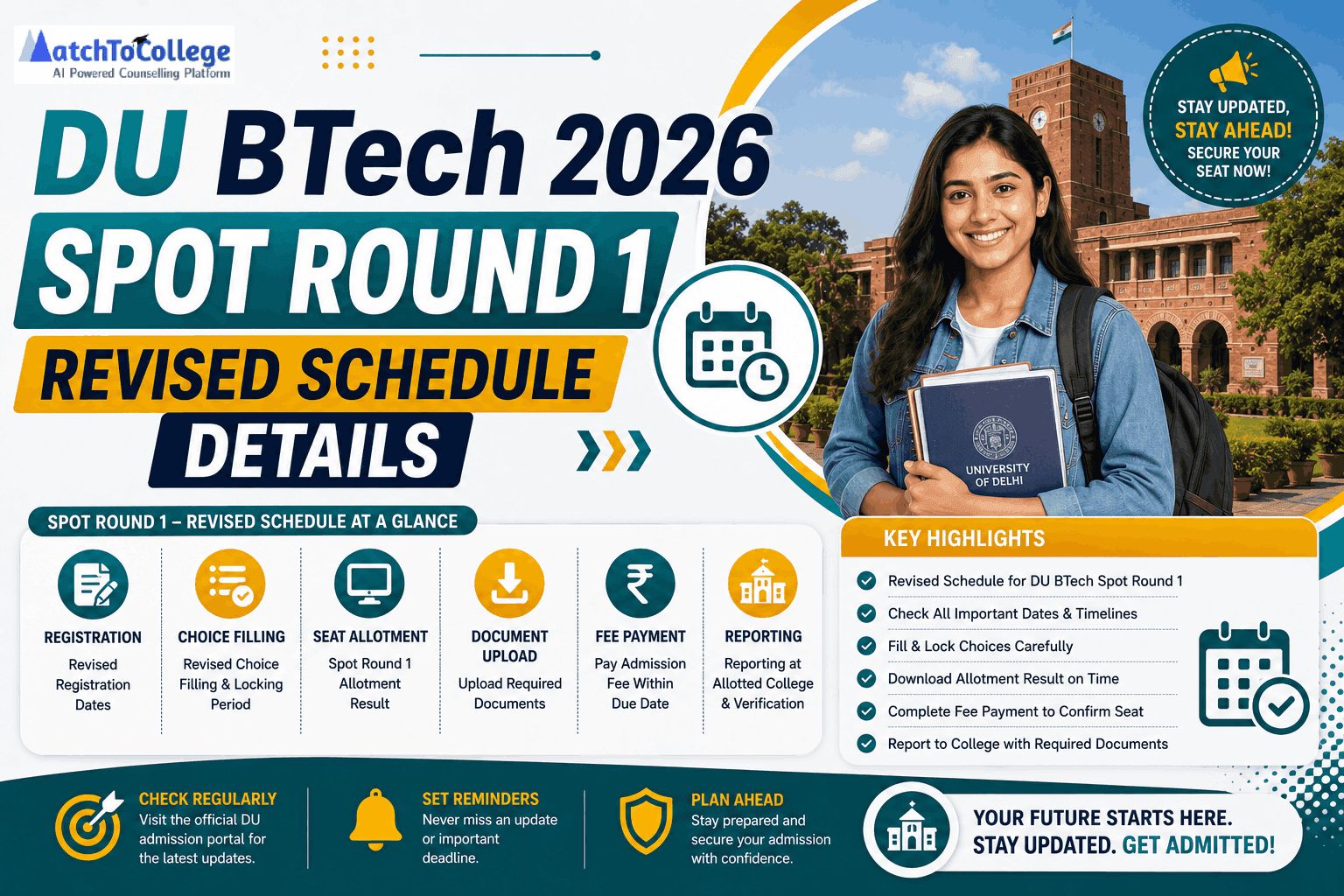
Delhi University (DU) has officially announced a revision to the DU BTech 2026 Spot Round 1 schedule, a move that significantly impacts thousands of engineering aspirants vying for a seat in one of India's most prestigious central universities. The Faculty of Technology at the University of Delhi, which offers B.Tech programs in Computer Science and Engineering, Electronics and Communication Engineering, and Electrical Engineering, released the updated notification on its primary portal, admission.uod.ac.in.
For students navigating the high-pressure environment of college admissions, staying updated with these changes is critical. At MatchToCollege, we understand that late-stage admission rounds like the Spot Round are often the last opportunity for students to secure their place in a top-tier program, making precision and timing more important than ever. This revision in the schedule for the 2026-27 academic session is designed to streamline the seat allocation process and ensure that vacant seats across various categories are filled efficiently before the semester fully gains momentum.
The Spot Round is distinct from regular counseling rounds. Unlike the initial rounds where students have multiple opportunities to upgrade their preferences, the Spot Round is a 'final call' scenario. Once a seat is allocated in the Spot Round, the candidate is mandatory bound to accept it, and there is typically no provision for further upgrades or withdrawals. This makes the revised schedule even more vital for students who might have missed earlier deadlines or are still looking for better opportunities within the DU ecosystem. The Faculty of Technology has integrated rigorous verification processes to ensure that only eligible candidates—those who have registered but were not admitted to any program in previous rounds—participate in this phase. With the advent of AI-powered tools like MatchToCollege, students can now better predict their chances in these rounds by analyzing past vacancy trends and cutoff shifts, allowing for a more strategic approach to choice filling.
The shift in the 2026 timeline likely stems from administrative adjustments or to accommodate the high volume of applications received during the mid-entry window. As the official website admission.uod.ac.in becomes the central hub for all updates, students are advised to monitor the portal frequently. The revised schedule outlines specific windows for seat declaration, acceptance of seats by candidates, and the final verification by the university.
Understanding the nuances of this schedule is not just about knowing the dates; it’s about preparing the necessary documentation and financial resources to complete the admission formalities within the narrow timeframes provided. As we delve into the details of the revised schedule, it is essential to remember that Delhi University B.Tech admissions are based purely on JEE Main scores, and the spot round follows the same merit-based transparency that DU is known for globally.
Comprehensive Breakdown of the DU BTech 2026 Revised Schedule
The revised schedule for DU BTech Spot Round 1 for the 2026-27 academic session introduces several key changes that students must note immediately. According to the latest update on admission.uod.ac.in, the declaration of the Spot Round 1 Allotment has been shifted to a new date, providing a slight buffer for the university to process the mid-entry applications.
Following the announcement of the allotment, students are usually granted a 48 to 72-hour window to 'Accept' the offered seat. This acceptance is the first and most crucial step; failure to click the 'Accept' button within the stipulated time will result in the forfeiture of the seat, and the candidate will be removed from any subsequent admission considerations. This year, the university has emphasized that the physical reporting and document verification process will also see a modified timeline to ensure that the Faculty of Technology can manage the influx of students without logistical bottlenecks.
After the student accepts the seat, the online verification of documents by the Faculty of Technology begins. This phase is entirely digital initially, where the university officials cross-check the uploaded certificates, JEE Main 2026 scorecards, and category-specific documents. If the department approves the admission, the candidate is then prompted to pay the admission fee online through the CSAS portal. The revised schedule specifies the last date for fee payment, which is typically the final confirmation of the seat. For 2026, DU has also indicated a specific 'query response' period where students must be available to answer any discrepancies found in their documents.
Using an AI-driven platform like MatchToCollege can help students keep track of these micro-deadlines, ensuring that a missed notification doesn't lead to a missed career opportunity. The complexity of these dates underscores the need for a centralized tracking system for modern engineering aspirants.
Eligibility Criteria and Rules for DU BTech Spot Round 1
Participation in the DU BTech Spot Round 1 is governed by a strict set of eligibility rules that differ from the standard counseling rounds. To be eligible for the 2026-27 Spot Round, a candidate must have registered for the DU B.Tech admission process through the CSAS(FT) portal but must not be currently admitted to any program in the Faculty of Technology.
This means if you have already secured a seat and are satisfied with it, you are generally not eligible for the Spot Round. However, those who were either not allotted a seat in previous rounds or those who failed to accept their previous allotments (under specific conditions) may find themselves eligible. It is vital to note that once the Spot Round begins, the 'Upgrade' and 'Withdraw' options are typically suspended. This 'Freeze' by default policy ensures that the seats are filled by students who are genuinely committed to joining the program.
Furthermore, candidates must ensure their JEE Main 2026 credentials are perfectly aligned with their DU application. The university utilizes a merit-ranking system based solely on the All India Rank (AIR) in JEE Main. During the Spot Round, the university releases a list of vacant seats across Computer Science, Electronics, and Electrical Engineering. Candidates are required to select only those programs where vacancies exist.
A common mistake students make is applying for a branch that has zero vacancy in their specific category (UR, OBC-NCL, SC, ST, EWS). MatchToCollege recommends that students perform a thorough 'Vacancy Analysis'—available on our platform—before finalizing their Spot Round preferences. This data-driven approach minimizes the risk of wasting a spot round application on unattainable options, focusing instead on branches where the JEE Main rank aligns with the projected spot round cutoffs.
The Seat Allotment Process: What Happens at admission.uod.ac.in?
The seat allotment process for the DU BTech Spot Round 1 is an automated procedure conducted through the University of Delhi’s admission portal. When the allotment result is released, candidates must log in using their JEE Main application number and password to check their status. The allotment is determined by several factors: the candidate's rank, the availability of seats in the chosen branch, the candidate’s category, and the preference order submitted during the Spot Round registration window.
Because the Spot Round is designed to fill the final remaining slots, the competition can be surprisingly intense, as students who may have been holding out for other state-level counselings often return to DU if they haven't secured a preferred branch elsewhere. The university's algorithm processes thousands of permutations to ensure that the highest-ranked students are placed according to their top available preference.
Once the allotment list is published, the 'Dashboard' of the candidate will display the allotted college (in this case, the Faculty of Technology) and the specific B.Tech branch. It is important to download the Provisional Allotment Letter immediately. This document is required for the subsequent stages of physical verification. The 2026-27 session will also see a more robust digital audit of seats. If a student fails to pay the fee by the revised deadline, that seat is instantly moved to the 'Vacant' pool for Spot Round 2, if applicable.
This cycle of allotment and payment is fast-paced. At MatchToCollege, we highlight the importance of having a 'Financial Readiness Plan.' Since the time between allotment and the fee payment deadline is often less than 48 hours, students should ensure that their bank limits and online payment methods are ready to handle the admission fee, which can be a significant amount for the first semester.
Post-Allotment Procedures: Physical Reporting and Verification
Securing a seat in the DU BTech Spot Round 1 allotment is only half the battle; the final step is the physical reporting and document verification. Under the revised 2026 schedule, the University of Delhi has designated specific dates for students to visit the Faculty of Technology campus. During this visit, candidates must carry original documents along with at least two sets of self-attested photocopies.
The required documents typically include the Class 10th and 12th mark sheets, JEE Main 2026 Scorecard, Admit Card, Character Certificate, and the Category Certificate (if applicable). For OBC-NCL and EWS candidates, it is imperative that the certificates are issued after March 31, 2026, as per the latest central government guidelines. Any discrepancy in the certificate date or format can lead to immediate cancellation of the allotted seat.
During the physical reporting, the university officials will verify the originals against the digital copies uploaded during the registration phase. If everything is in order, the admission status is updated to 'Confirmed' on the CSAS portal. This is also the time when students get their first look at the campus life and infrastructure of the Faculty of Technology.
Located within the North Campus vicinity, the engineering department offers a unique blend of DU’s rich heritage and modern technical education. Students are often advised to arrive early on their scheduled reporting day to avoid long queues. MatchToCollege’s community forums often feature tips from senior students on navigating this physical verification day smoothly, such as which counters to approach first and how to handle any sudden 'query' raised by the verification officer. Completing this stage marks the official beginning of your journey as a DU Engineer.
Strategic Advice: How MatchToCollege AI Helps You Navigate Spot Rounds
Navigating the Spot Round of Delhi University's B.Tech admissions requires more than just luck; it requires a data-centric strategy. This is where MatchToCollege’s AI-powered counseling platform becomes an invaluable asset for 2026 aspirants.
Our platform analyzes historical data from previous years' spot rounds, looking at how cutoffs fluctuate when seats are limited. Often, in Spot Round 1, the cutoffs can be unpredictable—sometimes dropping significantly if many students have migrated to IITs or NITs, and sometimes remaining high if students are desperate for a DU brand name. By inputting your JEE Main rank into our AI predictor, you can get a realistic percentage-based chance of securing a seat in Computer Science vs. Electrical Engineering.
This allows you to prioritize your preferences in a way that maximizes your chances of an allotment rather than aiming for branches that are already statistically closed.
Beyond just predictions, MatchToCollege offers a comprehensive 'Admission Tracker' that syncs with revised schedules like the one recently released for DU BTech. Our users receive real-time alerts on their mobile devices as soon as a schedule is revised or an allotment link goes live. In the fast-moving Spot Round 1, being the first to know means having more time to prepare documents and arrange finances.
We also provide a 'Document Pre-Verification' tool where our experts review your uploaded certificates to ensure they meet DU’s 2026 criteria, preventing last-minute rejections during the university’s audit. In an era where admission processes are becoming increasingly digital and complex, having an AI partner like MatchToCollege ensures that you are always one step ahead, turning the stressful Spot Round into a manageable and successful milestone in your academic career.
Share this Article
FAQFrequently Asked Questions
Q: What is the new date for DU BTech Spot Round 1 Allotment 2026?
The revised date for the DU BTech Spot Round 1 allotment for the 2026-27 session can be found on the official portal admission.uod.ac.in. Candidates should log in to their dashboard to see the specific time and date for their result declaration.
Q: Who is eligible for the DU BTech Spot Round?
Candidates who registered for CSAS(FT) 2026 but are not currently admitted to any BTech program at Delhi University are eligible. Those who were never allotted a seat or those who opted for the spot round specifically are candidates for this phase.
Q: Can I withdraw my seat after being allotted in the Spot Round?
No, as per DU guidelines, there is typically no option to 'Withdraw' or 'Upgrade' once a seat is allotted in the Spot Round. Acceptance is mandatory to stay in the admission process.
Q: Where can I check the vacant seat list for the Spot Round?
The vacancy list for the Spot Round 1 is published on the official website admission.uod.ac.in just before the preference-filling window opens.
Q: What documents are needed for physical reporting at DU Faculty of Technology?
You need your JEE Main 2026 Scorecard, 10th and 12th Marksheets, Provisional Allotment Letter, Category Certificate (if applicable), and Passport-sized photographs.
Top Colleges Covered in this Blog
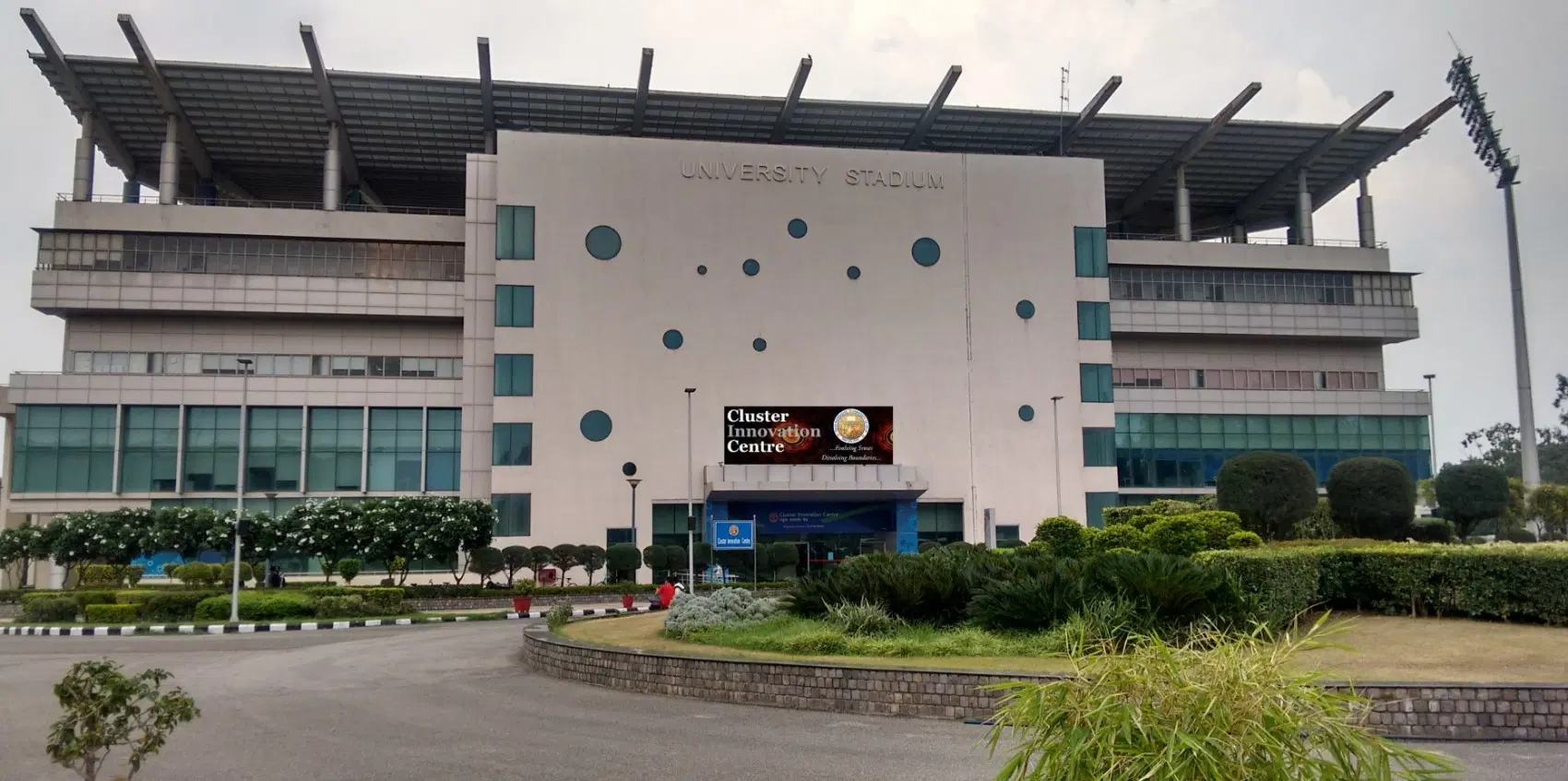

Cluster Innovation Centre, University of Delhi
Cluster Innovation Centre, University of Delhi
Cluster Innovation Centre (CIC), University of Delhi, is an interdisciplinary institution established to promote innovation-driven education, research, and entrepreneurship. CIC focuses on solving real-world problems through collaborative learning, design thinking, and applied research across technology, mathematics, social sciences, and education.
Total Fees
₹13K - ₹1.2L
Total Courses
4


University of Delhi, Department of Financial Studies
University of Delhi, Department of Financial Studies
Since 1987, the Department of Financial Studies (DFS) at Delhi University has been a cornerstone of finance education, offering a rigorous two-year MBA (Finance) Programme. This program equips students with advanced conceptual and analytical skills essential for financial decision-making. DFS stands out by blending foundational managerial subjects like Managerial Economics and Quantitative Techniques with specialized finance courses such as Financial Management, International Finance, Investment Management, and more. The curriculum evolves continuously to include cutting-edge topics like Derivatives & Risk Management, Treasury Management, and Real Estate Investmen
Total Fees
₹100K
Total Courses
2
Get More Info About DU BTech 2026 Spot Round 1 Revised Schedule Details
Recommended Reading

Maharashtra NEET UG 2026 Counselling: Complete Guide
Maharashtra NEET UG 2026 CAP Counselling is now live at medical2026.mahacet.org. Discover the full schedule, eligibility, and expert registration tips.
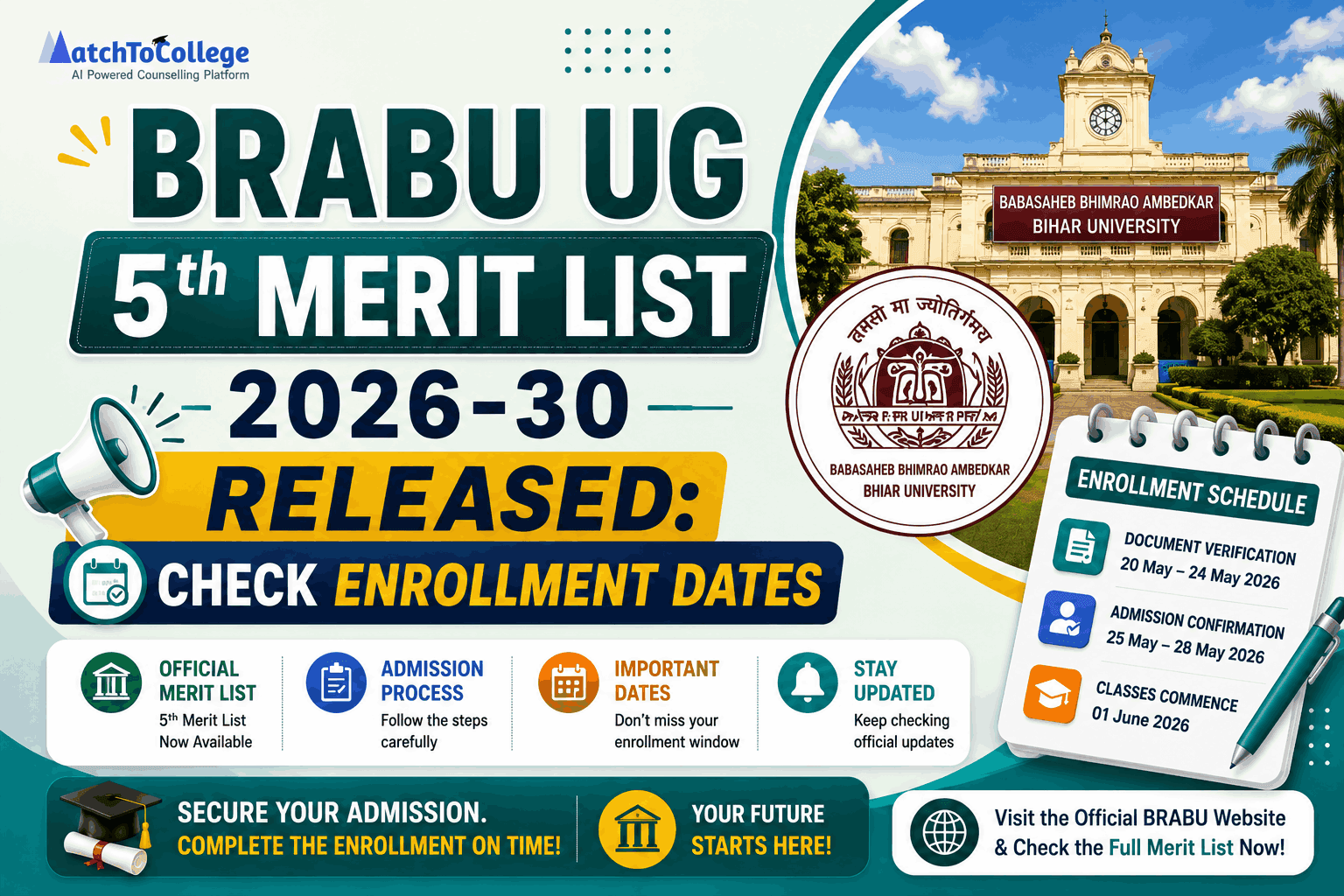
BRABU UG 5th Merit List 2026-30 Released: Check Enrollment Dates
BRABU has officially released the UG 5th Merit List 2026-30 at brabu.ac.in. Check selection status, admission deadlines, and required documents for 2026-27 enrollment.

Cummins College Pune BTech Institute Quota Admissions 2026-27
Apply now for MKSSS’s Cummins College Pune BTech Institute Quota admissions 2026-27. Check dates, eligibility, and application steps at cumminscollege.org.