


AP EAPCET 2026 Phase 1 Seat Allotment Result Out Now
Admission & Info Tools
Need Expert Assistance?
Our counselors can help you with fee structures, eligibility guidelines, and upcoming admission cutoffs instantly.
Direct Application Tools
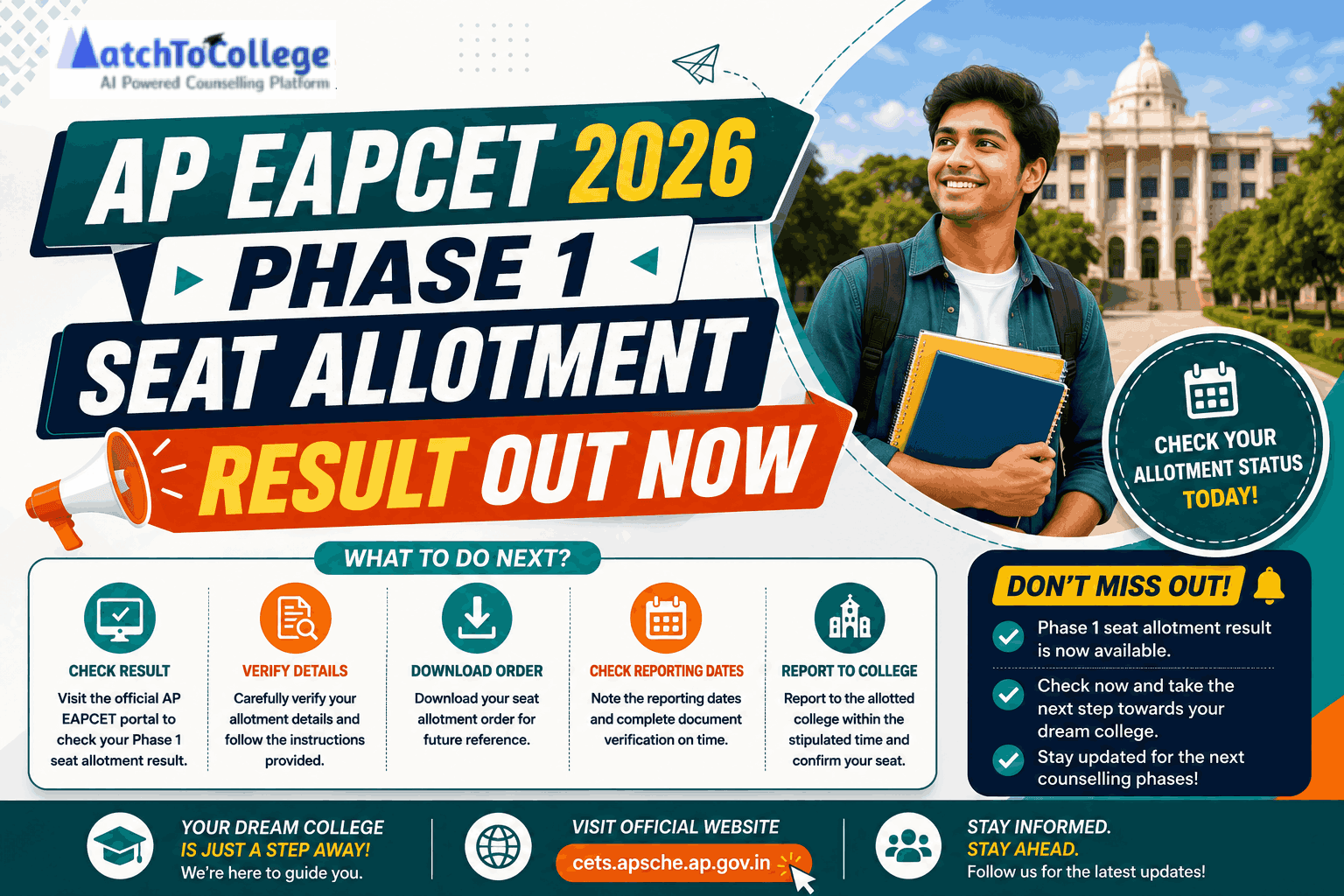
The Department of Technical Education and the Andhra Pradesh State Council of Higher Education (APSCHE) have officially released the AP EAPCET 2026 Phase 1 Seat Allotment Result for the MPC (Mathematics, Physics, and Chemistry) stream. This announcement marks a critical milestone for thousands of engineering and pharmacy aspirants across the state of Andhra Pradesh.
Students who participated in the web-based counseling process can now access their allotment status by visiting the official portal at cap.apcfss.in. The allotment is based on the candidate's rank, preferences submitted during the web-options entry phase, and the availability of seats in various participating institutions.
For the academic year 2026-27, the competition has been notably intense, particularly for top-tier government and private engineering colleges. The MPC stream, which facilitates entry into Bachelor of Technology (B.Tech) and Bachelor of Pharmacy (B.Pharm) programs, remains the most sought-after pathway for science students in the region. Along with the allotment results, the authorities have also published the College-wise Allotment Lists and the individual Allotment Orders, which are essential for the subsequent admission formalities.
At MatchToCollege, we understand that this period can be stressful for students and parents alike, which is why we have compiled this comprehensive guide to help you navigate the post-allotment phase with ease and precision.
The current phase is not just about knowing which college you have been assigned; it is about taking immediate action to secure that seat. Candidates must adhere strictly to the timelines provided for self-reporting and physical reporting at the respective colleges. Failure to complete these steps within the stipulated window will result in the automatic cancellation of the allotted seat, which will then be moved to the vacancy pool for Phase 2 counseling.
In the following sections, we will delve deep into the step-by-step process of checking your result, the nuances of the reporting window, and the strategic decisions you need to make if you are considering participating in the next round of counseling.
How to Check AP EAPCET 2026 Allotment Result at cap.apcfss.in
Accessing your seat allotment status is a straightforward process, but it requires careful attention to detail to ensure you are viewing the correct and most updated information. To begin, navigate to the official Andhra Pradesh Engineering Agricultural and Pharmacy Common Entrance Test (AP EAPCET) counseling website: cap.apcfss.in.
On the homepage, look for the link titled 'Seat Allotment Result - Phase 1 MPC Stream' or 'Download Allotment Order'. Clicking this will redirect you to a secure login page where you must enter your unique credentials.
You will typically need three pieces of information: your AP EAPCET 2026 Hall Ticket Number, your Date of Birth, and the security captcha shown on the screen. Once you submit these details, your dashboard will display the college and branch allotted to you. If a seat has been assigned, you will see a link to 'Download Allotment Order' and 'Self-Reporting'. It is highly recommended to download and print at least three copies of the allotment order, as it is a mandatory document for physical verification at the college.
If the system shows 'No Seat Allotted', do not panic. This usually happens when the choices filled during the web-options entry were limited or if the ranks for those specific colleges were higher than your earned rank. In such cases, you are eligible to participate in the second phase of counseling, where you can refine your choices based on the vacancy list that will be released shortly.
For those who have secured a seat, the next immediate step is to proceed with the online 'Self-Reporting' process. This is a digital confirmation that you are aware of the allotment and intend to take up the seat. This step must be completed before the deadline mentioned on the portal to keep the seat active.
APSCHE has released the AP EAPCET 2026 Phase 1 seat allotment for the MPC stream at cap.apcfss.in. Candidates must complete online self-joining and physical reporting at their allotted college from August 10 to August 15 2026.
The Andhra Pradesh State Council of Higher Education (APSCHE) has released the seat allotment result. It is the Andhra Pradesh Engineering Agriculture and Pharmacy Common Entrance Test (AP EAPCET) 2026 Phase 1 allotment for the Mathematics Physics Chemistry (MPC) stream. Candidates can download orders now at cap.apcfss.in.
The self-joining and reporting window opened on August 10 2026. It closes on August 15 2026. Candidates must complete both steps to confirm their allotted seats. Colleges will verify original documents between 10:00 AM and 5:00 PM daily.
Login on the portal requires the AP EAPCET Hall Ticket Number and the Date of Birth. The allotment order carries the college code, branch, and payable tuition fee. Missing the deadline will cancel the allotted seat automatically.
AP EAPCET 2026 Phase 1 Allotment Key Details
| Item | Details |
| Conducting Body | APSCHE |
| Counselling Portal | cap.apcfss.in |
| Phase 1 Allotment Released | August 9 2026 |
| Stream | MPC (Engineering and allied courses) |
| Self-Joining Window | August 10 to August 15 2026 |
| College Reporting Window | August 10 to August 15 2026 |
| Daily Reporting Timings | 10:00 AM to 5:00 PM |
| Login Credentials | Hall Ticket Number and Date of Birth |
How to Download the AP EAPCET 2026 Phase 1 Allotment Order?
Allotted candidates can follow the steps below to access their letters. The provisional allotment order must be printed before reporting.
- Visit the official portal at cap.apcfss.in.
- Click on the AP EAPCET 2026 Phase 1 allotment link.
- Enter the Hall Ticket Number and Date of Birth.
- View the allotted college code and branch details.
- Download and print the provisional allotment order.
How to Complete Self-Joining and Report at the College?
Every allotted candidate must finish two mandatory admission steps. Skipping either step will cancel the seat without notice.
- Log in at cap.apcfss.in and pay the tuition fee online.
- Confirm online self-joining after the payment is successful.
- Visit the allotted college with all original certificates.
- Complete physical reporting between 10:00 AM and 5:00 PM.
- Collect the college admission slip after document verification.
Documents Required at the Time of Reporting
Carry the following originals with two sets of photocopies. Missing any document may delay or block the admission.
- AP EAPCET 2026 Hall Ticket and Rank Card.
- Provisional allotment order printout from cap.apcfss.in.
- Class 10 and Class 12 marksheets and pass certificates.
- Transfer Certificate from the last attended institution.
- Study or Bonafide Certificate for the last four years.
- Income and Caste Certificates where applicable.
- Aadhaar card and recent passport-size photographs.
Why This Matters
The MPC stream feeds admissions into every AP engineering college under APSCHE. A missed reporting date means losing the Phase 1 seat entirely. The same vacancy then moves into the Phase 2 counselling pool.
Action Plan for Candidates
- Log in at cap.apcfss.in and download the allotment order today.
- Arrange the tuition fee and pay it online without delay.
- Photocopy all original certificates in two full sets.
- Reach the allotted college between August 10 and August 15.
- Complete physical verification and collect the admission slip.
Understanding the Reporting Window and Mandatory Deadlines
The reporting window for the AP EAPCET 2026 Phase 1 is a two-step process: Online Self-Reporting and Physical Reporting at the allotted institution. According to the official notification for the 2026-27 academic session, the window opens immediately following the result declaration and typically lasts for 4 to 5 working days. Candidates must understand that both steps are compulsory. Completing only the online self-reporting without visiting the college will lead to the forfeiture of the seat.
During the online self-reporting phase, candidates are required to log into the portal and click on the 'Accept My Allotment' button. Upon doing so, a 'Self-Reporting Certificate' will be generated. This certificate includes a joining report and a unique admission number. After this, the candidate must visit the allotted college in person within the specified dates.
The college authorities will verify the original documents and confirm the admission in the university portal. This physical presence is vital for the college to update the 'Joining Status' of the student, which is then communicated back to APSCHE.
What happens if you miss the deadline? The counseling system is automated and highly time-sensitive. Once the reporting window closes, the portal locks, and any seats not confirmed through both reporting methods are treated as vacant. These seats are then added to the pool for the Phase 2 (Final Phase) of counseling. Therefore, students should not wait until the last day to report, as technical glitches or travel delays could jeopardize their admission. We advise students to reach their allotted colleges at least one or two days before the deadline to ensure all paperwork is processed smoothly by the college administration.
Essential Documentation for Physical Reporting 2026-27
When you visit the allotted college for physical reporting, you must carry a set of original documents along with at least two sets of photocopies. The college's admission cell will verify these originals against the data provided during the registration process. The primary document is the AP EAPCET 2026 Allotment Order and the Self-Reporting Joining Report. Without these, the college will not initiate the admission process. Additionally, your AP EAPCET Rank Card and Hall Ticket are essential for identity verification.
Academic records are the next priority. You must carry your 10th (SSC) Marks Memo, 12th (Intermediate) Marks Memo, and Study/Bonafide Certificates from Class 6 to Intermediate. These study certificates are crucial for determining your 'Local' or 'Non-Local' status (AU/SVU/OU regions). If you are claiming a seat under a specific reservation, you must provide the relevant Caste Certificate (BC/SC/ST) and, if applicable, the EWS (Economically Weaker Section) certificate issued by the competent authority. For students seeking fee reimbursement, the latest Income Certificate or the 'Rice Card' is mandatory.
Other necessary documents include the Transfer Certificate (TC) from your last attended institution, a valid Aadhaar Card, and several passport-sized photographs. Some colleges may also require a medical fitness certificate. It is a good practice to keep digital scans of all these documents on a cloud drive (like Google Drive) for future use. Once the verification is complete, the college will return your original documents (except the TC in some cases) and provide you with an acknowledgment or a provisional admission letter. Ensure that you receive this acknowledgment, as it serves as proof of your successful admission.
Strategic Advice: To Freeze or Wait for Phase 2?
One of the most common dilemmas students face after the Phase 1 allotment is whether to stick with the current seat or try for a better option in Phase 2. In the AP EAPCET counseling system, you have the option to 'Accept' the seat while still participating in the subsequent rounds. This is a 'safety-first' strategy. By self-reporting and paying the fee, you secure your current seat. If you get a better allotment in Phase 2, the Phase 1 seat is automatically cancelled, and the fee is adjusted toward the new college. If you don't get a better seat in Phase 2, your Phase 1 seat remains intact.
However, if you are completely satisfied with the allotment—say you got your first choice of branch in a top-tier college like JNTU or AU—you can choose to 'Freeze' your admission and prepare for the commencement of classes. On the other hand, if the allotted college is far from your preferences, you must analyze the 'Phase 1 Cutoff Ranks' which are usually published after the allotment. Comparing your rank with the closing ranks of your desired colleges will give you a realistic picture of your chances in Phase 2. If the gap is narrow, participating in the next round is highly recommended.
At MatchToCollege, we encourage students to use our AI-driven tools to analyze college rankings and placement data before making this decision. A 'better' college on paper might not always be the best fit for your specific career goals. Consider factors like faculty expertise, lab facilities, and campus placement records for the specific branch you have been allotted. If you decide to go for Phase 2, remember that you will need to enter fresh web-options. The choices you made in Phase 1 do not carry over. This is your chance to correct any mistakes made in the previous round by listing only those colleges that are genuinely better than your current allotment.
Fee Structure and Reimbursement Schemes (Jagananna Vidya Deevena)
The fee structure for engineering and pharmacy courses in Andhra Pradesh is regulated by the Andhra Pradesh Higher Education Regulatory and Monitoring Commission (APHERMC). During the reporting process, students will be informed about the tuition fee and other miscellaneous fees (like library, laboratory, and sports fees). For many students, the Jagananna Vidya Deevena (JVD) scheme is a major boon, as it provides full tuition fee reimbursement directly to the mother's bank account in quarterly installments. To be eligible for this, the student's family income must meet the prescribed criteria, and they must have the necessary documentation validated during counseling.
Even if you are eligible for full reimbursement, some colleges might ask for a caution deposit or specific university-related fees at the time of admission. It is important to clarify this with the college's accounts department during physical reporting. For students who do not qualify for the reimbursement scheme, the tuition fee must be paid as per the schedule provided by the college. Most institutions offer online payment modes or Demand Draft options. Ensure you collect a valid receipt for every payment made.
In addition to tuition fees, consider the living expenses if you are opting for a hostel. Most top engineering colleges have attached hostels, but seats are often limited and allotted on a first-come, first-served basis. If you require hostel accommodation, make sure to inquire and apply for it simultaneously with your academic reporting. Understanding the total financial commitment for the four-year program is essential for long-term planning. MatchToCollege provides detailed insights into the ROI (Return on Investment) of various colleges, helping you understand which institutions offer the best value for your educational investment.
Share this Article
FAQFrequently Asked Questions
Q: Where can I check my AP EAPCET 2026 Phase 1 allotment result?
You can check your result on the official counseling portal at cap.apcfss.in by entering your Hall Ticket Number and Date of Birth.
Q: Is online self-reporting enough to secure my seat?
No, online self-reporting is only the first step. You must also physically report to the allotted college with your documents within the specified window to confirm your admission.
Q: Can I participate in Phase 2 if I have already accepted a seat in Phase 1?
Yes, you can participate in Phase 2 for a better option. If you get a new seat in Phase 2, your Phase 1 seat will be automatically cancelled.
Q: What documents are needed for AP EAPCET reporting?
Key documents include the Allotment Order, Self-Reporting Certificate, Rank Card, Hall Ticket, 10th and 12th Marks Memos, Study Certificates, Caste/EWS Certificate (if applicable), and Transfer Certificate.
Q: What if I missed the reporting deadline for Phase 1?
If you miss the deadline, your allotted seat will be cancelled. You will then have to wait and participate in the Phase 2 counseling process to get a fresh allotment.
Get More Info About AP EAPCET 2026 Phase 1 Seat Allotment Result Out Now
Recommended Reading

Odisha SAMS PG Round 1 Seat Allotment 2026 Released Now
Check the Odisha SAMS PG Round 1 Seat Allotment 2026 results at pg.samsodisha.gov.in. Learn about the reporting deadlines, required documents, and next steps.

ICAR Round 3 Seat Allotment 2026 Out: Fee Payment Deadlines
The ICAR Round 3 Seat Allotment 2026 is live at icarcounseling.com. Check the fee payment deadline for the 2026-27 session and secure your admission today.

Bihar PGEAC 2026 Round 2: Schedule and Interview Details
Bihar PGEAC 2026 Round 2 counselling schedule is out! Interviews are set for August 10-14, 2026. Check the official dates at bceceboard.bihar.gov.in.