


AICTE Shuts 58 Engineering Colleges: Impact & Your Future
Admission & Info Tools
Need Expert Assistance?
Our counselors can help you with fee structures, eligibility guidelines, and upcoming admission cutoffs instantly.
Direct Application Tools
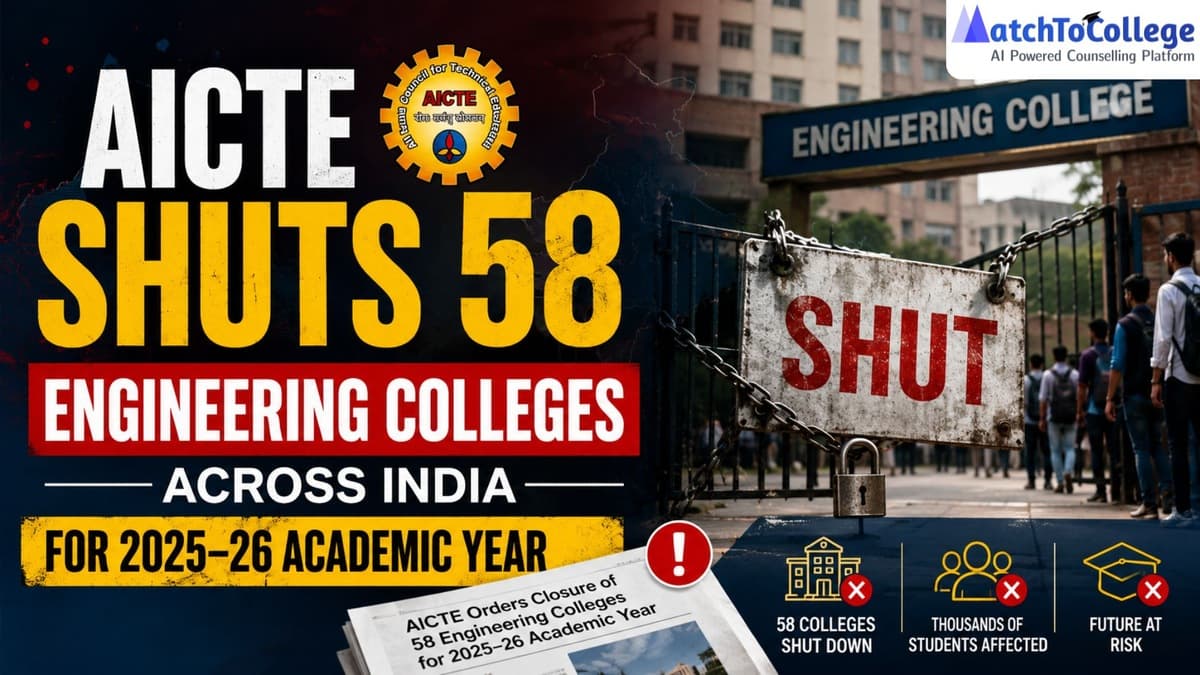
AICTE shuts down 58 colleges
If you've been scrolling through education news lately, you've probably seen the headline: AICTE just shut down 58 engineering and technical colleges across India for the 2025-26 academic year. That sounds scary, but let's break down what it really means, because it's not as dramatic as it first sounds.
AICTE is short for the All India Council for Technical Education — think of it as the government body that keeps an eye on every engineering, BTech, and technical college in the country. It decides which colleges are allowed to run, and it can shut down the ones that aren't meeting the required standards.
This year, 58 colleges failed to meet those standards well enough to keep running. But here's the important part: none of these closures happened overnight, and no student currently enrolled in these colleges is being kicked out. We'll explain exactly why in a bit.
Key Details
| What | The Number / Detail |
| Total colleges shut down | 58 |
| Type of closure | Progressive closure (all 58 of them) |
| Government-run/aided colleges among these | Just 3 |
| Private colleges among these | 55 |
| Courses (not whole colleges) dropped nationwide | 950+ |
| States/regions affected | 15 |
| Worst-hit states | Uttar Pradesh & Maharashtra — 12 closures each |
| Who confirmed this | AICTE, quoted by PTI (Press Trust of India), 5 July 2026 |
out of 58 colleges shut down, only 3 were government or government-aided institutions. The other 55 were privately run colleges. On top of that, over 950 individual courses (not entire colleges — just specific programmes within colleges) were also discontinued across the country during the same period.
Which States Got Hit the Hardest?

Uttar Pradesh and Maharashtra top the list, with 12 colleges shut in each state. That's not a coincidence — both states have historically had a huge number of private engineering colleges, many of which opened during a boom period when everyone wanted to start a BTech college. Now that student demand has cooled off for many of these institutions, the weaker ones are being weeded out.
| State / Region | Colleges Closed |
| Uttar Pradesh | 12 |
| Maharashtra | 10 |
| Madhya Pradesh | 8 |
| Telangana | 4 |
| Punjab | 4 |
| Andhra Pradesh | 3 |
| Rajasthan | 3 |
| Gujarat | 2 |
| Karnataka | 2 |
| Pune region (Maharashtra) | 2 |
| Tamil Nadu | 2 |
| Haryana | 1 |
| Odisha | 1 |
| Uttarakhand | 1 |
| West Bengal | 1 |
Wait — Does This Mean Students Are Losing Their Degrees?
No. And this is the part everyone should relax about. AICTE calls this type of shutdown a "progressive closure," and it works very differently from a college just switching off the lights and locking the gates. Here's the difference between the two types of closure, explained simply:
| Aspects | Progressive Closure | Complete Closure |
| New students | Can't admit any new 1st-years from this year onward | Can't admit anyone, ever — course is dead |
| Students already inside | Totally fine — finish your degree like normal, same college | Have to shift to a different, AICTE-approved college |
| Speed | Slow fade-out, batch by batch, until the last batch graduates | Shuts immediately |
| Is this what happened to the 58 colleges? | Yes — all 58 | No — none of the 58 |
All 58 colleges this year fall under progressive closure. So if you (or someone you know) is already studying at one of these colleges, you can breathe easy — you'll finish your degree at the same college, with the same recognition. The only real impact is that these colleges cannot take in any new first-year batch going forward.
Why Are These Colleges Being Shut Down?
An AICTE official explained the main reasons to PTI (Press Trust of India), and they mostly come down to colleges not being able to keep up with basic quality standards:
- Not enough students applying — many of these colleges had seats sitting empty year after year
- Not enough qualified teachers/faculty to meet the required staff-to-student ratio
- Poor infrastructure — labs, classrooms, and campus facilities not up to AICTE's required standards
- General non-compliance with AICTE's operating rules
Basically, if a college can't attract enough students, can't hire enough good faculty, and can't maintain proper facilities, it becomes unsustainable — and AICTE steps in.
This Isn't a One-Time Thing — It's Part of a Bigger Trend
1. Too Many Seats, Not Enough Students
Here's some context that helps explain why this keeps happening. Between 2019-20 and 2023-24, nearly 2 million engineering seats out of 6.4 million sanctioned seats across India went completely unfilled — that's about 30% of all seats sitting empty every year. A lot of colleges built capacity for a boom that didn't fully materialise, especially outside the big cities.
2. Things Are Improving Overall — But Unevenly
The good news is that overall interest in engineering has bounced back strongly. Approved seats hit an 8-year high of about 14.9 lakh in 2024-25, with 12.53 lakh students actually enrolling — the vacancy rate dropped to around 16.36%, the lowest in years. But almost all of that renewed demand is going toward one thing: Computer Science and related fields like AI and Data Science, which alone pulled in close to 3.9 lakh students in 2024-25.
That leaves a lot of smaller colleges — especially ones without strong Computer Science programmes, weak brand names, or shaky placement records — struggling to fill seats in traditional branches like Mechanical, Civil, or Electrical engineering. Those are exactly the kinds of colleges most at risk of closure, which lines up with why states with lots of smaller private colleges (UP, Maharashtra, MP) saw the most shutdowns.
3. A Rule Change Worth Knowing About
Back in 2023, AICTE removed a rule that required colleges to have NBA (National Board of Accreditation) accreditation before they could add more seats or launch new courses. This made it easier for colleges to expand quickly — but some former AICTE officials have pointed out that it also removed an important quality check, since NBA accreditation is generally considered stricter and more reliable than the alternative (NAAC accreditation).
What Should You Actually Do With This Information?
- Before applying anywhere for 2026-27, check the college's current AICTE approval status directly on the official AICTE website — don't rely only on the college's own claims.
- Look at how many seats the college usually leaves empty, especially in non-Computer Science branches — high vacancy year after year can be a warning sign.
- Where possible, pick programmes with NBA accreditation, since it usually reflects better quality checks.
- If you're already studying at a college that got a progressive closure, don't panic — you get to finish your degree normally. Just know that no new batches will join after you.
- Placement record and industry connections tell you a lot about whether a college is financially and academically healthy — dig into these before committing.
58 engineering colleges shutting down sounds alarming at first, but it's really the education system cleaning up colleges that weren't able to keep up — mostly small, private colleges that couldn't fill seats, hire enough staff, or maintain proper facilities. If you're already enrolled somewhere, your degree is safe. If you're applying soon, use this as a reminder to actually check a college's approval status, accreditation, and placement record before you commit — not just its brochure.
What This Means for Aspiring Engineering Students
The closure of nearly 60 engineering colleges has significant implications for prospective students eyeing an engineering career, particularly those planning for the 2026-27 academic year. Here's what you need to know:
- Increased Competition for Seats: With fewer colleges offering engineering programs, competition for admission into the remaining accredited and reputable institutions will likely intensify. Students will need to aim for higher scores in entrance examinations and present stronger applications.
- Heightened Importance of Research: It becomes more critical than ever to thoroughly research colleges, their accreditation status, infrastructure, faculty quality, placement records, and alumni networks. Do not rely solely on rankings; look for AICTE approval and NAAC accreditation.
- Opportunity for Quality Focus: While daunting, this move also serves as a quality filter. Students can be more confident that the colleges that remain approved generally meet higher standards, reducing the risk of enrolling in a substandard institution.
- Exploring Alternative Pathways: Students might need to broaden their search criteria, considering emerging specializations, different geographical locations, or even exploring related fields if their initial top choices become too competitive.
Navigating this altered landscape requires strategic planning and access to reliable, up-to-date information. Making an informed decision now can save years of regret later.
Navigating Your Engineering Future with Confidence
In times of change and increased competition, having a trusted guide is invaluable. This is precisely where MatchToCollege steps in to empower students and parents. Our AI-powered platform is designed to provide personalized, data-driven insights to help you make the best college choices, even amidst the recent AICTE closures.
We can help you:
- Identify Top-Tier Institutions: Our algorithms analyze a vast database of colleges, considering factors like accreditation, academic performance, infrastructure, and student outcomes to recommend institutions that meet rigorous standards.
- Personalized Matchmaking: Beyond just rankings, we match you with colleges and courses that align with your academic profile, career aspirations, interests, and even budget, ensuring a holistic fit.
- Explore & Compare Alternatives: If your initial choices are affected or become too competitive, MatchToCollege can quickly present you with viable, high-quality alternatives that you might not have considered.
- Stay Informed: We provide real-time updates and expert insights on significant higher education developments, keeping you ahead of the curve.
Don't let the news of college closures deter your engineering dreams. With MatchToCollege, you gain an advantage, transforming uncertainty into a clear, confident path toward your ideal higher education journey. Start exploring your options today and build the future you deserve.
Share this Article
FAQFrequently Asked Questions
Q: What is the primary reason for these AICTE engineering college closures?
AICTE cites several reasons including non-compliance with regulations, inadequate infrastructure, consistent low student enrollment, and failure to meet the required quality education standards set for technical institutions.
Q: How will these closures affect engineering admissions for the 2025-26 academic year?
The closures will likely intensify competition for seats in the remaining accredited engineering institutions. Aspiring students will need to research colleges more thoroughly, ensure their chosen institutions are AICTE-approved, and prepare for potentially higher cut-offs in entrance exams.
Get More Info About AICTE Shuts 58 Engineering Colleges
Recommended Reading

Jharkhand NEET UG 2026 Round 1 Deadline Extended: New Dates
JCECEB has extended the Jharkhand NEET UG 2026 Round 1 registration deadline. Explore the revised schedule, seat allotment dates, and expert counselling tips.
Tamil Nadu NEET MDS 2026 Rank List Released: Download PDF
The Tamil Nadu NEET MDS 2026 Provisional Rank List is officially out! Download the PDF and discover the next steps for TN MDS Counseling 2026-27 here.

WBJEE BPharm Round 3 Counselling 2026: Apply at wbjeeb.nic.in
WBJEE BPharm Round 3 Counselling 2026 registration begins at wbjeeb.nic.in. Follow our comprehensive guide for choice filling and pharmacy admissions steps.