

Study in Germany 2026: Free Tuition & APS Guide
Admission & Info Tools
Need Expert Assistance?
Our counselors can help you with fee structures, eligibility guidelines, and upcoming admission cutoffs instantly.
Direct Application Tools
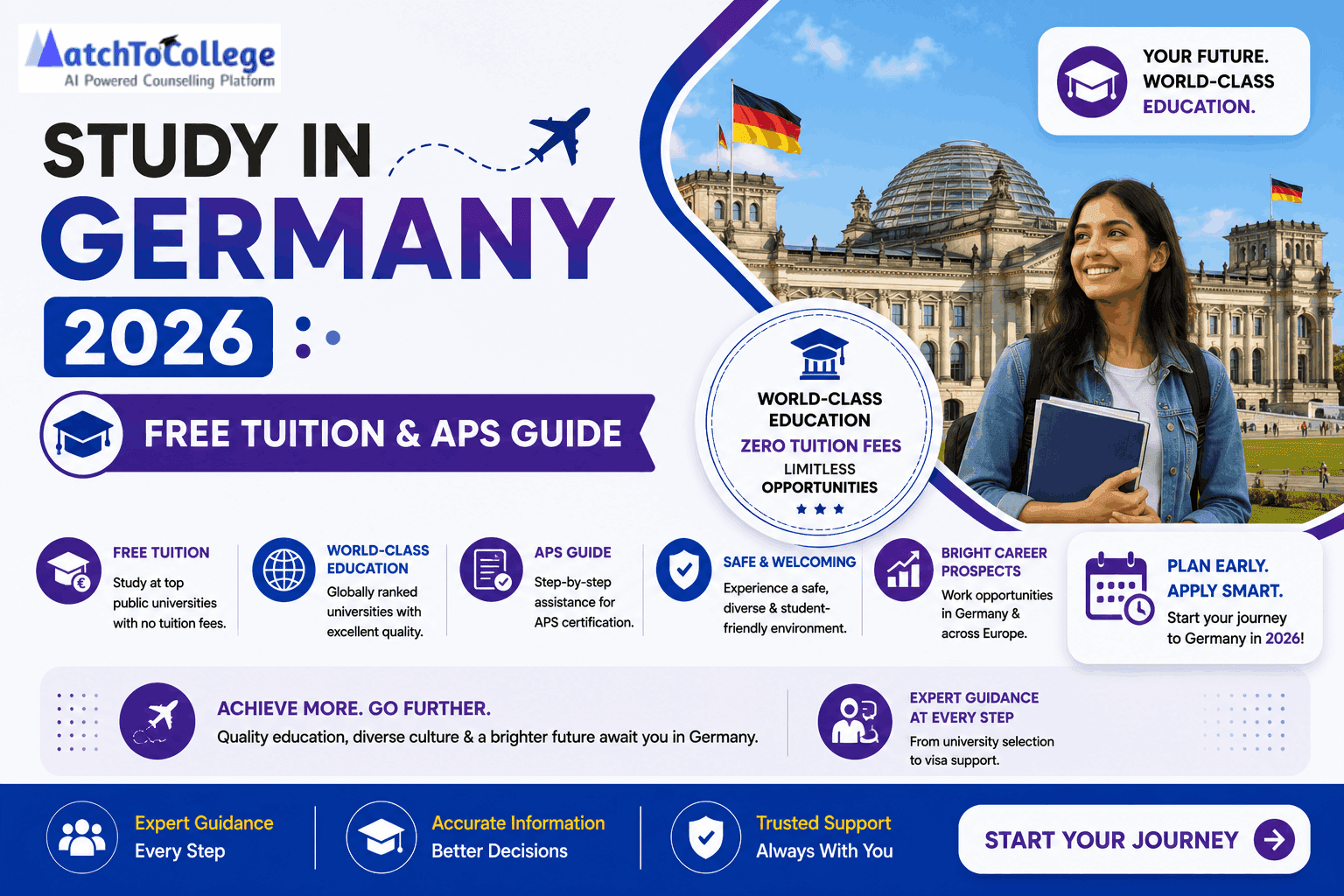
As we look toward the 2026-2027 academic cycle, Germany remains the undisputed champion for international students seeking high-quality, low-cost higher education. The German higher education landscape is evolving, integrating more English-taught programs and digitalizing its administrative processes to accommodate the growing influx of global talent.
For students aiming to leverage the 'Land of Ideas,' understanding the shifting regulatory landscape—from the mandatory APS certificate to the updated Blocked Account (Sperrkonto) thresholds—is critical for a successful application. MatchToCollege, powered by advanced AI, simplifies this complex journey by matching your profile with the specific requirements of over 400 German universities. This guide serves as your authoritative roadmap for navigating the 2026-27 admission cycle, ensuring you meet every milestone with precision.
Germany's appeal lies not just in its lack of tuition fees at public universities but in its robust industrial-academic link. For a student in 2026, the focus is increasingly on STEM fields, sustainability, and AI-driven engineering. However, the path to entry has become more structured. The introduction of the APS (Akademische Prüfstelle) for several nations has added a layer of verification that requires early planning. Moreover, the financial requirements for the German Student Visa are tied to the federal BAföG rates, which are subject to annual adjustments. Preparing for 2026 means anticipating these changes now.
Germany is not just offering an education; it is offering a pathway to a career in the heart of Europe’s economy. With the 'Fachkräftereinwanderungsgesetz' (Skilled Immigration Act) making it easier for graduates to transition into the workforce, there has never been a better time to plan your German academic journey.
At MatchToCollege, we recognize that the 'one-size-fits-all' approach to counseling is obsolete. Our AI tools analyze your academic transcripts, language proficiency, and career goals to identify the public universities where you have the highest probability of admission. Whether you are targeting a TU9 technical university or a specialized University of Applied Sciences (Fachhochschule), understanding the nuances of the 2026 intake is essential. In the following sections, we will break down the three pillars of German admission: the financial security of the Blocked Account, the academic integrity of the APS Certificate, and the strategic selection of Free Tuition programs.
The Reality of Free Tuition Universities in 2026
The concept of 'Free Tuition' in Germany is often misunderstood but remains a cornerstone of their educational philosophy. In 2026, the vast majority of public universities in Germany continue to charge zero tuition fees for both domestic and international students. This policy is based on the belief that education should not be a commercial product. However, students must distinguish between 'Tuition Fees' and 'Semester Contributions' (Semesterbeitrag). Every student at a public university is required to pay a semester contribution, which typically ranges from €200 to €450.
This fee is not for instruction; rather, it covers administrative costs, student union fees, and, most importantly, the 'Semesterticket,' which provides unlimited public transportation within the city or region for six months.
While the zero-tuition model is the norm, there are specific exceptions to keep in mind for the 2026-27 cycle. The state of Baden-Württemberg (home to prestigious universities like Heidelberg and KIT) continues to charge non-EU students a tuition fee of approximately €1,500 per semester.
Additionally, some other states have introduced or are considering nominal fees for 'long-term students' or those pursuing a second degree in a different field. It is also important to note that private universities in Germany, which are growing in number, do charge significant tuition fees, often comparable to those in the UK or USA. For those seeking the traditional free model, public 'Universitäten' and 'Fachhochschulen' are the primary targets.
To secure a spot in these competitive programs, your GPA (converted to the German 1-5 scale) is the most critical factor. Many programs are 'NC' (Numerus Clausus), meaning admission is restricted to the top tier of applicants. In 2026, we are seeing a trend where even English-taught Master’s programs in Data Science and Renewable Energy are becoming as competitive as medical degrees. Utilizing MatchToCollege’s AI matching engine allows you to see how your specific GPA stacks up against the previous year’s cutoff for hundreds of programs, ensuring you don't waste your application on 'reach' schools without a solid safety net.
Selecting the Right Program: University vs. Fachhochschule
A critical decision for any student in 2026 is choosing between a 'Research University' (Universität) and a 'University of Applied Sciences' (Fachhochschule or FH). Traditionally, Universitäten were for those interested in theory and PhD paths, while FHs were for those seeking practical, industry-ready skills. In 2026, the line is blurring, but the distinction remains important for your career trajectory. Public Research Universities are generally larger and offer a wider range of subjects, including 'pure' sciences, humanities, and medicine. They are the only institutions that can grant PhDs in most German states.
On the other hand, Fachhochschulen are deeply integrated with the German 'Mittelstand' (medium-sized companies that are global leaders). Their curricula often include mandatory internship semesters (Praxissemester) and project-based learning. For an Engineering or Business student in 2026, an FH might offer a faster route into the German job market. Employers in Germany highly value the practical experience gained at an FH. When using MatchToCollege, you can filter programs based on your learning style—whether you prefer deep academic research or hands-on industrial application.
Language of instruction is the next big hurdle. While 2026 sees a record number of English-medium Master's programs, Bachelor's degrees in Germany are still predominantly taught in German. If you are aiming for a 'Free' Bachelor's degree, you will likely need a C1 level of German (TestDaF 4x4 or DSH-2). However, many universities now offer 'Bridge' programs or 'Studienkolleg' (preparatory courses) for international students who have the academic merit but lack the language proficiency. Our platform helps you identify these 'Conditional Admission' pathways, which are essential for students who want to start their German journey while still mastering the language.
Visa Strategy & Post-Study Career Planning
The German Student Visa (National Visa - Type D) is the final hurdle. In 2026, the process is increasingly moving toward the 'Opportunity Card' (Chancenkarte) system for job seekers, but for students, the traditional study visa remains the standard.
The key documents for 2026 include your University Admission Letter (Zulassungsbescheid), the APS Certificate, the Blocked Account confirmation, and proof of Health Insurance. A common reason for visa rejection is 'lack of motivation,' which is why your Statement of Purpose (SOP) must be exceptionally clear about why you chose a specific program and how it fits into your long-term career goals.
One of the greatest advantages of studying in Germany in 2026 is the post-study work rights. Upon graduation, international students are granted an 18-month Job Seeker Visa. This allows you to stay in Germany and work any job while you look for a position that matches your qualifications. Once you find a professional role, you can transition to a Work Permit or an EU Blue Card. The German government has recently shortened the timeline for Permanent Residency (PR) and Citizenship, making Germany one of the most immigrant-friendly hubs for skilled professionals in the Western world.
MatchToCollege doesn't just stop at admission. Our platform provides insights into the German labor market, identifying which regions (like the 'Silicon Saxony' for microelectronics or the 'Automotive Hubs' in Stuttgart) are hiring in 2026. By choosing a university in a region aligned with your industry, you significantly increase your networking opportunities and internship prospects. Planning your 2026 education with the end goal—a career in Europe—in mind is the smartest strategy you can employ today.
Share this Article
FAQFrequently Asked Questions
Q: Is education still free in Germany for 2026?
Yes, most public universities in Germany offer tuition-free education for the 2026-27 academic year. However, students must pay a semester contribution fee of €200-€450, and the state of Baden-Württemberg still charges €1,500 per semester for non-EU students.
Q: How long does the APS certificate take to process in 2026?
APS processing times for 2026 are expected to be between 4 to 12 weeks depending on the volume of applications. It is highly recommended to apply at least 6 months before your university application deadline.
Q: What is the Blocked Account amount for Germany 2026?
While the 2024 amount was €11,208, for the 2026-27 cycle, students should prepare for a required amount of approximately €11,900 to €12,300, following inflation adjustments.
Q: Can I study in Germany without knowing the German language?
Yes, there are over 2,000 English-taught programs in Germany, especially at the Master's level. However, for Bachelor's degrees, most public university programs are still taught in German and require a C1 level of proficiency.
Q: Does MatchToCollege help with the German Student Visa?
Yes, MatchToCollege provides AI-driven guidance on document checklists, SOP writing for the visa, and connecting students with verified Blocked Account and Health Insurance providers.
Get More Info About Study in Germany 2026
Recommended Reading
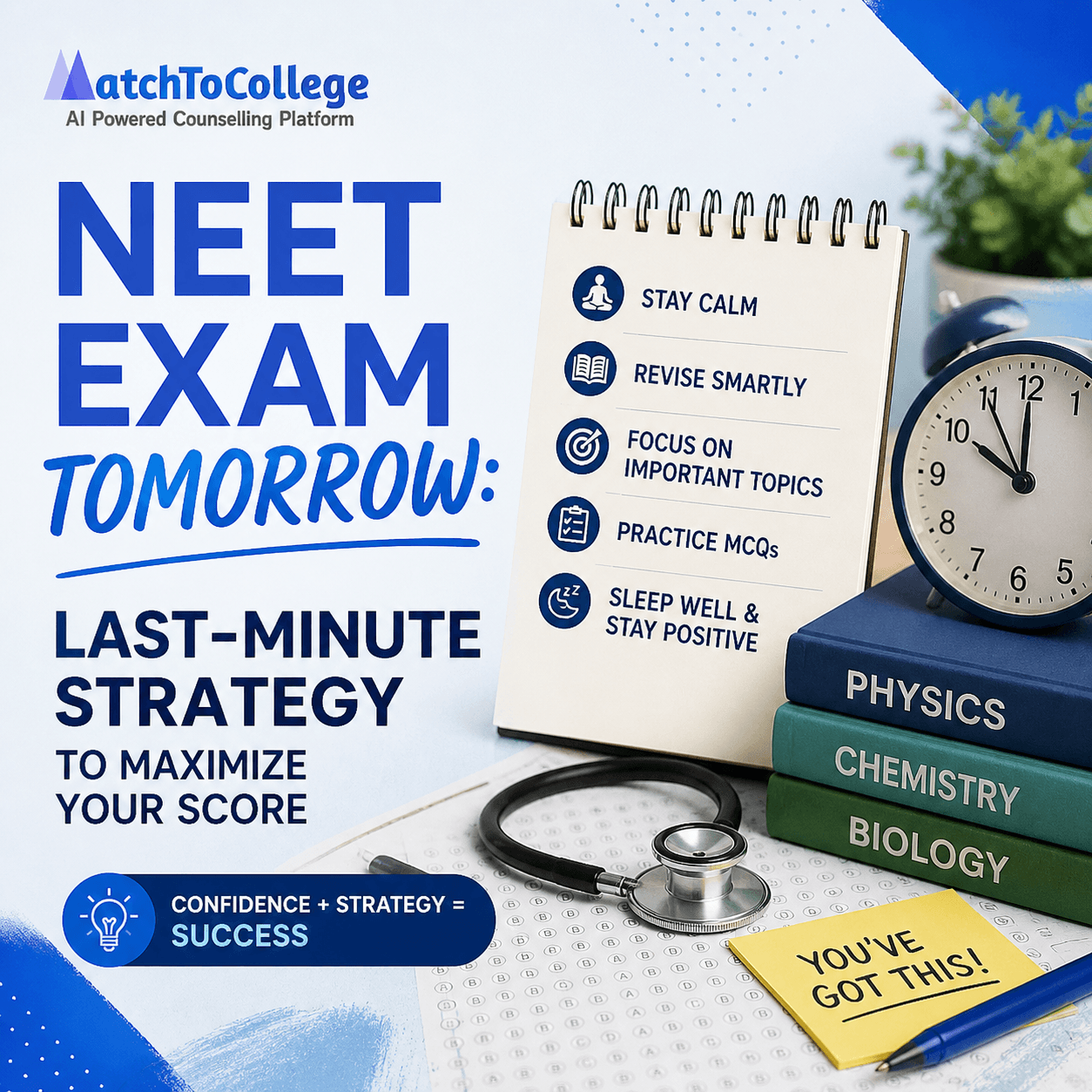
NEET Exam Tomorrow: Last-Minute Strategy to Maximize Your Score
NEET is tomorrow—here’s your complete last-day strategy covering revision, exam hall tips, and mistakes to avoid for maximum accuracy and performance.
GATE Previous Year Question Papers with Official Answer Keys (2007–2026) – Download PDF by Branch
Download official GATE previous year question papers with answer keys PDF from 2007 to 2026. Access branch-wise question papers for Computer Science (CS), Data Science (DA), Mechanical (ME), Electronics (EC), Electrical (EE), and Civil (CE) by IIT Madras.
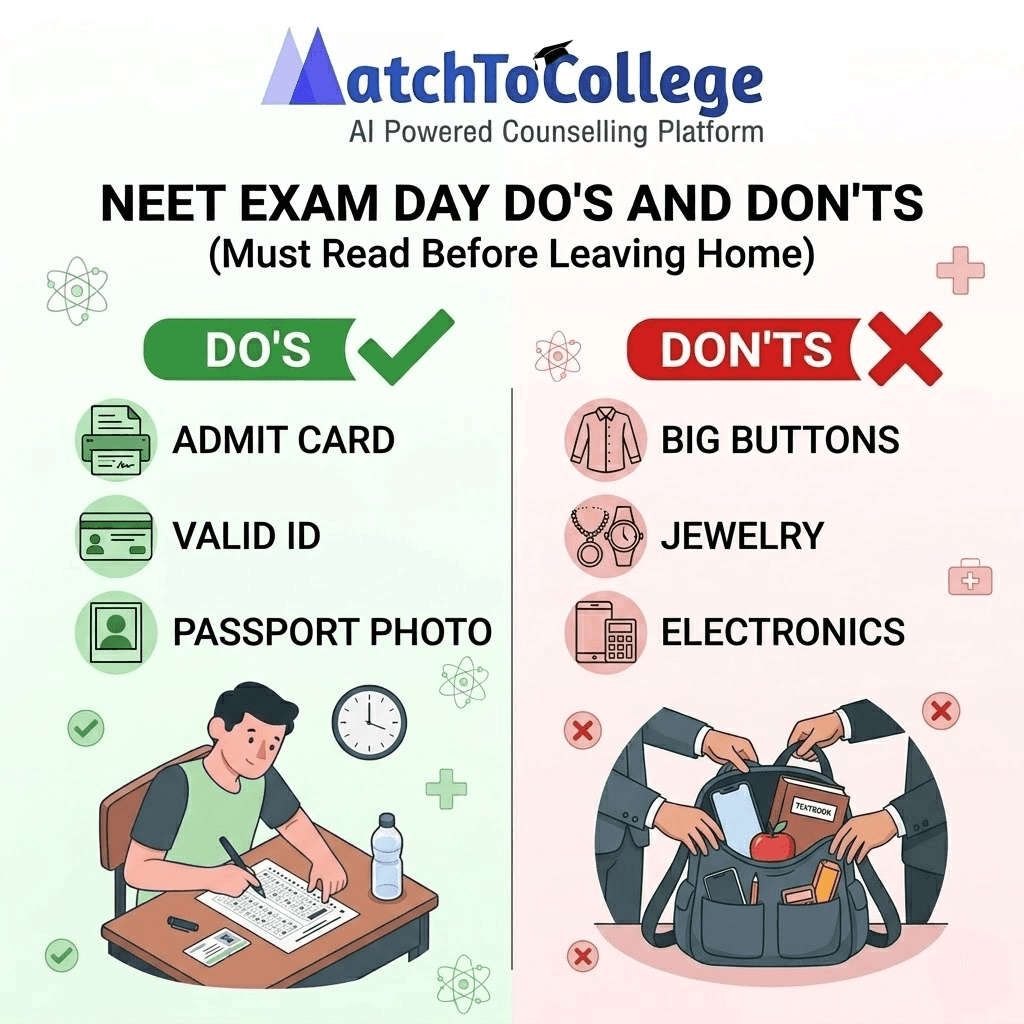
NEET Exam Day Do’s and Don’ts (Must Read Before Leaving Home)
Students appearing for the National Eligibility cum Entrance Test (NEET) must follow strict exam day guidelines set by the National Testing Agency. From required documents and dress code to prohibited items, this guide covers the most important NEET exam day do’s and don’ts to help candidates avoid last-minute problems at the exam center.