

Research vs. Corporate: Your Post-MBA Career Choice
Admission & Info Tools
Need Expert Assistance?
Our counselors can help you with fee structures, eligibility guidelines, and upcoming admission cutoffs instantly.
Direct Application Tools
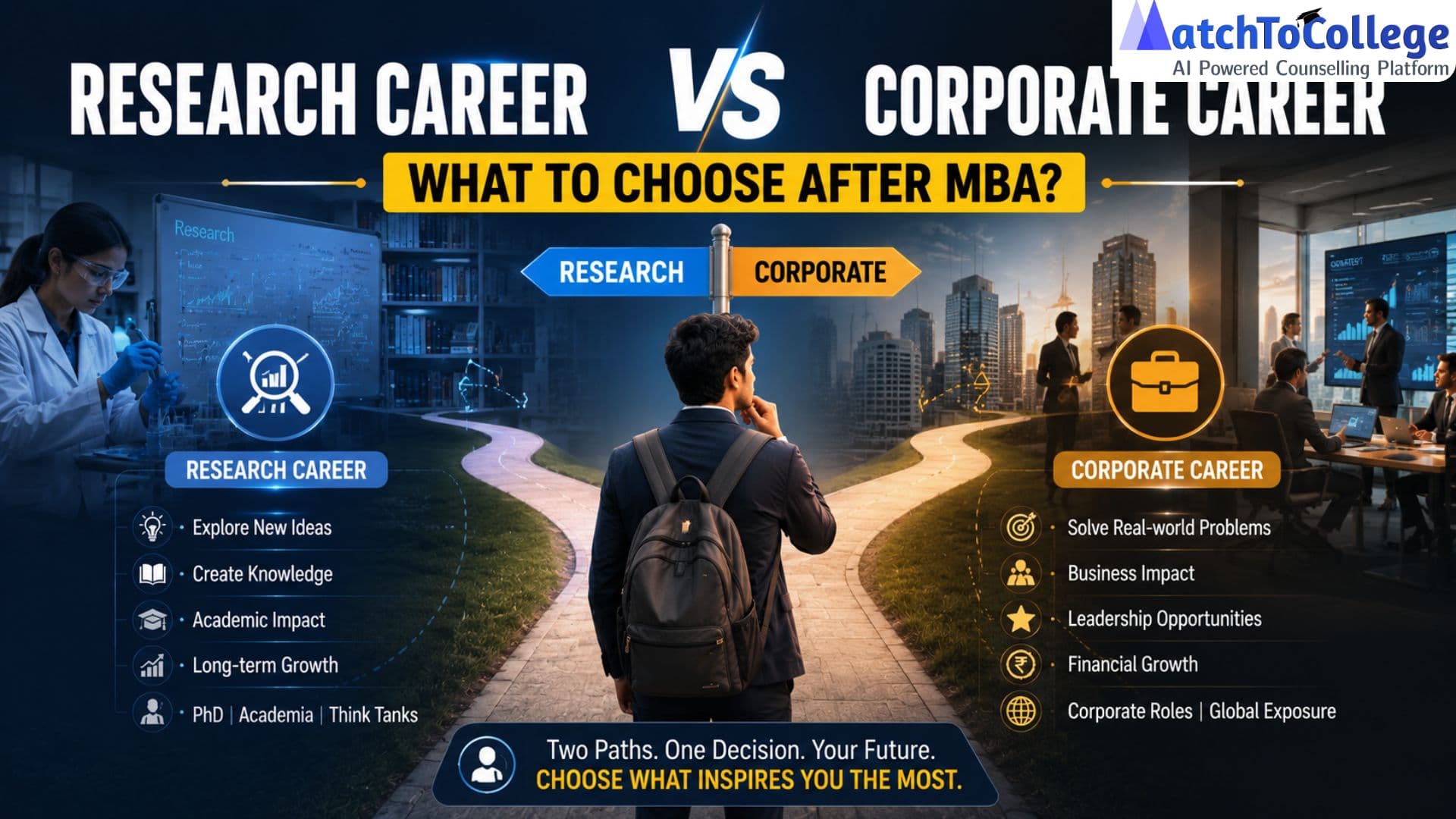
Career crossroads: research vs corporate
Completing an MBA opens up many career opportunities. One of the biggest decisions MBA graduates face is choosing between a Corporate Career and a Research Career. Both offer excellent growth, but they differ in work style, responsibilities, and career goals. The right choice depends on your interests, skills, and long-term aspirations.
Research Career vs Corporate Career
| Factor | Corporate Career | Research Career |
| Main Focus | Business growth, management, and decision-making | Research, analysis, and innovation |
| Work Environment | Fast-paced, target-driven, team-oriented | Analytical, knowledge-driven, and research-focused |
| Key Skills | Leadership, communication, problem-solving, management | Critical thinking, data analysis, research, and analytical skills |
| Career Growth | Promotions, leadership roles, and higher salaries | Subject expertise, research leadership, and academic or industry growth |
| Work Style | Client interaction, teamwork, and business operations | Independent research, data interpretation, and report writing |
| Best For | Students interested in management, consulting, finance, marketing, HR, or operations | Students who enjoy research, analysis, innovation, and knowledge creation |
How to Choose the Right Career
- Identify your interests and strengths.
- Define your long-term career goals.
- Consider your preferred work environment.
- Research job roles and future opportunities.
- Evaluate salary, growth, and work-life balance.
- Seek guidance from mentors and career experts.
How MatchToCollege Can Help
| Feature | Benefit |
| Personalized Career Guidance | Helps you choose between research and corporate careers based on your profile. |
| AI-Powered Recommendations | Suggests career paths that match your skills and interests. |
| Career Insights | Provides information on industry trends, job opportunities, and salary prospects. |
| Mentorship Support | Connects you with experts for career guidance and planning. |
Both Corporate Careers and Research Careers offer rewarding opportunities after an MBA. A corporate career is ideal for students who enjoy leadership, business management, and fast-paced environments, while a research career is better suited for those who enjoy analysis, innovation, and creating new knowledge. Choose the path that best matches your interests, skills, and long-term career goals.
The Allure of a Research Career Post-MBA
A research career is an excellent option for MBA graduates who enjoy data analysis, problem-solving, and discovering insights. Research professionals study business trends, customer behavior, and market data to help organizations make informed decisions and drive innovation.
Popular Research Career Roles
| Job Role | Primary Responsibility |
| Market Research Analyst | Studies customer behavior, market trends, and competitors. |
| Data Scientist | Analyzes large datasets to identify patterns and support business decisions. |
| Business Intelligence (BI) Analyst | Converts business data into meaningful insights for strategic planning. |
| UX Researcher | Studies user needs and experiences to improve products and services. |
| Economic or Policy Analyst | Conducts research on economic trends and public policies. |
| Research Consultant | Provides data-driven insights for business strategy and decision-making. |
Key Responsibilities
- Design and conduct research studies.
- Collect, analyze, and interpret data.
- Identify market trends and business opportunities.
- Develop reports and present findings to stakeholders.
- Support strategic planning through data-driven insights.
- Create predictive models for future business decisions.
Skills Required
- Critical thinking
- Data analysis and statistics
- Problem-solving
- Research methodology
- Communication and presentation skills
- Business and analytical thinking
Advantages and Challenges
| Advantages | Challenges |
| Intellectual and analytical work | Starting salaries may be lower than some corporate roles. |
| Continuous learning and skill development | Career progression may be less structured. |
| Opportunity to influence business decisions | Some roles involve independent or solitary work. |
| Contributes to innovation and new knowledge | Requires strong analytical and research skills. |
| Better work-life balance in many organizations | Continuous learning is essential to stay updated. |
Best Suited For
A research career is ideal for students who:
- Enjoy analyzing data and solving complex problems.
- Are curious and enjoy learning new concepts.
- Like working with facts, research, and business insights.
- Want to contribute to innovation and strategic decision-making.
A research career after an MBA is ideal for students with strong analytical and problem-solving abilities. It offers opportunities to analyze data, influence business strategies, drive innovation, and continuously learn, making it a rewarding choice for those passionate about research and business intelligence.
Navigating the Corporate Ladder After Your MBA
A corporate career is one of the most popular choices for MBA graduates. It offers opportunities to work in leading companies, manage business operations, solve real-world challenges, and contribute to business growth. These roles are fast-paced, performance-driven, and provide clear career advancement opportunities.
Popular Corporate Career Roles
| Job Role | Primary Responsibility |
| Management Consultant | Solves business problems and improves organizational performance. |
| Investment Banker | Manages financial transactions, investments, and corporate finance activities. |
| Product Manager | Develops and manages products from planning to launch. |
| Marketing Manager | Creates marketing strategies to promote products and grow the business. |
| Operations Manager | Improves business processes and ensures efficient operations. |
| Finance Manager | Manages budgeting, financial planning, and business performance. |
| Business Development Manager | Identifies new business opportunities and builds client relationships. |
| Entrepreneur/Start-up Founder | Builds and manages a new business venture. |
Key Responsibilities
- Lead teams and manage projects.
- Develop business strategies.
- Improve business processes and operations.
- Analyze market trends and business performance.
- Make data-driven business decisions.
- Drive innovation and business growth.
Skills Required
- Leadership and team management
- Communication and presentation skills
- Strategic thinking
- Problem-solving and decision-making
- Business and financial analysis
- Project management
Advantages and Challenges
| Advantages | Challenges |
| High salary potential | Long working hours |
| Fast career growth | High competition |
| Leadership opportunities | Stressful work environment |
| Strong professional network | Frequent travel in some roles |
| Exposure to diverse industries and projects | Maintaining work-life balance can be challenging |
Best Suited For
A corporate career is ideal for students who:
- Enjoy leadership and teamwork.
- Thrive in fast-paced environments.
- Like solving business problems.
- Want rapid career growth and higher earning potential.
- Are interested in management, consulting, finance, marketing, or operations.
A corporate career after an MBA offers high earning potential, leadership opportunities, rapid career growth, and exposure to diverse business challenges. It is best suited for students who enjoy working in dynamic environments, leading teams, and driving business success.
Making Your Decision: Key Factors to Consider
Before choosing between a research career and a corporate career after your MBA, evaluate your interests, skills, and future goals.
| Factor | Research Career | Corporate Career |
| Skills | Best for analytical thinking, research, data analysis, and problem-solving. | Best for leadership, communication, teamwork, and business management. |
| Career Goals | Focus on innovation, research, and generating business insights. | Focus on leading teams, growing businesses, and achieving organizational goals. |
| Work-Life Balance | Often offers better flexibility, though project deadlines may be demanding. | May involve long working hours, travel, and a fast-paced work environment. |
| Salary & Satisfaction | May have lower starting salaries but can provide high job satisfaction. | Generally offers higher earning potential and faster career growth. |
| Industry Preference | Common in research organizations, consulting research, technology, healthcare, academia, and R&D. | Common in consulting, finance, marketing, operations, retail, manufacturing, and technology companies. |
Questions to Ask Yourself
- Do I enjoy research and data analysis or business management and leadership?
- Which work environment suits me better?
- What are my long-term career goals?
- Do I value higher salary, work-life balance, or intellectual growth more?
- Which career matches my skills, interests, and personality?
Quick Comparison
| Choose Research If... | Choose Corporate If... |
| You enjoy research, data, and analysis. | You enjoy leading teams and managing businesses. |
| You like solving complex problems through research. | You enjoy making business decisions and achieving targets. |
| You prefer continuous learning and innovation. | You thrive in a fast-paced, competitive environment. |
| You value flexibility and knowledge creation. | You seek rapid career growth and higher earning potential. |
There is no right or wrong choice between a research career and a corporate career. Select the path that best aligns with your skills, interests, career goals, preferred lifestyle, and long-term aspirations. A well-informed decision will lead to greater career success and personal satisfaction.
MatchToCollege: Your AI Partner in Career Clarity
Navigating the complex landscape of MBA career paths can be overwhelming. This is where MatchToCollege excels. Our AI-powered higher education counseling platform is designed to provide personalized, data-driven insights tailored to your unique profile. By analyzing your academic background, professional experience, skills, interests, and aspirations, our platform can help you understand which path – research or corporate – aligns best with your potential for success and personal fulfillment.
We go beyond generic advice, offering an AI-powered matching system that connects you with relevant career opportunities and provides actionable steps to achieve your goals. Whether you're passionate about becoming a market research analyst, a management consultant, or a leader in corporate strategy, MatchToCollege empowers you to make informed decisions for your post-MBA journey. Let us guide you towards a career that truly resonates with who you are and who you aspire to be.
The Allure of a Research Career Post-MBA
A research career is an excellent option for MBA graduates who enjoy data analysis, problem-solving, and discovering insights. Research professionals study business trends, customer behavior, and market data to help organizations make informed decisions and drive innovation.
Popular Research Career Roles
| Job Role | Primary Responsibility |
| Market Research Analyst | Studies customer behavior, market trends, and competitors. |
| Data Scientist | Analyzes large datasets to identify patterns and support business decisions. |
| Business Intelligence (BI) Analyst | Converts business data into meaningful insights for strategic planning. |
| UX Researcher | Studies user needs and experiences to improve products and services. |
| Economic or Policy Analyst | Conducts research on economic trends and public policies. |
| Research Consultant | Provides data-driven insights for business strategy and decision-making. |
Key Responsibilities
- Design and conduct research studies.
- Collect, analyze, and interpret data.
- Identify market trends and business opportunities.
- Develop reports and present findings to stakeholders.
- Support strategic planning through data-driven insights.
- Create predictive models for future business decisions.
Skills Required
- Critical thinking
- Data analysis and statistics
- Problem-solving
- Research methodology
- Communication and presentation skills
- Business and analytical thinking
Advantages and Challenges
| Advantages | Challenges |
| Intellectual and analytical work | Starting salaries may be lower than some corporate roles. |
| Continuous learning and skill development | Career progression may be less structured. |
| Opportunity to influence business decisions | Some roles involve independent or solitary work. |
| Contributes to innovation and new knowledge | Requires strong analytical and research skills. |
| Better work-life balance in many organizations | Continuous learning is essential to stay updated. |
Best Suited For
A research career is ideal for students who:
- Enjoy analyzing data and solving complex problems.
- Are curious and enjoy learning new concepts.
- Like working with facts, research, and business insights.
- Want to contribute to innovation and strategic decision-making.
A research career after an MBA is ideal for students with strong analytical and problem-solving abilities. It offers opportunities to analyze data, influence business strategies, drive innovation, and continuously learn, making it a rewarding choice for those passionate about research and business intelligence.
Navigating the Corporate Ladder After Your MBA
A corporate career is one of the most popular choices for MBA graduates. It offers opportunities to work in leading companies, manage business operations, solve real-world challenges, and contribute to business growth. These roles are fast-paced, performance-driven, and provide clear career advancement opportunities.
Popular Corporate Career Roles
| Job Role | Primary Responsibility |
| Management Consultant | Solves business problems and improves organizational performance. |
| Investment Banker | Manages financial transactions, investments, and corporate finance activities. |
| Product Manager | Develops and manages products from planning to launch. |
| Marketing Manager | Creates marketing strategies to promote products and grow the business. |
| Operations Manager | Improves business processes and ensures efficient operations. |
| Finance Manager | Manages budgeting, financial planning, and business performance. |
| Business Development Manager | Identifies new business opportunities and builds client relationships. |
| Entrepreneur/Start-up Founder | Builds and manages a new business venture. |
Key Responsibilities
- Lead teams and manage projects.
- Develop business strategies.
- Improve business processes and operations.
- Analyze market trends and business performance.
- Make data-driven business decisions.
- Drive innovation and business growth.
Skills Required
- Leadership and team management
- Communication and presentation skills
- Strategic thinking
- Problem-solving and decision-making
- Business and financial analysis
- Project management
Advantages and Challenges
| Advantages | Challenges |
| High salary potential | Long working hours |
| Fast career growth | High competition |
| Leadership opportunities | Stressful work environment |
| Strong professional network | Frequent travel in some roles |
| Exposure to diverse industries and projects | Maintaining work-life balance can be challenging |
Best Suited For
A corporate career is ideal for students who:
- Enjoy leadership and teamwork.
- Thrive in fast-paced environments.
- Like solving business problems.
- Want rapid career growth and higher earning potential.
- Are interested in management, consulting, finance, marketing, or operations.
A corporate career after an MBA offers high earning potential, leadership opportunities, rapid career growth, and exposure to diverse business challenges. It is best suited for students who enjoy working in dynamic environments, leading teams, and driving business success.
Making Your Decision: Key Factors to Consider
Before choosing between a research career and a corporate career after your MBA, evaluate your interests, skills, and future goals.
| Factor | Research Career | Corporate Career |
| Skills | Best for analytical thinking, research, data analysis, and problem-solving. | Best for leadership, communication, teamwork, and business management. |
| Career Goals | Focus on innovation, research, and generating business insights. | Focus on leading teams, growing businesses, and achieving organizational goals. |
| Work-Life Balance | Often offers better flexibility, though project deadlines may be demanding. | May involve long working hours, travel, and a fast-paced work environment. |
| Salary & Satisfaction | May have lower starting salaries but can provide high job satisfaction. | Generally offers higher earning potential and faster career growth. |
| Industry Preference | Common in research organizations, consulting research, technology, healthcare, academia, and R&D. | Common in consulting, finance, marketing, operations, retail, manufacturing, and technology companies. |
Questions to Ask Yourself
- Do I enjoy research and data analysis or business management and leadership?
- Which work environment suits me better?
- What are my long-term career goals?
- Do I value higher salary, work-life balance, or intellectual growth more?
- Which career matches my skills, interests, and personality?
Quick Comparison
| Choose Research If... | Choose Corporate If... |
| You enjoy research, data, and analysis. | You enjoy leading teams and managing businesses. |
| You like solving complex problems through research. | You enjoy making business decisions and achieving targets. |
| You prefer continuous learning and innovation. | You thrive in a fast-paced, competitive environment. |
| You value flexibility and knowledge creation. | You seek rapid career growth and higher earning potential. |
There is no right or wrong choice between a research career and a corporate career. Select the path that best aligns with your skills, interests, career goals, preferred lifestyle, and long-term aspirations. A well-informed decision will lead to greater career success and personal satisfaction.
MatchToCollege: Your AI Partner in Career Clarity
Navigating the complex landscape of MBA career paths can be overwhelming. This is where MatchToCollege excels. Our AI-powered higher education counseling platform is designed to provide personalized, data-driven insights tailored to your unique profile. By analyzing your academic background, professional experience, skills, interests, and aspirations, our platform can help you understand which path – research or corporate – aligns best with your potential for success and personal fulfillment.
We go beyond generic advice, offering an AI-powered matching system that connects you with relevant career opportunities and provides actionable steps to achieve your goals. Whether you're passionate about becoming a market research analyst, a management consultant, or a leader in corporate strategy, MatchToCollege empowers you to make informed decisions for your post-MBA journey. Let us guide you towards a career that truly resonates with who you are and who you aspire to be.
Share this Article
FAQFrequently Asked Questions
Q: Is a research career less lucrative than a corporate one after an MBA?
Initially, top-tier corporate roles in fields like investment banking or management consulting often offer higher starting salaries and bonuses. However, research careers can also be highly lucrative, especially in specialized areas like data science, quantitative research, or senior roles in think tanks, with strong potential for long-term growth and intellectual satisfaction that often outweighs purely financial considerations for many.
Q: How can MatchToCollege help me choose between research and corporate paths?
MatchToCollege's AI-powered platform provides personalized career guidance by assessing your skills, interests, values, and career aspirations. We analyze extensive data on various post-MBA career paths, including research and corporate roles, to offer tailored recommendations and insights, helping you identify the best fit for your unique profile and long-term goals.
Get More Info About Research vs. Corporate
Recommended Reading

Online MBA Fees: 7 Vital Questions Before You Commit
Paying for an Online MBA? Don't rush! Discover 7 essential questions to ask about accreditation, costs, and career services before you pay your fees. Make a smart investment.

Top Careers After MBA in Marketing: Your Future Unlocked
Unlock your potential! Discover the most lucrative and impactful careers after an MBA in Marketing. From brand management to digital strategy, find your path.

Boost Your Career: The Power of an Online MBA
Unlock career growth with a flexible Online MBA. Discover top programs, navigate applications, and balance work-life. Your professional future starts here.