

Online MBA Scam? 5 Red Flags Before You Pay Fees
Admission & Info Tools
Need Expert Assistance?
Our counselors can help you with fee structures, eligibility guidelines, and upcoming admission cutoffs instantly.
Direct Application Tools
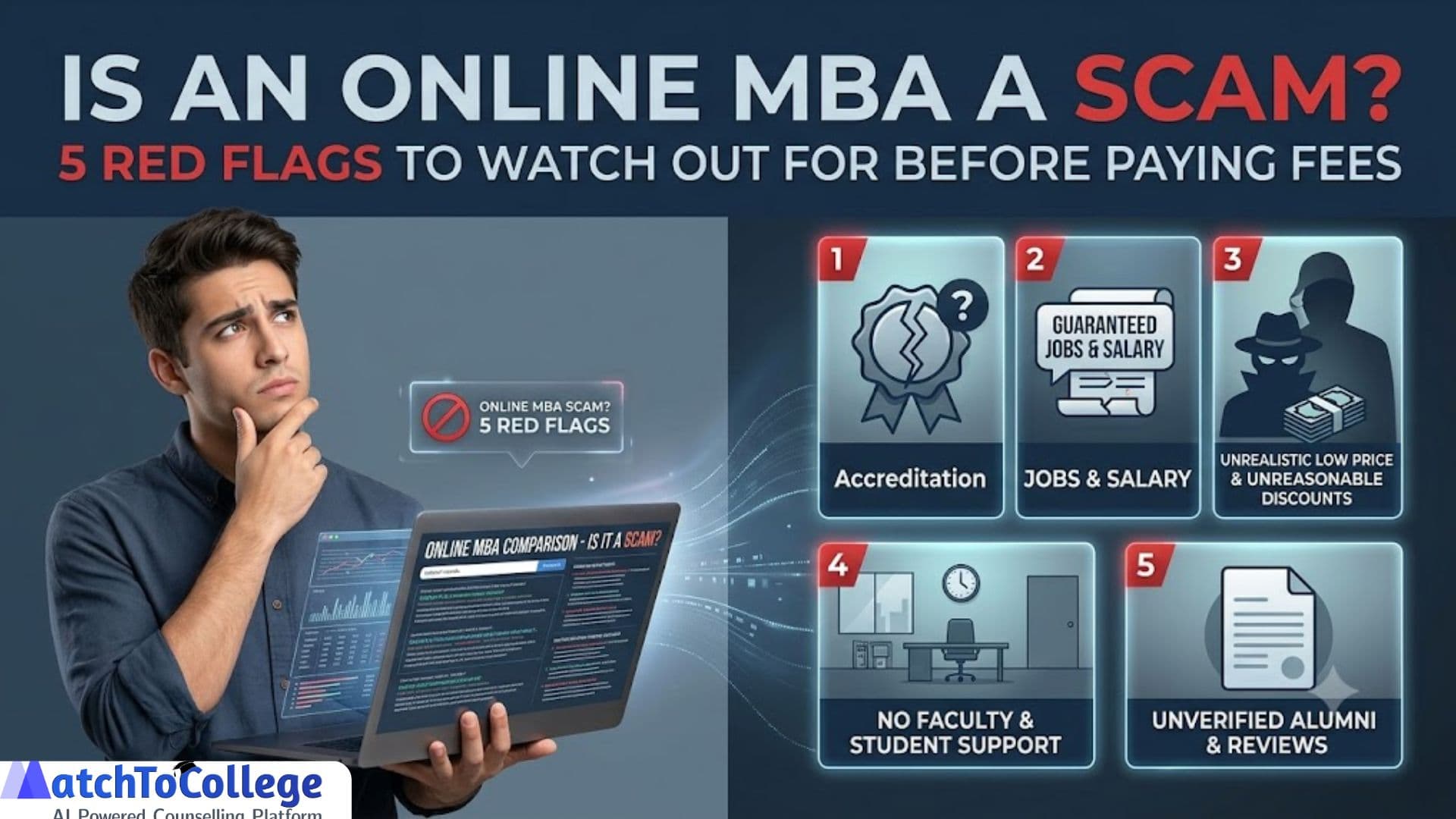
Man examines MBA red flags.
The idea that an Online MBA is a “scam” is not accurate in general. A better way to understand it is this: legitimate online MBAs exist, but low-quality or fake programs also exist.
Many reputed universities now offer fully accredited online MBA programs with real value, but the key is knowing how to separate genuine programs from risky ones.
Is an Online MBA a Scam?
| Reality | Explanation |
| Legitimate online MBAs | Offered by accredited universities with recognized degrees |
| Fake/dubious programs | Unrecognized institutions or “diploma mills” with no real value |
| Overall truth | Online MBA is valid, but quality varies widely |
How to Identify a Genuine Online MBA
Here are the most important warning signs and checks:
1. Check Accreditation (Most Important)
- Ensure approval from official bodies like UGC-DEB (India)
- Degree should be recognized for jobs and higher studies
- Avoid programs without clear accreditation details
2. Too-Good-To-Be-True Promises
Be cautious if a program claims:
- Guaranteed high salary placements
- Instant degrees in very short time
- “No study, just pass” structure
Real MBAs require effort and learning.
3. Lack of University Reputation
Check whether:
- The university is well-known or established
- It has a history in higher education
- It appears in rankings or official records
Unknown or newly created “institutions” can be risky.
4. Poor or Missing Academic Structure
A genuine MBA should include:
- Defined curriculum
- Assignments and exams
- Faculty interaction
- Learning management system (LMS)
If everything feels too simple or unclear, it’s a red flag.
5. Weak or No Career Support
Reliable programs usually offer:
- Placement assistance
- Career counseling
- Resume and interview support
- Industry exposure
If there is no career guidance at all, be cautious.
Myth and Reality
| Myth | Reality |
| Online MBA is a scam | False |
| Some online MBAs are low quality | True |
| Accreditation matters most | Absolutely true |
An online MBA is not a scam—it is a flexible and legitimate education option. The real risk comes from choosing the wrong provider. With proper research, you can find programs that are valuable, recognized, and career-boosting.
Smart Decision Support
Platforms like MatchToCollege help students:
- Verify program authenticity
- Compare accredited universities
- Evaluate ROI and career outcomes
- Avoid low-quality or unrecognized programs
Red Flag 1: Lack of Proper Accreditation
This is arguably the most critical red flag. A legitimate MBA program, whether online or on-campus, must be accredited by a recognized agency. For business programs, look for institutional accreditation (like regional accreditation in the U.S.) AND specialized accreditation from bodies like AACSB International, EQUIS, or AMBA. These accreditations signify that the program meets rigorous academic and quality standards. Absence of such accreditation, or reliance on obscure, unrecognised 'accreditors,' means your degree will likely be worthless to employers and other academic institutions. Always verify accreditation directly with the accrediting body, not just the institution's website.
Red Flag 2: Vague or Non-Existent Faculty Information
Who will be teaching you? Legitimate online MBA programs boast experienced, qualified faculty with strong academic credentials (Ph.D.s) and relevant industry experience. A transparent institution will readily display faculty bios, their qualifications, and areas of expertise. If a program's website features generic stock photos, lacks detailed faculty profiles, or lists instructors with questionable backgrounds, consider it a major warning sign. Your education quality directly depends on the expertise of your professors; don't settle for less.
Red Flag 3: Promises of Instant Admission or Guaranteed Outcomes
Real MBA programs, especially those with good reputations, have rigorous admission processes. They typically require GMAT/GRE scores (though some waive them for experienced professionals), essays, letters of recommendation, and interviews. Be extremely wary of programs that offer 'instant admission,' 'no entrance exam required for anyone,' or guarantee high-paying jobs immediately upon graduation. While career support is crucial, no reputable institution can guarantee specific job outcomes. Such promises often indicate a program more interested in collecting fees than delivering quality education or genuine career advancement.
Red Flag 4: Unclear or Exorbitantly Low/High Fees with Hidden Costs
Transparency in pricing is a hallmark of legitimate institutions. Watch out for online MBA programs with extremely low tuition that seems too good to be true, as it often is. Conversely, be cautious of programs with excessively high fees that don't align with the institution's reputation or the program's offerings. Scammers often use hidden fees, unclear payment structures, or pressure tactics to get you to commit quickly. A reputable program will provide a clear breakdown of all costs, including tuition, fees, books, and technology requirements, and will offer transparent financial aid information.
Red Flag 5: Poor or Non-Existent Student Support & Career Services
An online MBA should still offer robust support systems. This includes technical support for online platforms, academic advising, mental health resources, and crucially, comprehensive career services. A legitimate program invests in helping its graduates succeed, offering everything from resume workshops and interview coaching to networking events and alumni connections. If a program's website is vague about these services, or if student reviews highlight a severe lack of support, it's a strong indicator that the institution doesn't prioritize student success beyond collecting tuition.
Making an Informed Choice with MatchToCollege
Choosing an online MBA is a significant investment in your future. While the convenience and flexibility are attractive, vigilance against predatory practices is paramount. By carefully scrutinizing accreditation, faculty, admission processes, fee transparency, and student support, you can significantly reduce your risk of falling victim to an online MBA scam.
Don't navigate this complex landscape alone. MatchToCollege's AI-powered platform provides personalized guidance, helping you identify legitimate, high-value MBA programs that align with your career aspirations. We can help you verify program credentials, compare options, and make an informed decision that truly advances your professional journey. Explore your best MBA options with MatchToCollege today and secure a future built on a solid educational foundation.
Share this Article
FAQFrequently Asked Questions
Q: Are online MBAs as respected as traditional MBAs?
Yes, many online MBA programs from reputable and accredited universities are highly respected by employers. The key is to ensure the program has proper accreditation (e.g., AACSB), a strong curriculum, and qualified faculty, much like a traditional MBA. The delivery method (online vs. in-person) is becoming less critical than the quality and recognition of the institution itself.
Q: How can I verify if an online MBA program is accredited?
To verify accreditation, first identify the specific accrediting bodies mentioned by the institution (e.g., AACSB, regional accreditors like WASC, SACSCOC). Then, visit the official website of that accrediting body and use their search tools to confirm the institution and its programs are listed and in good standing. Do not solely rely on claims made on the institution's own website.
Get More Info About Online MBA Scam? 5 Red Flags Before You Pay Fees
Recommended Reading

Top Online Degrees for Govt Jobs in India (UGC Approved)
Discover UGC & DEB approved online degrees from top Indian colleges valid for government jobs. Your guide to flexible learning & career advancement!

Top Online B.Com, BCA, BBA Degrees in Kolkata 2024
Discover Kolkata's best online B.Com, BCA, and BBA degrees. Find UGC-approved programs, career prospects, and how MatchToCollege simplifies your admission journey.
Online MBA vs Regular: Why Pros Switch in 2026
Discover why ambitious working professionals are increasingly choosing Online MBA programs over traditional ones in 2026. Explore flexibility, cost, and career impact.