

New NAAC Framework 2026: BAF vs. Old RAF Explained
Admission & Info Tools
Need Expert Assistance?
Our counselors can help you with fee structures, eligibility guidelines, and upcoming admission cutoffs instantly.
Direct Application Tools
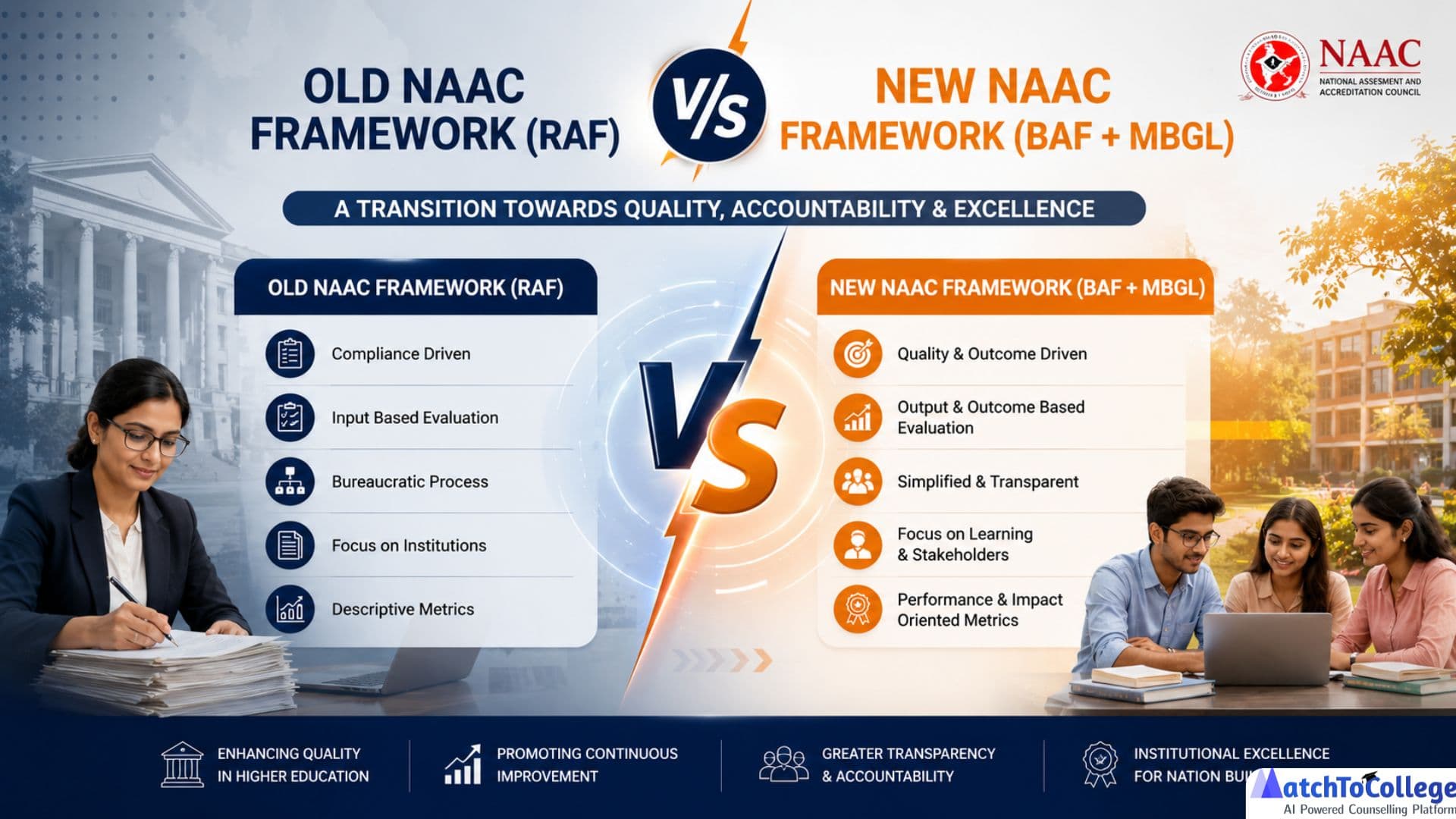
Old vs new NAAC framework comparison
Choosing the right college is one of the most important decisions in a student’s academic journey. While rankings and reputation matter, the quality of education and institutional standards are even more critical. In India, this quality is measured by the National Assessment and Accreditation Council (NAAC).
What is NAAC?
NAAC is India’s official body responsible for:
- Evaluating higher education institutions
- Assessing academic quality and infrastructure
- Accrediting colleges and universities based on performance
NAAC accreditation helps students and parents understand whether an institution meets national standards of education quality.
Why NAAC Accreditation Matters
| Factor | Why It Matters for Students |
| Academic quality | Ensures strong teaching and curriculum |
| Faculty standards | Indicates qualified and experienced teachers |
| Infrastructure | Reflects labs, libraries, and learning resources |
| Research output | Shows innovation and academic contribution |
| Student support | Covers placements, guidance, and services |
A higher NAAC grade generally signals a better learning environment and stronger institutional credibility.
NAAC Framework Change: What’s New in 2026?
The existing system, known as the Revised Accreditation Framework (RAF), is being replaced.
New System
NAAC will introduce a two-stage model:
| Stage | Name | Purpose |
| Stage 1 | Binary Accreditation Framework (BAF) | Basic eligibility check (Yes/No accreditation) |
| Stage 2 | Maturity-Based Graded Level (MBGL) | Detailed grading based on institutional growth and quality |
What This Change Means
The shift is not just procedural—it is a major transformation in how colleges are evaluated.
Key improvements include:
- More transparent evaluation system
- Focus on continuous institutional improvement
- Better alignment with National Education Policy (NEP 2020)
- Stronger emphasis on real educational outcomes
- More meaningful quality grading instead of only static scores
Why Students Should Care
If you are planning for:
- MBA programs
- Engineering degrees
- Medical courses
- Study abroad pathways
NAAC ratings will help you:
- Identify genuinely high-quality institutions
- Avoid low-performing colleges
- Make informed admission decisions
- Compare colleges more effectively
How MatchToCollege Helps You
MatchToCollege simplifies this evolving landscape by:
- Explaining updated NAAC frameworks in simple terms
- Helping you compare colleges based on quality metrics
- Matching you with institutions aligned to your goals
- Providing AI-driven college selection support
- Guiding you for MBA, Engineering, Medical, and global studies
The transition from RAF to BAF + MBGL (2026) marks a major step toward a more transparent and future-ready higher education system in India.
Understanding NAAC ratings is no longer optional—it is essential for making the right college choice and securing a strong academic future.
Understanding the Old NAAC Framework (RAF)
The Revised Accreditation Framework (RAF), introduced by NAAC in 2017, was designed to make college evaluation more transparent, structured, and data-driven. It played a major role in improving how higher education institutions in India are assessed.
Core Evaluation Criteria Under RAF
NAAC evaluated institutions based on seven key criteria:
| S. No. | Criterion | Focus Area |
| 1 | Curricular Aspects | Design and implementation of curriculum |
| 2 | Teaching-Learning and Evaluation | Quality of teaching and assessment methods |
| 3 | Research, Innovations and Extension | Research output and innovation activities |
| 4 | Infrastructure and Learning Resources | Campus facilities, labs, and libraries |
| 5 | Student Support and Progression | Guidance, placements, and student development |
| 6 | Governance, Leadership and Management | Institutional administration and leadership |
| 7 | Institutional Values and Best Practices | Ethics, inclusivity, and quality initiatives |
Evaluation Method Under RAF
RAF used a structured assessment model:
| Component | Weightage | Description |
| Self-Study Report (SSR) | 70% | Quantitative data submitted by institutions |
| Peer Team Visit (PTV) | 30% | On-site qualitative evaluation by experts |
Accreditation Outcome System
Based on performance, institutions received a Cumulative Grade Point Average (CGPA) and were assigned grades such as:
- A++
- A+
- A
- B++
- B+
- B
- C
- D (Not Accredited)
These grades helped students understand the overall quality level of an institution.
Strengths of RAF
- Improved transparency in evaluation
- Strong focus on data and documentation
- Standardized online submission system
- Clear grading structure for institutions
Limitations of RAF
Despite its improvements, RAF had certain gaps:
- Over-reliance on static grading systems
- Limited focus on continuous improvement
- More emphasis on inputs and processes rather than outcomes
- Less attention to institutional “growth maturity” over time
- Need for more dynamic, real-world performance evaluation
RAF helped establish a strong foundation for quality assessment in Indian higher education, but it also highlighted the need for a more outcome-based and evolving evaluation system, leading to future reforms in NAAC accreditation.
The RAF system was a major step forward in standardizing college quality assessment, but its limitations set the stage for newer frameworks that focus on continuous improvement and institutional maturity rather than static grading alone.
Introducing the New NAAC Framework (BAF + MBGL) 2026
To improve transparency and align with NEP 2020 reforms, NAAC is moving from the old RAF system to a two-stage accreditation model. This new system focuses more on continuous improvement and real outcomes, rather than static grades.
Overview of the New System
| Stage | Full Form | Purpose |
| Stage 1 | Binary Accreditation Framework (BAF) | Basic eligibility check |
| Stage 2 | Maturity-Based Graded Level (MBGL) | Detailed quality and progress evaluation |
Stage 1: Binary Accreditation Framework (BAF)
BAF is the first filter stage for all colleges and universities.
What it means:
Institutions are simply classified as:
- Accredited
- Not Accredited
What BAF checks:
- Basic infrastructure (labs, classrooms, libraries)
- Faculty qualifications
- Student enrollment strength
- Minimum academic standards
- Compliance with essential quality norms
Purpose:
To ensure every institution meets a minimum quality benchmark before moving to advanced evaluation.
Stage 2: Maturity-Based Graded Accreditation (MBGL)
Institutions that pass BAF move to the MBGL stage, which is a deeper and progressive evaluation system.
Key idea:
Instead of fixed grades, colleges are assessed on their level of maturity and growth over time.
Possible structure (conceptual):
| Level | Meaning |
| Level 1 | Basic compliance and functioning |
| Level 2 | Developing academic systems |
| Level 3 | Established quality teaching and research |
| Level 4 | Advanced innovation and strong outcomes |
| Level 5 | Highly mature, globally competitive institution |
What MBGL Evaluates
MBGL focuses on real outcomes and continuous improvement, including:
- Academic excellence and teaching quality
- Research output and innovation
- Student learning experience and success
- Industry collaboration and employability
- Societal and community impact
- Institutional growth over time
Why This New System Matters
Key improvements over RAF:
- More dynamic than static grading
- Focus on continuous improvement
- Better alignment with NEP 2020
- Strong emphasis on outcomes, not just inputs
- Encourages innovation and institutional growth
What It Means for Students
This new framework helps students:
- Identify truly improving institutions
- Understand long-term college quality, not just rankings
- Make more informed decisions for MBA, Engineering, Medical, and other programs
- Choose colleges based on real performance and outcomes
The BAF + MBGL system (2026) marks a major shift in Indian higher education quality assessment. It moves from simple grading to a progress-driven model that measures how institutions grow, improve, and deliver real-world impact over time.
Key Differences: RAF vs. BAF + MBGL
The transition from the Revised Accreditation Framework (RAF) to the new BAF + MBGL system is not just an update—it represents a complete redesign of how higher education quality is assessed in India.
1. Overall Approach
| Aspect | RAF (Old System) | BAF + MBGL (New System) |
| Structure | Single-stage evaluation | Two-stage evaluation |
| Process | Direct grading after assessment | First pass/fail, then maturity grading |
| Outcome | Static grade (CGPA-based) | Progressive maturity levels |
2. Evaluation Focus
| Area | RAF Focus | BAF + MBGL Focus |
| Assessment Type | Inputs + processes | Compliance + continuous improvement |
| Key Idea | What the institution has | How the institution is evolving |
| Outcome Orientation | Limited | Strong outcome-based evaluation |
3. Grading System
| Framework | Grading Style |
| RAF | CGPA-based grades (A++, A+, A, B++, etc.) |
| MBGL | Maturity levels (e.g., Level 1 to Level 5) |
Key Difference:
- RAF shows a fixed snapshot
- MBGL reflects a growth journey over time
4. Continuous Improvement
- RAF: Encouraged quality improvement but remained largely static in evaluation
- MBGL: Designed to actively measure and reward continuous institutional growth, innovation, and evolution
5. Alignment with NEP 2020
| NEP 2020 Principle | How New Framework Supports It |
| Flexibility | More adaptive evaluation model |
| Multidisciplinary education | Encourages broader academic development |
| Research & innovation | Strong focus in MBGL stage |
| Global standards | Benchmarking against international practices |
6. Transparency & Objectivity
| Aspect | RAF | BAF + MBGL |
| Transparency | High but single-layered | Higher due to separation of stages |
| Objectivity | Some subjectivity in grading | More structured and phased evaluation |
| Fairness | Moderate | Improved through clear compliance + maturity split |
The shift to BAF + MBGL represents a major transformation in NAAC’s philosophy—from awarding a static grade to tracking an institution’s continuous journey of quality, innovation, and academic maturity.
For students, this means a more reliable and future-focused way to evaluate colleges beyond traditional rankings and one-time scores.
What the New NAAC Framework Means for Students and Parents
The shift to the NAAC BAF + MBGL accreditation system is not just a policy update—it directly improves how students and parents evaluate colleges and universities.
1. Clearer Quality Understanding
The new system gives a two-layer clarity model:
| Stage | What It Ensures |
| BAF (Binary Accreditation Framework) | Basic quality check (Accredited / Not Accredited) |
| MBGL (Maturity-Based Grading Level) | Detailed quality and growth assessment |
Why this matters:
- BAF ensures minimum standards are met
- MBGL shows how strong and advanced the institution truly is
2. Strong Focus on Real Outcomes
The new framework shifts attention from basic inputs to real student success outcomes, such as:
- Learning effectiveness
- Employability and placements
- Research and innovation output
- Skill development and industry readiness
Key impact:
Colleges will focus more on career outcomes and practical learning, not just classroom teaching.
3. Better College Decision-Making
Students will be able to compare institutions more effectively:
| Indicator | Meaning |
| BAF status | Basic eligibility and quality compliance |
| Higher MBGL level | Stronger academic performance and continuous improvement |
| Lower MBGL level | Developing or improving institution |
Result:
More accurate and confident college selection decisions.
4. Higher Trust in Accreditation
The two-stage system improves transparency and reliability:
- Clear separation of basic eligibility and advanced evaluation
- Continuous improvement tracked over time
- Reduced confusion from single static grades
This builds greater trust in accreditation results.
5. What It Means for Students
For students and parents, the new system ensures:
- Easier identification of high-quality colleges
- Better understanding of long-term institutional performance
- More reliable guidance for MBA, Engineering, Medical, and Study Abroad choices
- Stronger alignment between education and career goals
The BAF + MBGL framework helps students move beyond traditional rankings and single grades. It offers a more transparent, outcome-focused, and future-oriented system for choosing the right college and building a successful academic and career path.
MatchToCollege: Your Partner in Navigating Higher Education
Understanding new education frameworks like NAAC’s BAF + MBGL system can feel complex, especially when you are focused on getting into top colleges for MBA, Engineering, Medical, or Study Abroad programs.
This is where MatchToCollege simplifies the entire process.
Turning Complex Rules into Simple Decisions
MatchToCollege uses AI and expert insights to convert complex accreditation data into clear, actionable guidance.
Instead of just showing rankings, it helps you understand:
- What a college’s NAAC status actually means
- How strong and future-ready an institution is
- Whether a college fits your academic and career goals
What MatchToCollege Helps You Do
1. Understand Accreditation Clearly
We explain:
- What BAF status means for basic quality assurance
- What MBGL levels indicate about institutional growth and maturity
- How accreditation impacts your learning experience and career outcomes
2. Get Personalized College Matches
Our AI analyzes your profile and suggests:
- Colleges aligned with your academic background
- Institutions matching your career goals
- Programs where you are more likely to succeed
We focus on:
- Accreditation strength
- Academic quality
- Career relevance
3. Make Future-Ready Decisions
With MBGL-based insights, you can identify:
- Institutions committed to continuous improvement
- Colleges investing in innovation and research
- Programs aligned with future job market demands
Why This Matters for Students
With MatchToCollege, you don’t just choose a college based on:
- Rankings
- Popularity
- Or assumptions
You make decisions based on:
- Real quality indicators
- Accreditation maturity levels
- Career outcomes and long-term value
The new NAAC system (BAF + MBGL) is reshaping how college quality is measured. MatchToCollege helps you decode this system and turn it into a smart, personalized college selection strategy.
Make informed choices. Choose better institutions. Build a stronger future with confidence.
Share this Article
FAQFrequently Asked Questions
Q: What is NAAC accreditation and why is it important?
NAAC (National Assessment and Accreditation Council) accreditation is a quality assurance process for higher education institutions in India. It's crucial because it certifies that a college or university meets certain standards of quality in teaching, research, infrastructure, and governance, helping students and parents make informed decisions about their academic future.
Q: Why is the NAAC framework changing in 2026?
The NAAC framework is changing to align with the National Education Policy (NEP 2020) and to introduce a more dynamic, robust, and outcome-based system for assessing institutional quality. The new BAF + MBGL framework aims for continuous improvement and a more nuanced evaluation of higher education institutions beyond static grades.
Q: What are BAF and MBGL in the new NAAC Framework?
BAF stands for Binary Accreditation Framework, which is the first stage where institutions receive a basic 'Accredited' or 'Not Accredited' status. MBGL stands for Maturity-Based Graded Accreditation, the second stage, which assesses 'Accredited' institutions on a progressive scale of maturity (e.g., Level 1 to Level 5), focusing on continuous quality enhancement and academic excellence.
Q: How does the new NAAC framework impact my college choice?
The new framework will provide clearer signals about college quality. BAF ensures a baseline, while MBGL will help you identify institutions committed to continuous improvement, cutting-edge research, and strong student outcomes. This enables more informed and confident decisions about where to pursue your higher education, aligning with your career aspirations.
Q: When will the new NAAC framework be fully implemented?
The new NAAC framework, encompassing BAF and MBGL, is targeted for full implementation by 2026. This transition period allows institutions to prepare for the updated assessment criteria and processes.
Get More Info About New NAAC Framework 2026
Recommended Reading

Best Online MBA Specializations for High-Paying Careers 2026
Discover the most lucrative online MBA specializations for 2026-27. Compare ROI, career growth, and use our AI tools to find your perfect management path.

Top Career Opportunities After an Online MBA in 2026-27
Discover high-paying career paths and roles after an online MBA in 2026-27. Explore salary trends, ROI, and tools to navigate your future professional success.

Tax Deductions on Higher Education: 2026-27 India Guide
Maximize your savings with our guide on tax deductions for higher education fees in India for FY 2026-27. Learn about Section 80C, 80E, and upskilling benefits.