

NEET UG 2026 Domicile Rules: State Quota Eligibility Guide
Admission & Info Tools
Need Expert Assistance?
Our counselors can help you with fee structures, eligibility guidelines, and upcoming admission cutoffs instantly.
Direct Application Tools
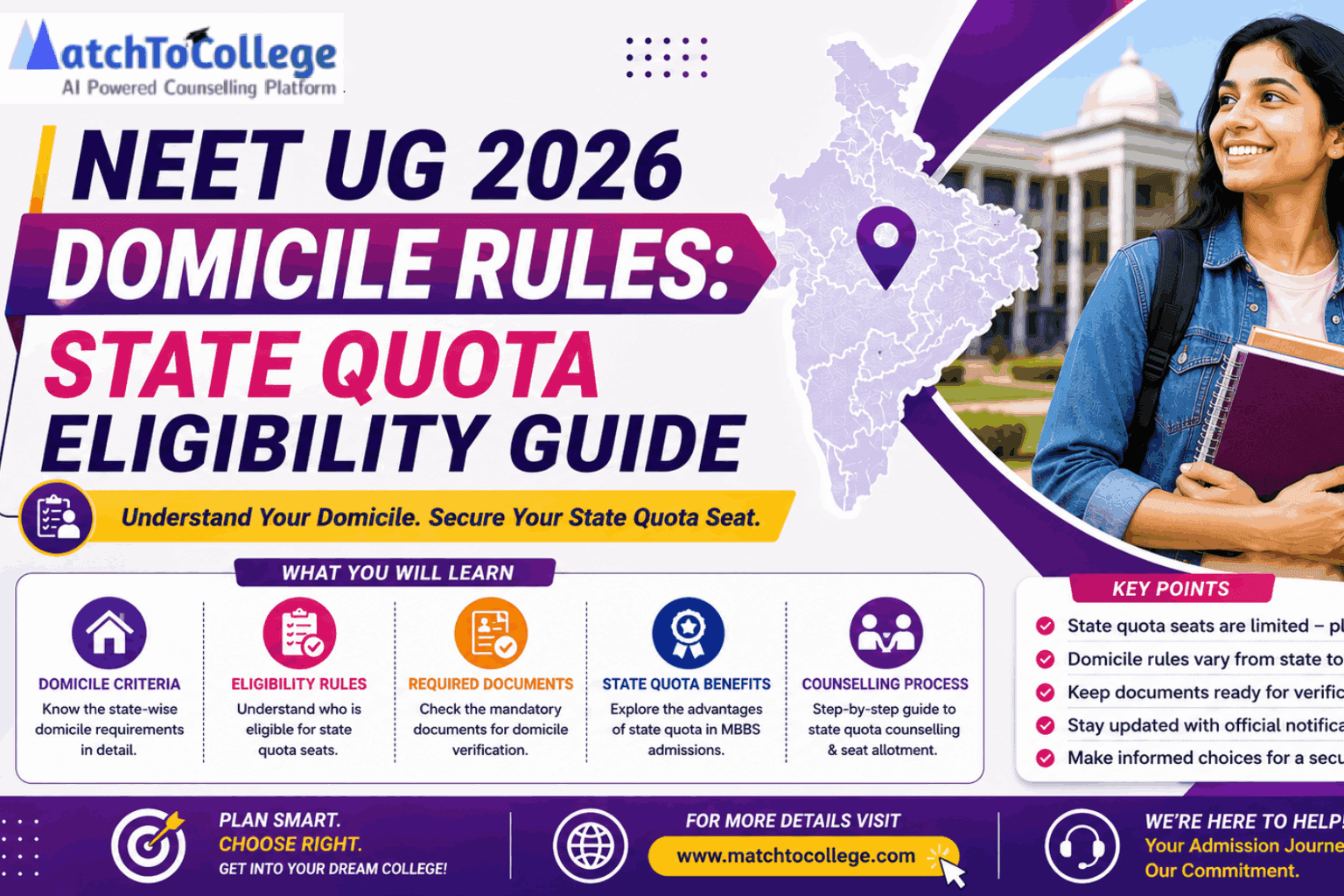
Decoding NEET UG 2026 Domicile Rules and State Quota Dynamics
As the National Eligibility cum Entrance Test (NEET) UG 2026 approaches, the tension among medical aspirants is palpable. While the exam itself is a Herculean task, the real strategy begins during the counselling phase. A common misconception among many students is that a high NEET score alone guarantees a seat in their preferred college.
However, the intricacies of the Indian medical admission system involve two primary gateways: the All India Quota (AIQ), which accounts for 15% of seats in government colleges, and the State Quota, which governs the remaining 85%. The most critical factor determining your eligibility for the latter is the 'Domicile Status'. Understanding domicile rules is not just a formality; it is a strategic necessity that can make or break your medical career dreams.
For many, the 85% State Quota is the most realistic path to securing a government medical seat because the cut-offs are generally lower than the AIQ cut-offs. But here is the catch—every state has its own unique set of rules to define who is a 'resident' or a 'domicile holder'. Some states require you to have completed your 10th and 12th education there, while others look at your parents' residency or the number of years you have lived in the state. To get a head start on your planning, you should Predict Your NEET 2026 Rank Instantly using our AI-driven tools to see where you stand globally before diving into state-specific strategies.
Once you have a projected rank, you can better assess your chances within your home state.
MatchToCollege aims to simplify this complex web of regulations. Whether you are aiming for top-tier institutions like KGMU Lucknow or local government medical colleges in Tamil Nadu, knowing whether you qualify for the state quota is paramount. Before the results are even announced, smart students utilize a NEET OMR Score Calculator to estimate their raw scores based on official answer keys.
This proactive approach allows families to gather the necessary legal documentation, such as domicile certificates, long before the frantic counselling season begins. In this guide, we will deep-dive into the nuances of domicile rules for 2026, the variation between 'Open' and 'Closed' states, and how to leverage your residency status to optimize your college choices.
Understanding the 85% State Quota vs. 15% AIQ
The Medical Counselling Committee (MCC) conducts the counselling for the 15% All India Quota, where any student from any state can compete for seats in government medical colleges across the country. However, the competition here is fierce as it draws the top-ranking students from the entire nation.
For the majority of aspirants, the 85% State Quota managed by respective state authorities offers a more accessible route. This quota is reserved exclusively for candidates who satisfy the domicile criteria of that particular state. Because the pool of candidates is restricted to residents only, the closing ranks for these seats are often significantly higher (meaning lower marks are required) compared to the AIQ.
For example, a student might not get a seat in a top Delhi college via AIQ with a rank of 5,000, but they might easily secure a seat in a reputable state college in West Bengal or Odisha with the same rank under the state quota. To visualize these probabilities, aspirants should use the NEET College Predictor.
This tool uses historical data and current trends to show you which colleges fall within your reach based on both AIQ and state-specific categories. Navigating these two parallel counselling processes requires a clear understanding of where your domicile certificate holds power. If you find that the competition in your home state is too high even for the state quota, it might be time to look at other avenues, such as MBBS Abroad opportunities where the admission criteria might be more flexible.
Always remember that your domicile status is your strongest legal asset in the medical admission journey; losing it due to lack of documentation or misunderstanding of rules can result in losing a year of hard work.
The Diverse Criteria of Domicile: State-by-State Breakdown
Domicile rules are not uniform across India; they are set by the state governments and are subject to change. Generally, domicile eligibility is categorized into three types: Birth Domicile, Property/Residence Domicile, and Educational Domicile. In states like Maharashtra, the rules are quite stringent.
You often need to have passed your 10th and 12th standards from an institution within the state. To check specific trends in high-demand states, you can look at the JEE College Predictor for Maharashtra (which provides insights into the state's educational landscape) or similar state-specific resources. Other states, like Uttar Pradesh, might consider you a domicile if your parents have lived there for a specific number of years, even if you studied elsewhere.
Conversely, some states are known as 'Open States.' This means they allow students from other states to apply for seats in their private medical colleges, though their government seats remain reserved for local residents. Karnataka and Chhattisgarh are often cited as open states. On the other hand, 'Closed States' like Gujarat or Punjab generally do not allow outsiders to even apply for private medical seats.
This makes the domicile certificate even more valuable in closed states. After the exam, keeping an eye on the NEET Result Checker is vital to see if you have met the minimum qualifying percentile required to participate in state counselling. Furthermore, if you are a student from Delhi, you should know that the domicile rules for IP University and Delhi University differ significantly, making tools like the IP University College Predictor essential for local aspirants.
Failure to prove domicile can lead to being moved to the general AIQ pool, where the cut-offs are substantially higher, often resulting in the loss of a government seat.
Documentation and Legal Verification: The Hidden Hurdle
Securing a high score is only half the battle; proving your residency is the other. The document verification process during NEET UG 2026 state counselling will be rigorous. Authorities typically require a Domicile Certificate issued by a Tehsildar or a District Magistrate. However, the supporting documents required to get this certificate can vary. You might need your birth certificate, parent’s residence proof (like Voter ID or Aadhar), or school-leaving certificates showing continuous education for 7 to 10 years in the state.
Many students realize too late that their documentation is incomplete, leading to disqualification from the state quota.
While preparing for medical exams, some students also keep engineering as a backup. If you are one of them, you might be familiar with the documentation required for the JAC Delhi College Predictor or other engineering portals; the domicile logic is often similar. However, for medical admissions, the stakes are higher. It is also wise to calculate the financial implications of your admission.
Use the Education Loan EMI Calculator to understand the potential debt if you end up in a private college due to domicile issues. Additionally, if you are confused about whether you are even on the right path, the Career Pathway Matcher can help you decide if a shift to related fields like Biotech or Pharmacy is a better fit for your profile. Ensure that your name, date of birth, and parent’s names match exactly across all documents—from your NEET admit card to your domicile certificate—to avoid technical rejection during the physical verification rounds.
The Impact of Domicile on Private College Admissions
While government colleges are the primary focus of domicile rules, private medical colleges are also deeply influenced by them. In many states, 50% of seats in private colleges are reserved as 'Government Quota' seats, which have much lower fees compared to 'Management Quota' seats.
These government quota seats in private institutions are usually reserved for state domicile candidates only. If you are a resident of a state like Telangana, you can use the TS EAMCET College Predictor to gauge the general competitiveness of the state's professional colleges, which often mirrors the medical seat competition. If you lack domicile in a state with many private colleges, you will be forced to apply through the Management Quota, where fees can be astronomical.
For those looking at the financial viability of their degree, our Online Courses ROI Calculator can be an eye-opener when comparing the cost of a private MBBS degree versus other high-paying career paths. Sometimes, the return on investment for a management seat in a private medical college is lower than expected, making other fields more attractive. If the financial burden seems too high, students often explore Online Courses or alternative degrees while they prepare for a second attempt at NEET.
Before making such a massive financial commitment, always ensure you have explored every possibility under your state domicile. The difference in fees between a state-quota seat and a management seat can be several lakhs per year, which is why verifying your domicile status early in 2026 is the smartest financial move a medical aspirant can make.
Strategic Planning: What to do if you have 'Dual Domicile'?
A rare but advantageous situation arises when a student might qualify for domicile in two states—for instance, being born in one state but completing schooling in another. However, NEET regulations and state laws are increasingly strict about this; most states require an affidavit stating that the candidate is not claiming domicile benefits in any other state for that academic year. Claiming dual domicile can lead to the cancellation of your candidature if discovered. Therefore, you must choose the state where you have the best statistical chance of admission.
By using a NEET 2026 Rank Predictor, you can compare the previous year's cut-offs of both states to see where your projected rank fits better.
Beyond medical, if your interests span across disciplines, you might also be looking at the CUET UG College Predictor for central university admissions. But for NEET, the choice is singular and high-stakes.
If you are unsure about the long-term prospects of your chosen path, tools like the Online Degree Passing Predictor can help you evaluate the difficulty and completion rates of various educational paths. In the end, the goal of NEET UG 2026 State Quota Counselling is to maximize your chances of getting the best possible medical education at the lowest possible cost.
Domicile rules are the primary tool to achieve this. Stay updated with the latest notifications from state medical directorates and keep your documents ready. Your residency isn't just where you live; it's your VIP pass to a government medical seat.
Share this Article
FAQFrequently Asked Questions
Q: Can I apply for State Quota in more than one state for NEET UG 2026?
Generally, no. Most states require an undertaking that you are not claiming domicile benefits in another state. Claiming multiple state quotas can lead to disqualification.
Q: What is the difference between an Open State and a Closed State in NEET counselling?
Open states allow students from other states to apply for seats in their private medical colleges. Closed states restrict private medical college admissions to their own domicile residents only.
Q: Does studying in a state for 10 years automatically give me domicile status?
Not necessarily. While many states use educational duration as a criterion, others may require parent residency, birth certificates, or property ownership. Always check the specific state's 2026 prospectus.
Q: What happens if I don't have a domicile certificate during counselling?
You will be considered ineligible for the 85% State Quota and will only be allowed to compete for the 15% All India Quota or Management Quota seats in private colleges.
Top Colleges Covered in this Blog


The Delhi Skill and Entrepreneurship University (DSEU) was established in August 2020 by the Government of NCT of Delhi to provide students with world-class skill education, enabling access to aspirational careers, fostering an entrepreneurial mindset, and promoting entrepreneurship. DSEU strives to create a win-win situation for both the youth and industry by addressing existing gaps in skill training. Drawing inspiration from the educational philosophies of thinkers like Mahatma Gandhi and Vinoba Bhave, DSEU seeks to integrate the hand, head, and heart for a balanced life and lifelong learning. The university emphasizes teaching both self-reliance for lifelong independence and the wisdom to nurture and value interdependence.
Total Fees
₹30K - ₹10.1L
Total Courses
15
Get More Info About NEET UG 2026 Domicile Rules
Recommended Reading

LBSIM Delhi & GIBS 2027 Admissions Open: Apply Online Now
LBSIM Delhi and GIBS Bangalore open 2027 admissions. Explore PGDM, MBA, and BBA application details, early bird offers, and WBJEE/TNEA 2026 counseling updates.

Best Online MBA Specializations for High-Paying Careers 2026
Discover the most lucrative online MBA specializations for 2026-27. Compare ROI, career growth, and use our AI tools to find your perfect management path.

Top Career Opportunities After an Online MBA in 2026-27
Discover high-paying career paths and roles after an online MBA in 2026-27. Explore salary trends, ROI, and tools to navigate your future professional success.