

NEET Eligibility for MBBS Abroad: Latest NMC Rules 2026-27
Admission & Info Tools
Need Expert Assistance?
Our counselors can help you with fee structures, eligibility guidelines, and upcoming admission cutoffs instantly.
Direct Application Tools
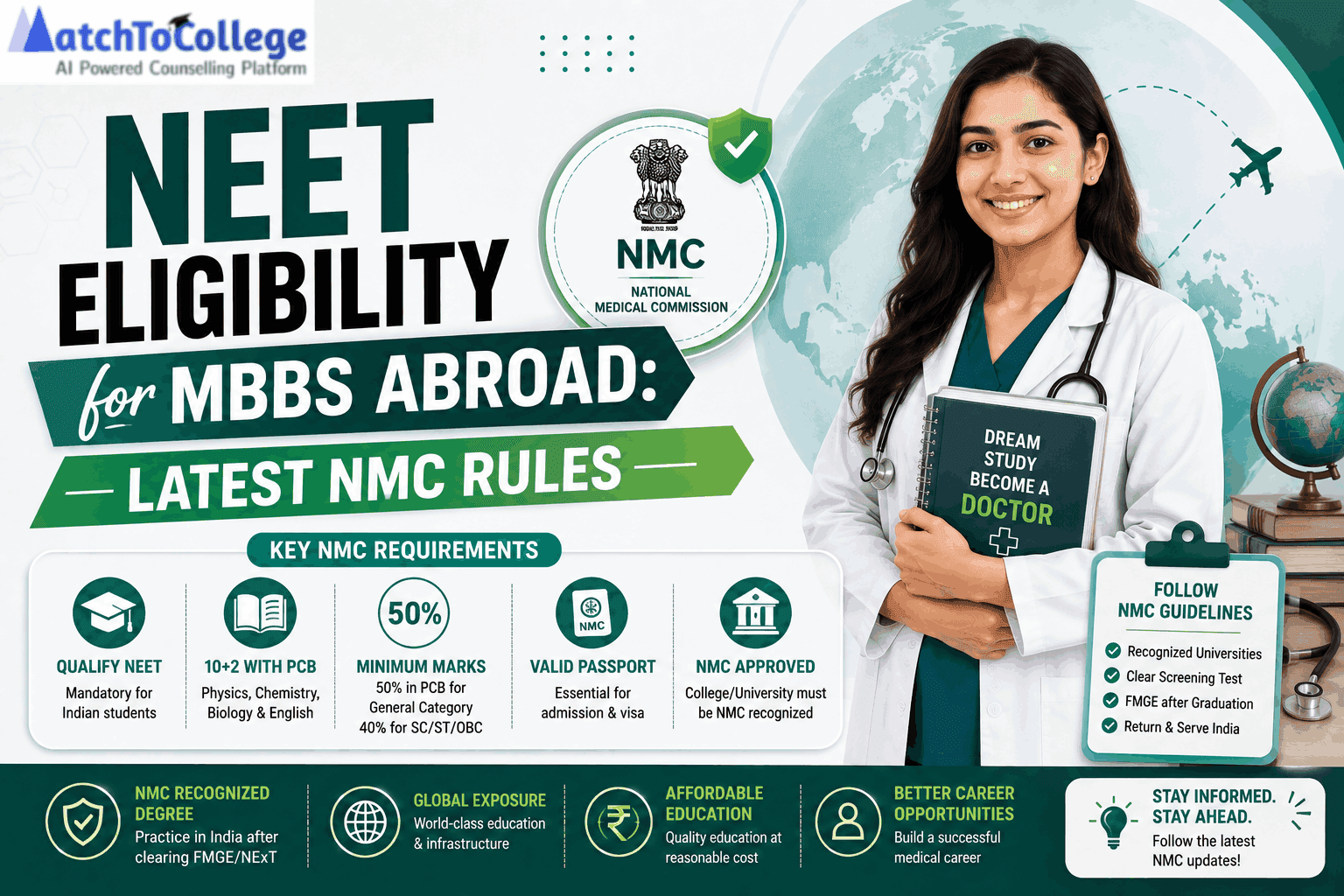
In the rapidly evolving landscape of medical education, the year 2026-27 has brought significant clarity and stricter enforcement regarding the NEET eligibility for MBBS abroad. For thousands of Indian medical aspirants who find the domestic competition for government seats overwhelming, pursuing a medical degree overseas is a lucrative and viable alternative.
However, the National Medical Commission (NMC) has streamlined the process through the Foreign Medical Graduate Licensure (FMGL) Regulations, making it mandatory for every student to qualify for the National Eligibility cum Entrance Test (NEET-UG) before flying abroad. The 2026-27 academic session marks a pivotal era where documentation, score validity, and university selection are under closer scrutiny than ever before.
If you are planning your journey, you must first assess where you stand. Using a tool like the NEET College Predictor can help you understand your domestic options before committing to an international path. Furthermore, for those aiming for the upcoming cycle, you can Predict Your NEET 2026 Rank Instantly to stay ahead of the competition.
The NMC has made it clear: without a valid NEET qualification, your foreign medical degree will hold zero value in India, effectively barring you from practicing medicine at home. This guide provides an exhaustive breakdown of the latest rules, regulatory updates, and the essential tools you need to navigate this high-stakes transition.
The Mandatory NEET Qualification Rule for 2026-27
The core of the NMC rules for MBBS abroad revolves around the mandatory qualification of the NEET-UG exam. As per the latest Gazette notifications for the 2026-27 cycle, any Indian citizen or Overseas Citizen of India (OCI) intending to pursue a primary medical qualification from a university outside India must qualify for NEET.
The qualifying marks are typically the 50th percentile for General category students and the 40th percentile for SC/ST/OBC candidates. It is crucial to note that simply appearing for the exam is not enough; you must secure the minimum qualifying cutoff score as declared by the NTA for that specific year.
To ensure your calculations are precise during the result season, the NEET OMR Score Calculator is an invaluable resource for students to cross-verify their responses against official keys.
Furthermore, the NMC has clarified the validity period of these scores. For students going abroad, a NEET-UG qualifying score is valid for a period of three years from the date of result declaration.
This provides a safety net for students who might take a gap year or face visa delays. However, the eligibility certificate, which was previously a separate document, is now legally substituted by the NEET result sheet itself. Before you finalize your admission, ensure you check your standing with the NEET Result Checker.
Failing to meet these criteria means you will not be allowed to sit for the National Exit Test (NEXT), which is replacing the FMGE, upon your return to India. This effectively renders your international degree unusable for clinical practice in the Indian healthcare system.
FMGL Regulations 2026: Course Duration and Medium of Instruction
The NMC's Foreign Medical Graduate Licensure (FMGL) Regulations have set strict parameters for what constitutes a 'valid' foreign medical degree. For the 2026-27 intake, the NMC mandates that the entire course must be conducted in the English language.
This has led to a significant shift in student preferences, moving away from non-English speaking tracks in countries like Russia or China unless they offer fully English-medium programs. Additionally, the course duration must be a minimum of 54 months (4.5 years), followed by a mandatory internship of 12 months in the same foreign medical institution.
If you are exploring options, our MBBS Abroad listing page provides a curated list of universities that strictly adhere to these NMC norms.
Another critical update involves the curriculum. The foreign university's curriculum must be equivalent to the MBBS curriculum prescribed by the NMC in India.
This includes mandatory subjects and clinical clerkships. Students are often confused about whether their chosen path aligns with their long-term goals. Using the Are You on the Right Path to Your Dream Career? tool can help students evaluate if an international medical degree aligns with their specific career aspirations.
Moreover, the NMC now requires that the foreign medical practitioner's license obtained in the country of study must be valid for at least 10 years, ensuring that the graduate is eligible to practice in the country where they studied before seeking registration in India. This 'rule of equivalence' is designed to protect the quality of healthcare professionals entering the Indian medical workforce.
The NEXT Exam and Clinical Internship Requirements
The transition from the Foreign Medical Graduate Examination (FMGE) to the National Exit Test (NEXT) is perhaps the most significant change affecting students in 2025 and 2026.
NEXT will serve as a common qualifying final year MBBS exam, a licentiate exam to practice medicine in India, and an entrance exam for postgraduate (PG) seats. Foreign Medical Graduates (FMGs) must clear NEXT Step 1 and Step 2 to register with the State Medical Councils or the National Medical Commission.
For those who are also considering alternative paths in engineering or other sciences, it's worth checking out the JEE Main Rank Predictor to compare competitive standings across different fields.
Regarding internships, the rules have become more stringent. After returning to India and clearing NEXT Step 1, FMGs must undergo an additional 12-month Compulsory Rotating Medical Internship (CRMI) in India.
This is in addition to any internship completed abroad. This 'double internship' requirement is a crucial factor in financial and time planning. If you are worried about the long-term financial commitment, you should use the Education Loan EMI Calculator to plan your budget.
Many students also find it helpful to Calculate Your University ROI Compare to see if the high cost of foreign education and the long duration of internships justify the eventual salary prospects of an MD or MBBS graduate in India.
Navigating Admissions: Documentation and Age Criteria
To be eligible for NEET-UG and subsequent admission to MBBS abroad in 2026, candidates must have completed 17 years of age by December 31st of the year of admission.
You can verify your exact eligibility using the Age Calculator. Academically, the candidate must have passed 10+2 with Physics, Chemistry, Biology/Biotechnology, and English. A recent 2026-27 update from the NMC now allows students who had Biology as an additional subject to also be eligible for NEET, a major relief for many. However, the aggregate marks in PCB must be at least 50% for General and 40% for Reserved categories.
To ensure your percentages are calculated correctly, especially when dealing with different grading scales, the CGPA to Percentage Calculator is highly recommended.
Students must also be wary of the 'transcripts' and conversion of units during their application process. Some European universities require measurements in different units; for instance, height or physical requirements might need an Inch to Centimeter Calculator. Furthermore, when dealing with international tuition fees often quoted in millions of local currency, students frequently use the Million to Crore Calculator or the Million to Lakhs Calculator to understand the real-world cost in Indian Rupees.
Ensuring every piece of documentation—from your BMI (often required for medical fitness certificates) to your 12th-grade transcripts—is accurate is the first step toward a successful international medical career.
Alternative Careers and Domestic Backups
While MBBS abroad is a popular choice, the increasing difficulty of the NEXT exam and the strict NMC regulations lead many students to explore domestic backups in other high-growth fields. If your NEET scores aren't quite where you want them, you might explore the Domestic Colleges section to find top-tier private institutions in India.
Alternatively, many students are pivoting toward B.Tech or Data Science. If you've also appeared for engineering entrance exams, the JoSAA College Predictor and the JEE Main College Predictor are essential tools to see which NITs or IIITs you might qualify for. For students in specific states, specialized tools like the TS EAMCET College Predictor or the Maharashtra JEE College Predictor offer localized insights.
Additionally, the rise of specialized management in healthcare has made the CAT College Predictor a relevant tool for medical students looking to transition into Hospital Administration or Pharma Management via an MBA. For those considering a purely academic or research-oriented path, exploring the CUET UG College Predictor can open doors to top central universities.
The key is to remain flexible and use data-driven tools to make informed decisions. Whether it's medicine, engineering, or management, MatchToCollege offers a comprehensive suite of resources, including the Online Degree Passing Predictor, to ensure that whatever path you choose, you have a high probability of success.
Share this Article
FAQFrequently Asked Questions
Q: Is NEET mandatory for MBBS abroad in 2026-27?
Yes, as per NMC regulations, every Indian student must qualify for NEET-UG to be eligible for an MBBS degree from a foreign university if they wish to practice in India.
Q: What is the validity of the NEET score for foreign medical admission?
The NEET qualifying score is valid for three years for students seeking admission to MBBS programs abroad.
Q: Can I practice in India after doing MBBS abroad without NEXT?
No. All Foreign Medical Graduates (FMGs) must pass the National Exit Test (NEXT) and complete a mandatory internship in India to obtain a license to practice.
Q: What is the minimum duration for an MBBS course abroad according to NMC?
The course must have a minimum duration of 54 months of theoretical and clinical study, plus a 12-month internship at the same institution.
Get More Info About NEET Eligibility for MBBS Abroad
Recommended Reading

LBSIM Delhi & GIBS 2027 Admissions Open: Apply Online Now
LBSIM Delhi and GIBS Bangalore open 2027 admissions. Explore PGDM, MBA, and BBA application details, early bird offers, and WBJEE/TNEA 2026 counseling updates.

Best Online MBA Specializations for High-Paying Careers 2026
Discover the most lucrative online MBA specializations for 2026-27. Compare ROI, career growth, and use our AI tools to find your perfect management path.

Top Career Opportunities After an Online MBA in 2026-27
Discover high-paying career paths and roles after an online MBA in 2026-27. Explore salary trends, ROI, and tools to navigate your future professional success.