

MS in CS & AI in USA 2026-27: Timeline, GRE & Costs
Admission & Info Tools
Need Expert Assistance?
Our counselors can help you with fee structures, eligibility guidelines, and upcoming admission cutoffs instantly.
Direct Application Tools
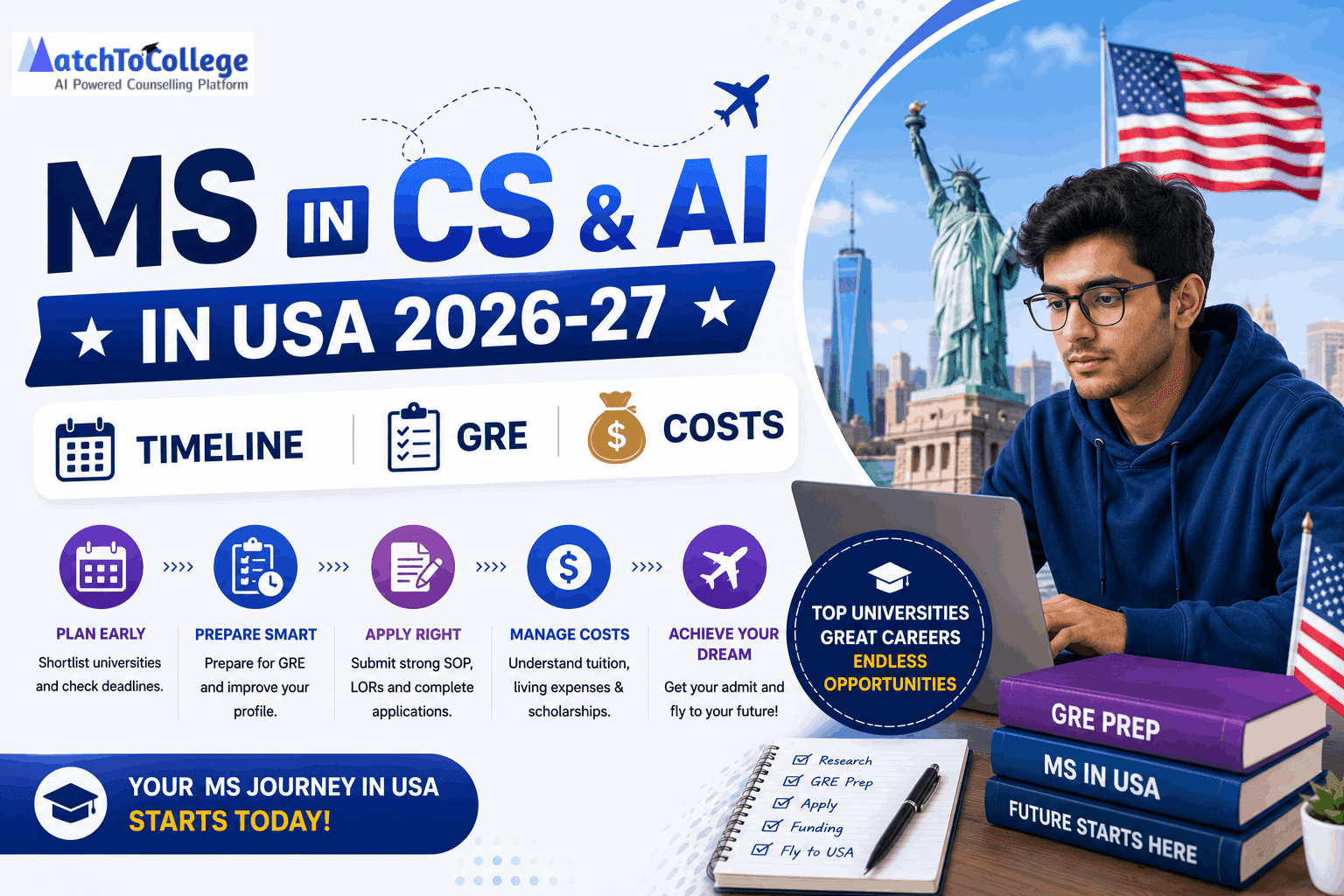
The landscape of higher education is undergoing a seismic shift, driven primarily by the rapid advancement of Artificial Intelligence (AI). For students eyeing a Master of Science (MS) in Computer Science or AI in the United States for the 2026-27 academic year, the stakes have never been higher.
The USA remains the global epicenter for technological innovation, boasting a unique ecosystem where academia and industry collaborate to push the boundaries of what is possible. With the emergence of Generative AI, Large Language Models (LLMs), and autonomous systems, the demand for high-level technical expertise is skyrocketing. However, securing a seat at a top-tier American university requires more than just high grades; it demands a strategic, multi-year plan that aligns your academic profile with the evolving requirements of the Fall 2026 intake.
As an AI-powered counseling platform, MatchToCollege recognizes that the journey to a US graduate degree is complex. The 2026-27 cycle is expected to be one of the most competitive yet, as global interest in STEM (Science, Technology, Engineering, and Mathematics) fields continues to surge. Prospective students must navigate a maze of standardized tests, financial planning, and rigorous documentation.
This guide serves as your definitive roadmap, providing granular details on the application timeline, realistic GRE score expectations, and a comprehensive breakdown of living costs in the current economic climate. Whether you are aiming for the Ivy League or specialized research institutions in Silicon Valley, understanding the nuances of the US admissions process is the first step toward your professional success.
In the following sections, we will delve into the critical milestones you need to hit starting from mid-2026. We will also address the 'GRE-optional' trend and clarify where a high score remains a non-negotiable asset. Furthermore, we provide updated financial projections for 2026-27, accounting for inflation and the rising costs of housing in major tech hubs. By the end of this article, you will have a clear, actionable strategy to transform your aspirations into a reality at a premier American university.
Curating a High-Impact Profile for AI Specializations
With AI becoming the most competitive specialization within Computer Science, a generic application is no longer enough. To stand out in the 2026-27 application pool, you must demonstrate a deep, hands-on engagement with the field. This goes beyond just taking online courses. Admissions committees look for evidence of research contributions, such as papers published in reputable journals or presented at conferences like NeurIPS, ICML, or CVPR.
Even if you don't have a publication, a well-documented GitHub repository featuring original AI projects—such as a custom transformer model or a computer vision application—can serve as a powerful 'technical portfolio.'
Work experience also plays a critical role.
If you have been working as a Software Engineer or Data Scientist, highlight how you have applied AI/ML to solve real-world problems. Quantifiable results, like 'improved model accuracy by 15%' or 'reduced latency in data processing by 30%,' resonate strongly with admissions officers. Additionally, the Statement of Purpose (SOP) must be tailored.
Avoid clichés about loving computers since childhood; instead, discuss specific problems in AI you wish to solve, such as AI ethics, explainable AI, or the integration of AI in healthcare. Mentioning specific faculty members at the target university whose work aligns with yours demonstrates that you have done your homework and are a serious candidate.
Why MatchToCollege is Your Best Ally for 2026-27 Admissions
The road to a US Master's degree is paved with data, deadlines, and decisions. MatchToCollege simplifies this journey by leveraging AI to match your unique profile with the universities where you have the highest probability of acceptance. Our platform analyzes thousands of data points—including historical GRE cutoffs, GPA trends, and successful SOP structures—to provide you with a personalized roadmap.
In an era where AI is transforming education, it only makes sense to use an AI-powered tool to navigate your academic future.
Beyond university matching, MatchToCollege offers insights into the shifting labor market for AI professionals in the USA. We provide data on which universities have the strongest ties to the industry and which regions are seeing the highest growth in AI-related job openings.
As you prepare for the 2026-27 cycle, our resources will help you stay ahead of the curve, ensuring that your application is not just another file in the pile, but a compelling narrative of a future tech leader. Start your journey today by creating a profile and letting our algorithms guide you to the perfect campus.
Share this Article
FAQFrequently Asked Questions
Q: What is the ideal GRE score for MS in AI in the USA for 2026?
For top-tier universities, aim for a Quantitative score of 167-170 and a Verbal score of 155+. For mid-tier universities, a Quant score of 160+ is generally acceptable.
Q: Is the GRE mandatory for MS in Computer Science in 2026-27?
It varies. Many schools are now test-optional, but many elite programs still recommend or require it for international students to validate their technical readiness.
Q: How much does it cost to live in the USA as a student in 2026?
Living costs range from $1,200 to $2,800 per month depending on the city. High-tech hubs like San Francisco and New York are on the higher end of that spectrum.
Q: When should I start my application for Fall 2026?
Ideally, you should start preparing 15 months in advance (June 2026) to allow time for testing, profile building, and drafting documents.
Get More Info About MS in CS & AI in USA 2026-27
Recommended Reading
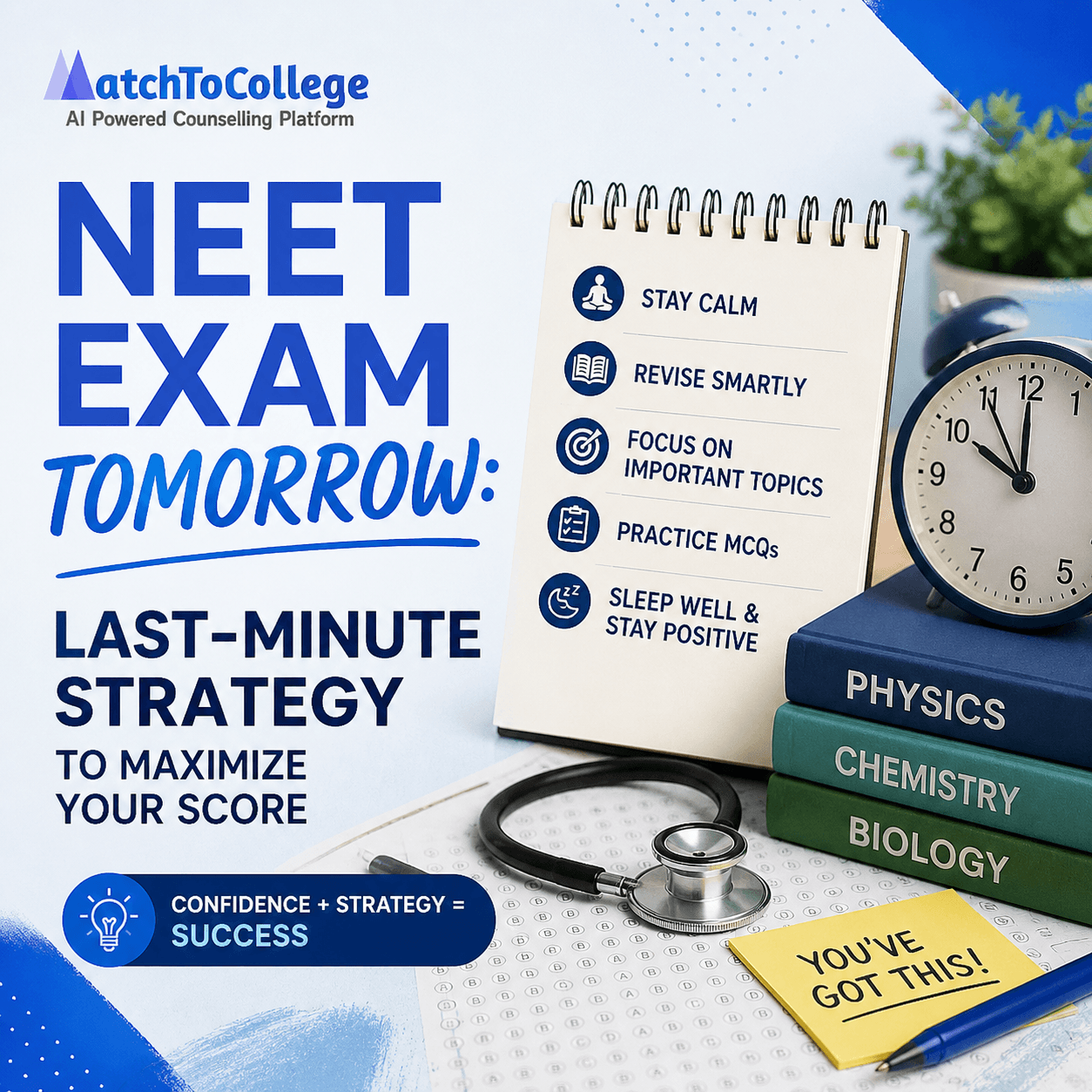
NEET Exam Tomorrow: Last-Minute Strategy to Maximize Your Score
NEET is tomorrow—here’s your complete last-day strategy covering revision, exam hall tips, and mistakes to avoid for maximum accuracy and performance.
GATE Previous Year Question Papers with Official Answer Keys (2007–2026) – Download PDF by Branch
Download official GATE previous year question papers with answer keys PDF from 2007 to 2026. Access branch-wise question papers for Computer Science (CS), Data Science (DA), Mechanical (ME), Electronics (EC), Electrical (EE), and Civil (CE) by IIT Madras.
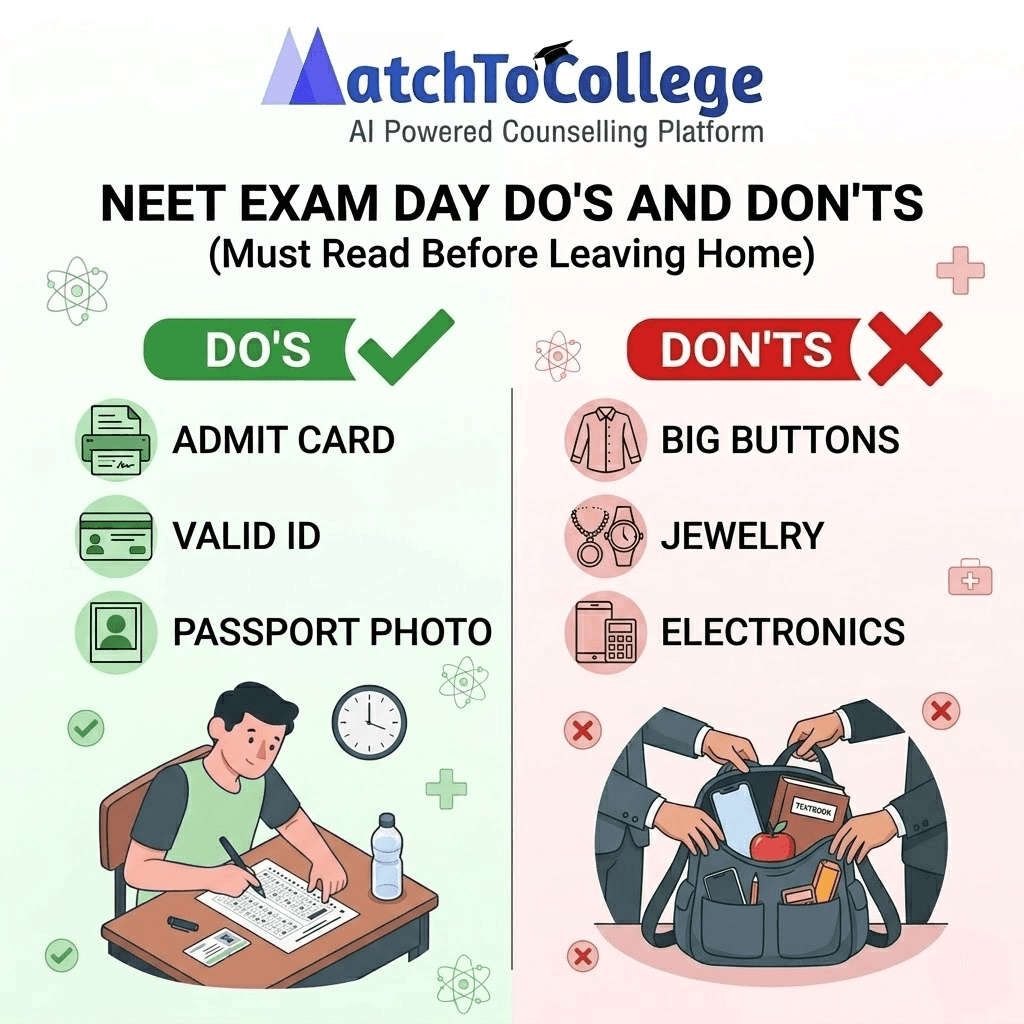
NEET Exam Day Do’s and Don’ts (Must Read Before Leaving Home)
Students appearing for the National Eligibility cum Entrance Test (NEET) must follow strict exam day guidelines set by the National Testing Agency. From required documents and dress code to prohibited items, this guide covers the most important NEET exam day do’s and don’ts to help candidates avoid last-minute problems at the exam center.