

MBBS vs BDS vs BAMS vs BHMS: Which Medical Path is Best?
Admission & Info Tools
Need Expert Assistance?
Our counselors can help you with fee structures, eligibility guidelines, and upcoming admission cutoffs instantly.
Direct Application Tools
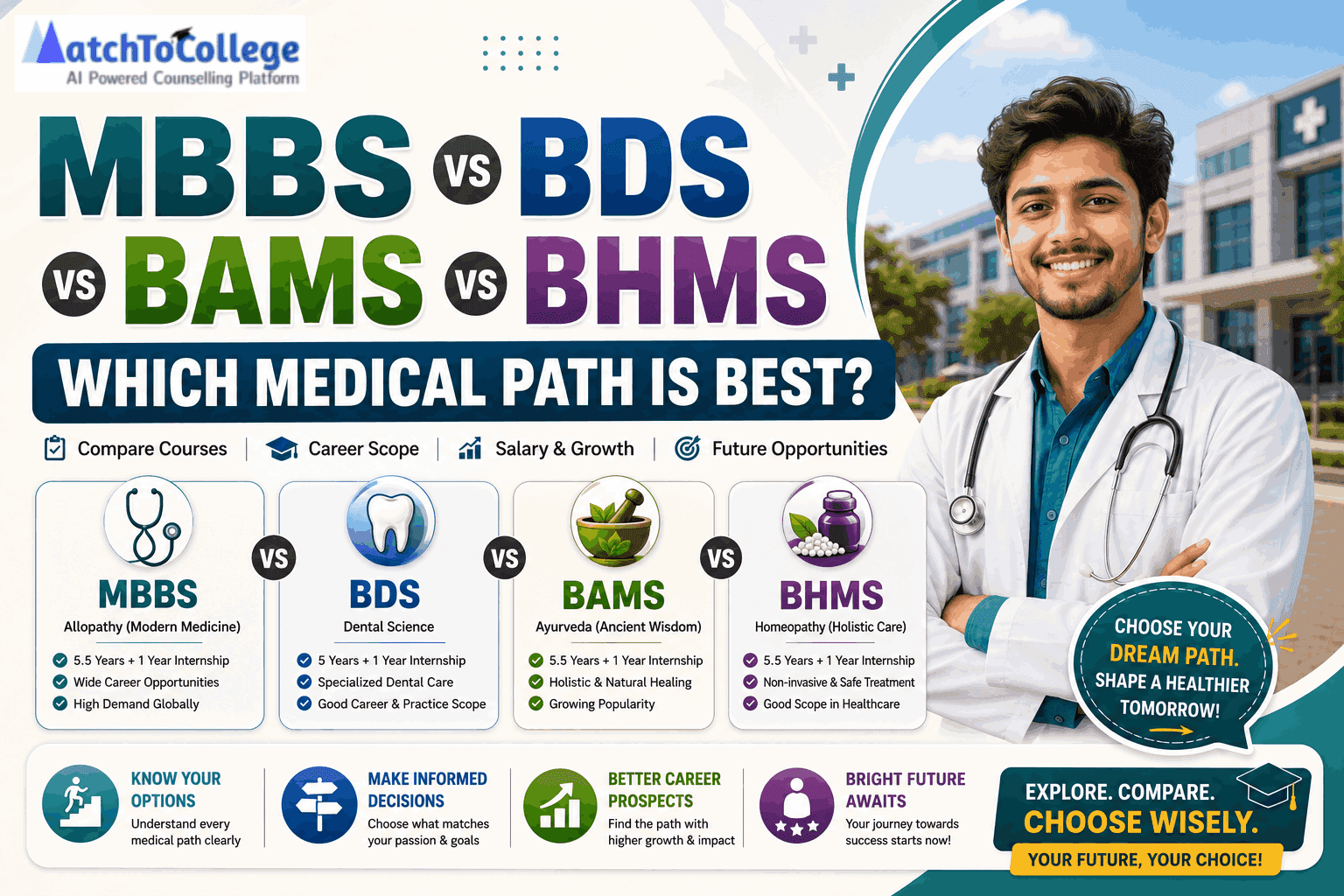
Deciding your career path after completing Class 12 with Biology is perhaps one of the most critical decisions of your life. For most medical aspirants in India, the journey starts with the National Eligibility cum Entrance Test (NEET). However, the competition is fierce.
While MBBS remains the most sought-after degree, BDS, BAMS, and BHMS offer equally rewarding and specialized career paths. Understanding the fundamental differences between these courses is essential for every student. Whether you are aiming for clinical practice, research, or administrative roles in healthcare, each of these degrees has a unique curriculum and professional trajectory. At MatchToCollege, we aim to simplify this complex decision-making process by providing data-driven insights and AI-powered tools.
Before diving deep into the comparison, it is crucial to know where you stand in the competitive landscape. You can use our Predict Your NEET 2026 Rank Instantly tool to estimate your standing.
Furthermore, if you have recently appeared for the exam or are practicing with mock tests, our NEET OMR Score Calculator can help you verify your accuracy. This blog will break down MBBS, BDS, BAMS, and BHMS based on their duration, core subjects, difficulty level, and career prospects to help you find the best fit for your medical aspirations.
MBBS: Bachelor of Medicine, Bachelor of Surgery
MBBS is widely considered the gold standard of medical education in India and abroad. It focuses on Allopathic medicine, involving the study of human anatomy, physiology, biochemistry, pharmacology, and clinical procedures.
The course duration is 5.5 years, which includes 4.5 years of academic study followed by a mandatory 12-month rotatory internship. Admission to MBBS is strictly based on NEET scores, and the cutoffs for government medical colleges are notoriously high. Students who successfully complete their MBBS are eligible to practice as General Physicians or pursue postgraduate specializations (MD/MS).
The career scope for MBBS graduates is vast. From working in government hospitals to setting up private clinics or joining the corporate healthcare sector, the opportunities are endless. However, the path is rigorous.
Students must be prepared for long hours of study and intense clinical rotations. If you find the cutoffs in India too high, many students consider looking beyond borders. You can explore our dedicated section on MBBS Abroad to find quality universities with more accessible admission criteria. Additionally, to see which Indian colleges you might qualify for based on your scores, check the NEET College Predictor.
Beyond clinical practice, MBBS graduates often find lucrative roles in hospital administration, clinical research, and even public health policy. With the integration of technology, AI-driven diagnostics are becoming a reality, and MBBS doctors are at the forefront of this revolution.
If you are worried about the financial aspects of such a long course, our Education Loan EMI Calculator can help you plan your finances effectively, ensuring that your dream of becoming a doctor isn't hindered by budget constraints.
BDS: Bachelor of Dental Surgery
If your interest lies in oral healthcare, then BDS is the right choice. It is the second most popular medical course in India. The program spans 5 years, including 4 years of classroom learning and 1 year of internship. BDS focuses specifically on the prevention, diagnosis, and treatment of diseases related to the teeth, gums, and other parts of the oral cavity.
Unlike the broad scope of MBBS, BDS is highly specialized from the very beginning. Students learn about dental materials, oral pathology, and oral surgery.
Many students choose BDS because it offers a better work-life balance compared to the often grueling hours of a general physician. After graduation, you can start your own dental clinic, work in hospitals, or pursue a Master of Dental Surgery (MDS) in various specializations like Orthodontics or Endodontics. If you are unsure if dentistry aligns with your long-term goals, use our Are You on the Right Path to Your Dream Career? tool to analyze your personality and professional interests.
The rise in dental awareness and cosmetic dentistry has significantly boosted the demand for skilled dentists. From smile makeovers to dental implants, the field is evolving rapidly. While the initial setup cost for a dental clinic can be high, the Return on Investment (ROI) is generally favorable.
To compare the potential financial outcomes of different medical paths, you can use our Calculate Your University ROI Compare tool. This will give you a clearer picture of the earnings potential versus the tuition fees of various dental colleges listed in our domestic colleges directory.
BAMS: Bachelor of Ayurvedic Medicine and Surgery
BAMS is a professional degree that integrates traditional Ayurvedic principles with modern medical sciences. With the Indian government’s increasing focus on the AYUSH (Ayurveda, Yoga and Naturopathy, Unani, Siddha, and Homeopathy) sector, BAMS has gained significant traction.
The course duration is 5.5 years, including a one-year internship. BAMS covers subjects like Kriya Sharir (Physiology), Rachana Sharir (Anatomy), and Shalya Tantra (Surgery), alongside modern medicine modules.
BAMS graduates are recognized as medical practitioners in many Indian states and can work in both government and private hospitals. The holistic approach of Ayurveda is finding global acceptance, leading to opportunities in wellness centers, pharmaceutical companies, and research. For students who want to bridge the gap between ancient wisdom and modern science, BAMS is an excellent choice.
To stay updated on the latest admission trends for these courses, visit our NEET Result Checker page regularly.
One of the biggest advantages of BAMS is the relatively lower competition compared to MBBS, yet it offers the status of a 'Doctor.' Many BAMS practitioners also pursue specialized certificates in modern medicine to enhance their clinical practice.
If you are weighing the benefits of BAMS versus other degrees, consider using the Career Pathway Matcher. This tool helps you understand if your aptitude aligns more with the holistic nature of BAMS or the surgical precision of BDS or MBBS. Also, check the Age Calculator to ensure you meet the eligibility criteria for the current admission cycle.
BHMS: Bachelor of Homeopathic Medicine and Surgery
BHMS focuses on the homeopathic system of medicine, which is based on the principle of 'Similia Similibus Curentur' (Like Cures Like). Like MBBS and BAMS, this is also a 5.5-year course. BHMS students study anatomy, physiology, and pathology, but their specialized training focuses on homeopathic pharmacy, material medica, and the repertory.
Homeopathy is widely practiced in India for chronic conditions and is preferred by patients looking for non-invasive treatments with minimal side effects.
BHMS doctors can practice in private clinics, work in homeopathic hospitals, or join the research departments of pharmaceutical firms. The demand for homeopathic treatment is particularly high in urban areas where people are seeking alternative therapies for lifestyle diseases.
If you are planning to pursue BHMS, it is essential to calculate your score accurately using the NEET OMR Score Calculator to see if you meet the cutoffs for top-tier homeopathic colleges. You can browse through various institutions on our Domestic Colleges listing.
Choosing BHMS requires a belief in the homeopathic philosophy and a commitment to understanding the subtle nuances of patient history. While the career trajectory might seem slower than MBBS initially, dedicated homeopathic practitioners build very loyal patient bases over time.
For those concerned about the academic burden and whether they will complete their degree, our Will You Actually Finish Your Degree? predictor offers insights into student success rates based on historical data. Whether it's MBBS, BDS, BAMS, or BHMS, your success depends on your passion and the accuracy of your career planning.
Share this Article
FAQFrequently Asked Questions
Q: Is NEET mandatory for BAMS and BHMS?
Yes, NEET is mandatory for admission to BAMS, BHMS, and BDS courses in India, following the regulations by the Ministry of AYUSH and the National Medical Commission.
Q: Which course has the highest salary: MBBS or BDS?
Generally, MBBS graduates, especially after completing MD/MS, tend to have higher starting salaries. However, a successful BDS practitioner with their own clinic can earn equally well or more.
Q: Can BAMS doctors perform surgeries?
According to recent government notifications, BAMS doctors trained in Shalya and Shalakya (Ayurvedic surgery) are permitted to perform certain specified surgical procedures.
Q: What is the duration of the BDS course?
The BDS course is 5 years long, consisting of 4 years of academic study and 1 year of mandatory rotatory internship.
Get More Info About MBBS vs BDS vs BAMS vs BHMS
Recommended Reading

LBSIM Delhi & GIBS 2027 Admissions Open: Apply Online Now
LBSIM Delhi and GIBS Bangalore open 2027 admissions. Explore PGDM, MBA, and BBA application details, early bird offers, and WBJEE/TNEA 2026 counseling updates.

Best Online MBA Specializations for High-Paying Careers 2026
Discover the most lucrative online MBA specializations for 2026-27. Compare ROI, career growth, and use our AI tools to find your perfect management path.

Top Career Opportunities After an Online MBA in 2026-27
Discover high-paying career paths and roles after an online MBA in 2026-27. Explore salary trends, ROI, and tools to navigate your future professional success.