

MBBS in India vs Abroad: Which is Better for Your Career?
Admission & Info Tools
Need Expert Assistance?
Our counselors can help you with fee structures, eligibility guidelines, and upcoming admission cutoffs instantly.
Direct Application Tools
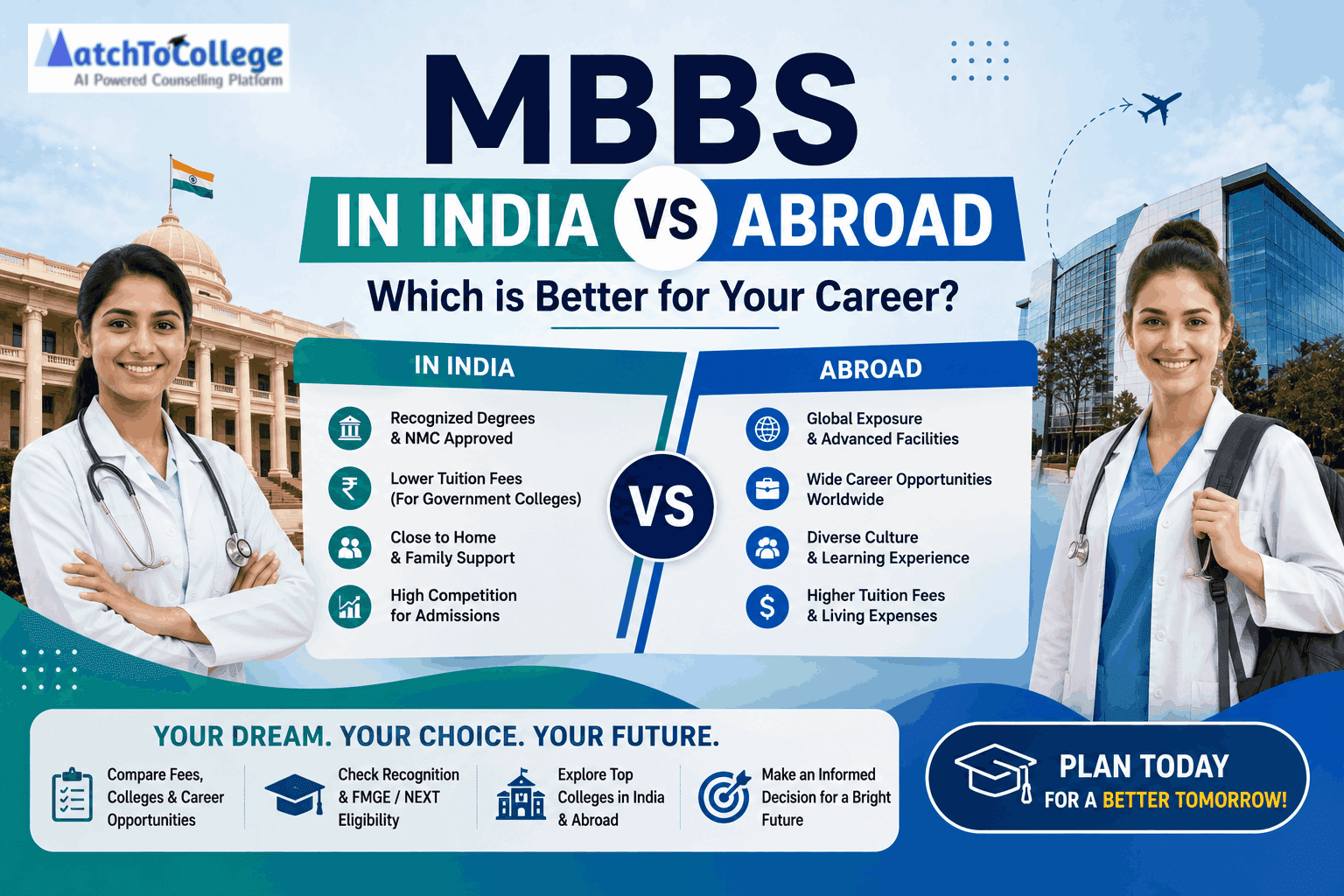
The journey to becoming a doctor is one of the most rigorous and rewarding career paths a student can undertake. In India, the prestige associated with the medical profession is unmatched, leading to an annual surge in aspirants. However, with over 20 lakh students appearing for the NEET examination every year, the competition for a limited number of government seats has reached a boiling point.
This intense pressure often leaves students and parents at a crossroads: should they continue to fight for a seat in an Indian medical college, or should they explore the burgeoning opportunities of pursuing an MBBS degree abroad? At MatchToCollege, we understand that this is not just a choice of geography, but a life-defining decision that impacts your finances, career trajectory, and clinical skills.
Understanding the current landscape requires a deep dive into the statistics. While the number of medical seats in India has increased significantly over the last decade, the ratio of applicants to available seats remains skewed. For those who do not secure a top rank, the alternative in India is often a private medical college, where the fee structure can be prohibitively high.
This is where the 'MBBS abroad' option becomes attractive, offering global exposure and modern infrastructure at a fraction of the cost of Indian private institutions. To navigate this complex landscape, students must stay updated with their performance metrics. Using tools like the NEET OMR Score Calculator can provide immediate clarity on your standing after the exam, allowing for proactive planning.
However, the decision is not purely financial. One must consider the quality of clinical exposure, the medium of instruction, the recognition of the degree by the National Medical Commission (NMC), and the ultimate goal of practicing medicine in India or elsewhere.
If you are preparing for upcoming cycles, you can Predict Your NEET 2026 Rank Instantly to see where you stand in the national hierarchy. Whether you choose the domestic route or an international one, the path requires meticulous planning and a clear understanding of the 'Return on Investment' (ROI) on your education.
By using our University ROI Calculator, you can compare the long-term benefits of different paths. This guide aims to dismantle the myths and provide a clear, data-driven comparison between MBBS in India and MBBS abroad to help you find your perfect match.
The Competitive Landscape: NEET and Seat Allocation in India
In India, the National Eligibility cum Entrance Test (NEET) is the sole gateway to medical admissions. The sheer volume of candidates makes it one of the toughest entrance exams globally. For a student to secure a seat in a prestigious government medical college, they must typically score in the top percentile.
If your score falls short of the government cutoff, you are left with two choices: take a drop year to prepare again or opt for a private medical college. This is where many students use the NEET College Predictor to understand their realistic chances of admission based on their category and domicile status. The stress of the 'cutoff' is a major factor that drives students to look at international options where admissions are often based on qualifying NEET rather than achieving a top-tier rank.
Furthermore, the reservation system in India plays a critical role in seat allocation, which can sometimes disadvantage general category students with high scores. Abroad, most universities in countries like Russia, Georgia, Kazakhstan, and the Philippines offer direct admission to Indian students who have simply 'qualified' NEET. This inclusivity is a major draw for students who have the aptitude but couldn't make the cut for the limited government seats in India.
To get a head start on your planning for the next session, you should check the NEET Result Checker regularly for updates on score trends. Knowing your rank early through the NEET 2026 Rank Predictor can help you decide whether to focus on domestic counseling or start the application process for foreign universities early.
It is also important to note that the curriculum in India is strictly governed by the NMC, ensuring a standardized level of education across the country. Students in India benefit from a patient-to-doctor ratio that provides immense clinical exposure, which is often cited as the biggest advantage of staying in the country. However, the lack of infrastructure in some newer private colleges can be a drawback. Therefore, if you are looking at domestic options, browsing our Domestic Colleges listing can help you identify institutions that meet your quality standards.
Cost Comparison: Breaking Down the Financial Investment
Finances are often the deciding factor for Indian families. A government medical seat in India is highly subsidized, with annual fees ranging from as low as ₹10,000 to ₹1 lakh. However, private medical colleges in India are a different story. The total package for a 5-year MBBS course in an Indian private college can range from ₹60 lakhs to over ₹1.2 crore.
When you compare this to MBBS programs abroad, the difference is stark. In countries like Kyrgyzstan or Russia, the entire 6-year program, including tuition and hostel fees, can often be completed for ₹20 lakhs to ₹35 lakhs. To convert these international prices into a format your family understands, you can use our Million to Crore Calculator or the Million to Lakhs Calculator to get an exact figure in Indian currency.
While the lower tuition fees abroad are attractive, students must also account for hidden costs such as airfare, visa renewals, insurance, and the cost of living in a foreign country. Often, these costs can add up, making it essential to have a solid financial plan. We recommend using our Education Loan EMI Calculator to understand the long-term debt implications of taking a loan for your medical studies. It is vital to ensure that the degree you earn will eventually allow you to earn enough to pay back these loans, which is why checking our MBBS Abroad Listings for affordable yet reputed universities is a smart move.
Another financial aspect to consider is the 'donation' or 'capitation' fees that some private colleges in India might unofficially demand. In contrast, most reputable foreign universities have a transparent fee structure paid directly to the university. This transparency is a significant advantage for middle-class Indian families. For a more granular understanding of currency conversions, our Million to Rupees Calculator can be extremely helpful when reviewing international university brochures. Always compare the total cost of the degree against the quality of education and future earning potential to ensure you are making a sound investment.
The FMGE/NExT Challenge: Practicing in India After Abroad
One of the most critical aspects of choosing MBBS abroad is the requirement to pass a licensing exam to practice in India. Currently, this is the Foreign Medical Graduate Examination (FMGE), but it is soon to be replaced by the National Exit Test (NExT). Historically, the pass percentage for FMGE has been relatively low, often hovering between 15% and 25%. This means that a student who finishes their degree abroad must be exceptionally dedicated to their studies to clear this hurdle.
In contrast, students who graduate from Indian medical colleges will also have to take the NExT exam in the future, but they are often perceived to have a curriculum more aligned with the Indian exam pattern. To see if you are truly ready for this rigorous path, you can use our Career Pathway Matcher to see if your strengths align with the demands of international medical study.
The introduction of NExT aims to level the playing field, as both domestic and foreign graduates will have to pass the same exam to obtain their license to practice and to qualify for post-graduate (PG) seats. This move potentially reduces the 'stigma' previously attached to foreign medical degrees. However, the quality of clinical training abroad varies wildly. Some universities in the Caribbean or Eastern Europe have excellent simulation labs but lack the high patient inflow found in Indian hospitals. If you are unsure if you will have the stamina for this long-term commitment, try our Online Degree Passing Predictor (adapted for long-term study) to gauge your academic resilience.
Success in the licensing exam depends heavily on the university you choose. It is essential to select an institution that provides FMGE/NExT coaching alongside the regular curriculum. Many top-rated universities listed on our Study Abroad portal now offer this. Students should also consider the duration of the course; while India has a 5.5-year program (including internship), some foreign countries have a 6-year program. Ensuring the internship abroad is recognized by the NMC is paramount, otherwise, you may have to repeat your internship in India, adding another year to your timeline.
Clinical Exposure and Infrastructure: A Comparative View
India is known for its diverse pathology and high patient volume, which is a goldmine for medical students. By the time an Indian medical student completes their internship, they have usually assisted in numerous surgeries and handled hundreds of patients. This 'hands-on' experience is often superior to what is available in many foreign countries.
However, Indian government colleges, while rich in clinical exposure, may sometimes lack the latest technological advancements in medical equipment and infrastructure due to funding constraints. If you are looking at top-tier engineering or medical colleges in specific states, our IP University Predictor or JAC Delhi Predictor can help you explore localized options that might offer better facilities.
On the other hand, medical universities in countries like Germany, the USA, or even top-tier Russian institutes boast world-class infrastructure, high-tech labs, and advanced research facilities. The focus there is often on 'Evidence-Based Medicine' and research. For students interested in a global career or research-oriented medicine, this environment can be more beneficial.
If you are currently in a system using GPA and need to convert your scores for Indian eligibility, our GPA to Percentage Calculator is a quick way to ensure you meet the NMC's 50% criteria. Similarly, if your college uses CGPA, the CGPA to Percentage Calculator is equally essential.
Ultimately, the choice depends on where you intend to practice. If your goal is to stay in India, the clinical exposure here is unbeatable. If you want a more technologically advanced learning environment and are prepared to work harder to gain clinical skills during your electives or later during your residency, abroad could be the way to go. You can also explore our Online Courses section to find preparatory modules that can bridge the gap between different international medical curricula and Indian standards.
Share this Article
FAQFrequently Asked Questions
Q: Is NEET mandatory for MBBS abroad?
Yes, as per the National Medical Commission (NMC) guidelines, any Indian student wishing to study MBBS abroad must qualify for the NEET-UG exam to be eligible to practice in India upon their return.
Q: Which is cheaper: Private MBBS in India or MBBS abroad?
Generally, MBBS abroad is significantly cheaper. While private Indian colleges can cost between ₹60 lakhs to ₹1.2 crore, many foreign medical programs in countries like Russia or Kazakhstan cost between ₹20 lakhs to ₹35 lakhs total.
Q: What is the NExT exam?
NExT (National Exit Test) is a proposed unified exam that will serve as a licensing exam for all medical graduates in India, a screening test for foreign medical graduates, and an entrance exam for PG medical courses.
Q: Can I practice in India after doing MBBS from a foreign country?
Yes, but you must pass the FMGE (currently) or NExT (future) exam and fulfill the NMC's internship requirements to get a permanent registration to practice in India.
Get More Info About MBBS in India vs Abroad
Recommended Reading

LBSIM Delhi & GIBS 2027 Admissions Open: Apply Online Now
LBSIM Delhi and GIBS Bangalore open 2027 admissions. Explore PGDM, MBA, and BBA application details, early bird offers, and WBJEE/TNEA 2026 counseling updates.

Best Online MBA Specializations for High-Paying Careers 2026
Discover the most lucrative online MBA specializations for 2026-27. Compare ROI, career growth, and use our AI tools to find your perfect management path.

Top Career Opportunities After an Online MBA in 2026-27
Discover high-paying career paths and roles after an online MBA in 2026-27. Explore salary trends, ROI, and tools to navigate your future professional success.