

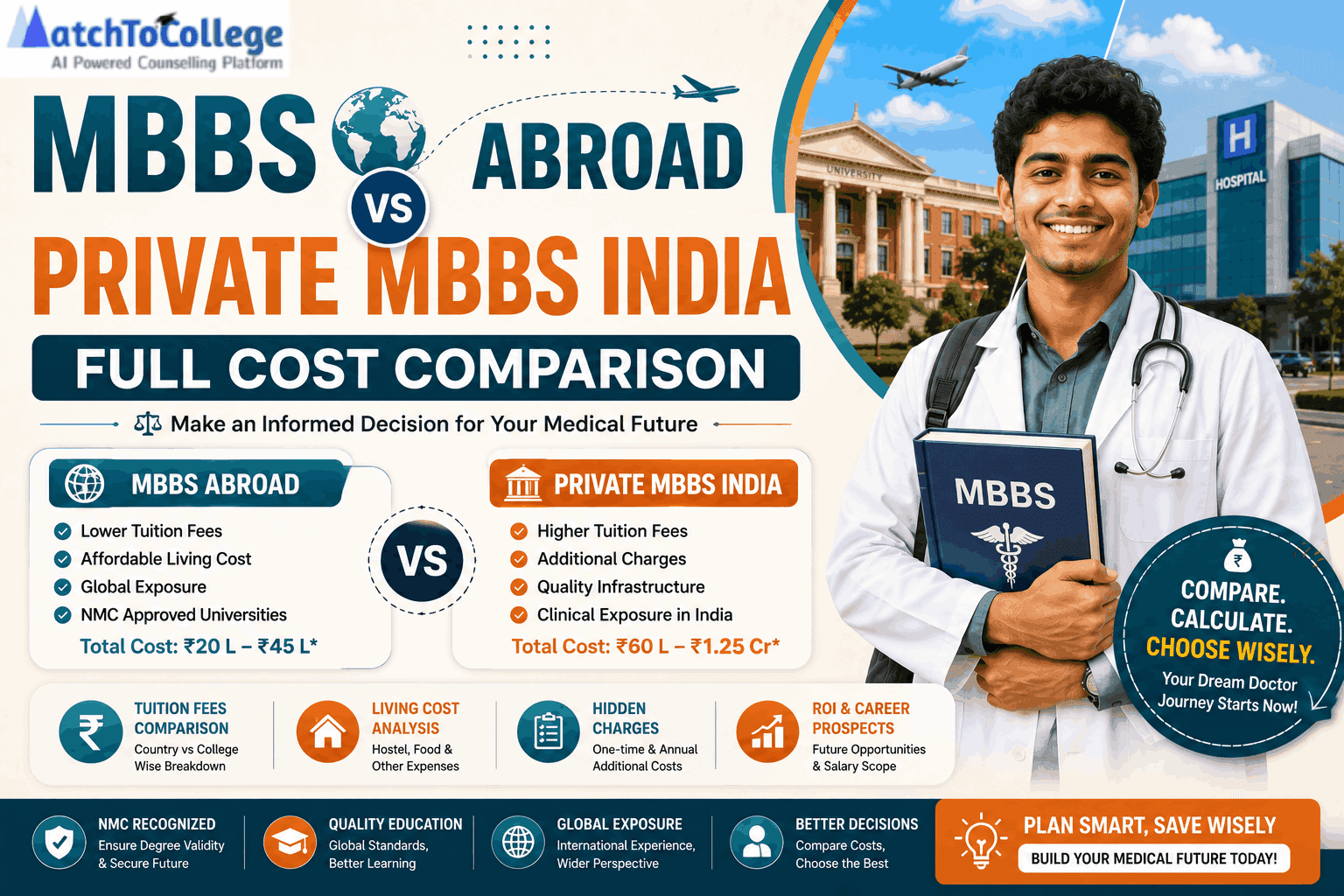
MBBS Abroad vs Private MBBS India: Full Cost Comparison
Admission & Info Tools
Need Expert Assistance?
Our counselors can help you with fee structures, eligibility guidelines, and upcoming admission cutoffs instantly.
Direct Application Tools
For millions of Indian medical aspirants, the journey to becoming a doctor is paved with intense competition and complex financial decisions. Every year, over 20 lakh students appear for the National Eligibility cum Entrance Test (NEET-UG), all vying for a limited number of government medical seats.
While government seats offer high-quality education at a nominal cost, the reality is that the vast majority of candidates will either have to settle for private medical colleges in India or look for opportunities beyond national borders. This brings us to the ultimate dilemma: MBBS Abroad vs. Private MBBS in India.
The primary driver for this comparison is often the staggering difference in cost, coupled with the quality of infrastructure and global exposure. To help you navigate this, tools like the NEET College Predictor and the NEET 2026 Rank Predictor are essential for assessing your current standing before diving into financial planning.
The cost of pursuing an MBBS degree in a private medical college in India has seen a sharp incline over the last decade. In many states, the total package for a management quota seat can range anywhere from ₹60 lakhs to over ₹1.5 crores.
On the other hand, several foreign destinations offer medical programs that are recognized by the National Medical Commission (NMC) and the World Health Organization (WHO) at a fraction of that price—often between ₹20 lakhs and ₹40 lakhs for the entire course duration. However, cost is not the only factor. Students must also consider the cost of living, travel, language barriers, and the mandatory National Exit Test (NExT) for practicing in India.
Before making a leap, students often use the NEET OMR Score Calculator to verify their raw scores and determine if they meet the eligibility criteria for both domestic and international admissions. At MatchToCollege, we believe in empowering students with data-driven insights. Whether you are looking at Domestic Colleges or exploring MBBS Abroad, understanding the Return on Investment (ROI) is crucial.
A medical degree is a lifelong investment, and choosing the wrong path based solely on initial tuition fees can lead to long-term financial strain. This guide provides a deep dive into the financial nuances, hidden costs, and strategic advantages of both paths to ensure you are on the Right Path to Your Dream Career.
The Real Cost of Private MBBS in India: Tuition and Management Quotas
Private medical education in India is often characterized by high demand and limited supply, which naturally drives up the cost. While the government regulates fees to some extent, the 'Management Quota' and 'NRI Quota' seats remain prohibitively expensive for middle-class families.
Typically, the tuition fee for a private medical college in India ranges from ₹10 lakhs to ₹25 lakhs per annum. Over a 5.5-year course duration (including internship), the tuition alone can exceed ₹1 crore. Additionally, there are other costs such as hostel fees, mess charges, library fees, and laboratory deposits, which can add another ₹10-₹15 lakhs to the total budget.
You can browse detailed fee structures on our Domestic Colleges listing page to get a clearer picture of specific institutions.
Another factor to consider is the hidden 'capitation fee' or donation, which, although officially banned, sometimes persists in various forms of 'development fees' in certain regions.
Furthermore, the cost of living for a student in a major Indian city like Bangalore, Chennai, or Mumbai is significantly higher than in smaller towns. When comparing these costs, students must also factor in the opportunity cost. Is the education quality in a mid-tier private Indian college worth ₹1 crore when compared to a top-tier government university in Russia or Georgia at one-third the price?
Students frequently use our Education Loan EMI Calculator to realize that the monthly installments for a ₹1 crore loan can be a massive burden on a fresh medical graduate's salary.
In India, a junior resident typically earns between ₹40,000 to ₹70,000 per month, which may not even cover the interest on such a large loan. Therefore, it is imperative to use the University ROI Calculator to compare if the local private college truly justifies its price tag.
MBBS Abroad: A Budget-Friendly Alternative with Global Standards
Studying MBBS abroad has become a mainstream choice for Indian students, primarily due to the affordability factor. Countries like Russia, Kazakhstan, Uzbekistan, Georgia, the Philippines, and even some Caribbean islands offer medical programs that are highly optimized for international students.
The total cost of an MBBS degree in these countries often ranges between ₹20 lakhs and ₹45 lakhs, which includes tuition, hostel, and even insurance in many cases. For instance, top-ranked universities in Russia often have annual tuition fees as low as $3,000 to $5,000 (roughly ₹2.5L to ₹4.2L). You can explore various international options on our MBBS Abroad listing page to see which country fits your budget.
One of the biggest advantages of studying abroad is the absence of capitation fees or entrance exams like the CET, provided you have qualified for NEET. Admission is typically based on your 12th-grade marks and NEET qualification score.
Furthermore, many of these universities provide advanced laboratories and high-quality clinical exposure, often surpassing the facilities found in mid-range private colleges in India. However, students must be aware of the currency exchange rates.
Using a tool like the Million to Rupees Calculator can help parents understand the exact financial outflow in local terms. While the tuition is lower, students should also account for biennial or annual travel costs back to India, visa renewal fees, and the cost of learning a new language (if the medium of instruction is bilingual).
To ensure you are choosing a program that leads to success, check the Online Degree Passing Predictor logic, which applies here in terms of graduation consistency and FMGE success rates. The goal is not just to save money, but to ensure that the degree obtained is valid and respected globally.
NMC Regulations and the NExT Exam: Levelling the Playing Field
Historically, one of the biggest drawbacks of studying MBBS abroad was the Foreign Medical Graduate Examination (FMGE), which students had to pass to practice in India.
The passing percentage for FMGE was notoriously low, leading to concerns about the quality of foreign education. However, the National Medical Commission (NMC) has introduced the National Exit Test (NExT), which will replace both the NEET-PG and the FMGE. This means that whether you study in a private college in India or a medical university abroad, you will have to clear the same standardized exam to obtain your license to practice and to qualify for post-graduation in India.
This move has significantly leveled the playing field, making the 'Abroad' option much more attractive for those who were previously skeptical about its validity.
Before deciding, it is vital to check if the foreign university complies with the NMC's 'Foreign Medical Graduate Licentiate' (FMGL) regulations of 2021. These rules mandate a minimum course duration of 54 months, an English medium of instruction, and an internship in the same country.
Failure to meet these criteria can render your degree invalid in India. To stay updated on these regulations, visit our Study Abroad section. Students should also use the Dream Career Matcher to see if their long-term goal—be it practicing in the USA via USMLE, the UK via PLAB, or India via NExT—aligns with the curriculum offered by the host country.
If you are calculating your eligibility based on previous academic scores, the CGPA to Percentage Calculator can be handy for university applications. The transition to NExT essentially means that clinical knowledge and skills are what matter most, not just the location of your medical school.
Living Expenses, Hidden Costs, and Lifestyle Comparison
When comparing costs, many families only look at the tuition fees, overlooking the day-to-day living expenses which can fluctuate based on inflation and exchange rates. In India, hostel and mess fees in private colleges are relatively stable but can be high, ranging from ₹1.5 lakh to ₹3 lakh per year.
In contrast, living expenses in countries like Kazakhstan or Kyrgyzstan are quite affordable, often comparable to living in a Tier-2 city in India. However, in European countries like Georgia or Poland, the cost of groceries, heating, and transport can be higher. Parents can use the Education Loan EMI Calculator to plan for a 'buffer' amount in their educational loan to cover these variations.
Another 'hidden' cost is the coaching for NExT/FMGE. Most students studying abroad start online coaching from their second or third year to stay in touch with the Indian curriculum. This can cost an additional ₹50,000 to ₹1 lakh over the course of their degree. On the lifestyle front, studying in India allows students to remain in a familiar cultural environment with local language support during clinical rotations. Studying abroad requires high adaptability and emotional resilience.
To ensure you are physically and mentally prepared for the change, simple checks like the BMI Calculator or general health assessments are recommended before moving to extremely cold climates like Russia. Finally, always convert your foreign currency requirements using the Million to Lakhs Calculator to keep a precise track of your monthly budget. Knowing the exact conversion can prevent financial surprises halfway through the semester.
Final Verdict: Which Path Should You Choose?
The choice between a private MBBS in India and an MBBS abroad ultimately depends on your financial capacity and your score in competitive exams. If you have a NEET score that is just short of a government seat and your family can comfortably afford ₹1 crore without jeopardizing their retirement, a private college in India offers the convenience of staying home and an easier transition to the local healthcare system.
You can check your probability of getting into these colleges using the NEET College Predictor. However, for the majority of students, the 'Abroad' route offers a pragmatic way to achieve the 'Dr.' prefix without the crushing weight of a massive debt. By choosing a reputable university from our MBBS Abroad list, you can get a global perspective and a high-quality education for 1/3rd of the cost.
Before you make the final deposit, use the Education ROI Calculator one last time. Compare the total expenditure against the expected starting salary of a doctor.
If the 'Abroad' route allows you to graduate debt-free, it gives you a massive head start in your career, allowing you to save for a specialized post-graduation or a private practice later. Whether you are checking your NEET Result or planning for the 2026 cycle with the JEE Rank Predictor for other family members, MatchToCollege is here to guide you. Take the Career Path Matcher test today to see if you have the temperament for international medical education and take the first step toward your global medical career.
Share this Article
FAQFrequently Asked Questions
Q: Is MBBS abroad cheaper than private MBBS in India?
Yes, in most cases, MBBS abroad is significantly cheaper. While private colleges in India can cost between ₹60 lakhs to ₹1.5 crores, an MBBS abroad in countries like Russia or Kazakhstan typically costs between ₹20 lakhs to ₹40 lakhs total.
Q: Will I be able to practice in India after studying MBBS abroad?
Yes, but you must qualify for the National Exit Test (NExT), which is the mandatory licensing exam for all medical graduates (both Indian and foreign) to practice in India.
Q: Is NEET mandatory for MBBS abroad?
Yes, according to NMC guidelines, qualifying for NEET is mandatory for any Indian student who wishes to pursue MBBS abroad and intends to practice in India later.
Q: How do I calculate the EMI for an education loan for MBBS?
You can use the MatchToCollege Education Loan EMI Calculator to input your loan amount, interest rate, and tenure to see your monthly repayment schedule.
Get More Info About MBBS Abroad vs Private MBBS India
Recommended Reading

LBSIM Delhi & GIBS 2027 Admissions Open: Apply Online Now
LBSIM Delhi and GIBS Bangalore open 2027 admissions. Explore PGDM, MBA, and BBA application details, early bird offers, and WBJEE/TNEA 2026 counseling updates.

Best Online MBA Specializations for High-Paying Careers 2026
Discover the most lucrative online MBA specializations for 2026-27. Compare ROI, career growth, and use our AI tools to find your perfect management path.

Top Career Opportunities After an Online MBA in 2026-27
Discover high-paying career paths and roles after an online MBA in 2026-27. Explore salary trends, ROI, and tools to navigate your future professional success.