

MBBS Abroad 2026-27: Fees, NMC Rules & Cheapest Countries
Admission & Info Tools
Need Expert Assistance?
Our counselors can help you with fee structures, eligibility guidelines, and upcoming admission cutoffs instantly.
Direct Application Tools
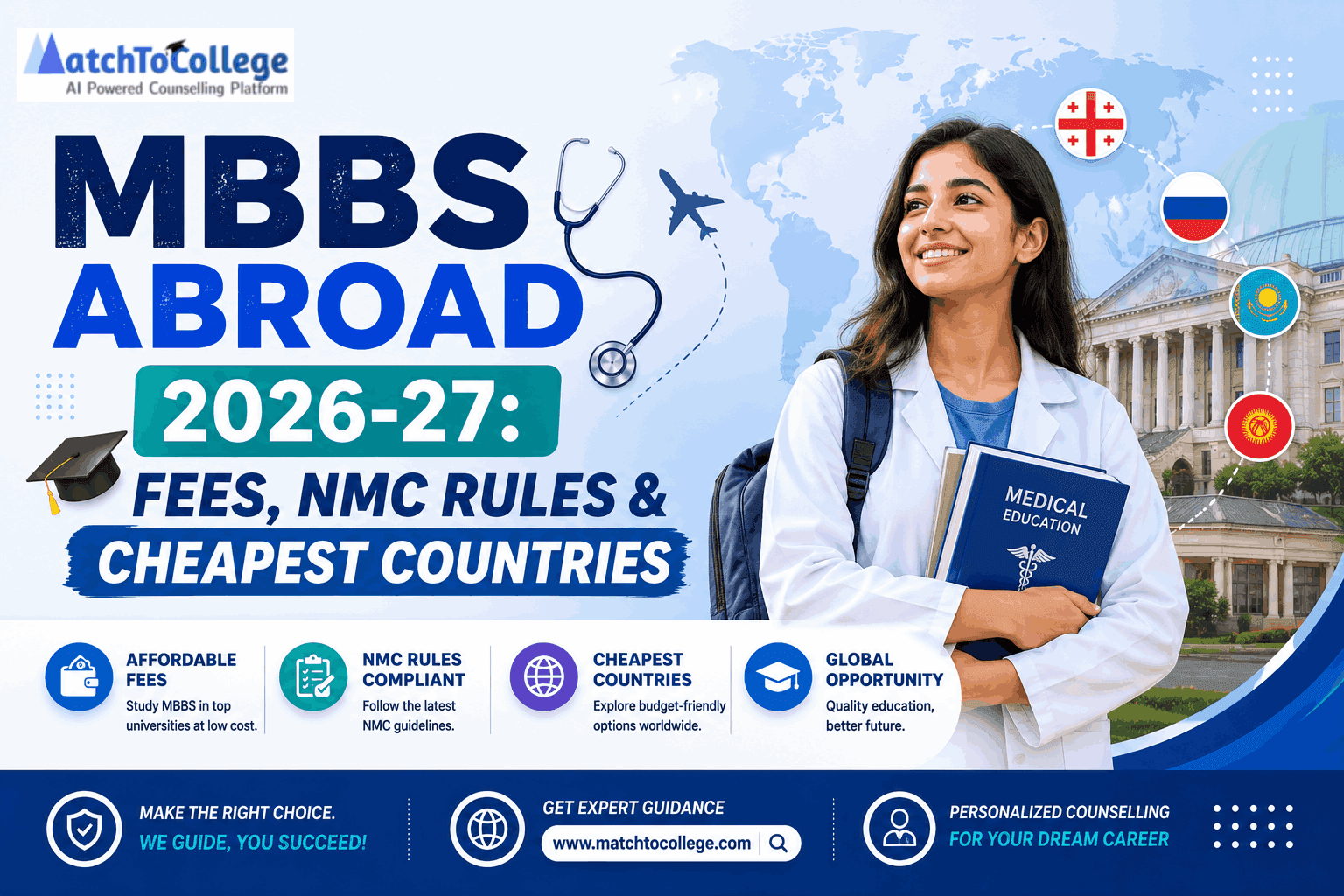
The landscape of medical education for Indian students is undergoing a seismic shift as we approach the 2026-27 academic session. With the competition for NEET reaching unprecedented levels—where over 25 lakh aspirants vie for a limited number of government seats—the 'MBBS Abroad' pathway has transitioned from a backup plan to a strategic first choice. However, the rules of the game have changed.
The National Medical Commission (NMC) has tightened its grip on foreign medical qualifications through the Foreign Medical Graduate Licensure (FMGL) Regulations, making it mandatory for students to be more informed than ever before.
As we look toward the 2026 intake, students must navigate a complex web of eligibility criteria, varying fee structures across continents, and the looming transition to the National Exit Test (NExT). This comprehensive guide is designed to provide you with the most urgent updates, policy shifts, and financial insights needed to secure your medical future. Before you commit to a university, it is vital to assess your current preparation levels; use our NEET College Predictor to see if a domestic seat is within reach or if an international destination is your most viable path for 2026.
MatchToCollege, powered by advanced AI, helps you filter through thousands of international universities to find the perfect match based on the latest 2026-27 NMC guidelines. In this article, we break down the cheapest countries, the mandatory NEET scores, and the fine print of the newest NMC regulations that every aspirant must know to avoid getting their degree invalidated upon return to India.
Latest NMC Guidelines for MBBS Abroad (2026-27)
The National Medical Commission (NMC) has implemented strict mandates that govern the validity of foreign medical degrees. For the 2026-27 batch, the Foreign Medical Graduate Licensure (FMGL) Regulations 2021 remain the cornerstone of eligibility. First and foremost, the entire duration of the MBBS course must be at least 54 months (4.5 years), followed by an obligatory 12-month internship in the same foreign medical institution. If you are eyeing a country where the course duration is shorter, your degree will not be recognized in India.
One of the most common misconceptions is that studying MBBS abroad allows you to skip the NEET exam. This is false. For the 2026-27 session, qualifying for NEET is a mandatory prerequisite for any Indian student wishing to study medicine overseas. Without a qualifying NEET scorecard, you will never be eligible to sit for the NExT exam or practice medicine in India, regardless of how prestigious your foreign university is. The NEET score for abroad purposes is valid for a period of three years from the date of the result, providing students with a flexible window to plan their admission.
Given the rising cut-offs, it is essential to stay updated with your performance metrics. If you have just appeared for a mock or the actual exam, use the NEET OMR Score Calculator to get an immediate sense of your raw score. Understanding where you stand in the national percentile is crucial because even 'cheapest' universities in countries like Russia or Georgia are now becoming more selective due to the high volume of Indian applicants.
To get a realistic view of your competitive standing, we recommend using the Predict Your NEET 2026 Rank Instantly tool. While the qualifying mark for the 'General' category usually hovers around the 50th percentile, for 'OBC/SC/ST' it is the 40th percentile. However, aiming for a score higher than the bare minimum qualification is advisable to secure admission in top-tier government-funded universities abroad, which often have their own internal entrance tests or interview processes for the 2026 intake.
The Role of AI in Selecting the Right Medical University
The introduction of the National Exit Test (NExT) is perhaps the most significant change for the 2026-27 batch. Unlike the FMGE, which was a qualifying exam for foreign graduates, NExT will be a uniform exam for all medical students in India, whether they studied at AIIMS or in a state university in Russia. This levels the playing field but also raises the bar for quality. The exam will be divided into NExT-1 (theory-based) and NExT-2 (practical/clinical). To prepare for this, students studying abroad must ensure their university offers a clinical-heavy curriculum from the third year onwards.
For those also considering alternative paths like Engineering if NEET doesn't go as planned, you might want to look at our JEE Main Rank Predictor or JEE Main College Predictor. However, for the committed medical aspirant, the focus must remain on clinical competence. Universities in Egypt and Georgia are currently leading the way in updating their simulators and clinical rotas to match the NExT requirements. If you're currently in school and wondering about your grades, use the CGPA to Percentage Calculator to ensure your 12th-standard marks meet the minimum 50% (PCB) requirement set by the NMC for international study.
Share this Article
FAQFrequently Asked Questions
Q: Is NEET mandatory for MBBS abroad in 2026-27?
Yes, qualifying for NEET is absolutely mandatory for all Indian students who wish to pursue MBBS abroad and eventually practice in India. The NEET score is valid for 3 years for admission abroad.
Q: Which is the cheapest country for MBBS for Indian students in 2026?
Russia, Uzbekistan, and Kazakhstan are currently the most affordable options, with total tuition fees starting from approximately INR 15-18 lakhs for the full course.
Q: What are the latest NMC rules for MBBS abroad?
The main rules include: a course duration of at least 54 months, a 12-month internship in the same country, English as the medium of instruction, and obtaining a local license to practice in the host country.
Q: Can I practice in India after MBBS abroad?
Yes, provided you have studied in an NMC-compliant university and clear the NExT (National Exit Test) after returning to India.
Get More Info About MBBS Abroad 2026-27
Recommended Reading

LBSIM Delhi & GIBS 2027 Admissions Open: Apply Online Now
LBSIM Delhi and GIBS Bangalore open 2027 admissions. Explore PGDM, MBA, and BBA application details, early bird offers, and WBJEE/TNEA 2026 counseling updates.

Best Online MBA Specializations for High-Paying Careers 2026
Discover the most lucrative online MBA specializations for 2026-27. Compare ROI, career growth, and use our AI tools to find your perfect management path.

Top Career Opportunities After an Online MBA in 2026-27
Discover high-paying career paths and roles after an online MBA in 2026-27. Explore salary trends, ROI, and tools to navigate your future professional success.